
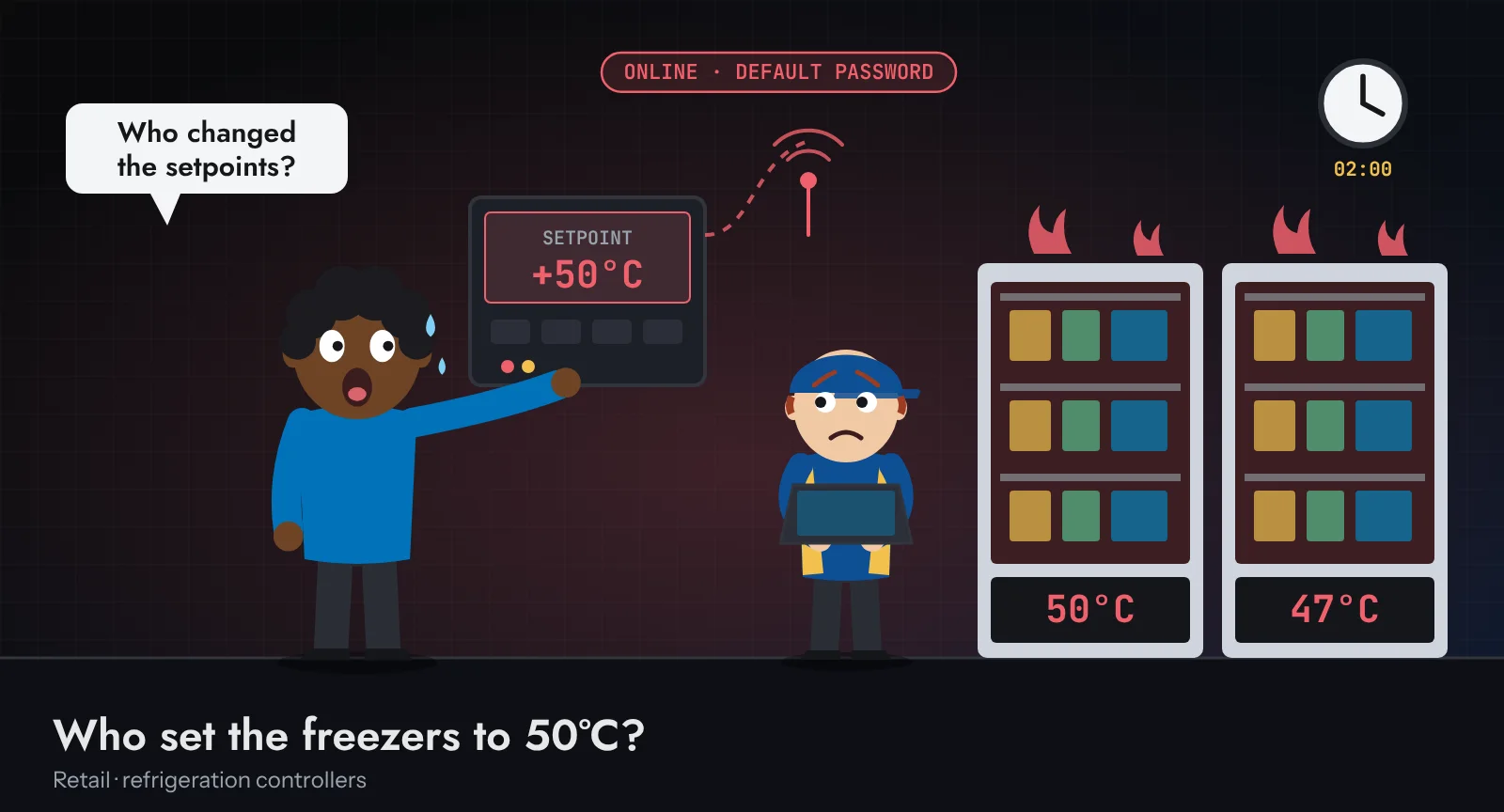
At 2 a.m. on Monday 2 November, the freezers at an ICA franchise store in Stockholm started to warm up. Nobody noticed for hours. When Engla Ingwall, the store's sales manager, walked a Reuters reporter through the aisle later that day, every freezer had reached 50°C. "Everything is destroyed," she said.
The same night, stores in Belgium, Ireland, Luxembourg, Estonia and beyond woke up to the same thing. Three weeks earlier, it had happened to about 700 stores in France.
The supermarket fridge hack worked because refrigeration controllers were reachable from the internet, protected by weak or default passwords and often running old firmware, so attackers simply logged in and turned the temperature up. No malware, no clever exploit. That is the good news: the fixes are known, and most of them cost very little.
Key takeaways
- About 700 French stores were hit on 11 to 13 October 2026, and a second wave on 2 November reached at least nine European countries.
- France's cyber agency ANSSI blamed basic failures: equipment exposed directly to the internet, weak passwords and outdated units.
- Censys counted 1,825 exposed Danfoss StoreView systems in France on 11 October; 220 were still online on 2 November.
- On 5 November, CISA, the FBI, HHS, USDA and DOT told US grocery and cold-storage operators to take controllers off the internet, change default passwords, patch and replace end-of-life units.
- Any system that can change a setpoint, whether a contractor's laptop or an AI agent, should need a named human to approve the change and should log it.
What happened to Europe's supermarket fridges?
Two waves, three weeks apart, and an earlier warning that few people heard.
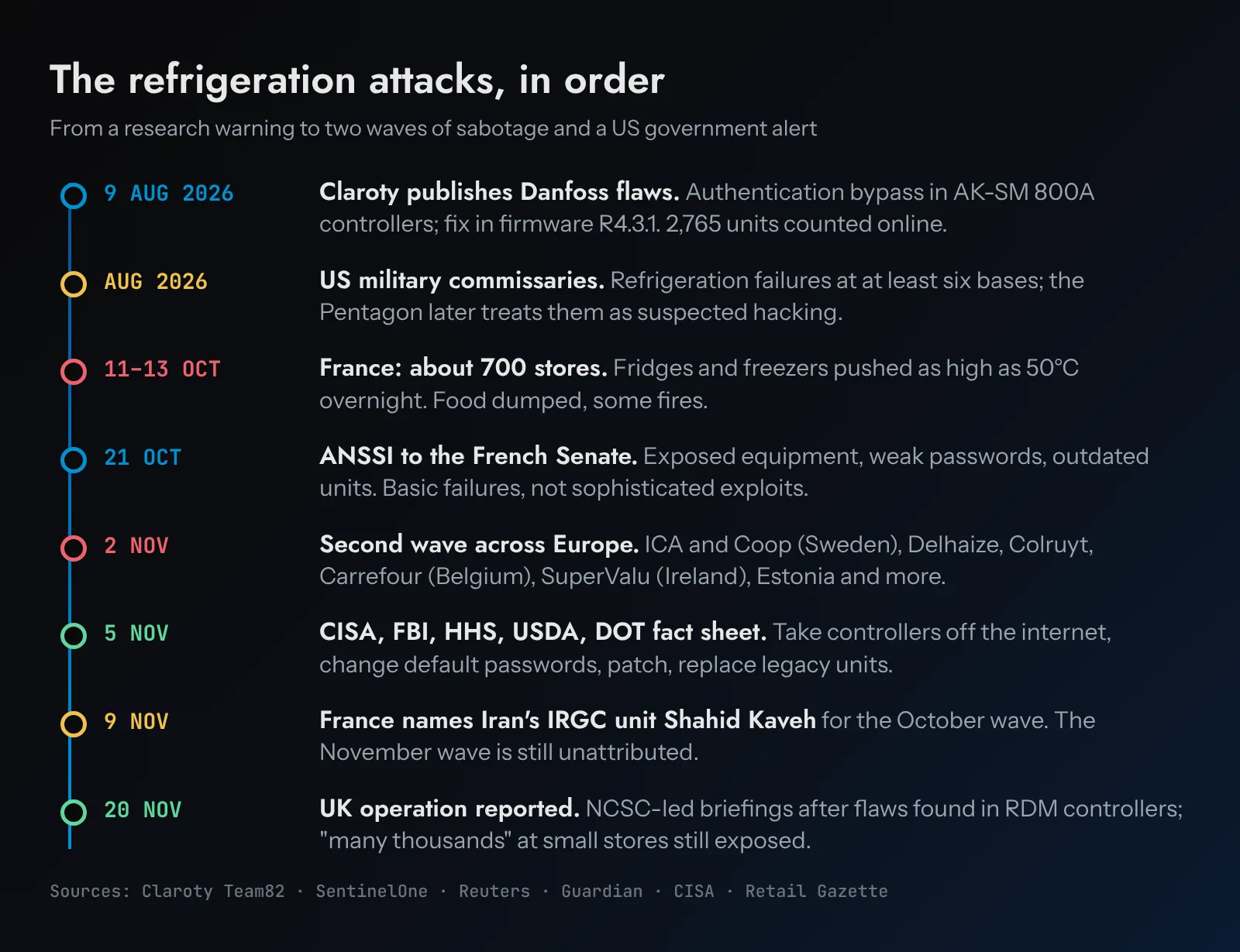
The first wave, France, 11 to 13 October. Attackers took control of the systems that run store refrigeration and pushed temperatures up. Economy minister Roland Lescure told Parliament that approximately 700 stores were affected. The Guardian reported temperatures pushed from as low as -27°C to well over 50°C in some cases, with fires in some stores that set off sprinklers. Fortune reported about 80 Carrefour, 24 Monoprix and 150 Intermarché locations among those hit.
The second wave, 2 November. This time the list ran from ICA and Coop in Sweden to Ahold Delhaize and Colruyt in Belgium and Luxembourg. Reuters reported that Carrefour had 15 of its 700 Belgian stores affected, Coop 7 of its 800 stores, and Musgrave 13 SuperValu stores in Ireland. Al Jazeera counted at least nine European countries in this wave.
Who did it? On 9 November, France blamed the October wave on Shahid Kaveh, a cyber unit linked to Iran's Revolutionary Guards. Nobody has been officially named for the November wave. Russian-aligned groups have posted claims, but SentinelOne's assessment says those claims have not been independently verified and do not show the attacks share one operator. Treat any claim of responsibility as a claim.
For a store owner, attribution matters less than it seems. As SentinelOne researcher Tom Hegel told Reuters, "an attacker who logs into an exposed control panel leaves almost nothing behind ... A teenager and an intelligence service would look much the same from the defender's side."
How did hackers get into supermarket fridges?
A supermarket's fridges and freezers are usually run from one control panel, a "system manager", which is often connected to the internet so a refrigeration contractor can manage it remotely. That convenience is the door.
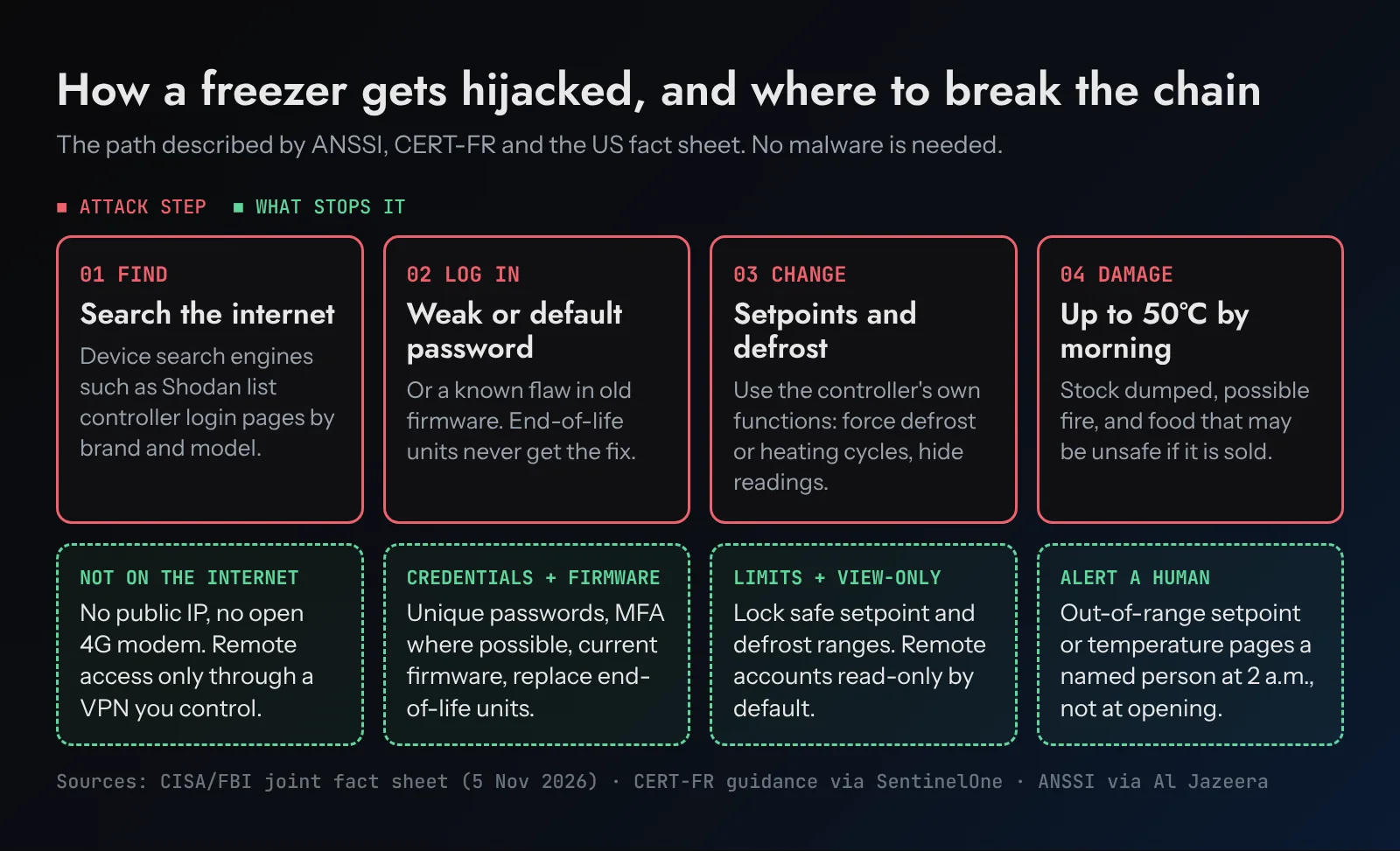
Step 1: find it. According to Al Jazeera, the attackers reportedly found the supermarket systems using Shodan, a search engine for internet-connected devices. Anyone can search it by brand and model.
Step 2: log in. Speaking to the French Senate on 21 October, ANSSI's director Vincent Strubel said the attack was made possible by basic security failures: weak passwords and refrigeration equipment directly exposed to the internet, rather than sophisticated software vulnerabilities. Many units were old models that no longer receive security updates. In the Netherlands, some affected systems used default passwords on unsecured networks.
Step 3: change the settings. In France, the attackers used the controllers' own defrost function, according to Al Jazeera's account of ANSSI's findings. That is why there was "no trace of a weapon at the scene", as Sophos's Rafe Pilling put it to the Guardian: it was like "wearing rubber gloves and messing with the switches".
Step 4: wait. At 2 a.m., nobody is watching the screen.
Which equipment was involved?
France's CERT-FR alert named Danfoss AK-SM and AK-SC equipment, Copeland and Dixell XWEB systems. Danfoss told AFP that most of the affected equipment was "legacy" products that "no longer receive software or security updates", and that it had long advised customers to update firmware and migrate to current systems.
There were also published flaws in current models. In August 2026, Claroty's Team82 described an authentication bypass and other vulnerabilities in the Danfoss AK-SM 800A, fixed in firmware R4.3.1, and counted 2,765 of these units exposed online. Nobody has publicly confirmed those flaws were used in the attacks. ANSSI's view points to passwords and exposure. Either way, an unpatched controller on the internet is a risk.
Two details from the second wave matter for anyone with a contractor-managed estate. Coop in Sweden said some of its fridges were linked to a 4G mobile network that made them more exposed. A 4G modem in a plant room bypasses your firewall completely. And Belgian installer Sabcobel said the damage could have been far worse if it had not started patching after the French attack.
How many refrigeration controllers are still exposed?
Fewer than in October. Not few enough.
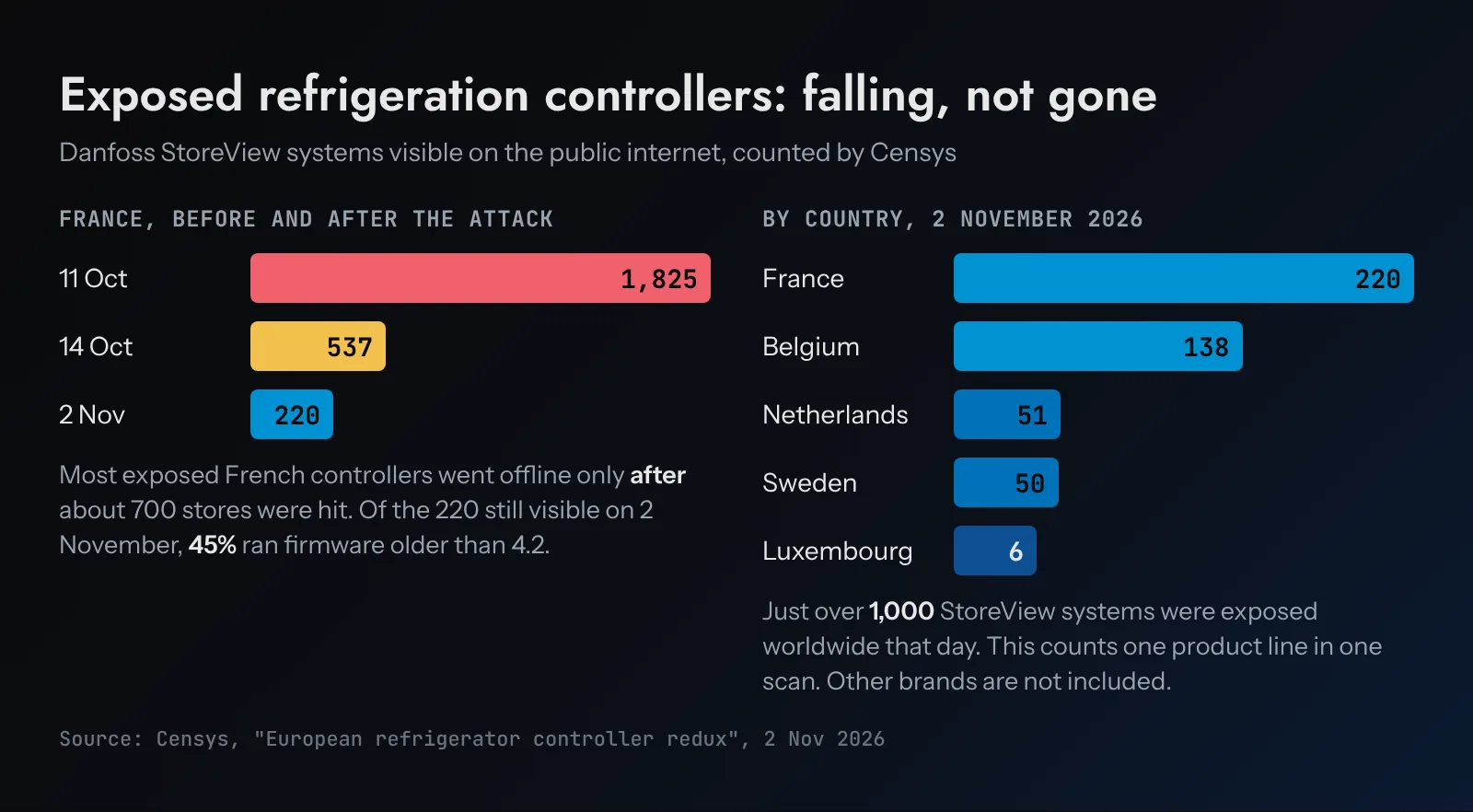
Censys counted 1,825 Danfoss StoreView systems exposed in France on 11 October, before the first attack. By 2 November there were 220, and 45% of those still ran firmware older than 4.2. Worldwide, just over 1,000 were exposed that day. That is one product line, counted by one scanner. It says nothing about other brands.
The UK has not been hit, but it is not clean either. On 20 November the Guardian reported a government-led operation with the NCSC after Pen Test Partners found vulnerabilities in controllers made by Resource Data Management. Some owners were easy to contact, it said, "but many thousands at small stores are still exposed".
Could the supermarket fridge hack happen in the US?
Yes, and US agencies are treating it as live. On 5 November, CISA, the FBI, HHS, USDA and the Department of Transportation published a joint fact sheet warning that attackers are targeting electronic temperature controllers and commercial refrigeration controllers "in retail grocery and cold storage facilities". CISA's Chris Butera said every organisation that depends on these systems "should assume it could be a target".
The US has its own warning signs. In August, refrigeration failures hit half a dozen US military commissaries, and the Pentagon is investigating a suspected hack. Danfoss is a major supplier of building control systems in the United States. And the US Government Accountability Office, in a report published on 19 November, found that USDA and FDA have not run emergency response exercises for cyberattacks on the food sector since 2024. Do not wait for a federal plan.
What does a fridge hack cost a store?
The reported figures vary a lot, and the sources do not all agree.
| Who | What was reported | Source |
|---|---|---|
| Belgian butchery chain De Laet & Van Haver | About €15,000 of meat ruined at one store | Reuters, 2 Nov |
| Some stores (unnamed) | More than €130,000 each | Axios, 2 Nov |
| Two French stores | €270,000 combined | Axios says two markets in Alsace; Fortune says Intermarché and E.Leclerc |
| Intermarché's parent company | Nationwide losses estimated in the tens of millions of euros | Axios, 2 Nov |
Here is a rough worked example. The figures are assumptions, not data. Assume a regional chain of 20 stores, each losing only the smallest reported amount, €15,000, in one night. That is 20 × €15,000 = €300,000 of stock before you count clean-up, lost sales on empty shelves, staff overtime or a fire. Against that, most of the fixes below are a contractor visit and a change of settings.
There is also a food-safety cost that is harder to price. The US fact sheet warns that an attack can "indirectly harm consumers if products are consumed after unsafe storage", and can cause a "denial-of-view" where you lose sight of real temperatures. If your logs cannot prove the cold chain held, the safe answer is to bin the stock. Our companion piece on the first hour of a cold-chain cyberattack covers what to do when it is already happening.
How do you lock down refrigeration controllers?
The US fact sheet and CERT-FR's guidance agree on the essentials. Here they are as a checklist you can hand to your facilities manager and refrigeration contractor this week.
This week
- Find every controller. List each store's refrigeration system manager, brand, model, firmware version and who has remote access. Include building-management, HVAC and alarm panels while you are there.
- Check what is visible from the internet. Ask your IT team or provider to scan your own public IP ranges, including connections a third party set up, as the December 2025 joint advisory from US and partner agencies advises. Ask specifically about 4G or 5G modems in plant rooms.
- Take controllers off the public internet. No public IP address, no open port forward. If the contractor needs remote access, it goes through a VPN or secure gateway you control. CERT-FR says firewall filtering of contractors' addresses is acceptable only as a stopgap. Check your maintenance contract and insurance terms before cutting a data feed.
- Change every default password. Unique per site, stored in a password manager, multi-factor authentication where the device supports it.
- Patch what can be patched. For Danfoss AK-SM 800A, Claroty and Danfoss point to firmware R4.3.1 or later. Follow your own vendor's advisory for other brands.
This month
- Set safe limits. Lock setpoint and defrost ranges so nobody, remote or local, can push a freezer outside a safe band without a second step. The US fact sheet asks for "reasonable setpoint limits" and alerting on deviations.
- Make remote accounts view-only. CERT-FR and the December 2025 joint advisory, as summarised by SentinelOne, recommend limiting remotely accessible accounts to view-only where possible.
- Alert a person, not a dashboard. A temperature or setpoint change outside range should page a named person at 2 a.m., with a backup if they do not answer. The Stockholm store found out hours late.
- Back up controller configurations and practise running refrigeration manually, so you can restore a known-good setup quickly.
- Plan to replace end-of-life units. Danfoss's AK-SM 800 and AK-SC 355 no longer get security updates. Put replacement in next year's budget now.
What to ask your refrigeration contractor
- Which of our controllers can be reached from the internet today, and how?
- Who at your company can log in to our systems, with which accounts, and is it logged?
- Are any of our units end of life? What firmware does each one run?
- Will you connect only through our VPN, and only when we open access?
Contractor access is a big enough topic for its own article: see how to secure contractor remote access.
Where does AI fit into this?
Two ways, one bad and one useful.
The bad one: AI makes finding weak systems cheaper. Belgium's Centre for Cybersecurity told Reuters that "AI can now be used to successfully exploit these weaknesses", especially by sophisticated actors. A default password does not survive that.
The useful one: the same rules that protect a fridge are the rules we build into AI agents. Any system that can change something physical or financial should be able to read freely, but every write, such as a setpoint change, should wait for a named human to approve it, and every action should be logged. That is least-privilege access plus a human in the loop. A monitoring agent that reads temperatures and setpoint logs across 50 stores, and calls the duty manager the moment a defrost cycle runs at the wrong hour, is a sensible use of AI. An agent with unattended write access to your controllers is another open door.
If you are planning that kind of automation in stores, our AI Readiness Audit looks at where AI would sit in your systems and what it should and should not be allowed to touch. For retailers, our retail and e-commerce work shows the kind of software we build. Neither replaces your refrigeration contractor or a security firm, and the checklist above comes first.
Frequently asked questions
How did hackers take over supermarket fridges in 2026?
They found refrigeration control panels that were reachable from the internet, logged in using weak or default passwords or old, unpatched firmware, and changed temperature and defrost settings. France's cyber agency ANSSI said these were basic security failures, not sophisticated exploits. No malware was needed.
Which supermarkets were affected by the fridge hack?
In October, about 700 French stores, including Carrefour, Intermarché and Monoprix locations. On 2 November, ICA and Coop in Sweden, Delhaize and Colruyt in Belgium and Luxembourg, Carrefour Belgium, SuperValu in Ireland, an IKEA store in Belgium and businesses in Estonia, Finland and elsewhere.
Who was behind the supermarket freezer attacks?
On 9 November, France attributed the October attacks to Shahid Kaveh, a cyber unit linked to Iran's Revolutionary Guards. The November wave has not been officially attributed. Russian-aligned groups have posted claims, but these have not been independently verified.
Are US grocery stores at risk of refrigeration cyberattacks?
Yes. On 5 November 2026, CISA, the FBI, HHS, USDA and DOT warned that attackers are targeting refrigeration controllers in US retail grocery and cold-storage facilities. US stores use similar equipment, and refrigeration failures at six US military commissaries in August are under investigation as a suspected hack.
How do I protect my store's refrigeration controllers?
Take controllers off the public internet and route contractor access through a VPN you control. Change default passwords, update firmware, replace end-of-life units, lock safe setpoint ranges and set alerts that wake a named person when temperatures or settings change.
Is changing the password enough to secure a refrigeration controller?
No. A strong password helps, but an end-of-life controller may have flaws that will never be fixed. Remove it from the internet first, then patch or replace it, and limit remote accounts to view-only.