
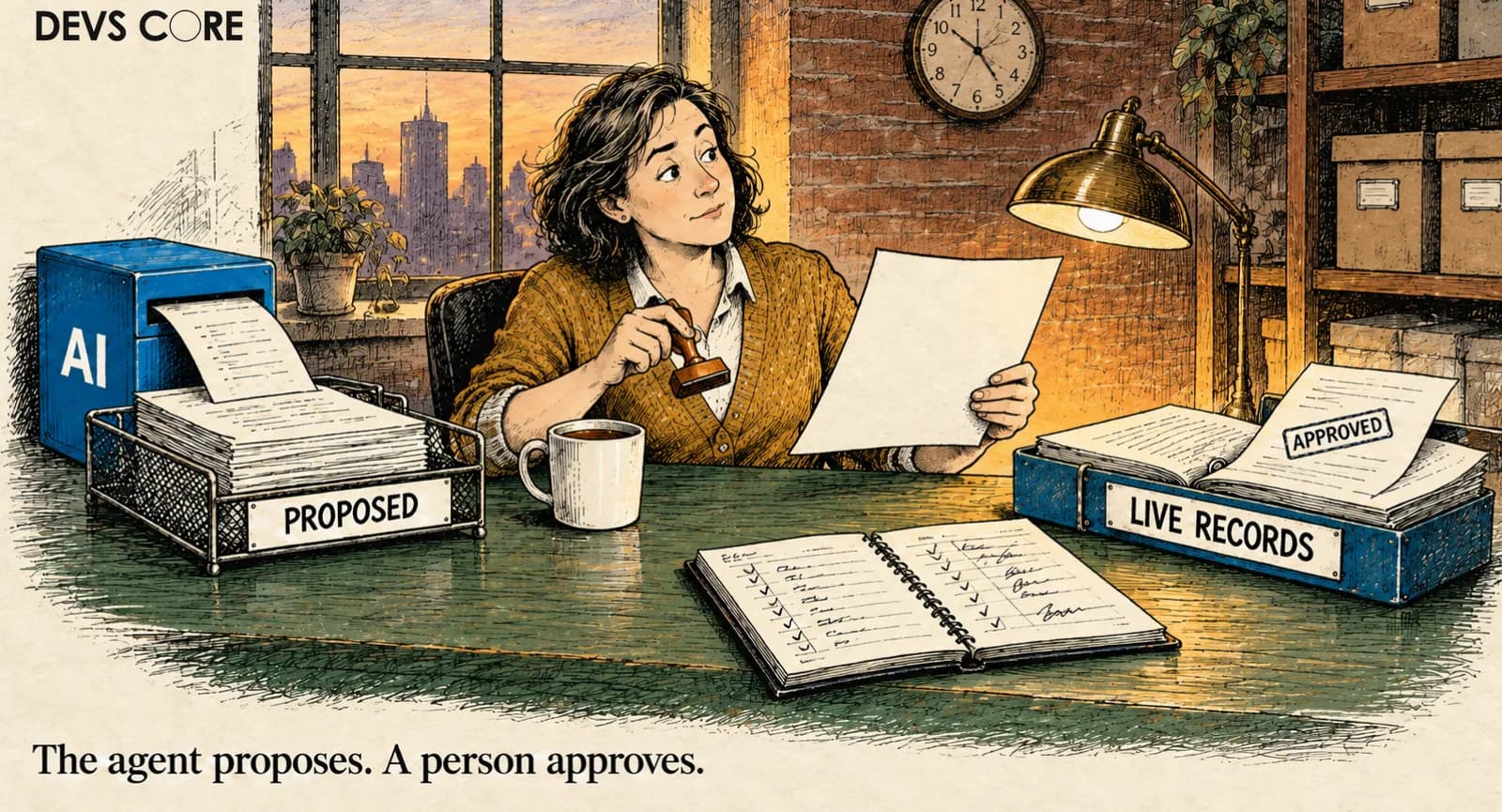
A human in the loop AI agent is a system where an AI model executes tasks autonomously but requires explicit manual approval before committing changes. In production, this requires an asynchronous write queue where reads happen instantly and mutations wait for named sign-off.
This guide is for founders, COOs, and operations leaders at US companies connecting autonomous AI to operational software. We cover how to structure an access layer to enforce safe, governed AI agent deployments.
Key takeaways
- Without staging queues, AI agents are either stranded in read-only pilots or risk severe data corruption upon deployment.
- Synchronous prompt-pausing creates stale database locks; true governance relies on decoupled, asynchronous staging queues.
- A reviewed write queue displays the record, the field, the old value, and the new value before any change commits.
- Agents should earn unattended write-back permissions per operation once the log has earned it.
Why do enterprise agent pilots stall at the database edge?
Enterprise agent pilots consistently trace their failure to integration boundaries. Teams either keep agents stranded in read-only environments, or they grant broad write access that risks severe data corruption.
Gartner predicts that over 40% of agentic AI projects will be cancelled by the end of 2027. When testing multi-step workflows, simulations show failure rates reaching up to 70% (Source: Elementum.ai), underscoring why direct write access to customer-facing or financial ledgers without staging queues introduces intolerable business risk. When assessing agent pilots, we see three pilot failure modes: the agent never gets access to anything real, it is never permitted to write, or it becomes unmaintainable once working. To move past the pilot phase, you must isolate the risk of writing back to operational software.
What is the structural flaw of in-prompt human-in-the-loop?
In-prompt human-in-the-loop fails because synchronous chat interrupts cause reviewer fatigue and stale-state database locks. When an agent pauses its thread to ask for permission, the underlying system state often changes before the human responds.
Industry patterns highlight that synchronous pausing risks thread timeouts (Source: Redis). You cannot enforce governance through prompt instructions. Large language models drift, ignore system instructions, or hallucinate permissions. A governed AI agent is an AI agent whose access to business systems is explicitly scoped and auditable. Permissions are set per system and per operation, not per model. An agent that can read stock levels cannot silently gain the ability to change a price.
How does an out-of-band staging queue split reads from writes?
An out-of-band staging queue isolates business software so that queries execute freely, while state-altering changes queue up for human validation. This asynchronous architecture prevents database locks and ensures operators review changes when they are ready.
At Devs Core, we build an access layer where queries run at machine speed. Anything that changes a system of record goes to a review queue with the proposed change shown in full, and a named person approves or rejects it. This approach demands a decoupled architecture rather than handing models direct API write tokens (Source: Platform Engineering).
What is the anatomy of a governed mutation in a write queue?
A governed mutation isolates the exact change as a diff, presenting the specific field updates rather than a vague summary. The operator sees precisely what the agent intends to overwrite before it happens.
In our builds, the proposed change is shown in full — the record, the field, the old value and the new one. The reviewer approves or rejects, and the decision is logged against their name.
| Direct AI Write (High Risk) | Governed Mutation (Low Risk) |
|---|---|
| Agent executes raw API POST request | Agent generates a JSON payload for staging |
| Changes commit immediately | Changes pause in an asynchronous queue |
| Hard to identify what was overwritten | Shows side-by-side old and new values |
| Fails audits due to lack of traceability | Every decision is logged against a named reviewer |
How does least privilege work at the access layer?
Least privilege works by isolating business software behind system connectors that expose a discrete, allowable list of operations rather than raw database credentials. Models never receive unrestricted access to an underlying database.
We build a connector per system — ERP, CRM, inventory, helpdesk, the internal database nobody documented. Each one exposes a named set of operations, and nothing beyond them. We build the permissioned layer between the software you already run and any AI model. Your agents get operations, never credentials — reads at machine speed, writes through a named approver, every call logged. In practice it is three mechanisms, not a policy document: scoped permissions, a reviewed write queue, and an audit log.
How do agents earn graduated autonomy through audit trails?
Agents earn graduated autonomy by demonstrating zero defect rates over time, allowing operations managers to selectively switch specific actions from human-approved to unattended execution.
Unattended write-back into live financial records is not our starting position. It is something you switch on later, per operation, once the log has earned it. We capture exactly who asked, what ran, what came back, who approved it. Currently, only 5% of data leaders have 100% traceable AI outputs (Source: Dataiku), driving regulatory pressure to mandate deterministic audit trails. As an AI systems company building agents, integrations and automation that act inside the software you already run — under permissions you control, with every change reviewed and every call logged — we see audit trails as the only path to safe autonomy.
What is a practical 3-step adoption playbook for mid-market operators?
A practical adoption playbook limits early exposure by constraining the agent to read-only observation, proving integration safety, and enabling manual approval gates before pursuing autonomy.
- Start read-only. Start with one process, read-only, beside the people who do it today. Let the agent fetch context without writing anything back.
- Implement the access layer. Configure system connectors so agents stage their intent rather than executing directly.
- Review batches. Shift human effort from typing data to approving staged queues, building the audit log necessary for future automation.
Frequently asked questions
What does an out-of-band staging queue cost to build?
Costs vary by the complexity of the legacy systems involved, making technical discovery the first step in budgeting custom AI agents. For context on our custom AI integration services, a full access layer across several systems starts at $8,000 and takes five to eight weeks to deliver.
Does an access layer replace my existing ERP security?
No. It acts as a translation layer. The system connector translates the agent's intent into explicit, allowable operations against your ERP's existing API, ensuring you never hand raw database credentials to an AI model.
Can the agent bypass the human reviewer?
Not if built correctly. True governance places the review queue in the external access layer, entirely outside the model's control. A prompt hallucination cannot override a hardcoded engineering approval gate.
If you need to connect autonomous tools to your systems of record safely, book a scoping call with our engineering team to discuss your process automation workflows.