
By industry
AI, IoT and software for recycling, waste and sustainability programmes
Recycling schemes fail in the same two places: the collection data is trapped in hardware nobody can get a report out of, and the people doing the recycling stop caring after week three. We have built both halves — the device sync and the reward loop that brings people back — and the reporting layer that turns collection events into numbers a council or a funder will accept.
Two weeks to a written build plan · no obligation to build with us
- To collection hardware, in production
- IoT syncTo collection hardware, in production
- iOS and Android from a single Flutter app
- One codebaseiOS and Android from a single Flutter app
- Reporting built from individual collections
- Event-levelReporting built from individual collections
- To a written build plan, via the audit
- 2 weeksTo a written build plan, via the audit
Where the time goes
If two of these are true, there is something here
Written the way the people doing the work describe it, not the way a process document does.
The hardware knows, and nobody else does
Bins, scales and sorting equipment record what happened. Getting that into a report means somebody exporting a file and rebuilding the same spreadsheet every month.
Participation collapses after the launch
The first weeks look good because it is new. Without something that makes coming back worth it, the curve falls and the programme is judged on the flat part.
Nobody can prove the diversion numbers
Funders and councils want tonnage, contamination rates and diversion by stream. What exists is a total, a guess at the split, and no way to audit either.
Rewards are administered by hand
Points, vouchers and payouts tracked in a spreadsheet, credited manually, and disputed regularly — which costs more staff time than the collection itself.
What we connect to
The systems you are already running
These programmes sit across hardware, a consumer app and a reporting obligation. All three have to be built to talk to each other or the scheme becomes three separate jobs.
- Collection hardware
- Smart bin controllers
- Weighbridges and scales
- RFID / QR identification
- LoRaWAN
- MQTT / cellular gateways
- Participant experience
- Flutter (iOS + Android)
- Wallet and points ledger
- Push notifications
- QR scanning
- Reporting and partners
- Municipal reporting formats
- ESG and funder reports
- Voucher / payout providers
- Data exports (CSV, API)
What we build here
Five things worth building for sustainability & recycling
Each one names the systems it touches, because an integration that is not named is an integration nobody has thought about yet.
- 01
Device-to-ledger collection capture
Every deposit, weight and stream identification read from the hardware and written to an event ledger as it happens, with the device, time, location and participant recorded. Offline devices buffer and replay rather than losing events.
- Touches
- Bin controllers · gateways · event ledger
- What changes
- Collection data exists as records, not as a monthly export.
- 02
A reward loop that survives week three
An eco-coin or points wallet that updates the moment a deposit lands, with a balance a participant can see, spend and watch grow. The mechanic matters more than the amount — this is what we built for ReCyrcle, where recycling through the machines rose 65%.
- Touches
- Mobile app · wallet ledger · voucher providers
- What changes
- Participation is driven by a balance going up rather than by a campaign.
- 03
Fraud and anomaly detection
Duplicate scans, impossible weights, unusual deposit rates and device tampering flagged against each participant’s and each device’s own baseline, held for an operator rather than silently refused.
- Touches
- Event ledger · device telemetry · operator console
- What changes
- Abuse is caught without penalising legitimate heavy users.
- 04
Stream classification from images
Camera-based sorting support that identifies material streams and contamination at deposit or on the line, with a stored image and confidence for every call, so contamination rates become a measured number.
- Touches
- Cameras · event ledger · sorting operations
- What changes
- Contamination stops being an estimate in the annual report.
- 05
Reporting a funder will accept
Tonnage, diversion, contamination and participation built from the event ledger, split by stream, site and period, in the formats your council or funder asks for — with every figure traceable to the collection events behind it.
- Touches
- Event ledger · reporting templates · exports
- What changes
- Reporting is a query, and the numbers survive questions.
How it is put together
How a deposit becomes a credited, reportable event
The event ledger is the whole design. Everything else — the app, the rewards, the reports — is a view over it, which is why the numbers can be audited later.
- 01
Capture at the device
Deposits recorded locally first with a device-side identifier, so a lost connection delays the event rather than destroying it. Connectivity at collection points is unreliable everywhere and the design assumes it.
- 02
Sync and deduplicate
Buffered events replay when the gateway returns, deduplicated on the device event id. A replayed batch credits once, however many times it arrives.
- 03
Value the event
Stream, weight and quality turned into a credit using your published rate card, versioned with a date, so a participant can always be shown why a deposit was worth what it was worth.
- 04
Screen for anomalies
Baselines per participant and per device. Outliers hold for an operator with the evidence attached, while normal deposits credit immediately — because a reward delayed by review is a reward that stops motivating.
- 05
Report from the ledger
Every report is generated from the same events, so a tonnage figure can be expanded down to the individual deposits behind it. That traceability is what makes funder scrutiny survivable.
Your data
What we will and will not do with it
Stated plainly, and without claiming a certification we do not hold. If a requirement here is harder than what is written, say so on the call and we will tell you whether it is buildable.
Participant location is collected only where it earns its place
A deposit needs a site, not a person’s movements. We record collection-point identifiers rather than continuous location, because a recycling scheme that turns into a tracking dataset is a scheme people leave.
The rate card is public and versioned
What a deposit is worth is a published rule with a date, not a model’s judgement. Participants dispute rewards, and the answer has to be a rule they can read rather than an opaque score.
Devices are read, not driven
We read collection hardware and write to our own ledger. We do not send control commands to compactors, balers or sorting machinery — that is a safety domain with its own engineering discipline.
Proof
We have shipped this exact system
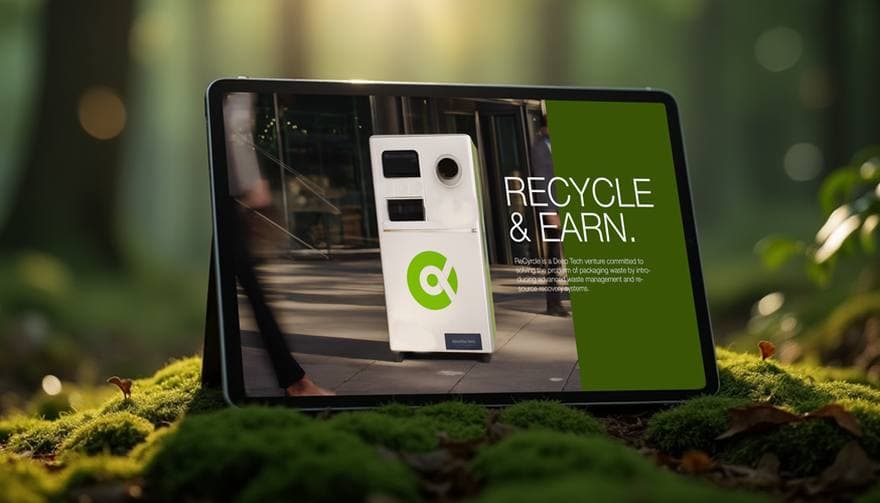
ReCyrcle is a London recycling-rewards company. We built its iOS and Android apps in Flutter, its React web app, its Django admin and the cloud layer its smart machines report to: people scan a QR code, recycle, and see eco coins in their wallet in under 500 ms. Recycling through the machines rose 65%.
- More recycling
- +65%More recycling
- Machine to wallet
- <500 msMachine to wallet
- iOS, Android, web, admin
- 3 monthsiOS, Android, web, admin
Technology
What this gets built with
We pick the boring option unless there is a reason not to — the framework is the part most likely to be abandoned before your system is.
- Devices and sync
- MQTT
- LoRaWAN
- Cellular gateways
- Offline buffering
- Device event ids
- App
- Flutter
- iOS + Android
- QR scanning
- Push notifications
- Wallet UI
- Backend
- Django
- PostgreSQL
- Event ledger
- Celery
- REST APIs
- Vision and reporting
- YOLO
- OpenCV
- Confidence scoring
- Funder report templates
- CSV / API exports
How the engagement runs
Five phases, each with something you can hold
Every phase ends in a named deliverable. You can stop after any of them and keep what has been built.
- 01Week 1–2
Sit with the work
We watch the process as it is actually done, not as the process document says. The output is a map of every step, which system it touches and how long it takes.
DeliverableProcess map and a shortlist of what is worth automating - 02Week 2–3
Design the access layer
Which systems get read, which get written to, what scope each credential carries, and which decisions stop for a person. Agreed in writing before anything is built.
DeliverableArchitecture and permission model - 03Week 3–8
Build against your real data
Built in your sandbox against real records, not a demo dataset. The write path goes through a review queue from the first day, so nothing lands in a live system unseen.
DeliverableRunning system in staging, with the review queue - 04Week 8–10
Run it beside the humans
It runs in parallel with the people doing the job. We compare the two outputs, fix what differs, and only then start letting the routine path through unattended.
DeliverableAgreement rate report and a go-live threshold - 05Ongoing
Hand over and watch
Source code in your repository, deployment in your accounts, cost and failure dashboards you can read without us. Support if you want it, not because you are locked in.
DeliverableRepository, runbook and monitoring
Why Devs Core
Three reasons that are checkable
We run two of our own products
Cadenza and Budge are ours. What an agent costs per run, where it fails and which decisions need a person came from operating them, not from a vendor deck.
The write path is reviewed by default
Anything that changes a record in a system of record goes through a queue a person can see. You choose what graduates to unattended, and when.
You own the code
Source in your repository, infrastructure in your accounts, model keys in your name. There is no runtime of ours you have to keep paying for.
Questions
Sustainability & Recycling — the questions we get asked
Our collection hardware is from a vendor who will not open it up. Now what?
Then we work with whatever it does emit — a file export, a serial feed, a dashboard API — and we tell you honestly how much resolution you lose.
Where a vendor is completely closed, adding an independent sensor or scan point at the deposit is sometimes cheaper than fighting them.
Does gamification actually change behaviour?
A visible balance that goes up does more than a leaderboard.
The failure mode is rewards that take days to appear — the loop has to close at the bin. On ReCyrcle, coins land in the wallet in under 500 ms, and recycling rose 65%.
Can it tell the difference between materials from a photo?
For the common streams and contaminants, with training data from your own sites, usefully well.
It will not match a trained sorter on edge cases, which is why every call stores its image and confidence and borderline ones go to a person.
We need to report to a municipality in a specific format.
That is a template over the event ledger.
Because every figure traces back to individual collection events, a challenged number can be expanded rather than defended from memory — which is usually the thing that makes these reports stressful.
How do you stop people gaming the rewards?
Per-participant and per-device baselines, duplicate detection on device event ids, and weight plausibility checks.
Flagged events hold for an operator instead of being refused automatically, because a legitimate heavy user looks a lot like a cheat until somebody looks.
Is this only for consumer-facing schemes?
No.
The same ledger and reporting design works for commercial waste contractors and in-plant recovery, where the reward loop is replaced by client billing and diversion reporting. The hardware and the audit trail are the common parts.
Related
What sustainability & recycling buys most often
- Mobile App Development
Mobile App Development
iOS and Android from one Flutter codebase, or native where the hardware demands it.
From $9,000 - AI Integration Services
AI Integration Services
The access layer between the software you already run and any AI model — so an agent can reach your ERP, CRM or helpdesk without being handed the keys.
From $8,000 - Computer Vision Development
Computer Vision Development
Detection, inspection and counting from camera feeds, running on the floor rather than in a research notebook.
From $9,000 - Custom Software Development
Custom Software Development
The operational system underneath — the one the packaged software did not cover. React and Django, built to be handed over.
From $14,000
Tell us which process is costing you.
Thirty minutes, no preparation, no deck. You describe what keeps going wrong and we tell you whether AI is the answer — including when it is not.
Prefer email? contact@devs-core.com