
By team
AI agents and automation for sales teams
A CRM is only as current as the last person who remembered to update it, which is why forecasts are argued about rather than read. We build the layer that keeps the record current from the work itself — email, calls and calendars — and that does the research and preparation a good rep does when they have time, which is never.
Two weeks to a written build plan · no obligation to build with us
- Our own research agent, in production
- CadenzaOur own research agent, in production
- Every CRM update points at its source
- Evidence-linkedEvery CRM update points at its source
- Nothing is sent to a customer unseen
- Rep approvesNothing is sent to a customer unseen
- To a written build plan, via the audit
- 2 weeksTo a written build plan, via the audit
Where the time goes
If two of these are true, there is something here
Written the way the people doing the work describe it, not the way a process document does.
The CRM is updated on Friday, from memory
Which means stages are wrong, next steps are stale and the forecast is a negotiation rather than a report.
Research before a call gets skipped
Everyone agrees it matters. Nobody has forty minutes before a discovery call to read a company’s filings, news and product pages, so the call starts cold.
Follow-ups are lost between deals
A promised document, a nudge in three weeks, an introduction. They live in a rep’s head and are remembered late or not at all.
Nobody knows why deals are actually lost
Closed-lost reasons are a dropdown filled in under duress, so the pattern that would change the pitch is invisible.
What we connect to
The systems you are already running
Sales teams generally have more tools than they use. The gap is that none of them read each other, so the rep is the integration.
- CRM
- HubSpot
- Salesforce
- Zoho CRM
- Pipedrive
- Custom pipelines
- Communication
- Gmail / Outlook
- Google Calendar / Microsoft 365
- WhatsApp Business API
- Call recording tools
- Signal and content
- Company and news sources
- Enrichment providers
- Product and pricing documents
- Proposal templates
What we build here
Five things worth building for sales
Each one names the systems it touches, because an integration that is not named is an integration nobody has thought about yet.
- 01
CRM hygiene from the work itself
Stage changes, next steps, stakeholders, competitors and dates extracted from email and call notes and written back to the right record, each with a link to the message it came from so a rep can check rather than trust.
- Touches
- Mailbox · calendar · CRM
- What changes
- The pipeline reflects reality without anyone doing admin on Friday.
- 02
Pre-call research briefs
A short brief before every meeting: what the company does, recent news, likely pressures, who is in the room and what was said last time. Sources cited, claims checked — this is what Cadenza was built to do and we run it on our own calls.
- Touches
- Calendar · CRM history · public sources
- What changes
- Calls start informed instead of starting with discovery you could have done yourself.
- 03
Follow-up that does not depend on memory
Promised documents, agreed next steps and the nudge in three weeks captured from the conversation as tasks with dates, and drafted when they come due for the rep to send.
- Touches
- Mailbox · CRM tasks · templates
- What changes
- Commitments made on a call actually happen.
- 04
Proposal and quote assembly
Proposals and quotes assembled from your approved content and pricing, populated with what the account record already knows, so a rep edits a near-complete draft instead of starting from a template.
- Touches
- CRM · pricing rules · document templates
- What changes
- Proposals go out in hours rather than at the weekend.
- 05
Loss and objection analysis
Objections, competitors and stated reasons pulled from the actual correspondence across closed deals, so the pattern is evidence from conversations rather than a dropdown value.
- Touches
- Mailbox · call notes · CRM history
- What changes
- The pitch changes based on what customers said, not what reps logged.
How it is put together
How the CRM stays current without anyone updating it
The rule that makes this safe is that the system only records what was said. It does not infer intent, score likelihood to buy, or decide that a deal has advanced because the tone was warm.
- 01
Read what already exists
Mailboxes, calendars and call notes, through delegated access the rep grants. Recording a call requires consent from everyone on it, which is a legal question in many jurisdictions and is handled explicitly, not assumed.
- 02
Extract facts, not impressions
Dates, names, stated next steps, named competitors, quoted prices. Each extraction keeps a pointer to the sentence it came from. Sentiment and buying intent are deliberately not inferred.
- 03
Match to the record
The right account, contact and opportunity, using domain, participants and thread history. A possible duplicate is never merged automatically — a merged CRM record is very hard to unpick.
- 04
Write within rules
Fields the team agreed may be written automatically are written; stage changes and anything touching value or forecast are proposed to the rep. Reps stop trusting a CRM that changes underneath them.
- 05
Keep the evidence
Every field carries the message that produced it. A manager questioning a stage change gets the email, which is a far better conversation than questioning a rep’s memory.
Your data
What we will and will not do with it
Stated plainly, and without claiming a certification we do not hold. If a requirement here is harder than what is written, say so on the call and we will tell you whether it is buildable.
Nothing is sent to a customer without a person
Drafts, briefs, proposals and follow-ups are prepared for a rep to send. Autonomous outbound to customers is where automated sales goes wrong publicly, and the time saved does not justify it.
No lead scoring dressed up as insight
We will build scoring from rules you can read and argue with. We will not ship an opaque propensity model that tells a rep to deprioritise a real person for reasons nobody can explain.
Personal data is handled as personal data
Prospect information is subject to GDPR and similar regimes wherever your prospects are. We build deletion, export and consent handling in rather than leaving it to be retrofitted after the first request.
Proof
We built the research agent, and we use it
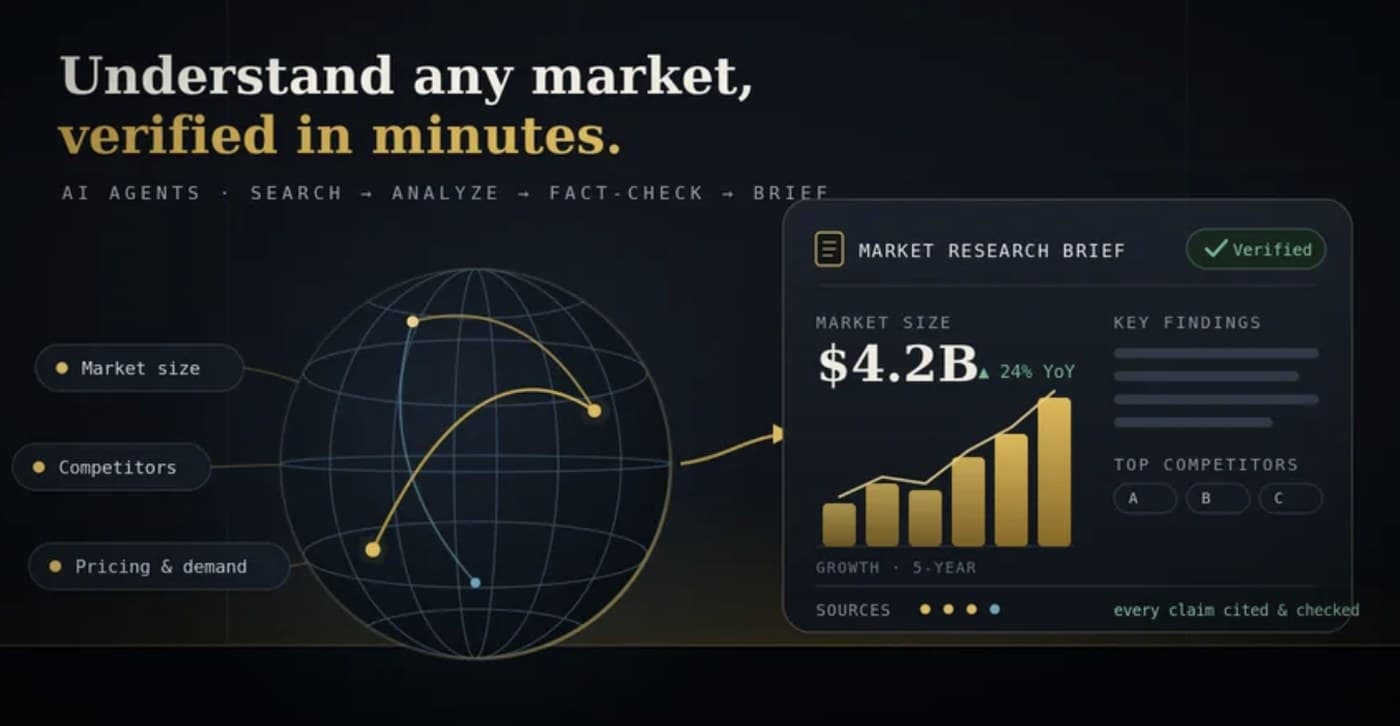
Cadenza is ours: a team of agents that plans a research question, searches and reads in parallel, pauses for a human to approve the direction, then verifies every claim against its source before writing the brief. It is what a pre-call brief should be, and running it on our own pipeline is where we learned how quickly unverified research turns into confidently wrong preparation.
- Planner, researchers, analyst, critic
- 5 agentsPlanner, researchers, analyst, critic
- Every step streamed as it happens
- LiveEvery step streamed as it happens
- Human approval before it writes
- 1 checkpointHuman approval before it writes
Technology
What this gets built with
We pick the boring option unless there is a reason not to — the framework is the part most likely to be abandoned before your system is.
- Agents
- LangGraph
- Multi-agent research
- Claim verification
- Structured extraction
- Integration
- HubSpot / Salesforce APIs
- Gmail / Microsoft Graph
- Calendar APIs
- Webhooks
- Content
- Proposal templates
- Pricing rules
- Approved content library
- Document generation
- Controls
- Field-level write rules
- Duplicate detection
- Evidence links
- Consent and retention
How the engagement runs
Five phases, each with something you can hold
Every phase ends in a named deliverable. You can stop after any of them and keep what has been built.
- 01Week 1–2
Sit with the work
We watch the process as it is actually done, not as the process document says. The output is a map of every step, which system it touches and how long it takes.
DeliverableProcess map and a shortlist of what is worth automating - 02Week 2–3
Design the access layer
Which systems get read, which get written to, what scope each credential carries, and which decisions stop for a person. Agreed in writing before anything is built.
DeliverableArchitecture and permission model - 03Week 3–8
Build against your real data
Built in your sandbox against real records, not a demo dataset. The write path goes through a review queue from the first day, so nothing lands in a live system unseen.
DeliverableRunning system in staging, with the review queue - 04Week 8–10
Run it beside the humans
It runs in parallel with the people doing the job. We compare the two outputs, fix what differs, and only then start letting the routine path through unattended.
DeliverableAgreement rate report and a go-live threshold - 05Ongoing
Hand over and watch
Source code in your repository, deployment in your accounts, cost and failure dashboards you can read without us. Support if you want it, not because you are locked in.
DeliverableRepository, runbook and monitoring
Why Devs Core
Three reasons that are checkable
We run two of our own products
Cadenza and Budge are ours. What an agent costs per run, where it fails and which decisions need a person came from operating them, not from a vendor deck.
The write path is reviewed by default
Anything that changes a record in a system of record goes through a queue a person can see. You choose what graduates to unattended, and when.
You own the code
Source in your repository, infrastructure in your accounts, model keys in your name. There is no runtime of ours you have to keep paying for.
Questions
Sales — the questions we get asked
Will reps trust a CRM that updates itself?
Only if they can see why.
That is why every automatic field carries a link to the message behind it, and why stage and value changes are proposed rather than applied. A CRM that changes silently is one reps start keeping a private spreadsheet beside.
Can it send outbound emails for us?
It can draft them.
We do not build autonomous outbound to prospects — the reputational downside is real, deliverability punishes it, and the time saved over a rep clicking send is marginal.
How is this different from what HubSpot or Salesforce already offer?
Their features work well inside their own ecosystem.
The gap is usually everything outside it — WhatsApp threads, a pricing spreadsheet, an ERP, your proposal library. That connective work is what we build, and if the native feature already covers your case we will tell you to use it.
Can it join our calls?
It can work from transcripts your existing recording tool produces, where everyone on the call has consented.
We would rather integrate with a tool your team already uses than add another bot to the meeting.
What about our data in a CRM we might leave?
The extraction layer writes to your CRM through its API; the evidence store is yours.
Changing CRM means rewriting an adapter, not losing the history, which is the point of keeping the evidence outside the CRM.
We are a small team. Is research automation overkill?
Small teams often get more from it, because there is no SDR doing the preparation.
A brief before every call is the highest-value piece for a two-person sales team; CRM hygiene matters more once there are enough deals to forecast.
Related
What sales buys most often
- AI Agent Development
AI Agent Development
Agents that take real actions in your systems — reading live data, drafting work, and writing back only what a person has approved.
From $6,500 - AI Integration Services
AI Integration Services
The access layer between the software you already run and any AI model — so an agent can reach your ERP, CRM or helpdesk without being handed the keys.
From $8,000 - Process Automation
Process Automation
Replace the manual steps between two systems — the re-keying, the copy-paste, the spreadsheet that reconciles what neither system knows.
From $4,500 - AI Readiness Audit
AI Readiness Audit
Two weeks that end in a written plan: which processes are worth automating, what each would cost, and what has to be fixed first.
From $2,400
Tell us which process is costing you.
Thirty minutes, no preparation, no deck. You describe what keeps going wrong and we tell you whether AI is the answer — including when it is not.
Prefer email? contact@devs-core.com