

Free AI Visibility Checker

Is your website visible to AI?

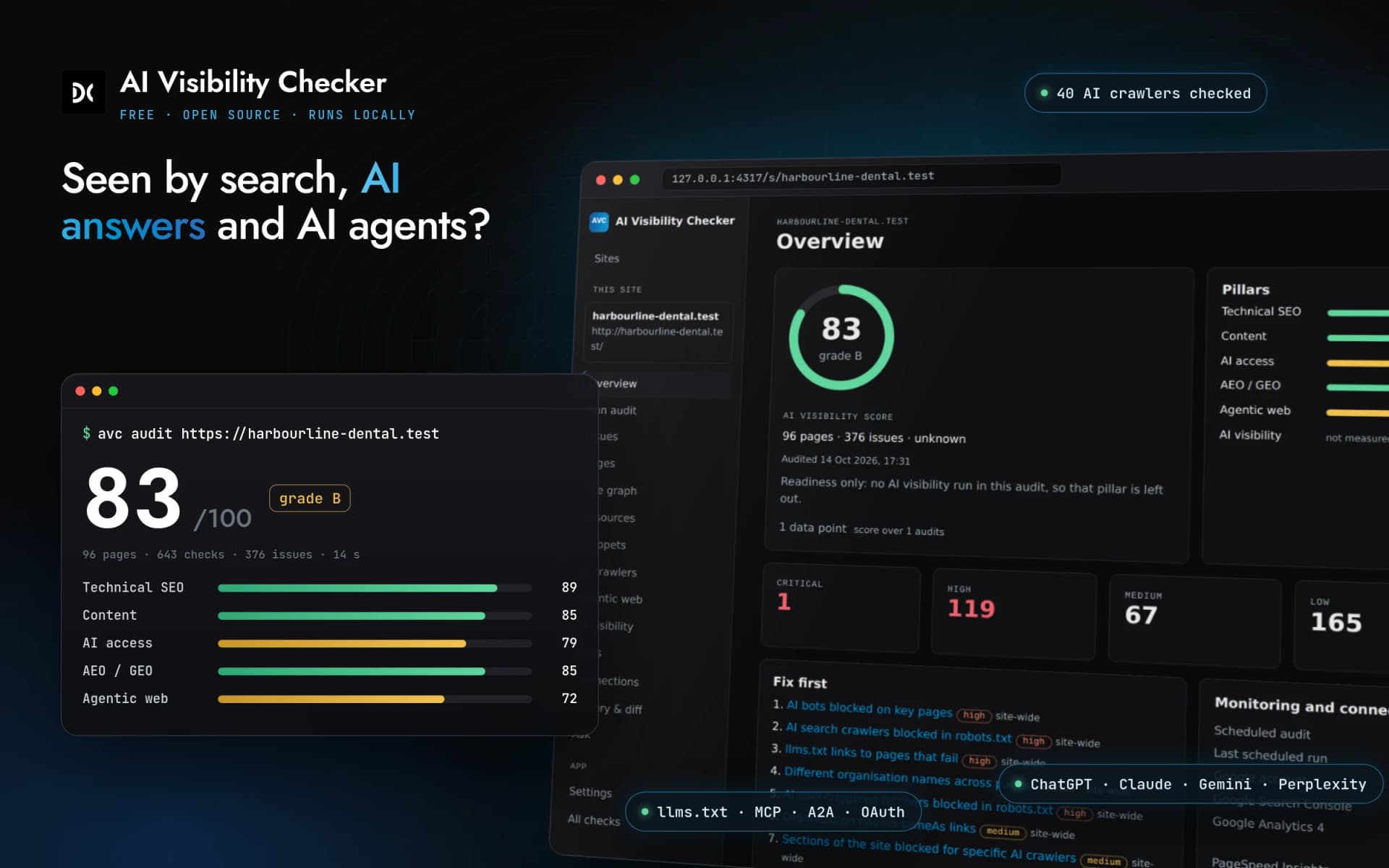
Find out whether ChatGPT, Claude, Perplexity and Google’s AI can reach your site, read it, and recommend you. We test 24 AI crawler rules, fetch your page as 19 of those crawlers, and show you what they actually see.

AI crawler rules checked
24AI crawler rules checked
crawlers fetched live
19crawlers fetched live
AI engines asked about you
4AI engines asked about you
no card, no trial
$0no card, no trial

What the checker tests

Five questions an AI engine asks before it recommends you

Most free checkers stop at robots.txt. This one requests your page the way each AI crawler does, measures what survives without JavaScript, and asks ChatGPT, Claude, Gemini and Perplexity who they would recommend.

  • Section AInstant

    AccessCan AI reach your site?

    • robots.txt rule for 24 AI crawler tokens, with the line that decides each
    • Live fetch as 19 AI crawlers, compared with a real browser
    • What a non-JavaScript crawler actually reads
    • HTTPS, redirects, sitemap, llms.txt and opt-out tags

    Not in other free tools: Live crawler fetch

  • Section BInstant

    ReadabilityCan AI understand what it reads?

    • JavaScript rendering gap: raw HTML versus the rendered page
    • Heading outline, semantic landmarks and paragraph length
    • Schema markup found, and what is missing
    • GEO content score with specific fixes
    • Site-wide audit of your top pages from the sitemap

    Not in other free tools: JavaScript rendering gap

  • Section FInstant

    Exclusive signalsWhat most checkers never test

    • Live fetch as each AI crawler, compared with a browser
    • How much of your page exists only after JavaScript runs
    • Presence in the last six Common Crawl releases
    • Every crawler grouped by purpose: training, search, user-triggered
    • What blocking each group costs you

    Not in other free tools: Common Crawl history

  • Section C Free with email

    AI perceptionWhat do ChatGPT, Claude, Gemini and Perplexity say?

    • Eight real questions per engine, about you and your category
    • Mentions, topics, cited sources and sentiment by topic and source
    • What AI states about you, checked against your own site
    • Whether the models know you without searching

    Not in other free tools: Claude included free; facts checked against your site

  • Section D Free with email

    Competition and researchWho gets recommended instead of you?

    • Share of voice against every business the engines name
    • A lite scan of up to three competitors, side by side
    • The exact prompts where a competitor wins, and the sources behind them
    • Query fan-out, prompts to track, and a GA4 guide for AI referral traffic

    Not in other free tools: Competitor gaps with sources

How it works

Three steps, and the first two need nothing from you

  1. 01

    Enter your website address

    Type your domain or any page URL. No account, no email for the technical scan.

  2. 02

    Get the technical report in about 20 seconds

    Crawler access, the live bot test, what AI can read, the JavaScript rendering gap, schema, llms.txt and your Common Crawl history — each with a pass or fail and how to fix it.

  3. 03

    Unlock the AI scan with your work email

    Confirm a six-digit code and we ask ChatGPT, Claude, Gemini and Perplexity eight real questions each about you and your category, check what they claim against your site, and compare you with up to three competitors.

Reference

Every AI crawler the checker tests

AI companies run separate crawlers for training, for their search index, and for fetching a page when a user asks. They have different consequences, so the report groups them the same way. Reviewed quarterly against each operator’s documentation.

Search crawlers

If you block them: You drop out of the index these assistants search when they answer. This is the group that decides whether you can be cited at all.

Search crawlers
robots.txt tokenOperatorWhat it doesLive test
OAI-SearchBotOpenAIBuilds the index behind ChatGPT search resultsFetched live
Claude-SearchBotAnthropicIndexes pages so Claude can cite them in search answersFetched live
PerplexityBotPerplexityBuilds the index behind Perplexity answersFetched live
GooglebotGoogleGoogle Search, including AI Overviews and AI ModeFetched live
BingbotMicrosoftBing Search, which also grounds Microsoft CopilotFetched live
ApplebotAppleSiri and Spotlight searchFetched live
AmazonbotAmazonAlexa and Amazon AI answersFetched live
DuckAssistBotDuckDuckGoDuckDuckGo AI-assisted answersFetched live

User-triggered crawlers

If you block them: When someone pastes your link into an assistant, or it tries to open your page to answer them, the request fails.

User-triggered crawlers
robots.txt tokenOperatorWhat it doesLive test
ChatGPT-UserOpenAIOpens a page when a ChatGPT user asks about itFetched live
Claude-UserAnthropicOpens a page when a Claude user asks about itFetched live
Perplexity-UserPerplexityOpens a page when a Perplexity user follows or asks about itFetched live
Google-CloudVertexBotGoogleFetches pages for agents built on Vertex AIFetched live
meta-externalfetcherMetaOpens a page when a Meta AI user asks about itFetched live
MistralAI-UserMistralOpens a page when a Le Chat user asks about itFetched live

Training crawlers

If you block them: Your pages stay out of future model training. Live AI answers are not affected, but models will know less about you when they answer without searching.

Training crawlers
robots.txt tokenOperatorWhat it doesLive test
GPTBotOpenAICollects content to train OpenAI modelsFetched live
ClaudeBotAnthropicCollects content to train Claude modelsFetched live
anthropic-aiAnthropicLegacy Anthropic token, still honoured in robots.txtrobots.txt only
Claude-WebAnthropicLegacy Anthropic token, still honoured in robots.txtrobots.txt only
Google-ExtendedGoogleOpt-out switch for Gemini training and groundingrobots.txt only
Applebot-ExtendedAppleOpt-out switch for Apple Intelligence trainingrobots.txt only
meta-externalagentMetaCollects content to train Meta AI modelsFetched live
BytespiderByteDanceCollects content for ByteDance modelsFetched live
CCBotCommon CrawlOpen web dataset used to train many modelsFetched live
cohere-aiCohereOpt-out switch for Cohere trainingrobots.txt only

How the score works

No black-box number

The instant report gives a Technical Score: Access and Readability, rescaled to 100. The AI scan adds the other three pillars for the full AI Visibility Score.

Every score in the report opens into the parts that earned it. A check we could not run is left out of the total, not counted as zero.

  • 25

    Access

    robots.txt rules, the live crawler fetch, opt-out tags, llms.txt, HTTPS and sitemap. Search and user-triggered crawlers count three and two times as much as training crawlers.

  • 20

    Readability

    The JavaScript rendering gap (weighted heaviest), heading structure, schema markup, and an audit of your top ten pages.

  • 35

    AI perception

    How often the four engines name you and on how many of them, with what sentiment, how deep and well-sourced the mentions are, whether they know you without searching, and whether what they say matches your site.

  • 15

    Competitive position

    Your share of the businesses named in category answers, your position when listed, and whether engines see you as a leader, challenger or niche player.

  • 5

    Entity footprint

    Profile links in your Organization markup, a Wikidata or Knowledge Graph entity, and presence in Common Crawl.

What we will not show you

AI visit counts, training-crawl counts and “mentions in conversations”

None of them can be measured from outside your website. Crawler visits live in your own server and CDN logs; conversations happen inside the assistants and are not published. A tool that shows you those numbers without access to your logs is estimating, and we would rather tell you what we actually measured.

Want the real numbers?

We can connect your server or CDN logs and show you which AI crawlers visit, how often, and what they read.

Talk to us about it

Questions

Questions about AI visibility

Straight answers, including the ones where the honest answer is “nobody can measure that”.

How do I check if ChatGPT can see my website?

Enter your URL in the Devs Core AI Visibility Checker. It reads your robots.txt for GPTBot, OAI-SearchBot and ChatGPT-User, then requests your page as each of them and compares the response with what an ordinary browser gets. If robots.txt allows a crawler but your firewall returns a 403 or a challenge page, the checker flags it as likely blocked. The scan is free and takes about 20 seconds.

How do I get my website to show up on ChatGPT?

Three things have to be true. OAI-SearchBot and ChatGPT-User must be able to fetch your pages, which means allowing them in robots.txt and in any firewall or bot protection. Your content must be in the HTML the server sends, because those crawlers do not run JavaScript. And other sites must describe you consistently, because ChatGPT prefers to recommend businesses it can corroborate. The checker tests the first two; its AI scan samples whether ChatGPT, Claude, Gemini and Perplexity already name you, and which sources they cite.

What is the difference between GPTBot, OAI-SearchBot and ChatGPT-User?

GPTBot collects content to train OpenAI models. OAI-SearchBot builds the index behind ChatGPT search results. ChatGPT-User fetches a page when a ChatGPT user asks about it or pastes a link. Blocking GPTBot keeps your content out of future training; blocking OAI-SearchBot or ChatGPT-User removes you from ChatGPT’s answers today. Anthropic (ClaudeBot, Claude-SearchBot, Claude-User) and Perplexity split their crawlers the same way.

Should I block AI crawlers in robots.txt?

Block training crawlers if you do not want your content used to train models; that is a legitimate choice and does not affect live answers. Do not block search or user-triggered crawlers unless you want to disappear from AI answers, because those are the bots that fetch your pages when someone asks ChatGPT, Claude or Perplexity about your category. The checker groups every crawler by purpose so you can see the consequence of each rule.

Why can’t AI crawlers see my website’s content?

The usual cause is client-side rendering. GPTBot, ClaudeBot and PerplexityBot read the HTML your server sends and do not execute JavaScript, so a site that builds its content in the browser can look empty to them. The second cause is bot protection that challenges or blocks non-browser requests. The checker measures both: it compares the words in your raw HTML with the words after a headless browser renders the page, and it fetches your page as 19 different AI crawlers.

What is llms.txt and do I need one?

llms.txt is a markdown file at the root of a site that gives language models a short summary and a list of your most important pages. It is proposed by llmstxt.org. No major AI engine has confirmed it reads the file, so it will not fix a visibility problem on its own, but it is cheap to publish. The checker tells you whether you have one and validates it against the format.

Is the AI Visibility Checker free?

Yes. The technical scan runs without an email address. The AI scan, which asks ChatGPT, Claude, Gemini and Perplexity real questions about your brand and your category, needs a verified work email because each one costs us money to run. There is no paid tier and no card.

Can the checker tell me how often AI bots visit my site?

No, and no outside tool honestly can. Crawler visit counts live in your own server or CDN logs, which only you can see. Tools that show “AI visits” or “mentions in conversations” without access to your logs are estimating. The checker reports only what can be measured from outside: whether crawlers are allowed, whether they are actually served your page, what they can read, and what sampled AI answers say.

How accurate are the AI answer results?

They are a sample, and the report labels them that way. We ask each engine the same eight questions through its official API with web search on, then twice more with search off, and grade every answer with a separate model. Consumer apps personalise answers and change them over time, so treat the results as a snapshot of how the models see you today, not a guarantee of what any one user will be told.

What happens to the details I enter?

Your URL is scanned and the report is stored under an unguessable link for 90 days. If you run the AI scan, your email, brand, location and service are used to run it, to email you the report, and to let Devs Core follow up about it. We do not sell or share them, and you can ask us to delete them at any time.

Want this fixed? See what Devs Core builds.

Server-rendered sites AI can read, clean crawler access, structured data, and AI agents that work inside the systems you already run.