
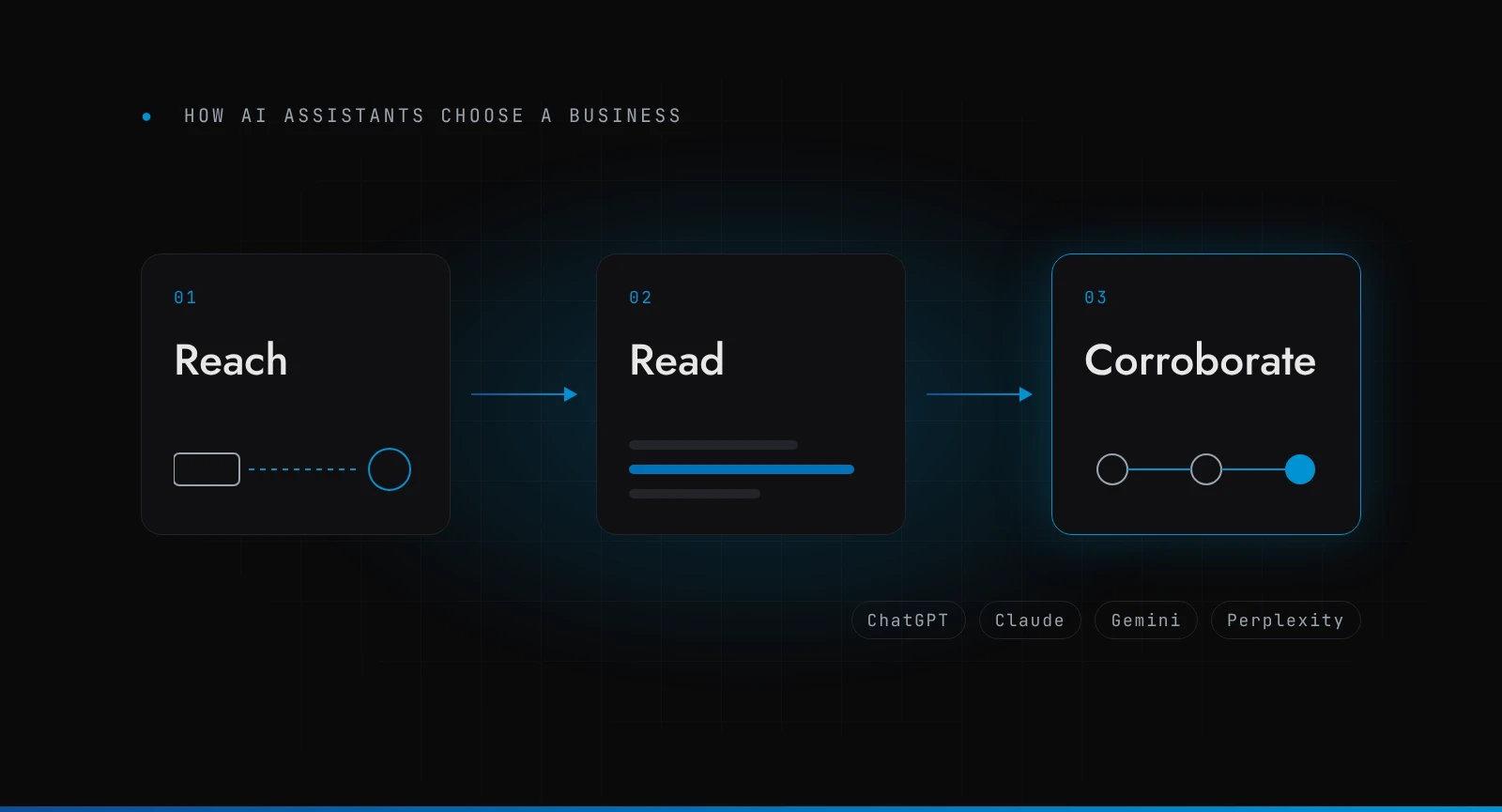
When someone asks ChatGPT "who should I hire for this?", it answers with a short list of businesses. Getting onto that list is not the same job as ranking on Google, though the two overlap. This guide covers how the assistants actually find and choose businesses, why most sites never appear, and what to fix, in the order it matters.
If you only want to know where you stand, run your site through our free AI Visibility Checker. It tests every step below and tells you which one is failing.
How does ChatGPT decide which websites to show?
ChatGPT, Claude, Gemini and Perplexity answer in one of two ways.
From what they learned in training. Asked "what is Acme Plumbing?" with search switched off, a model answers from the text it was trained on. If your business was rarely written about before the model's training cut-off, it will say it does not know you, or confuse you with someone else.
By searching the web first. For "best plumbers in Austin" most assistants now run a web search, read a handful of pages, and write an answer from them. Each has its own pipeline: ChatGPT's search is fed by its crawler OAI-SearchBot alongside partner search results, Claude searches with its own tool backed by Claude-SearchBot, Gemini uses Google Search, and Perplexity runs its own index. The businesses that get named are the ones those pages mention, and the sources the assistant trusts.
So there are three things to get right: the assistants must be able to reach your site, they must be able to read it, and the rest of the web must corroborate what you say.
Why doesn't my website show up on ChatGPT?
In the sites we check, it is almost always one of these five.
- robots.txt blocks the search crawler. Many sites blocked "AI bots" wholesale in 2023 to keep their content out of training. The same rule often blocks OAI-SearchBot, Claude-SearchBot or PerplexityBot, which are the crawlers that decide whether you can be cited, not trained on.
- The firewall blocks it anyway. robots.txt is only a request. Cloudflare, Vercel, Akamai and other bot-protection services often challenge or block unfamiliar crawlers regardless of what robots.txt allows. This is the most common problem we see, and the hardest to spot, because the site looks fine in a browser.
- The content only exists after JavaScript runs. GPTBot, ClaudeBot and PerplexityBot read the HTML your server sends. They do not run JavaScript. A site built entirely in the browser can look empty to them.
- Nothing on the page is quotable. Pages that say "we deliver innovative solutions" give an assistant nothing to repeat. Pages that say "commercial plumbing in Austin since 2009, fixed-price quotes from $95" do.
- Nobody else mentions you. Assistants prefer businesses they can corroborate: directory listings, review sites, press, forum threads. A company that exists only on its own website is a risk to recommend.
How do I get my website indexed by ChatGPT?
Allow the crawlers that feed it, and make sure your server actually serves them.
Check your robots.txt for these user agents and make sure none of them is disallowed:
OAI-SearchBot— builds the index behind ChatGPT search resultsChatGPT-User— fetches a page when a user asks about it or pastes a linkGPTBot— collects training data; blocking it is a legitimate choice and does not affect live answersBingbot— Bing results feed several assistants, Microsoft Copilot above all, so this matters too
Then test what your server does when those crawlers actually arrive. Request your page with each crawler's user agent and compare the response with a normal browser request. A 403, a "Just a moment…" challenge page, or a much shorter page means your firewall is turning them away. Our AI Crawler Checker does this for 19 crawlers at once.
Finally, keep a sitemap at /sitemap.xml and list it in robots.txt, so search crawlers find the pages that matter without having to discover them through links.
How do I get my business recommended by ChatGPT?
Being indexed makes you eligible. Being recommended depends on what the assistant reads about you.
Say plainly what you do, for whom, and where. Put it in the first paragraph of your homepage and your service pages, in text, not in an image or an animation. Include the specifics a buyer would ask about: services, location, prices or starting prices, turnaround, years in business.
Answer the questions buyers ask. Use subheadings phrased as real questions ("How much does a commercial kitchen fit-out cost?") and answer each in the first sentence underneath. Assistants lift the paragraph under a matching question almost verbatim.
Add structured data. Organization or LocalBusiness markup with your legal name, address, logo and sameAs links to your LinkedIn, Crunchbase and directory profiles tells an engine unambiguously which business it is reading about. FAQPage markup makes your question-and-answer sections machine-readable.
Get corroborated elsewhere. List yourself on the directories and review sites your category uses (Clutch for agencies, Google Business Profile for local services, G2 for software). Engines cite these constantly. A few honest reviews and a mention in a trade publication do more than any on-page change.
How do I rank on ChatGPT for my category?
There is no ranking factor you can buy or a setting you can switch. But you can see what the assistants currently say, and work on the gap.
Ask ChatGPT, Claude, Gemini and Perplexity the questions your buyers ask: "best [service] in [city]", "who should I hire for [service]", "is [your brand] a good choice for [service]". Note who gets named instead of you, and — more usefully — which sources the assistant cited when it named them. Those sources are the pages you need to be on.
The AI scan in our checker does this for you: eight questions on each of the four engines, a pass with search switched off to see what the models know from training, a check of every fact they state against your own site, and the exact answers where a competitor was named and you were not, with the sources behind them.
Does llms.txt help me show up in ChatGPT?
Not yet, as far as anyone can show. llms.txt is a proposed markdown file that gives language models a summary of your site and a list of key pages. No major assistant has confirmed it reads the file when answering. It is cheap to publish and does no harm — you can validate yours here — but it will not fix a crawler block or a JavaScript problem, which matter far more.
Should I block AI crawlers?
Decide by purpose, not by company.
- Training crawlers (GPTBot, ClaudeBot, Google-Extended, CCBot): blocking keeps your content out of future training. Live answers are not affected, but models will know less about you when they answer without searching.
- Search crawlers (OAI-SearchBot, Claude-SearchBot, PerplexityBot, Googlebot, Bingbot): blocking removes you from those assistants' answers. Almost never what a business wants.
- User-triggered fetchers (ChatGPT-User, Claude-User, Perplexity-User): blocking means that when someone pastes your link into an assistant, it cannot open it.
Can I see how many times ChatGPT mentions my business?
Not from outside, and be wary of any tool that claims to. Conversations happen inside the assistants and are not published. What you can measure honestly:
- Sampled answers: ask the assistants your buyers' questions through their APIs and count how often you are named. That is a sample, not a census, and should be labelled as one.
- Referral traffic: visits that arrive from a link in an AI answer show up in Google Analytics 4 with sources like
chatgpt.comandperplexity.ai. A custom channel group with a regex separates them from ordinary referrals; the AI scan in our checker includes the steps and the regex. - Crawler visits: your server or CDN logs record every visit from GPTBot, OAI-SearchBot and the rest. Only you can see them, but they are the one real number available.
The order to fix things in
- Make sure search and user-triggered crawlers are allowed in robots.txt and by your firewall.
- Make sure your content is in the server-rendered HTML.
- Rewrite key pages so they state specifics and answer real questions.
- Add Organization and FAQPage structured data.
- Get listed and reviewed where your category is discussed.
Steps one and two are technical and usually fixable in an afternoon. They also block everything after them, which is why they come first.
Check your site now — it is free, takes about 20 seconds, and needs no sign-up. If the report shows problems you would rather not fix yourself, see what we build.