
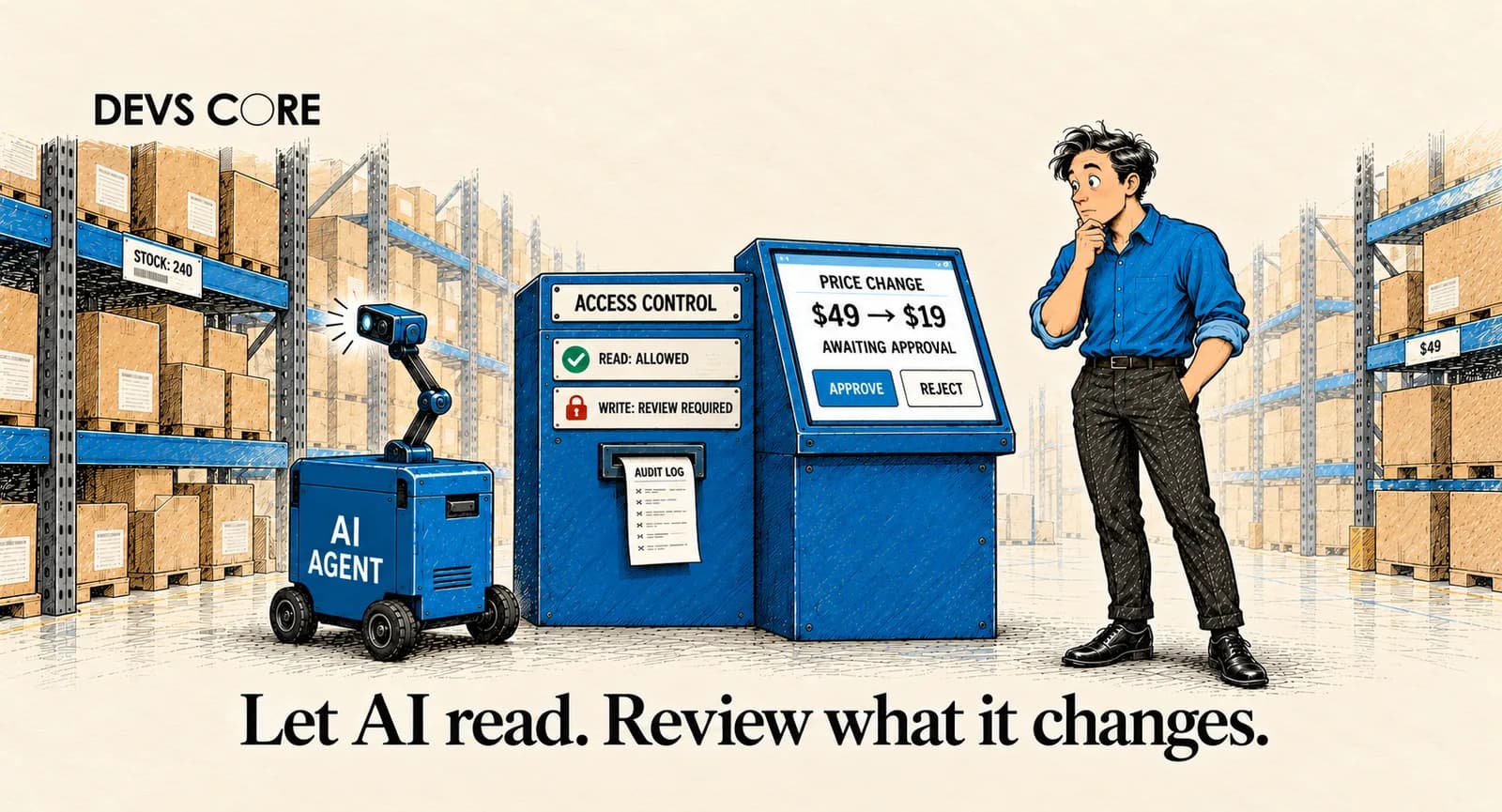
An AI agent relies on probabilistic language models to interpret intent, but securing the systems it touches requires hard, deterministic code. Guardrails inside a system prompt are easily bypassed by prompt injection, allowing attackers to hijack autonomous tool calls. To secure enterprise AI agents, engineering teams must move permissions out of the model and into a controlled access layer, enforcing explicit read/write separation and queuing irreversible actions for human review.
This guide is for technical leaders evaluating AI agent development and integrating these tools into internal systems like ERPs and CRMs. We cover why probabilistic models fail at access control and how to implement strict engineering governance, similar to the architecture used in agentic AI for startups and enterprise environments.
Key takeaways
- Governance must live in an external, deterministic access layer, not within the language model's prompt.
- System connectors should expose only an explicit allow-list of operations.
- Architectures require strict read/write separation, queueing database mutations for human review.
- Comprehensive audit trails must log who triggered the request, what code ran, and who approved the write.
- Owning your agent's source code gives your team complete visibility into its security logic.
Why can system prompts not protect production data?
System prompts are instructions processed by a probabilistic model, making them vulnerable to misinterpretation or deliberate overriding. When a large language model (LLM) evaluates incoming text, it weighs probabilities rather than executing strict conditional logic. This means soft guardrails telling the model not to execute harmful commands can be ignored if the surrounding context shifts.
The OWASP Top 10 for Large Language Model Applications 2025 states that prompt guardrails and secondary LLM evaluators are themselves vulnerable to prompt injection. The security of the system must rely on external runtime barriers and least-privilege tool execution. If an AI agent has direct credentials to your database and relies solely on a prompt to decide when to use them, the data is at risk.
| Probabilistic Prompt Guardrails | Deterministic Access Layer |
|---|---|
| Evaluates intent using LLM weights | Evaluates permissions using hardcoded logic |
| Susceptible to prompt injection | Blocks unauthorised API calls outright |
| Relies on hidden model instructions | Uses explicit API scopes and database roles |
How does prompt injection escalate through autonomous tool calling?
An AI agent is simply an LLM with functions it can call. If those functions have broad access to write to your enterprise resource planning (ERP) system or execute code, a manipulated prompt turns into manipulated actions.
For example, a prompt injection vulnerability in agent tooling (CVE-2026-18733) allowed remote actors to execute arbitrary operating system commands by manipulating tool parameters to bypass human confirmation. Another vulnerability (CVE-2026-70477) demonstrated how LLM responses bypassed soft validator blocklists to execute arbitrary Python code. The threat is not what the model says, but what the model does.
What are scoped connectors and strict parameter validation?
Scoped connectors are deterministic code bridges that expose a limited, predefined set of actions to an AI agent. Rather than giving the model a direct database connection string, the access layer provides specific API endpoints.
At Devs Core, we build a connector per system — ERP, CRM, inventory, helpdesk, the internal database nobody documented. Each one exposes a named set of operations, and nothing beyond them. This restricts the agent to an allow-list of explicitly named tools. In a first engagement with an unfamiliar ERP, we prove the integration in a sandbox before any build is quoted.
How do you enforce architectural read/write separation?
Architectural read/write separation ensures that an agent fetching data uses a fundamentally different permission path than an agent modifying data. You establish this by separating operations at the API access level before the model ever interacts with the system.
Permissions are set per system and per operation, not per model. An agent that can read stock levels cannot silently gain the ability to change a price. This protects against an attacker attempting to use an agent designed for customer support to rewrite financial ledgers.
How does a reviewed write queue secure irreversible operations?
A reviewed write queue intercepts state-changing operations and holds them until a human operator verifies the intended action. This halts autonomous execution right before the point of impact.
Queries run at machine speed. Anything that changes a system of record goes to a review queue, and a named person approves or rejects it. The proposed change is shown in full — the record, the field, the old value and the new one. The reviewer approves or rejects, and the decision is logged against their name. Unattended write-back into live financial records is not our starting position. It is something you switch on later, per operation, once the log has earned it.
What role do audit trails play in agent security?
An audit trail records the deterministic execution of every agent action, creating a permanent, verifiable history. If a system behaves unexpectedly, the engineering team needs to trace the exact input, reasoning and resulting API payload.
We ensure every agent call is tracked: who asked, what ran, what came back, who approved it. We maintain that in practice it is three mechanisms, not a policy document: scoped permissions, a reviewed write queue and an audit log.
How do you implement governed access layers in existing systems?
Implementing a governed access layer requires mapping the existing systems, identifying the necessary operations and building intermediate APIs. Many agent initiatives stall because they fail to solve production data access. The tech research firm Gartner cited that over 40% of agentic AI projects will be cancelled by the end of 2027. We see this often; a pilot fails because it never got access to anything real.
We recommend that teams start with one process, read-only, beside the people who do it today. For legacy systems without clean APIs, our integration approach follows a strict hierarchy. In order of preference: a direct read-only database connection, a supported export or file drop, the vendor’s reporting or integration module, or — last — driving the interface the way a person does.
When we build this architecture, the client owns 100% of the source code for every engagement, handed over documented and in the client’s own repository. Devs Core builds AI agents, integrations and automation that plug into the software your business already runs on — with scoped permissions, a reviewed write queue, full audit logs, and 100% source code ownership. This ensures you maintain total control over your security logic.
Frequently asked questions
Can system prompts completely secure an AI agent?
No. System prompts are interpreted probabilistically. They cannot guarantee security because prompt injection can manipulate the model's context and trick it into ignoring initial safety instructions.
What is a governed AI agent?
A governed AI agent is an AI agent whose access to business systems is explicitly scoped and auditable. The governance lives in deterministic code layers rather than inside the model's textual instructions.
Why do so many AI agent pilots fail?
Many pilots fail because they never achieve secure access to production data. Without a structured access layer separating reads from writes, businesses are left unable to trust the system with real work, keeping the agent trapped in a sandbox.
To evaluate the feasibility and security of adding AI to your operations, start with an AI Readiness Audit. An AI Readiness Audit starts at $2,400 for two weeks. Book a scoping call with our technical team to discuss how a secure access layer integrates with your architecture.