
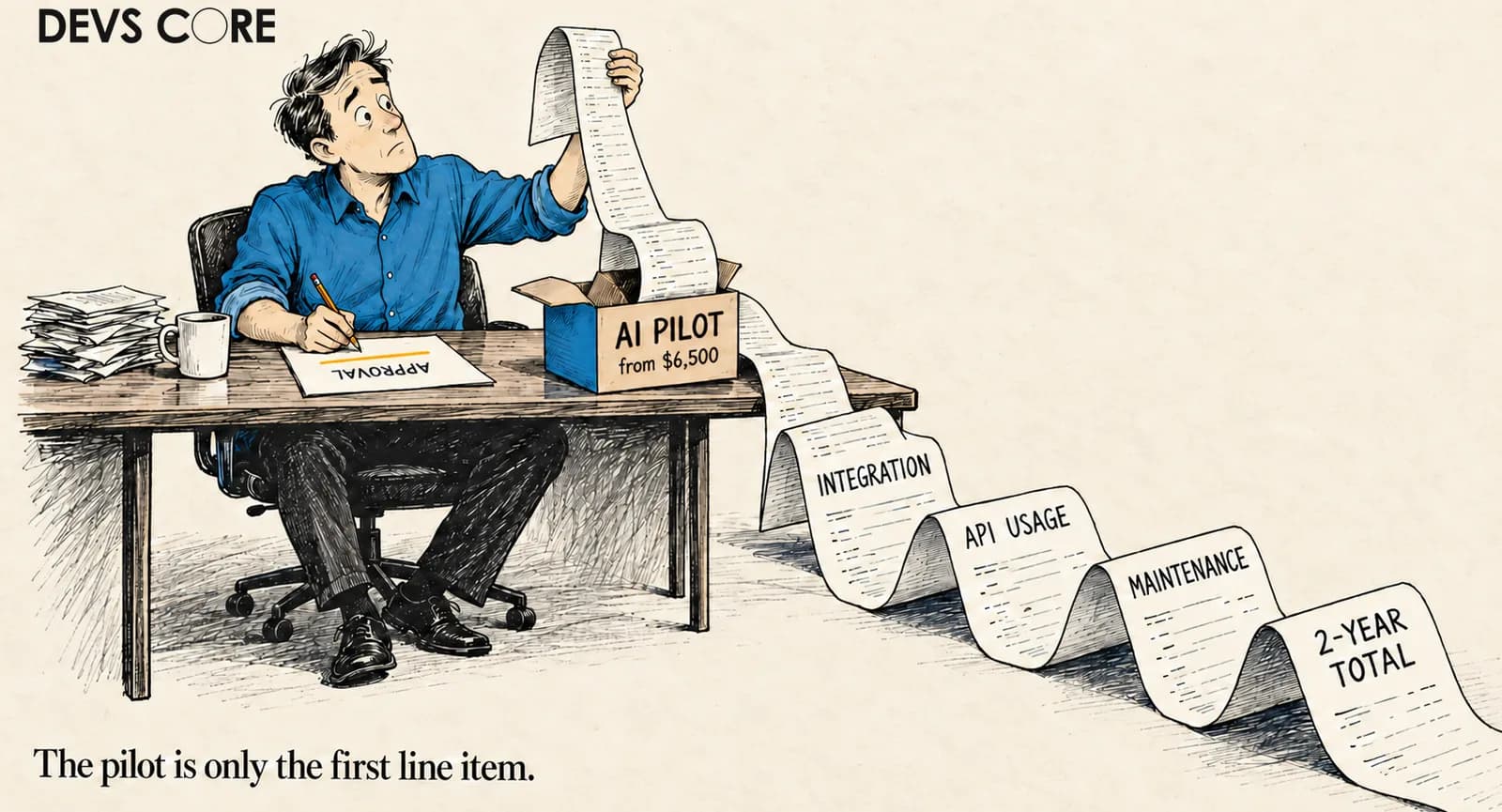
An agent pilot on a single process starts at $6,500, but budgeting for a custom AI agent requires US businesses to plan for both the upfront build and ongoing operating economics. In 2026, planners must factor in connector engineering for legacy systems, token execution loops, and proactive maintenance.
This guide is for US CTOs, COOs, and operations leaders planning AI agent development deployments across ERP and CRM systems. We break down the exact costs of fixed-scope pilots, legacy system integrations, and governed process automation to help you build a reliable budget over a two-year horizon.
Key takeaways
- Upfront capital costs scale with system complexity, from basic rule automation to complex enterprise multi-agent deployments.
- Missing governance and unproven access to live systems are the primary reasons agentic AI projects fail before production.
- Permissions set per system and a reviewed write queue protect operations from unauthorised changes, while hard spend limits prevent runaway API token usage.
- Custom-coded systems eliminate no-code subscription creep by offering 100% code ownership.
What is the true cost of a custom AI agent?
Budgeting for an AI agent requires separating upfront build capital from run-rate operating costs. Industry pricing benchmarks show entry-level rule agents cost $5,000–$20,000, model-based workflow agents cost $25,000–$75,000, and complex multi-agent enterprise systems range from $80,000 to $300,000+. However, the upfront price tag is only part of the commercial picture.
Operating an agent in production introduces ongoing API token costs, cloud compute fees, and maintenance retainers. Planners often underestimate how many tokens a reasoning model uses to complete a single task, turning a reasonable build into an expensive liability if inference limits are not strictly enforced. We see teams succeed when they price the entire two-year total cost of ownership (TCO) from day one.
Why do 40% of AI agent projects fail before reaching production?
Projects fail when they cannot connect to real data safely, turning them into expensive chat interfaces rather than useful operational tools. Gartner predicts that over 40% of agentic AI projects will be cancelled by the end of 2027, driven by escalating integration costs, lack of clear business value, and missing governance and access controls.
When Devs Core rescues stalled builds, the primary failure mode is often that it never got access to anything real. A proof of concept built on mocked data looks impressive in a presentation but breaks when exposed to messy legacy APIs or undocumented databases. Without a disciplined approach to systems integration, the projected ROI collapses under the weight of connection errors and security blocks.
How much capital is required for upfront audits and pilots?
The safest way to budget a custom agent is to divide the project into discrete, fixed-scope phases rather than open-ended retainers. Moving from concept to live constraints generally follows three funding milestones:
- AI Readiness Audit: Starts at $2,400 | 2 weeks (fixed price)
- Single-Process Pilot: Starts at $6,500 | 4–6 weeks
- Full Access Layer: Starts at $8,000 | 5–8 weeks
How do legacy systems affect connector engineering costs?
Integration engineering is priced per system surface rather than per model, meaning your choice of legacy ERP or CRM dictates the build complexity.
We build a connector per system — ERP, CRM, inventory, helpdesk, the internal database nobody documented. Each one exposes a named set of operations, and nothing beyond them.
Connecting to legacy infrastructure without native APIs introduces a connector engineering tax. In order of preference: a direct read-only database connection, a supported export or file drop, the vendor’s reporting or integration module, or — last — driving the interface the way a person does. Budgeting accurately requires auditing these systems first to understand exactly which connection method is viable.
What are the run-rate economics of token execution loops?
Operating costs are driven by how many times an agent loops through its reasoning steps to solve a problem. CloudZero reports that multi-agent execution loops consume 15x more tokens than basic chat and complete agent workflows can reach 19x to 50x the cost of a single model call. This amplification turns cheap base models into expensive ongoing operations.
To control this, businesses must shift from measuring cost per token to cost per task. If an agent loops fifty times to process an invoice, the task cost may exceed human processing. Applying hard spend limits per job and per month prevents runaway usage when an agent gets stuck in a retry loop.
How does the governance layer protect operational budgets?
Governance is not an administrative add-on; it is an architectural investment that protects your systems of record from costly errors. Permissions are set per system and per operation, not per model. An agent that can read stock levels cannot silently gain the ability to change a price.
Queries run at machine speed. Anything that changes a system of record goes to a review queue with the proposed change shown in full, and a named person approves or rejects it. Furthermore, the audit log records who asked, what ran, what came back, who approved it.
Why is custom code ownership cheaper than no-code SaaS?
Many mid-market teams start on no-code automation platforms because the entry price appears low, only to hit steep scaling walls as task volumes increase. As reasoning cycles grow, the recurring software-as-a-service (SaaS) tax balloons, often forcing companies to upgrade to enterprise tiers simply to increase execution timeouts.
Devs Core builds AI agents, integrations and automation that plug into the software your business already runs on — with scoped permissions, a reviewed write queue, full audit logs, and 100% source code ownership. Owning your code means you pay raw API costs directly to the model provider with no markup. You avoid vendor lock-in and retain the ability to swap models or host them locally as the technology evolves.
What should US businesses budget for ongoing maintenance?
An AI agent requires proactive maintenance to handle API version changes, prompt drift, and underlying library updates. Devs Core charges from $1,200 a month to maintain a custom system or agent, with the fixed figure set after a scoping call.
This maintenance retainer replaces the unpredictable subscription creep of no-code tools with a fixed, predictable operating expense. It ensures your agent continues to function correctly when a CRM vendor updates their endpoints or an OpenAI model deprecates an older version.
How should technical teams scope their initial AI build?
A successful AI agent deployment begins with testing the riskiest assumptions on a single workflow before scaling. Start with one process, read-only, beside the people who do it today. By taking this measured approach, you build the access layer correctly, establish the exact token amplification costs on real data, and secure internal buy-in without risking a six-figure budget on an untested concept.
Frequently asked questions
How much does it cost to build a custom AI agent?
Based on industry benchmarks, entry-level agents start at $5,000 while complex multi-agent enterprise systems range from $80,000 to $300,000+. At Devs Core, a fixed-scope agent pilot starts at $6,500.
What is the ongoing cost of running an AI agent?
Ongoing costs consist of cloud compute, model inference (API tokens), and maintenance. Because complex agents can loop and consume up to 50x the cost of a single model call, businesses must set hard spend limits. Devs Core custom agents include a maintenance plan starting from $1,200 a month.
Why are so many AI agent projects cancelled?
More than 40% of projects are expected to be cancelled by 2027 primarily because they never secure safe access to real business systems. Escalating integration costs, lack of clear business value, and missing governance and access controls turn promising pilots into unmaintainable risks.
Are no-code AI platforms cheaper than custom code?
No-code platforms appear cheaper initially due to low monthly entry tiers, but costs creep rapidly as task volume and execution times increase. Custom-coded agents require a larger upfront capital build but offer 100% source code ownership, meaning you only pay raw model API costs without recurring vendor markups.
Ready to scope your AI agent deployment with clear, predictable costs? Book a scoping call with our engineering team to discuss an AI Readiness Audit and map out the exact integrations your business needs. What is the biggest budget surprise you have faced when integrating AI into legacy systems?