
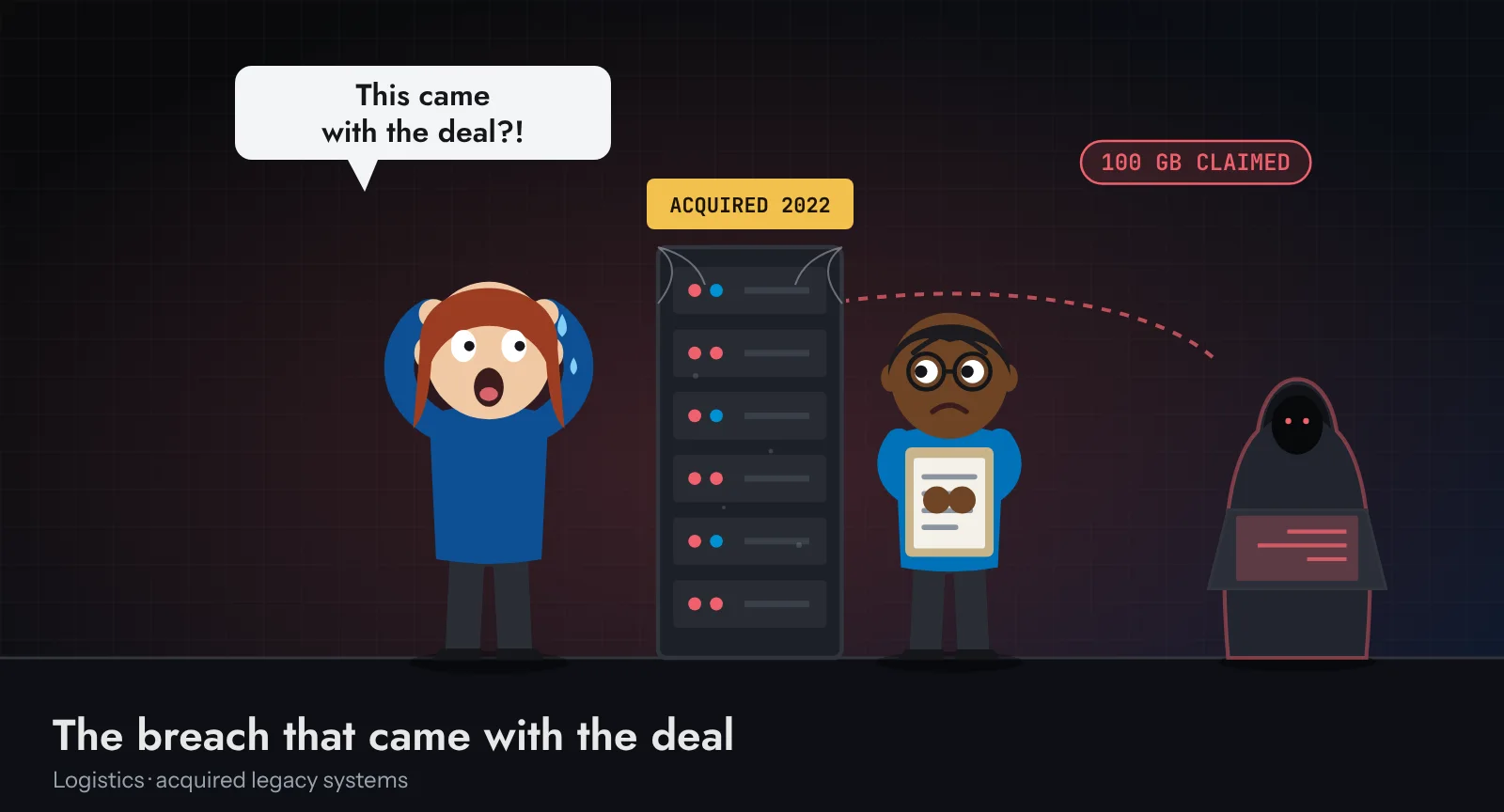
On 7 November an extortion group called WhiteArmor put Maersk on its leak site. Four days later the shipping group published a short notice. It had found "unauthorised access and data extraction from one of our local legacy systems from a previous acquisition". Not the booking platform. Not the ships. An old system that came with a company it bought.
If you have ever bought a business, that sentence should make you think of a specific server, portal or login. Legacy systems from an acquired company are a breach risk because they arrive with their own accounts, passwords, patch habits and data, they often keep running long after the deal because nobody owns retiring them, and attackers look for exactly that kind of forgotten door. The fix is not glamorous: know what you bought, lock it down, keep only the data you need, and retire it on a plan.
Key takeaways
- Maersk confirmed on 11 November 2026 that data was taken from a legacy system inherited through an acquisition; WhiteArmor claims 100 GB and demands $5m in bitcoin by 7 December.
- The attackers claim 16,093 driver passwords in plain text; Maersk says that is not accurate and that passwords were stored in protected form.
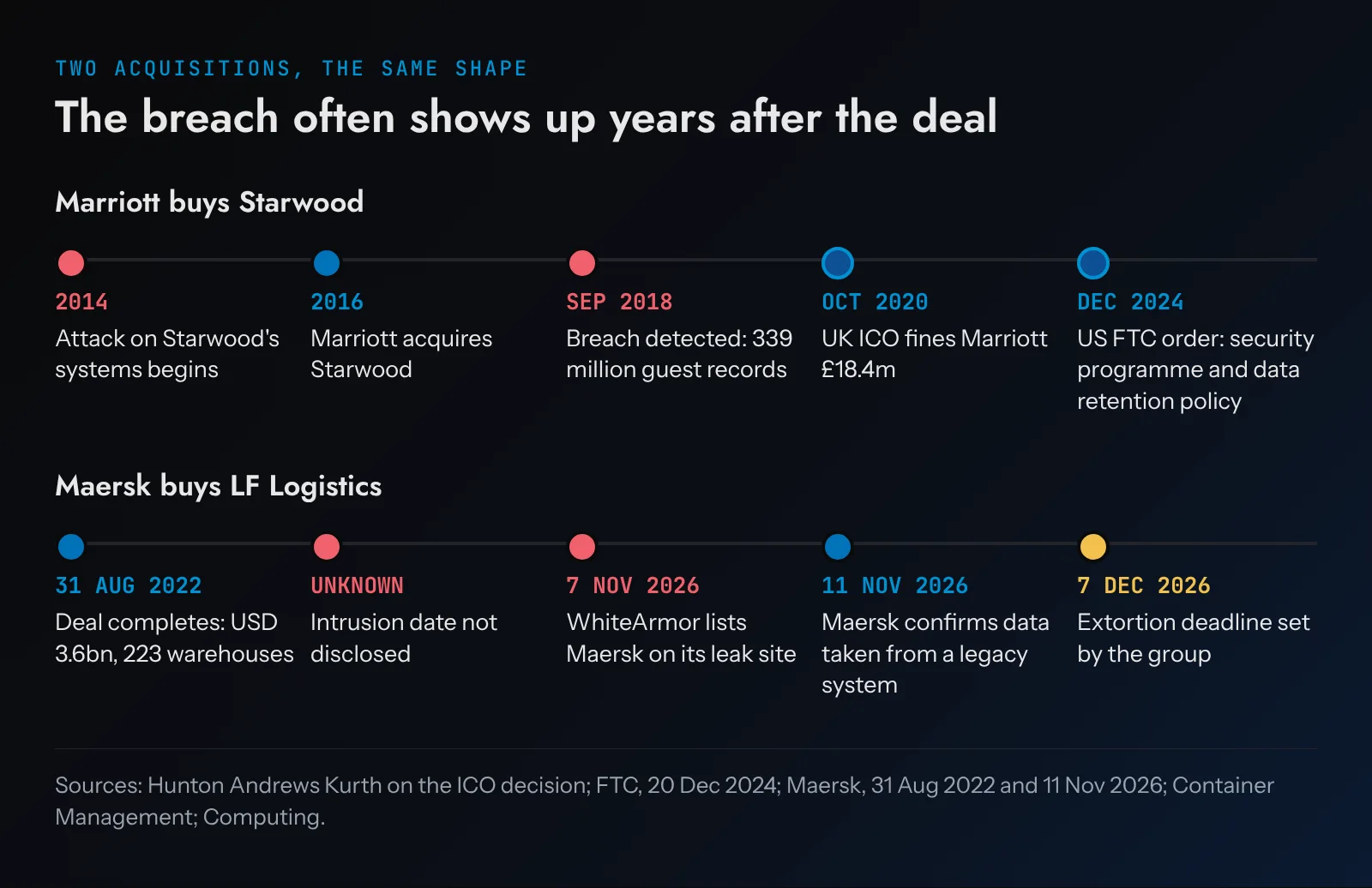
- Marriott's Starwood breach began in 2014, two years before the 2016 acquisition, and was found in 2018; the UK ICO fined Marriott £18.4m for failing to maintain the systems it inherited.
- Every acquired system needs a named owner, a credential reset, a data-minimisation decision and a retirement date, written down within the first 90 days of ownership.
What happened at Maersk?
Here is what is confirmed, and what is only claimed. As of 22 November 2026 the investigation is ongoing.
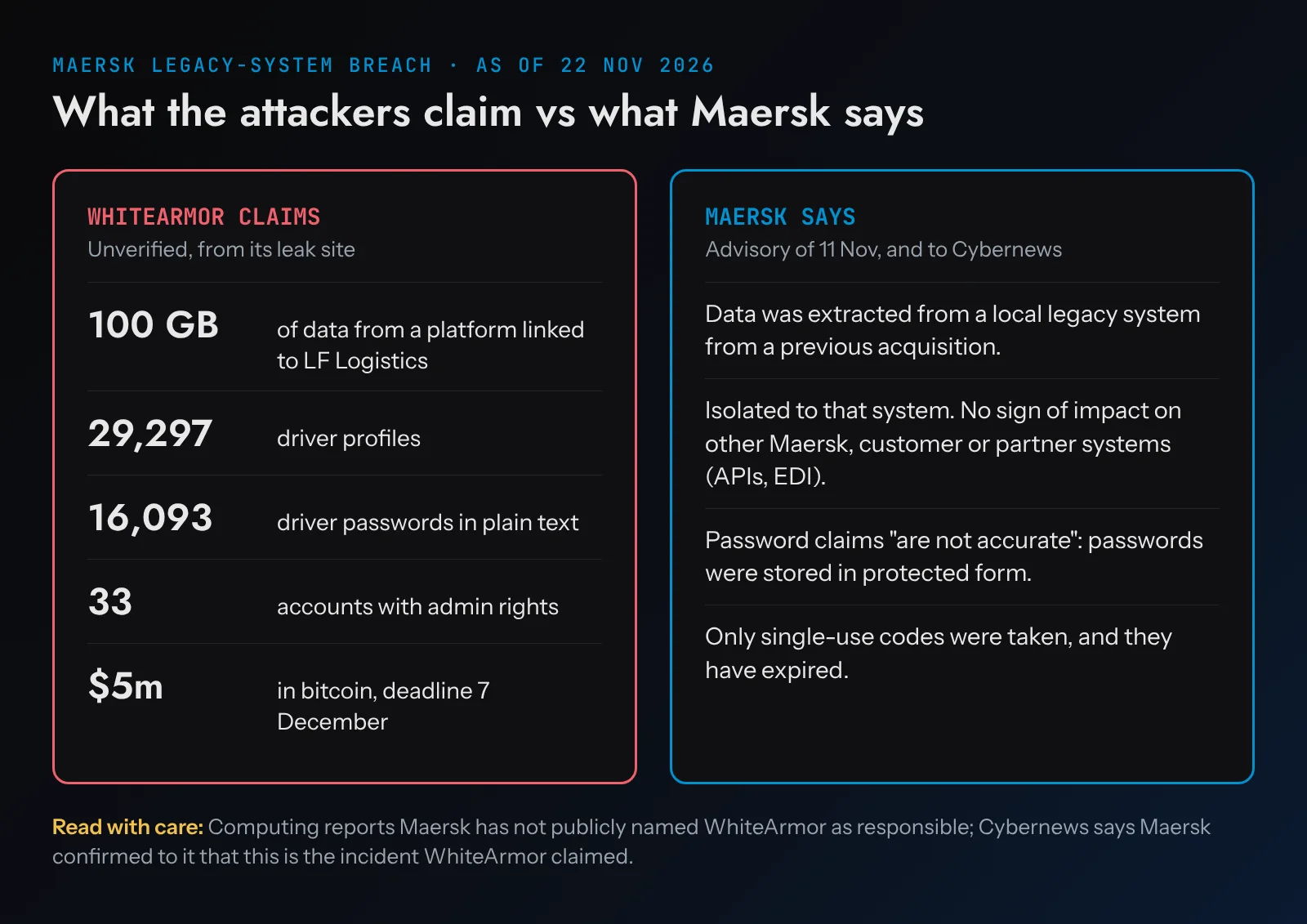
Confirmed by Maersk. In its 11 November advisory, Maersk said the incident is "isolated to a local system". It said it had found no indication of impact on other Maersk systems, or on customer and partner systems that connect through APIs and EDI. It does not expect disruption to operations, and its findings so far "strongly suggest no sensitive data has been disclosed". Maersk has not named the acquisition or said when the intrusion happened.
Claimed by the attackers. According to Container News, citing the Danish publication Ingeniøren, WhiteArmor says it holds about 100 GB from a platform formerly operated by LF Logistics. The claimed contents: 29,297 driver profiles, 16,093 of them with plaintext passwords, 16,123 employee accounts (33 with admin rights), records on nearly 19,000 delivery recipients, more than 64,000 signed delivery receipts and about 14.44 million warehouse inventory records. None of this has been independently verified.
Where the sources disagree. Researchers at Cybernews linked the breach to LF Logistics, which Maersk bought in 2022. Cybernews reports that Maersk confirmed to it that the incident is the one WhiteArmor claimed. It also quotes a Maersk spokesperson: "The claims about passwords are not accurate. Passwords for the system are stored in protected form." Maersk says the attackers took single-use codes that have since expired. Computing, meanwhile, reports that Maersk has not publicly said WhiteArmor was responsible. Treat the record counts as the attackers' sales pitch, not fact.
Why are acquired legacy systems such an easy target?
Look at what the deal itself brought. When Maersk completed the LF Logistics acquisition on 31 August 2022, it was a USD 3.6bn transaction that added 223 warehouses and 10,000 people across Asia-Pacific. That is a lot of sites, a lot of local systems and a lot of user accounts to absorb. The press release talked about a "seamless transition experience". Seamless for customers usually means the old systems keep running while the new ones are built.
Seemant Sehgal of BreachLock put the problem in one sentence to Infosecurity Magazine: "Acquired systems arrive with their own credentials, their own patch schedule, and connections into the parent network that were set up during integration and rarely revisited."
In plain terms, four things go wrong:
- Nobody owns it. The acquired company's IT lead leaves within a year. The parent's IT team never learnt the system. It runs because it works.
- The accounts never die. Drivers, temps, contractors and former staff keep logins. Service accounts made by an integrator in 2019 still have admin rights.
- It holds other people's data. Cybernews says the platform "mostly holds data from other logistics companies". A 3PL's legacy WMS holds your customers' inventory, orders and recipient addresses. That is exactly what an extortion group can sell back.
- It falls outside the parent's standards. Old software versions, single-factor logins and passwords that never rotate. CISA lists unsupported software, known or default credentials and single-factor authentication for remote or admin access as its three named "bad practices". Inherited systems that nobody owns often have at least one of them.
The timing matters too. The FBI warned in a November 2021 private industry notification that "ransomware actors are very likely using significant financial events, such as mergers and acquisitions, to target and leverage victim companies".
Is this a one-off, or a pattern?
It is a pattern, and the best-known case took years to surface. Marriott bought Starwood in 2016. Starwood's reservation system had already been compromised in 2014, and the breach was only detected in September 2018. It affected an estimated 339 million guest records. The UK ICO fined Marriott £18.4m in October 2020 and concluded it had acted negligently in failing to adequately maintain the affected systems. In December 2024 the US Federal Trade Commission finalised an order over three breaches affecting more than 344 million customers. Among other things, it requires a policy to keep personal information only as long as reasonably necessary.
Note what regulators did. They did not accept "we inherited it" as a defence. Once you own the company, you own its systems and its data.
The group behind the Maersk claim is also working through logistics. Nick Harris of Assured tracked WhiteArmor's first weeks of claims against J.B. Hunt, Ryder, Echo Global Logistics and others, with demands from $140,000 to $20m. Most named companies have not confirmed a breach. The entry points the group has volunteered are telling: a token authentication bypass in a gateway, and "a years-old machine account with admin reach that was never rotated". It also says it wants to buy access to VPNs and identity systems, and to recruit insiders in transport and logistics.
How do you find the legacy systems you inherited?
Start with a list, because you cannot secure what you have not written down. Give one person two weeks and these questions.
Build the inventory
For every company you have bought in the last ten years, list each system that is still switched on: WMS, TMS, ERP instances, driver apps, customer portals, EDI gateways, file-transfer servers, reporting databases, and the "temporary" integration servers set up during the deal. For each one record:
- Owner: a named person in your company, not "the old IT team".
- Who uses it: which sites, customers and how many active users in the last 90 days.
- What it holds: personal data (drivers, staff, delivery recipients), customer data, credentials, API keys.
- How it is reached: internet-facing login page, VPN, remote desktop, vendor support access.
- What it connects to: APIs, EDI, shared file drops, direct database links into your systems.
- Software status: version, and whether the vendor still supports it.
Score each system
A simple score helps you decide where to start. This is our working heuristic, not an industry standard: give one point for each "yes".
| Question | Yes = 1 point |
|---|---|
| Is its login reachable from the internet? | |
| Does it accept a password alone, with no second factor? | |
| Are there shared, generic or admin accounts nobody can name an owner for? | |
| Does it hold personal data about drivers, staff or delivery recipients? | |
| Does it hold data belonging to your customers? | |
| Is the software or operating system out of vendor support? | |
| Has nobody in your current IT team logged in to administer it this year? | |
| Does it have a live connection (API, EDI, database link) into your network? |
Anything scoring five or more goes to the top of the list this week. Anything with zero active users in 90 days is a candidate for switching off now.
What should you lock down this week?
You do not need to replace a system to make it much harder to break into. These steps are quick, and none of them stops a warehouse from shipping.
- Reset every credential. All user passwords, service accounts, API keys and integration secrets on the legacy system. Maersk says only expired single-use codes were taken; reset anyway, because you cannot prove what an attacker saw before you noticed. Disable accounts with no login in 90 days.
- Put a gate in front of it. Remove direct internet exposure. Put the login behind your VPN or zero-trust access, with multi-factor authentication for every human user and every admin.
- Cut the admin list. WhiteArmor claims 33 admin accounts on the platform it attacked. Count yours. Every admin account should have a named owner and a reason.
- Narrow the connections. Where the legacy system talks to your core systems, restrict it to the specific calls it needs, from known addresses. Assume the legacy side could be hostile. Our access layer is built on the same idea: an integration gets named operations, not a login.
- Turn on logging and alerts. Log sign-ins, exports and admin changes, and alert on bulk downloads. Data-theft extortion leaves a trail of large exports; you want to see it in hours, not from a leak site.
- Move secrets out of the database. API keys, FTP and telematics credentials stored in plain configuration files are a common find in old systems. We covered how to handle them in keeping secrets away from AI agents; the same rules apply to any integration.
How do you retire a legacy system without stopping operations?
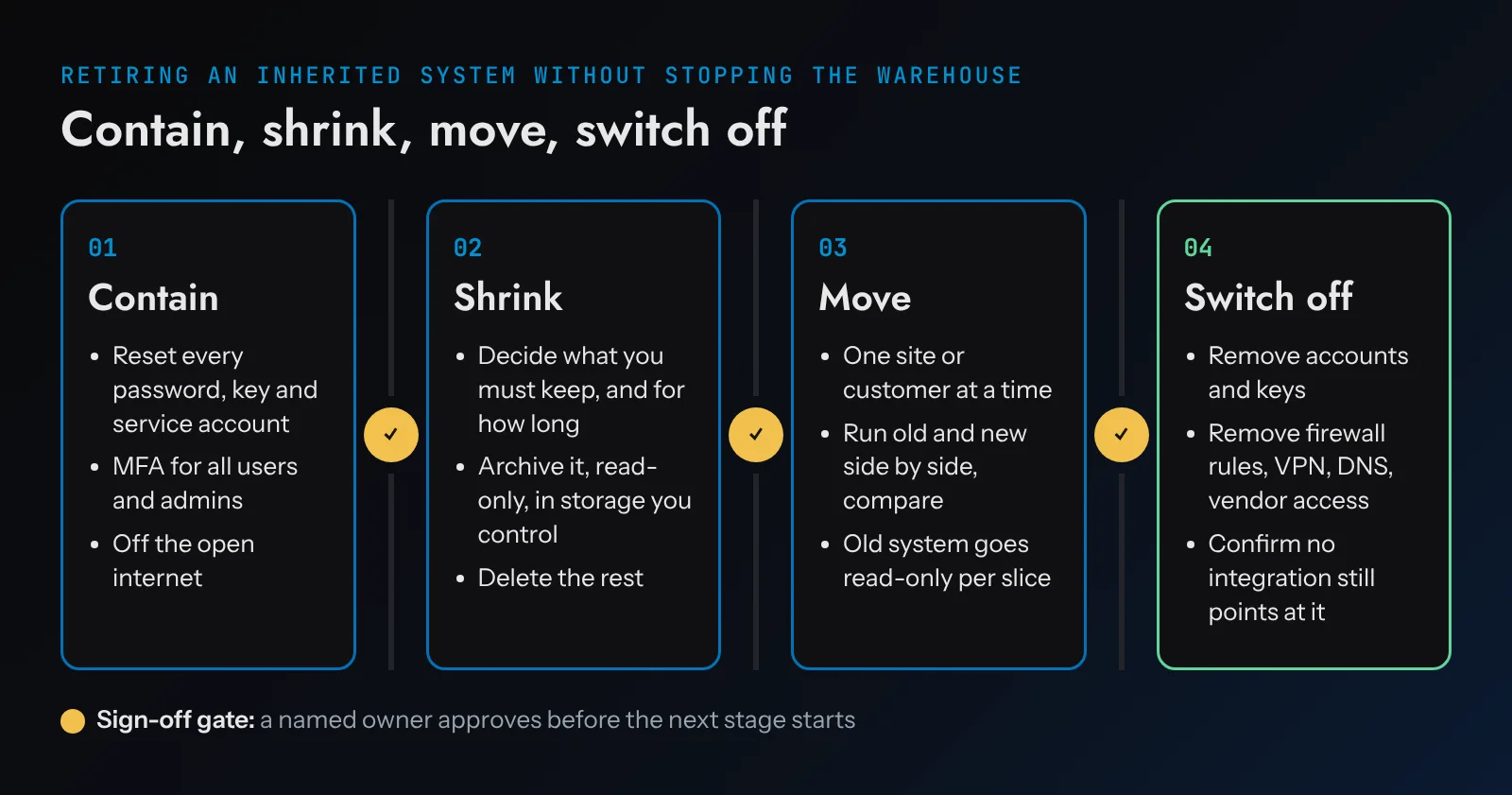
This is the part most companies avoid, because the old system still ships orders for three customers at two sites. The answer is to retire it in slices, with a human sign-off at each step.
1. Freeze it
No new features, no new customers, no new integrations on the legacy system. Write that down and tell sales.
2. Shrink the data
Decide what the business and the law need you to keep, and for how long. Archive that to locked, read-only storage you control. Delete the rest. The FTC's Marriott order made a retention policy mandatory for a reason: data you no longer hold cannot be stolen or ransomed.
3. Move work over one slice at a time
Migrate by site or by customer, not all at once. Run the old and new side by side for a defined period, compare outputs (orders shipped, stock levels, invoices), and only then switch that slice. Turn each migrated slice to read-only on the old system so nobody keeps using it out of habit.
4. Switch it off properly
When the last slice moves, disable every account and key, remove firewall rules, VPN profiles, DNS records and vendor support access, and confirm no integration still points at it. Then keep the archived data under your normal controls.
If the replacement needs building, this is ordinary custom software development: a fixed scope, a data migration plan and the integrations that matter.
What should you change in your next deal?
The board guidance has caught up. The NACD's 2026 Director's Handbook on Cyber-Risk Oversight recommends technical testing during due diligence, not just questionnaires, and building remediation costs into the transaction price "to avoid additional funding requests by IT and security teams after the transaction when these funds are more difficult to obtain".
Practical additions for a mid-size buyer:
- Before signing: ask for a list of every system, its software version, who can log in remotely and what personal data it holds. Check what is visible from the internet yourself.
- In the price: budget for credential resets, MFA, migration and decommissioning as a line item, with a target date.
- On day one: reset privileged credentials and vendor access, and name an owner for every inherited system.
- Within 90 days: score every system, gate the risky ones and set retirement dates.
- Every quarter: report to the board which inherited systems are still running and why.
Where does AI fit into this?
Carefully. Merging two companies' operations is where people want automation most: reconciling two sets of stock records, moving orders between systems, answering "where is this shipment" across both. That is useful work. But an AI agent or integration connected to a legacy system with a shared admin login inherits every weakness above. Give it read access first, put writes to a system of record behind a named human approver, and log every action. That is how we build, and it is set out on our AI governance page.
If you have bought companies and are not sure what is still running, our AI Readiness Audit is a two-week, fixed-price review that maps your systems, where data and access sit, and ends in a written plan. For logistics operators, see how we work in distribution and logistics.
Frequently asked questions
How did hackers get into Maersk?
Maersk says attackers gained unauthorised access to, and extracted data from, a local legacy system inherited through a previous acquisition. It has not said how they got in or when. Cybernews researchers linked the system to LF Logistics, which Maersk bought in 2022, and Maersk confirmed to Cybernews that it is the same incident WhiteArmor claimed.
Did WhiteArmor really steal plaintext passwords from Maersk?
That is the attackers' claim, and Maersk disputes it. A Maersk spokesperson told Cybernews the password claims "are not accurate" and that passwords were stored in protected form, adding that only single-use codes, now expired, were taken. None of the claimed figures had been independently verified as of 22 November 2026.
Are we liable for a breach in a system that came with a company we bought?
In practice regulators treat you as the owner. The UK ICO fined Marriott £18.4m over the Starwood systems it acquired, finding it had failed to maintain them adequately, and the US FTC imposed a security and data-retention order. Take legal advice for your own case, but plan on the basis that "we inherited it" is not a defence.
How long should we keep legacy systems after an acquisition?
Only as long as a defined business need exists, with a written retirement date. Set the date within the first 90 days, migrate work in slices, archive the data you are required to keep in storage you control, and delete the rest.
What is the first thing to do about inherited systems?
Write the inventory: every system still running from every company you have bought, its owner, its users, what data it holds and how it is reached. Then reset all credentials and put multi-factor authentication in front of anything reachable from the internet. Both can start this week.
Should we pay an extortion demand like WhiteArmor's?
That is a decision for your board, your lawyers, your insurer and law enforcement, not a blog post. Paying does not guarantee deletion. Assured reports that the group uses countdowns, data samples and escalating demands, and that one victim, Wagyu.xyz, confirmed a leak after refusing a $5m demand. Reducing the data you hold is the only way to make the question smaller before it arrives.