
Call her Dana. She is made up, but her week is not unusual. Dana runs people and compliance at a 400-person home-goods retailer with stores in Colorado, California and Illinois. On the morning of 4 November her CEO forwards a headline about the Democratic sweep with one line: "Does this change anything for us and AI?"
Dana knows the company uses AI in three places. A résumé screener ranks store applicants. A chatbot answers customer questions. The e-commerce platform adjusts some prices automatically. She does not know which of those, if any, a new law would touch, or when.
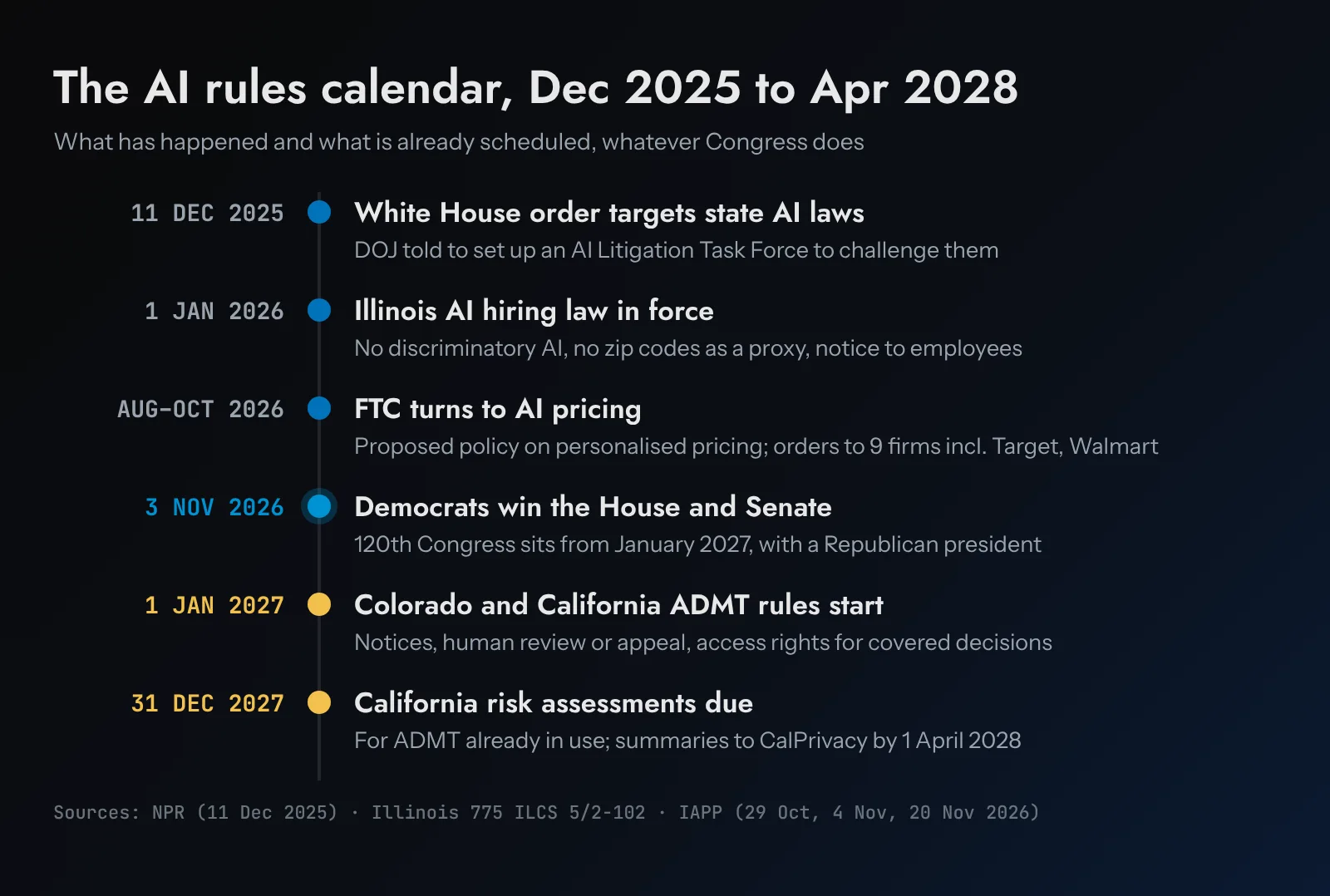
A Democratic Congress is unlikely to pass a sweeping AI law fast, because any bill still needs President Trump's signature, but AI regulation in 2027 will bite anyway: Colorado's and California's automated decision-making rules start on 1 January 2027, Illinois's AI hiring law already applies, and Congress will add hearings, investigations and pressure on top. So the useful question for Dana is not "what will Congress pass?" It is "which of our AI tools make decisions about people, and can we show a human is in charge of them?"
This is a practical summary for operators, not legal advice. Check the specifics with your counsel.
Key takeaways
- In an NBC exit poll cited by Crowell & Moring, 56% of voters said AI and data centres were a crucial or major factor in their vote for Congress.
- Colorado's rewritten AI law (SB 26-189) and California's ADMT regulations both take effect on 1 January 2027, whatever happens in Washington.
- Illinois has banned AI that discriminates in employment decisions, and required notice to employees, since 1 January 2026.
- On 29 October 2026 the FTC ordered nine companies, including Target and Walmart, to explain how personal data and AI set prices.
- The prep work is the same under every regime: an AI inventory, a named human reviewer with authority, logs of what the tool saw and said, and notices.
What will a Democratic Congress do about AI in 2027?
Democrats won both chambers on 3 November. Edelman's post-election analysis describes "a comfortable majority in the House and the party's largest margin in the Senate since 2009", and expects the 120th Congress, which sits from January 2027, to face gridlock with a White House that will lean on executive orders and agency rules.
That gridlock matters. As IAPP notes, Democrats "will still have to work with President Trump or have a veto-proof majority for any potential legislation." So expect fewer new laws than headlines suggest, and much more of three other things.
Oversight. Committee chairs get subpoena power and set hearing agendas. Rep. Frank Pallone, in line to chair House Energy and Commerce, has promised a "bold agenda" to "rein in Big Tech" and has been probing personalised pricing (IAPP). Edelman expects "heightened congressional scrutiny" of technology companies, AI and data centres.
Bills that signal direction. Crowell & Moring's 17 November review lists the likely priorities: data centres, frontier model safety, cybersecurity, workers' welfare, civil rights and national security. Three strands touch ordinary businesses rather than AI labs:
- AI agents and cyber liability. The bipartisan Hawley–Murphy AI Agent Accountability Act and Rep. Lori Trahan's CLAIM Act would create causes of action holding AI agent operators and developers liable for hacking incidents. Rep. Josh Gottheimer's Stop Rogue AI Act would have NIST write standards for organisations' secure use of AI agents.
- Civil rights. Rep. Ayanna Pressley has urged Democrats to prioritise the AI Civil Rights Act, which would bar algorithms that cause disparate impact in consequential areas such as jobs and services.
- Workers. Rep.-elect Manny Rutinel, one of the authors of Colorado's AI Act, campaigned on notice before AI-driven layoffs at large employers.
A federal-versus-state fight. On 11 December 2025 the President signed an order directing the Justice Department to set up an AI Litigation Task Force to challenge state AI laws (NPR). Legal experts quoted by NPR doubted an executive order can pre-empt state law without Congress. A Democratic Congress is very unlikely to pass the pre-emption the White House wants. In practice that means the state laws are the ones to plan for.
Which state AI laws already apply to your business?
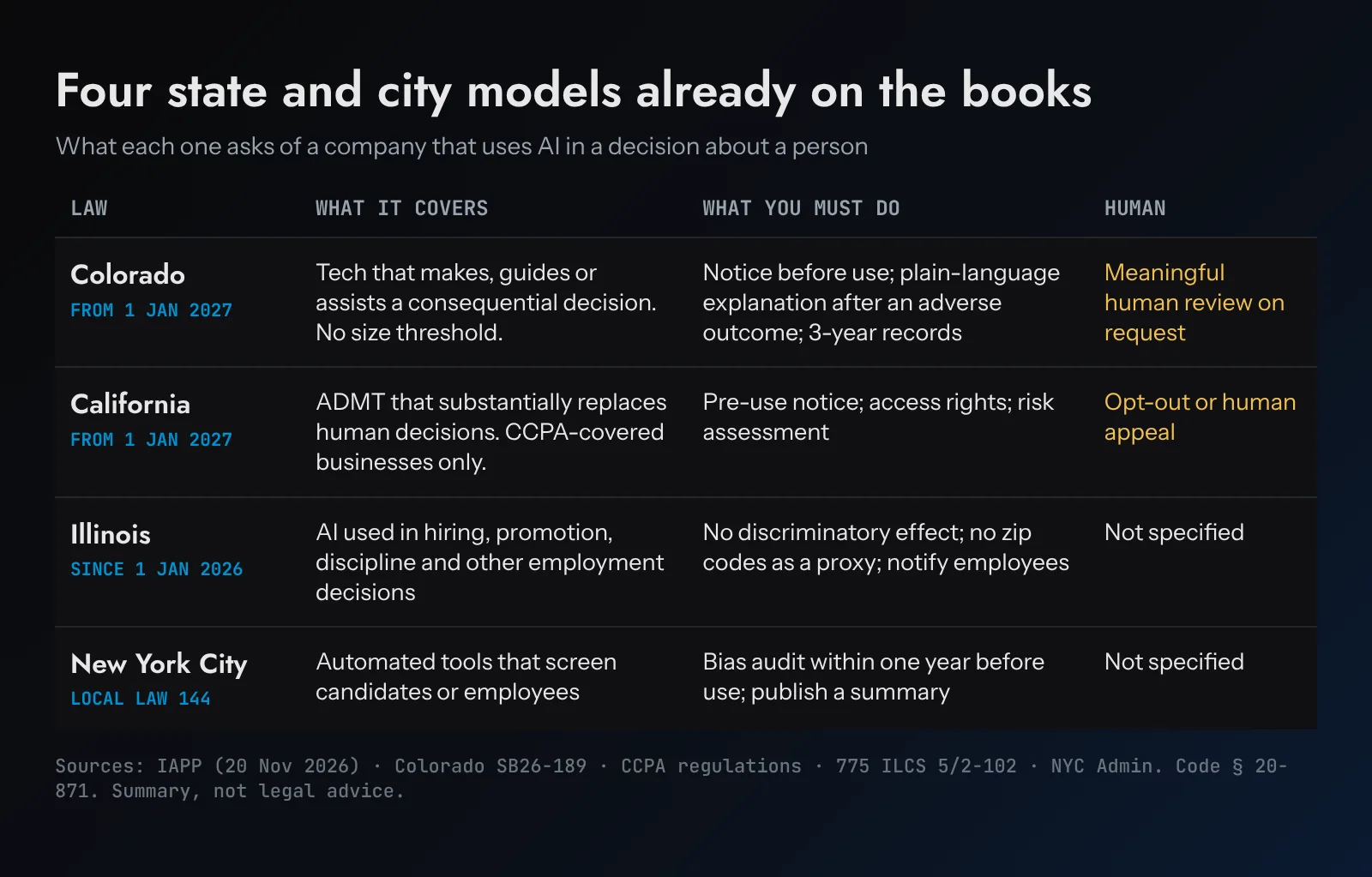
Goodwin partner Omer Tene told IAPP to expect momentum for AI rules "focused on safety and automated decision-making, drawing on the regulatory models emerging from blue states like California, Colorado, Illinois and New York." Those models are worth knowing, because federal bills tend to copy them.
Colorado: rewritten, narrower, from 1 January 2027
Colorado's original AI Act (SB 24-205) was never implemented. SB 26-189 repealed and replaced it, moving the start to 1 January 2027 and dropping the risk-management programme, impact assessments and duty of care.
What remains, as IAPP's 20 November analysis sets out:
- It covers technology that processes personal data and whose output is used to "make, guide or assist" a consequential decision about a person. A tool does not have to decide anything by itself to count.
- There is no company-size threshold.
- You must give a clear notice before use. After an adverse outcome, you owe a plain-language explanation of the role the tool played, a way to correct inaccurate data, and "meaningful human review" where commercially reasonable.
- Developers must hand deployers a documentation packet, and both keep records for three years.
Two caveats. The attorney general must adopt rules by 1 January 2027 and only drafts were public as of 20 November. And a court order in xAI's lawsuit bars enforcement of the old act "or any legislation replacing or amending it" for now, so enforceability is uncertain until the final rules land. Uncertain is not the same as gone.
California: ADMT rules under the CCPA, from 1 January 2027
California's finalised CCPA regulations apply to a business that uses automated decision-making technology to make a "significant decision" about a consumer. They only reach CCPA-covered businesses: roughly USD 28 million in annual revenue (the 2027 figure is not yet published), or personal information of 100,000 or more consumers or households a year, or half of revenue from selling or sharing data.
The bar is "substantially replaces human decision-making". A tool escapes that if a human who knows how to read the output actually reviews it and has authority to change the decision. If you are in scope, you need a pre-use notice, an access right, an opt-out or a human appeal, and a risk assessment. For uses already running, the assessment must be documented by 31 December 2027 (IAPP).
Illinois: AI in employment, since 1 January 2026
Public Act 103-0804 amended the Illinois Human Rights Act. It is a civil rights violation for an employer to use AI that has the effect of discriminating on protected characteristics, to use zip codes as a proxy for them, or to fail to tell employees it is using AI for these decisions. The bill record confirms the 1 January 2026 effective date.
New York City: bias audits for hiring tools
Under NYC Administrative Code § 20-871 (Local Law 144), an employer may not use an automated employment decision tool to screen candidates or employees unless it has had a bias audit within the past year and a summary of the results is public. A New York State Comptroller audit examined how the city enforces it and told the city agency it is "responsible for fully enforcing LL144". Expect enforcement to tighten, not loosen.
Does AI pricing count as a regulated AI decision?
Not under the hiring and credit rules above, mostly. Colorado's law does reach a decision about "differentiated price" or other material terms if it is reasonably likely to limit access to a covered area, such as credit or insurance. Ordinary product pricing is a different, faster-moving fight.
According to IAPP's report on personalised pricing, the FTC in August 2026 proposed an enforcement policy saying personalised pricing without adequate disclosure "likely violates Section 5". On 29 October it ordered nine companies (Delta, United, JetBlue, Lyft, Uber, DoorDash, Instacart, Target and Walmart) to explain how personal data and AI set prices and pay. Connecticut, Maryland, New Jersey and New York have acted on it, and Seattle approved a measure restricting grocers from using personal data to set individual prices.
For a retailer, the line to watch is simple. Prices that move with demand, stock or time of day are one thing. Prices that move with who the shopper is are what regulators and Congress are asking about.
Which AI tools in retail and manufacturing are most exposed?
Here is our reading of where common tools sit. It is a starting point for your counsel, not a ruling.
| AI use | Decision about a person? | Likely exposure in 2027 |
|---|---|---|
| Résumé screening, interview scoring | Yes, employment | High: Colorado, California, Illinois, NYC |
| Promotion, discipline, termination aids | Yes, employment | High: Colorado, Illinois, California |
| Store credit or B2C financing approvals | Yes, credit | High: Colorado, California (plus existing lending law) |
| Personalised pricing using shopper data | Sometimes | Rising: FTC, state pricing laws, Colorado if access-limiting |
| Customer service chatbot | Usually no | Low for ADMT; disclosure and accuracy still matter |
| Demand forecasting, stock, routing | No | Low for ADMT; cyber and agent-liability bills apply |
| Machine vision quality inspection | No (about parts) | Low for ADMT |
The pattern: rules follow the person. A tool that decides about pallets is mostly out of scope. A tool that decides about people needs a human with real authority over it.
What should you do before 1 January 2027?
Six steps. Most companies can do the first three in a fortnight.
1. Build the AI inventory
List every tool that uses AI, including features switched on inside software you already pay for: the applicant tracking system, the e-commerce platform, the CRM. Note the vendor, the data it uses and who owns it. Our AI governance framework for a mid-size company has a one-page template, and the shadow AI guide covers the tools nobody signed up for officially.
2. Run the scope test on each one
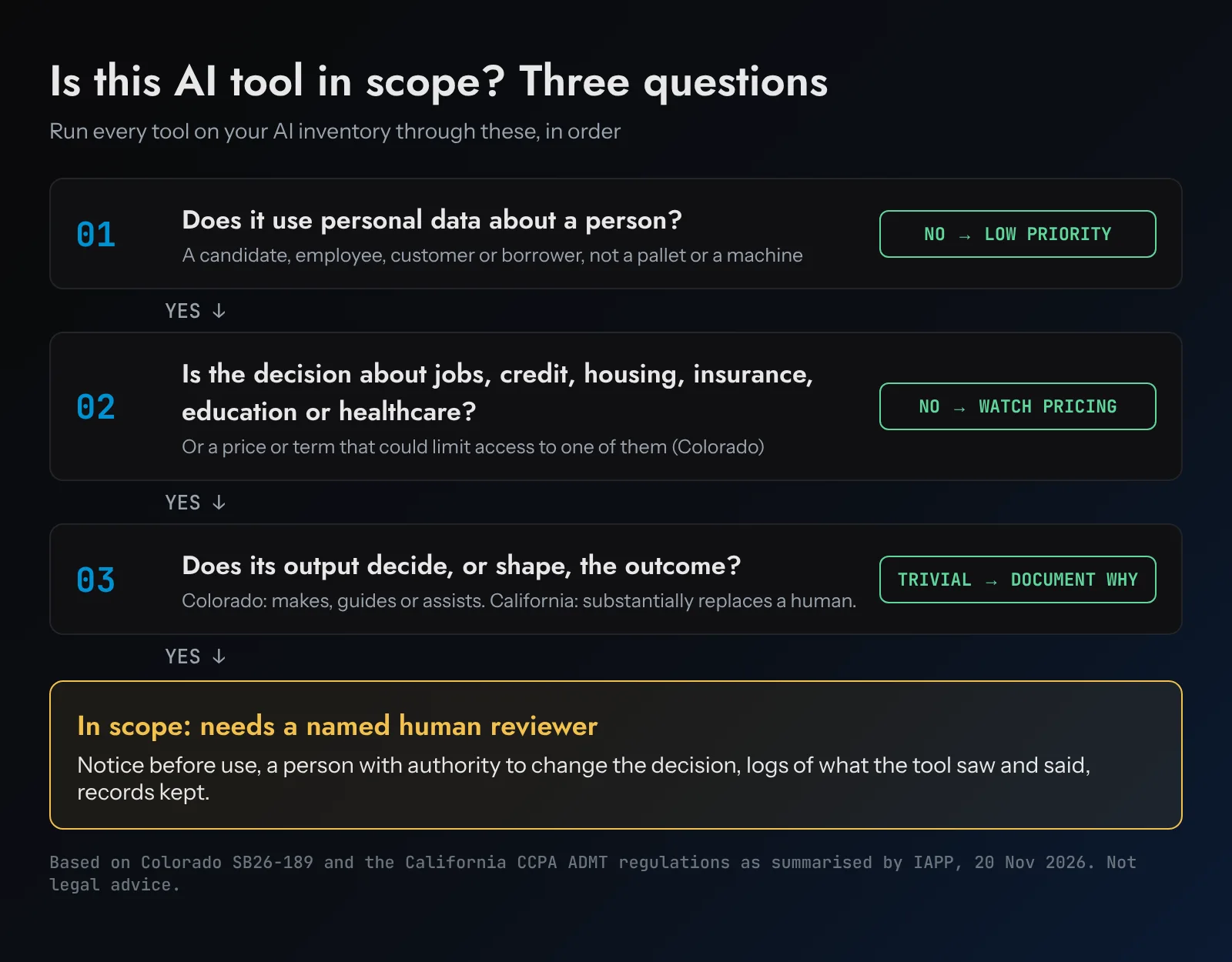
Use the three questions in the graphic above. Write down the answer and the reason, including for tools you judge out of scope. A one-line note made in December beats a reconstruction made after a complaint.
3. Name a human reviewer with real authority
Colorado's definition of "meaningful" review is a useful bar everywhere: a designated, trained person who considers the evidence, has authority to approve, change or override, and does not default to the system's output. California's human-involvement test is similar. If your reviewer rubber-stamps 400 rankings an hour, you do not have one. Our guide to human-in-the-loop AI agents shows how to design approvals people actually read.
4. Log what the tool saw and said
You cannot explain an adverse decision, answer an access request or defend a bias claim without a record of the inputs, the output, who reviewed it and what they decided. Colorado asks for three years of records. See what a useful AI audit trail contains.
5. Write the notices and the appeal route
Draft a pre-use notice for applicants and customers where a covered tool is used, and a short, plain-language adverse-outcome explanation. Decide who handles appeals and how fast.
6. Ask your vendors for their packet
Colorado developers owe deployers documentation on intended uses, known limitations, training data categories and how to run human review. Ask for it now, in writing. If a vendor cannot say what data drives its scores or prices, that is your answer.
Where does governed automation fit?
The rules converge on one idea: AI may help, but a named person stays accountable, and you can prove it. That is how we build agents at Devs Core. Reads run freely, anything that changes a system of record waits for a named approver, and every step is logged. We wrote up how those controls are built in and tested, and the same logging and oversight logic maps to the EU AI Act's requirements if you also sell in Europe.
If you want a second pair of eyes, our AI Readiness Audit is two weeks at a fixed $2,400. It maps where AI already sits in your systems and which uses touch people, and ends in a written plan. It is not a legal opinion; take the plan to your counsel.
Dana, by the way, found that the résumé screener was the only tool that clearly needed work. That took a week, not a year.
Frequently asked questions
Will a Democratic Congress pass a federal AI law in 2027?
Probably not a sweeping one quickly. Democrats control both chambers from January 2027, but any bill needs the President's signature or a veto-proof majority. Expect hearings, investigations and narrower bipartisan bills, for example on AI agent security and cyber incidents.
When does the Colorado AI law take effect?
Colorado's rewritten law, SB 26-189, takes effect on 1 January 2027. It requires notice, explanations after adverse outcomes and meaningful human review for automated tools used in consequential decisions. Its enforceability depends on final attorney general rules and a pending xAI lawsuit, so check the status with counsel in January.
Do California's ADMT rules apply to my company?
Only if you are a CCPA-covered business, roughly USD 28 million in annual revenue or personal information of 100,000 or more consumers or households a year, and you use automated technology to make a significant decision about someone. If a trained human genuinely reviews the output and can change the decision, the tool may fall outside the definition.
Is it legal to use AI to screen job applicants?
Yes, with conditions. In Illinois the AI must not have a discriminatory effect, zip codes cannot be used as a proxy, and employees must be told. In New York City the tool needs a bias audit within the past year with a public summary. From 2027, Colorado and California add notice and human review duties.
Does the Trump executive order cancel state AI laws?
No. The December 2025 order directs the Justice Department to challenge state AI laws in court, but experts quoted by NPR doubt an executive order can pre-empt state law without Congress. Until a court or Congress says otherwise, plan as if the state laws apply.
What is the first step to prepare for AI regulation in 2027?
Make an inventory of every AI tool you use, including AI features inside existing software, and mark which ones make or shape decisions about people. That list tells you where you need notices, a human reviewer and logs, and where you can stop worrying.