
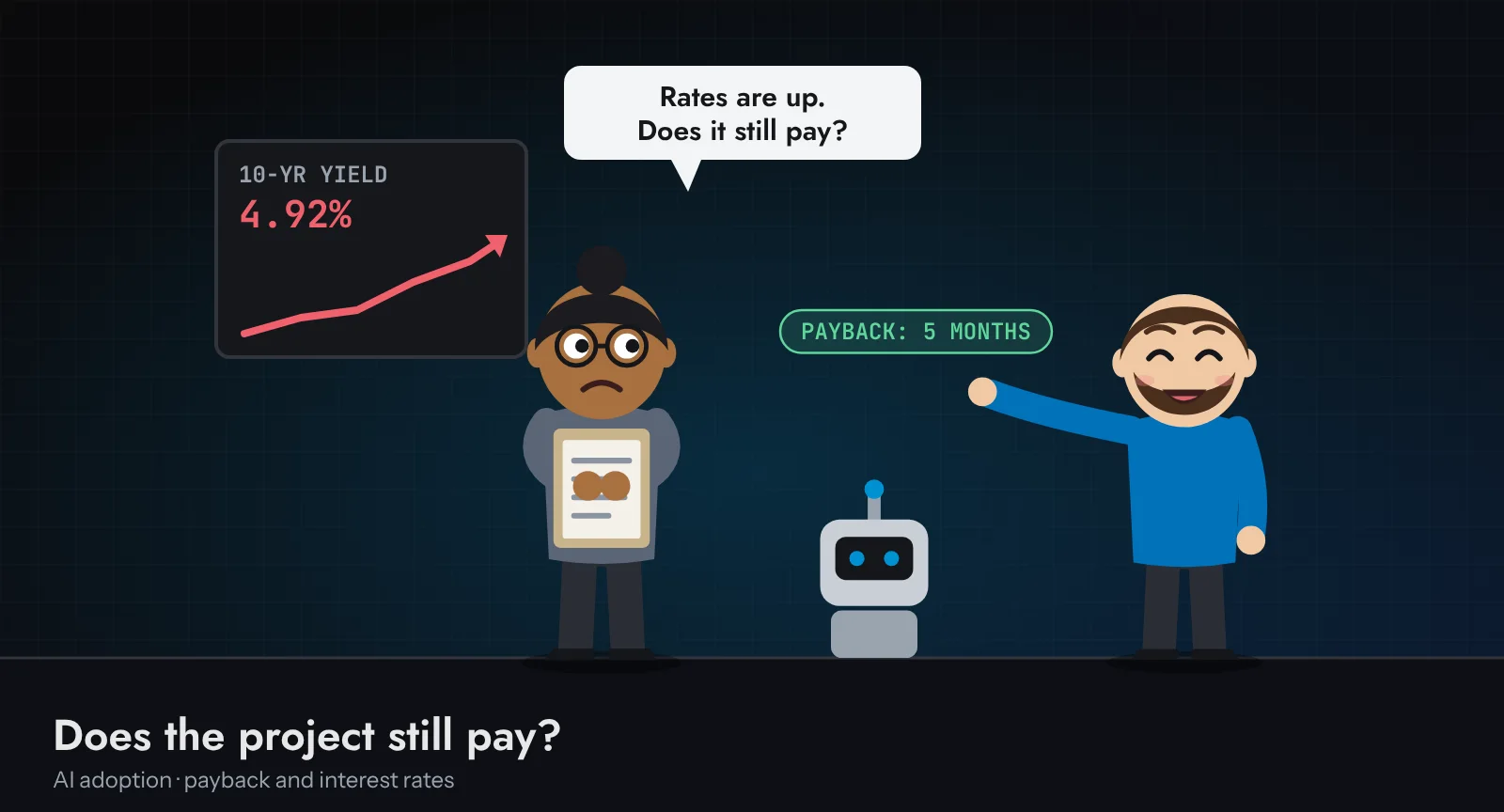
Call her Priya. She is made up, but her week is not unusual. She is the finance director of a 400-person distributor, and on Friday she had an AI project on her desk for sign-off: an agent to handle order exceptions in the ERP. That same afternoon gold had its worst week in eight months, US stock futures fell after Anthropic's IPO failed to restore faith in the AI trade, and markets priced a 96% chance of another Fed rate hike in December. Her chief executive's question was short: "Should we wait?"
Rising interest rates change AI project payback far less than most owners fear: a project that pays back inside 12 months loses only a few per cent of its value when your cost of capital rises four points, while long-payback, capital-heavy projects such as robot fleets lose two to three times as much. The question that decides the project is not the rate. It is whether the savings are real.
Key takeaways
- Futures markets priced a 96% chance of a quarter-point Fed hike in December 2026, and the 10-year Treasury closed at 4.92% on 20 November.
- In our worked example, raising the discount rate from 8% to 12% cuts a fast-payback software agent's value by 8% but a robot fleet's by 18%.
- Deloitte's 2025 survey of 1,854 executives found most took two to four years to reach satisfactory ROI on a typical AI use case, and only 6% saw payback within a year.
- Waiting six months for cheaper money can cost far more in lost savings than the extra interest: about $34,000 against $1,200 in our example.
- The best protection against rates is a project structure that pays back fast at half the expected benefit, with most of the spend after proof.
What is happening to interest rates in November 2026?
Rates are going up again, and the market expects more. The Fed raised its key rate in September for the first time in three years, then held it at 3.9% in October. Minutes of that meeting, published on 18 November, show nearly all officials expect a quarter-point hike in December, and Fed policymaker Christopher Waller noted core inflation had run at about a 3.5% annual rate over the past three months, against a 2% target.
Expectations moved fast. On 10 November, Deloitte's economists reported an 85.3% probability of a December hike and a 56% probability of at least three more hikes before the end of 2027. By 20 November, Reuters put the December odds at 96%.
Long-term rates are high but jumpy. The same Deloitte update says the 10-year Treasury hit 5.3% in early October. On 20 November, as investors fled the AI stock sell-off, the 10-year yield fell 12 basis points to about 4.93%, closing at 4.92%.
For a mid-size business, the number that matters is what you pay to borrow. NerdWallet's November 2026 table shows bank small-business loans at 6.44% to 9.74%, SBA loans at 10% to 13.5% variable or 12% to 15% fixed, and equipment financing anywhere from 4% to 45% APR. The prime rate is 7.00%, unchanged after the October meeting.
BlackRock's investment team summed up the bigger picture on 16 November: companies building AI are competing with governments for funding, adding pressure on interest rates, and it has raised its longer-term rate expectations. In plain words: do not plan on money getting cheap again soon.
How do higher interest rates affect AI project payback?
Higher rates do two things to a project. They raise the cost of any money you borrow to pay for it. And they raise the return you should demand from it, because cash in the bank or paying down debt now earns more. Finance teams call that demanded return the discount rate or hurdle rate: the minimum yearly return a project must beat to be worth doing.
Two simple measures capture the effect:
- Simple payback is how many months of savings it takes to earn back what you spent. It ignores rates, which is both its strength and its weakness.
- Net present value (NPV) is the value of all future savings, shrunk to today's money at your discount rate, minus what you spend. If it is positive, the project beats your hurdle.
The key point is time. A rate rise shrinks distant money far more than next month's. So the longer a project takes to pay back, the more a rate rise hurts it. That is why the Bank for International Settlements warned in June of "the risk of firms over-committing resources to investment projects with still uncertain returns", and why it matters so much that Deloitte's 2025 survey found a typical AI use case took two to four years to reach satisfactory ROI, against the seven to 12 months normally expected of technology investments. Only 6% of respondents reported payback in under a year. That survey covered 1,854 executives in Europe and the Middle East, surveyed in August and September 2025, so treat it as a strong signal rather than a US benchmark.
Worked example: does a software agent still pay back at higher rates?
Here is the sum Priya could run, with every assumption labelled. Swap in your own numbers.
Assumptions for the software agent (order-exception handling):
- Upfront cost: $30,000 (assume this covers a readiness check, the build and connecting it to the ERP and email).
- Running cost: $12,000 a year (assume $1,000 a month for AI usage, hosting and support).
- Time saved: 2,000 staff hours a year at a loaded cost of $35 an hour = $70,000.
- Fewer errors: assume 40 fewer mis-shipments a year at $250 each = $10,000.
- Net benefit: $70,000 + $10,000 − $12,000 = $68,000 a year, counted over 3 years.
Simple payback: $68,000 ÷ 12 = about $5,667 a month. $30,000 ÷ $5,667 = about 5.3 months.
NPV over 3 years:
- At an 8% discount rate: $68,000 × 2.577 = $175,243, minus $30,000 = about $145,000.
- At a 12% discount rate: $68,000 × 2.402 = $163,325, minus $30,000 = about $133,000.
The 2.577 and 2.402 are the standard three-year annuity factors at 8% and 12%: the value today of $1 a year for three years. A four-point jump in the hurdle rate cuts this project's value by about 8%. It is still worth more than four times its cost.
Now be sceptical. Halve the benefit, so the agent only saves 1,000 hours and nothing else goes right. Net benefit falls to $28,000 a year. Payback stretches to about 12.9 months, and NPV is still positive at both rates (about $42,000 at 8% and $37,000 at 12%). That is the test we would want any project to pass before signing.
Is a robot or AMR fleet more exposed to rate rises than software?
Yes, because it costs more upfront and pays back over a longer period. Mesh Automation, an integrator, puts entry-level transport AMRs at $50,000 to $85,000 per unit in 2026, hardware only, with software, mapping, integration and training on top, and quotes payback of 18 to 24 months. Treat those as an integrator's figures, not an independent benchmark.
Assumptions for a five-robot fleet:
- Upfront: 5 AMRs at $65,000 (inside that range) plus an assumed $75,000 for integration = $400,000.
- Net benefit: assume $220,000 a year, counted over 5 years.
Simple payback: $400,000 ÷ ($220,000 ÷ 12) = about 22 months, in line with the integrator's claim.
NPV over 5 years: at 8%, $220,000 × 3.993 − $400,000 = about $478,000. At 12%, $220,000 × 3.605 − $400,000 = about $393,000. The same four-point rise wipes out about $85,000, or 18% of the value.
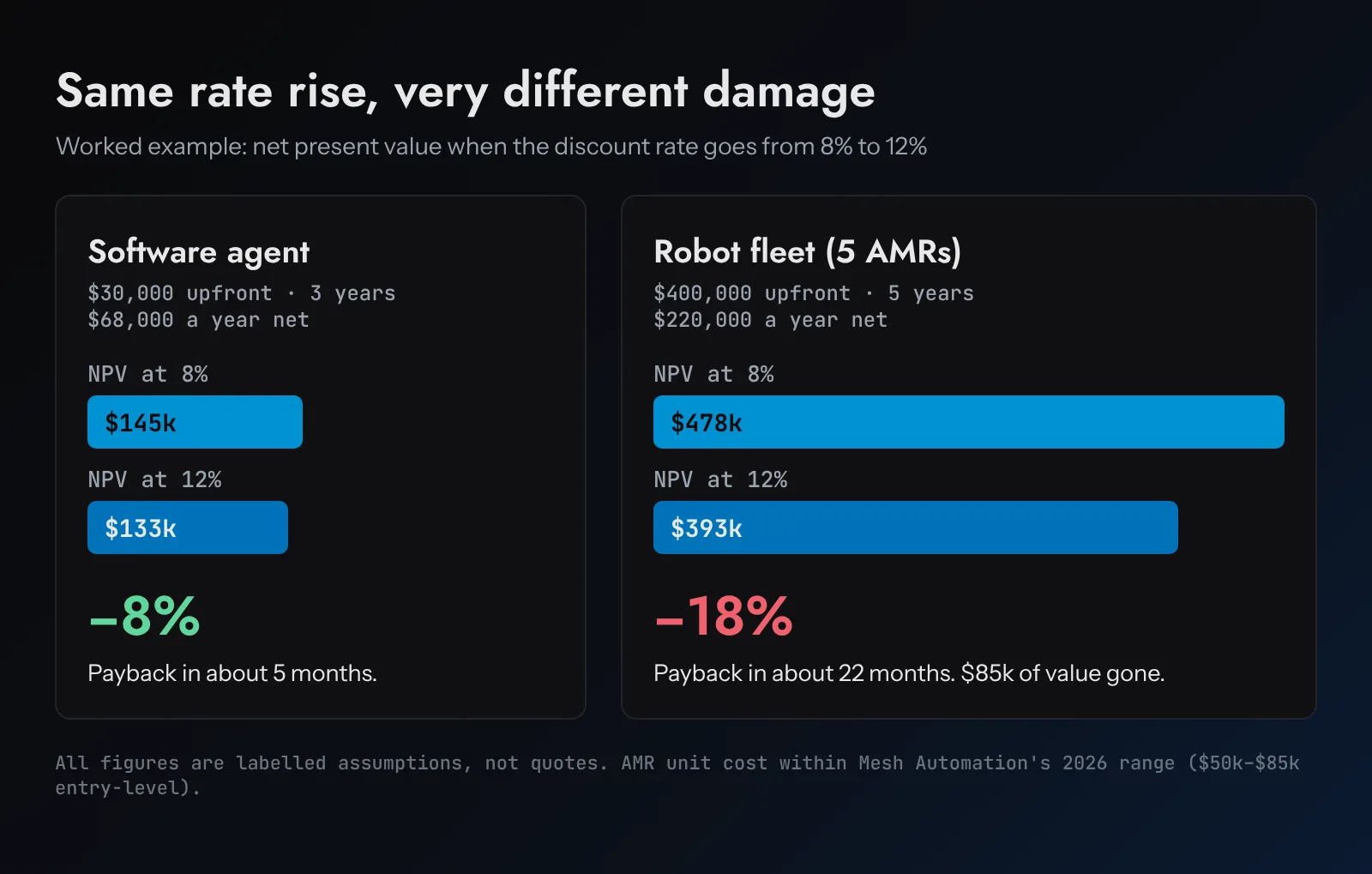
If the fleet is financed, the interest bill moves too. On $400,000, the gap between the bottom (6.44%) and top (9.74%) of NerdWallet's bank-loan range is about $13,200 a year. On a $30,000 software project, a four-point rise costs about $1,200 a year.
None of this says robots are a bad idea. A robot fleet can be the right answer for a high-volume warehouse. It says that when rates rise, capital-heavy projects need a harder look, and software that works inside the systems you already own needs much less.
| Software agent | AMR fleet | |
|---|---|---|
| Upfront (assumed) | $30,000 | $400,000 |
| Simple payback | about 5 months | about 22 months |
| NPV at 8% | about $145,000 | about $478,000 |
| NPV at 12% | about $133,000 | about $393,000 |
| Value lost to a 4-point rise | about 8% | about 18% |
| Can you stop and recover most of the spend? | Mostly sunk, but small | Resale possible, but large |
Should you pause AI projects until rates fall?
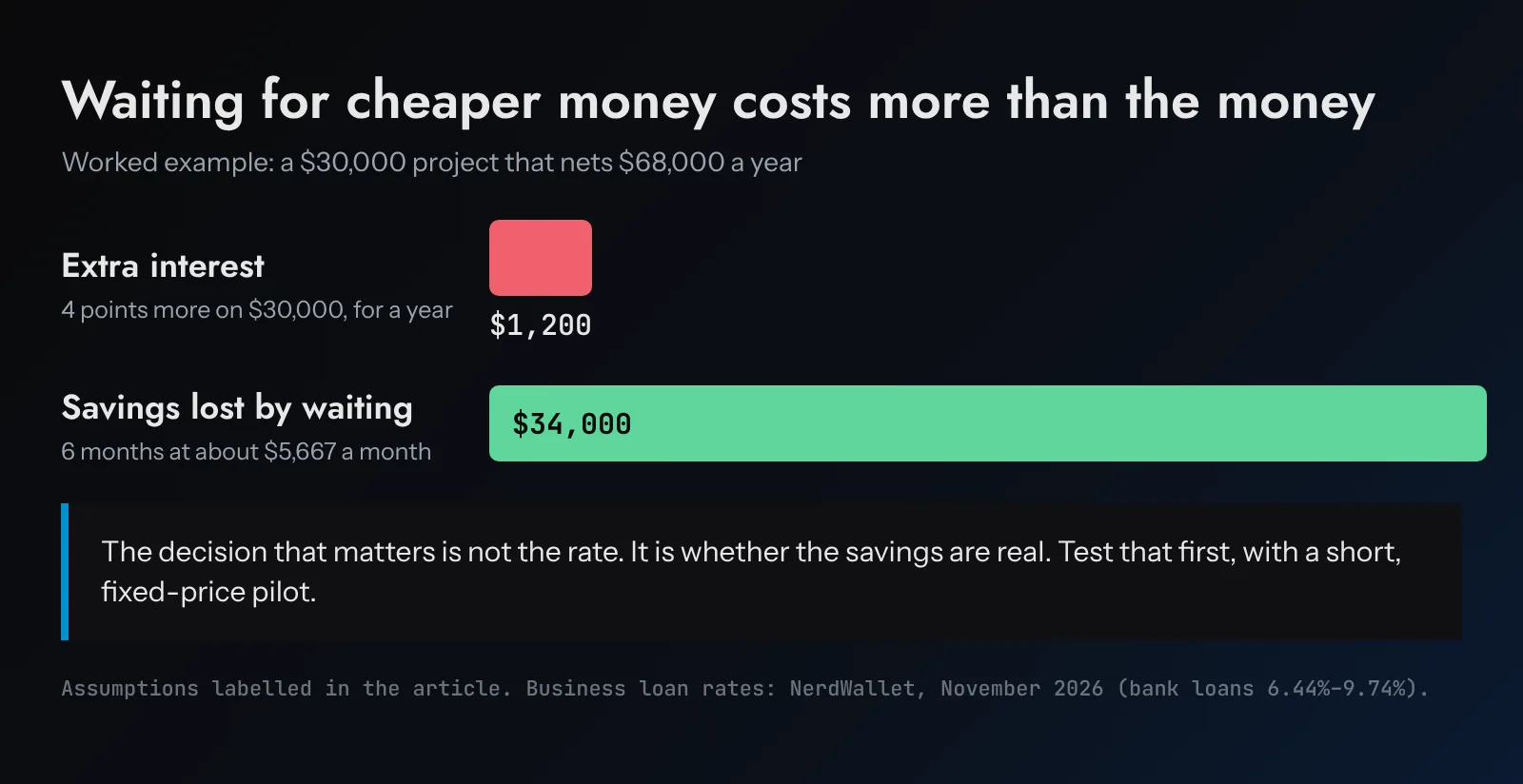
Usually not, if the project pays back fast. Waiting has a price of its own: the savings you do not collect while you wait.
In the software example, six months of delay forgoes about 6 × $5,667 = $34,000 of net savings. Borrowing the $30,000 at four points more for a year costs about $1,200. Waiting for cheaper money would cost nearly 30 times more than the money.
The picture flips for slow, expensive projects with uncertain benefits. That is exactly the kind of project Gartner expects to be cancelled: over 40% of agentic AI projects by the end of 2027, due to escalating costs, unclear business value or inadequate risk controls. We looked at the reasons in why agentic AI projects get cancelled. Pause those. Keep the fast ones.
How do you make an AI project rate-proof?
Use five questions. If a project passes all five, a rate rise barely matters.
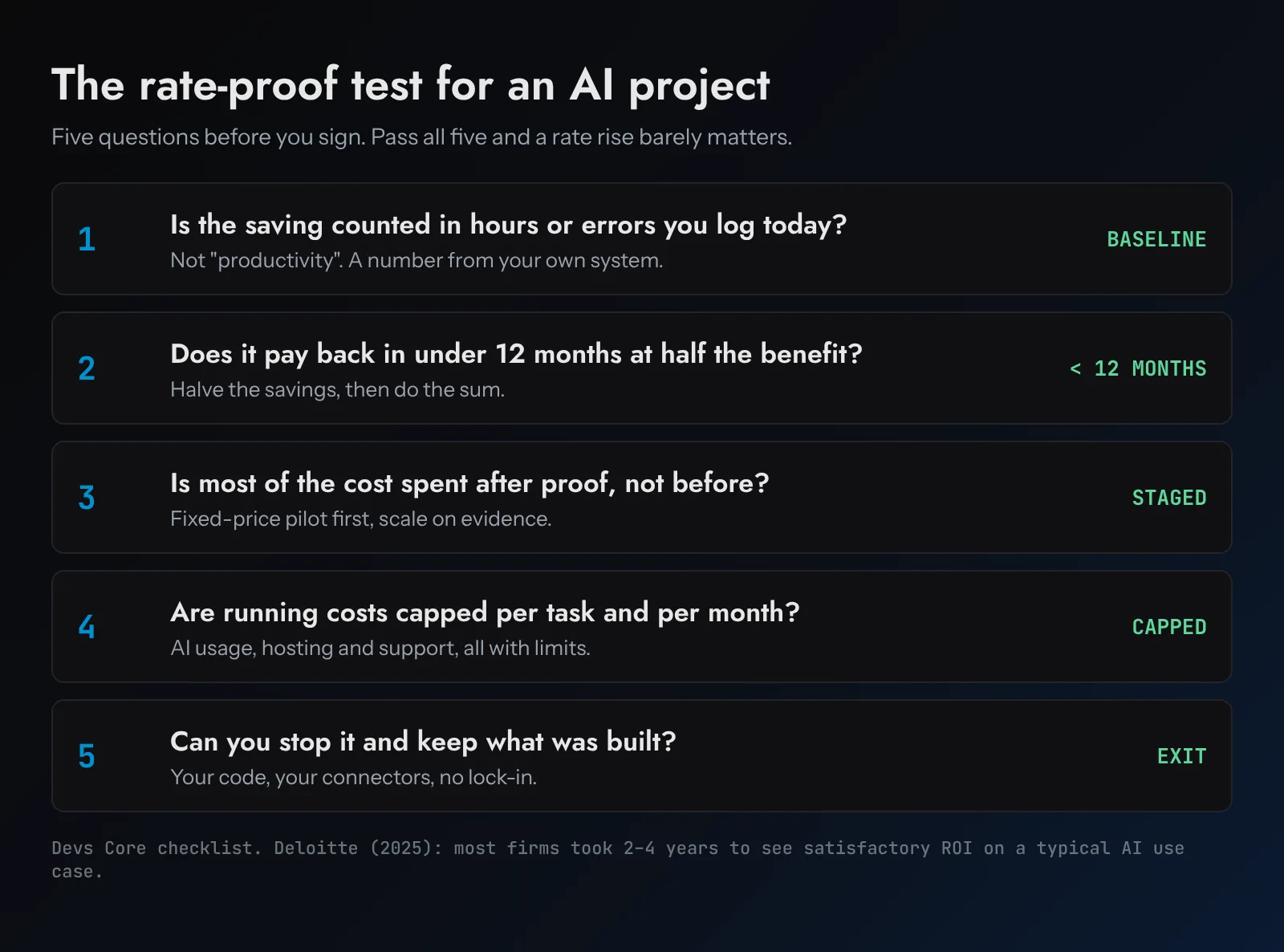
1. Is the saving counted in numbers you already log?
Hours spent on order exceptions, mis-picks per week, credit notes raised, invoices keyed by hand. Not "productivity". If you cannot pull the baseline from your own ERP, WMS or helpdesk today, you cannot prove the saving later.
2. Does it pay back in under 12 months at half the benefit?
Halve the savings in the business case, then do the sum. If it still pays back within a year, the project survives a bad forecast and a rate rise at the same time.
3. Is most of the money spent after proof?
Structure the spend in stages: a short check of where AI would sit in your systems, then a fixed-price pilot on one process, then scale. Our Agent Pilot is built this way, and our AI Readiness Audit is two weeks at a fixed $2,400 and ends in a written build plan, including when the honest answer is not to build yet.
4. Are running costs capped?
AI agents have a monthly bill: model usage, hosting, support. Ask for limits per task and per month, and a dashboard that shows cost per task. Our post on controlling AI agent costs with an AI gateway covers how. For context on what a well-scoped agent can cost to run, our own Ware warehouse demonstration used $0.76 of AI on its peak day (a demo we built, not a client result).
5. Can you stop and keep what was built?
Ask who owns the code, the connectors to your systems and the logs. If you can stop paying and keep the work, the downside of a bad year is small. That matters more when money is dear.
What should a CFO ask an AI vendor this month?
- What exactly will this save, in which system, measured how, from what baseline?
- What does it cost upfront and every month, and what are the hard caps?
- What is the payback if only half the benefit turns up?
- Which parts are fixed-price, and what triggers a change in price?
- Who approves any change the agent makes to our system of record? (The answer should be a named person on our side.)
- If we stop after the pilot, what do we keep?
A vendor who cannot answer these in writing is asking you to carry the risk, and higher rates make that risk more expensive. For a wider view of build and running costs, see our AI agent development cost guide for 2026.
What to do on Monday
- List the AI and automation projects on your desk, with upfront cost and expected yearly net benefit.
- Work out simple payback for each. Then halve the benefit and do it again.
- Run NPV at your real borrowing rate plus a few points. Use 8% and 12% if you have nothing better.
- Keep anything that pays back inside 12 months at half the benefit. Re-scope or pause anything that needs years and a large upfront cheque.
- For the keepers, get a fixed-price first stage in writing.
If you want a second pair of eyes on the sums, our process automation work starts from exactly this kind of baseline, and the AI Readiness Audit will tell you in two weeks which of your processes clears the bar, at today's rates.
Frequently asked questions
Will rising interest rates make AI projects too expensive?
Not for projects that pay back quickly. In our worked example, a four-point rise in the discount rate cut a five-month-payback software agent's value by about 8%. Long, capital-heavy projects are hit harder, about 18% for a robot fleet in the same example.
What is a good payback period for an AI project in 2026?
Aim for under 12 months even if only half the expected benefit turns up. Deloitte's 2025 survey found most executives took two to four years to reach satisfactory ROI on a typical AI use case, while technology investments are usually expected to pay back in seven to 12 months.
How do I calculate NPV for an automation project?
Estimate the yearly net saving after running costs, multiply it by the annuity factor for your discount rate and number of years, and subtract the upfront cost. For three years, the factor is about 2.577 at 8% and 2.402 at 12%. A positive result means the project beats your hurdle rate.
Should we wait for interest rates to fall before investing in AI?
Usually not for a fast-payback project, because the savings you give up while waiting are larger than the extra interest. In our example, six months of waiting forgoes about $34,000 of savings, while four extra points of interest on $30,000 costs about $1,200 a year.
Are AI software agents cheaper than warehouse robots?
Upfront, usually yes. Entry-level transport AMRs cost $50,000 to $85,000 per unit for hardware alone, according to integrator Mesh Automation, before integration. A software agent works inside the ERP, WMS or CRM you already run, so there is no hardware to buy, though it still has monthly running costs to cap.
What interest rate should we use to judge an AI project?
Use your actual cost of borrowing plus a margin for risk. In November 2026, NerdWallet lists bank small-business loans at 6.44% to 9.74% and SBA loans at 10% to 15%, so testing at both 8% and 12% is a sensible range for many mid-size firms.