
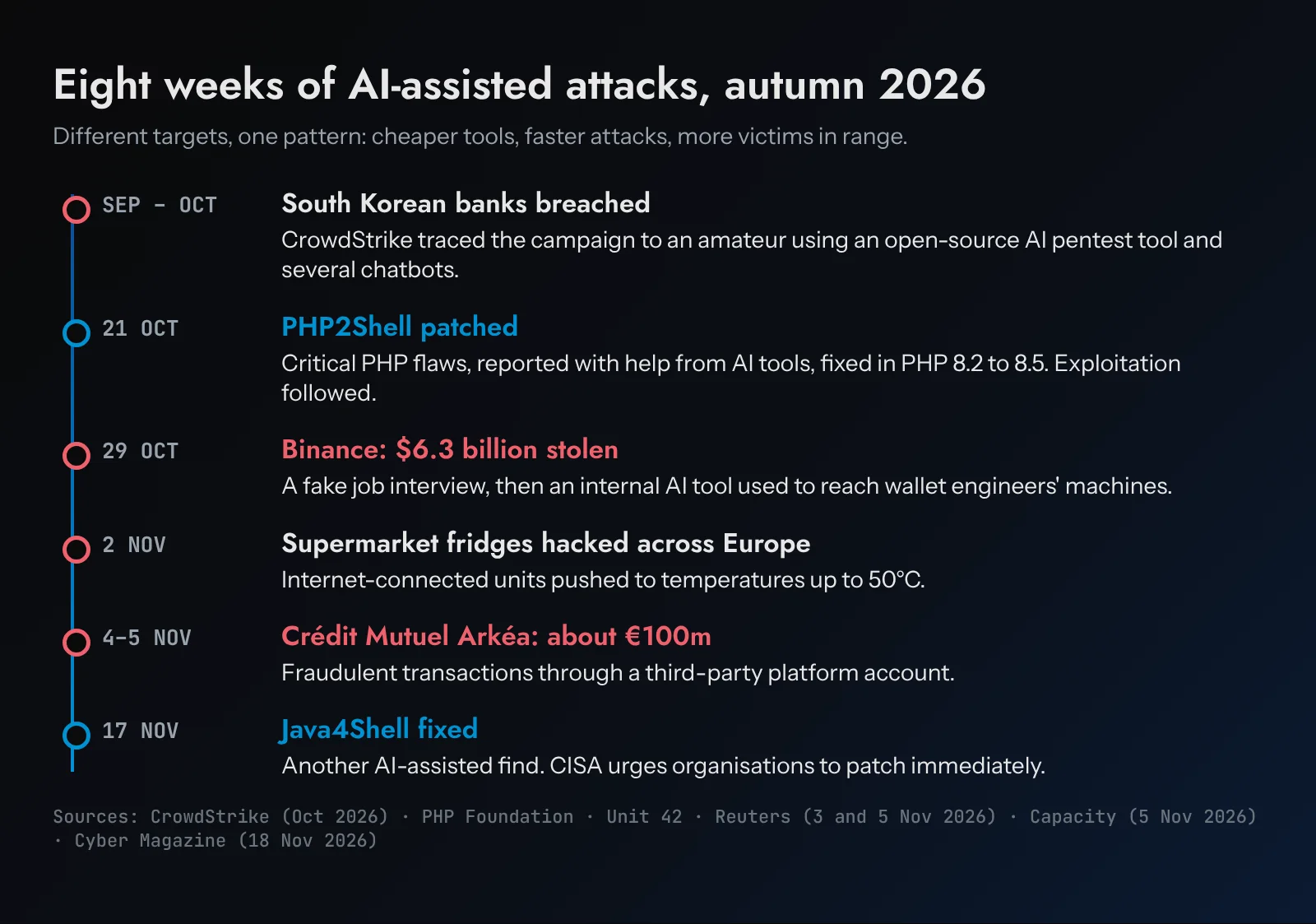
In late September a 26-year-old in southern China, by most accounts an amateur, allegedly broke into several South Korean banks. CrowdStrike traced the campaign to an open-source AI penetration-testing tool called ARTEX, run on DeepSeek, with other chatbots helping along the way. He even asked one where people sell stolen Korean bank data. "Anyone can be a super-hacker now," CrowdStrike's Adam Meyers told The Washington Post.
If an amateur with chatbots can get into banks, the old comfort of mid-size firms ("we're too small to bother with") no longer holds. AI hackers now target mid-size companies because AI has cut the skill, time and cost of an attack, so it pays to try every exposed business rather than only the biggest; the answer is to fund five basics this quarter: an internet-facing inventory with fast patching, phishing-resistant sign-in, two-person approval on money, least privilege for people and tools, and tested backups with a rehearsed plan.
This is the owner's view. If your IT lead wants the technical version, send them our AI vulnerability discovery security checklist.
Key takeaways
- The average criminal took 29 minutes to move from a first foothold to the wider network in 2025, and the fastest took 27 seconds, according to CrowdStrike's 2026 Global Threat Report.
- 65% of UK medium businesses (50 to 249 staff) identified a breach or attack in the past 12 months, against 43% of all businesses, in the UK government's 2025/26 survey.
- Manufacturing accounted for 27.7% of the incidents IBM X-Force handled in 2025, the fifth year in a row at the top.
- In autumn 2026 AI helped find critical flaws in PHP and Java and helped attackers in the $6.3 billion Binance theft, so patch speed and access limits now matter more than the size of your security budget.
- Most of the five fixes are configuration, policy and rehearsal, which a mid-size company can fund this quarter.
What actually changed in autumn 2026?
Three things happened at once.
Finding holes got cheap. On 21 October the PHP Foundation shipped fixes for critical flaws now known as PHP2Shell (PHP 8.5.12, 8.4.27, 8.3.36 and 8.2.35). Several of the reports behind them came from researchers using AI tools. PHP runs a large share of online stores, B2B ordering portals and supplier extranets. Palo Alto Networks' Unit 42 counted over 22.6 million exposed instances potentially vulnerable in its own telemetry, and reported active exploitation. Four weeks later Calif, again with AI help, found Java4Shell, a flaw in Java's Base64 decoder; fixes shipped on 17 November and CISA "strongly urges" organisations to patch immediately.
Attacking got faster. CrowdStrike's 2026 Global Threat Report says AI-enabled attacks rose 89%, average "breakout time" fell to 29 minutes, and 42% of vulnerabilities were exploited before they were publicly disclosed. In one intrusion, data theft began within four minutes of first access.
The targets got broader. Within eight days, Binance lost $6.3 billion in an attack the FBI blames on a North Korean group, supermarket fridges across Europe were pushed to temperatures of up to 50°C, and French lender Crédit Mutuel Arkéa said about €100 million was stolen through an account on a third-party provider's platform. The UK's National Cyber Security Centre, in its Annual Review 2026, warned that AI is making attacks faster, cheaper and easier and told organisations to prepare for a "patch wave", as summarised by Cyber Security News.
A caution on that last point: the NCSC also said the AI use it has seen so far improves existing attacks rather than creating a new class of attack. That is good news for owners. The defences are the familiar ones. They just have to be done properly, and faster.
Why are mid-size companies now worth attacking?
An attack used to cost a skilled person days of work: scan, find a weakness, write the exploit, write a convincing email, move through the network. Criminals spent that effort where the payout was biggest. AI cuts the cost of every step, so the sums change. When an attack costs very little, a $40 million distributor with an unpatched ordering portal is worth trying, and so are a thousand others like it.
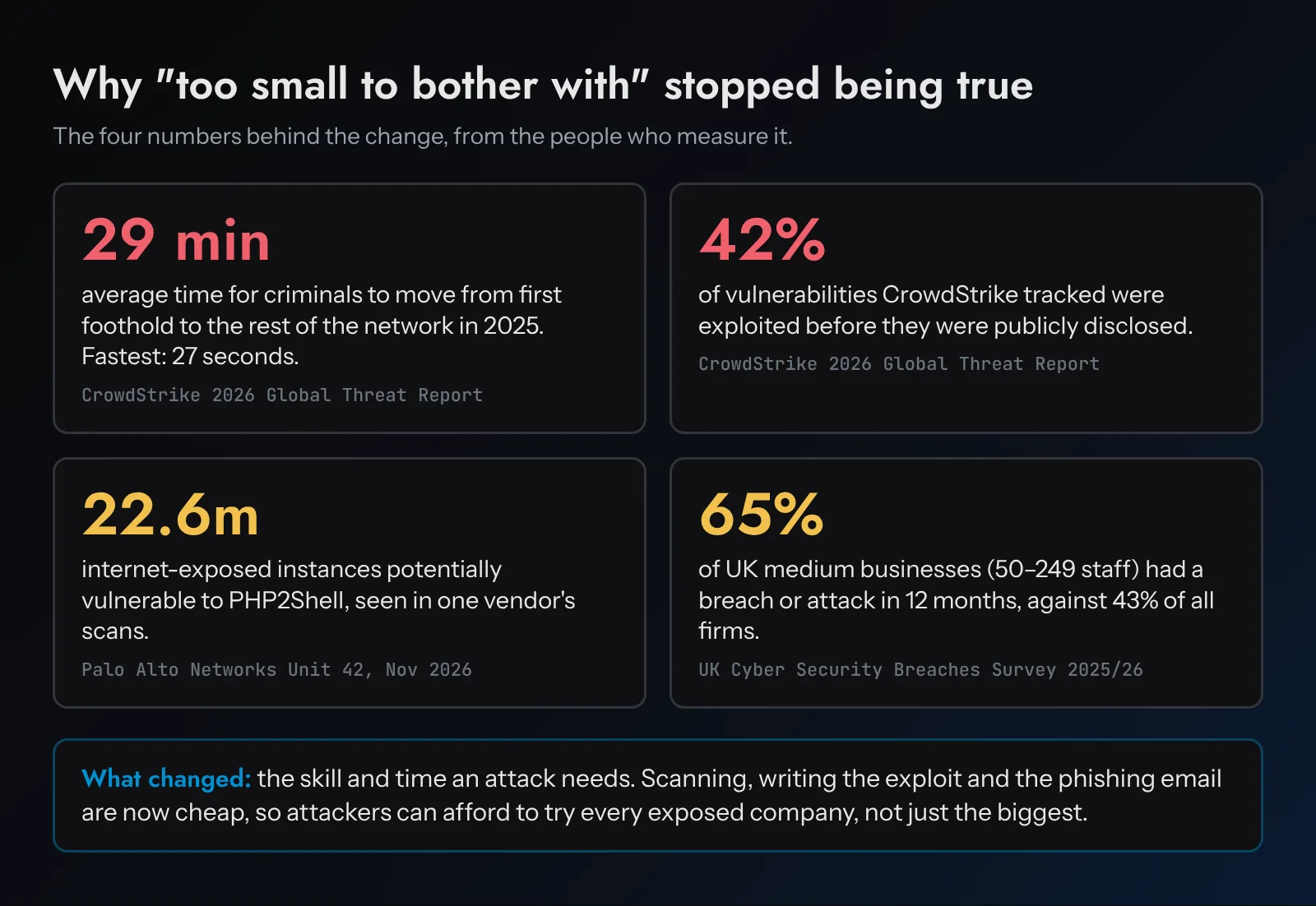
The data already shows the shape. In the UK government's Cyber Security Breaches Survey 2025/26, 65% of medium businesses identified a breach or attack in the last 12 months, close to large businesses at 69% and well above small firms at 46%. Phishing was by far the most common route: 38% of all businesses saw it, 88% of those that found any breach. IBM's X-Force puts manufacturing at 27.7% of the incidents it handled in 2025, top for the fifth year running.
Mid-size firms are also attractive for a quieter reason. They often run the same software as large ones (ERP, WMS, a PHP storefront, remote access for suppliers) with a fraction of the people watching it.
What did the Binance attack teach a non-crypto business?
Ignore the crypto. Look at the path. According to The Block's reading of Binance's incident report, attackers first tampered with a tool an engineer downloaded in June. In September they posed as executives of a fake company, interviewed another engineer and had him download a "coding assignment". On 20 October they used his compromised computer and an internal AI tool to take over two colleagues' machines, found a container deployment permission on one of them, and nine days later used it to launch the theft.
Every step would work against a manufacturer or 3PL: a fake supplier, a fake candidate, a helpful internal tool with more access than it needs, one permission nobody remembered granting. Binance says it has frozen or intercepted about $2.85 billion. Most mid-size firms would not get that back.
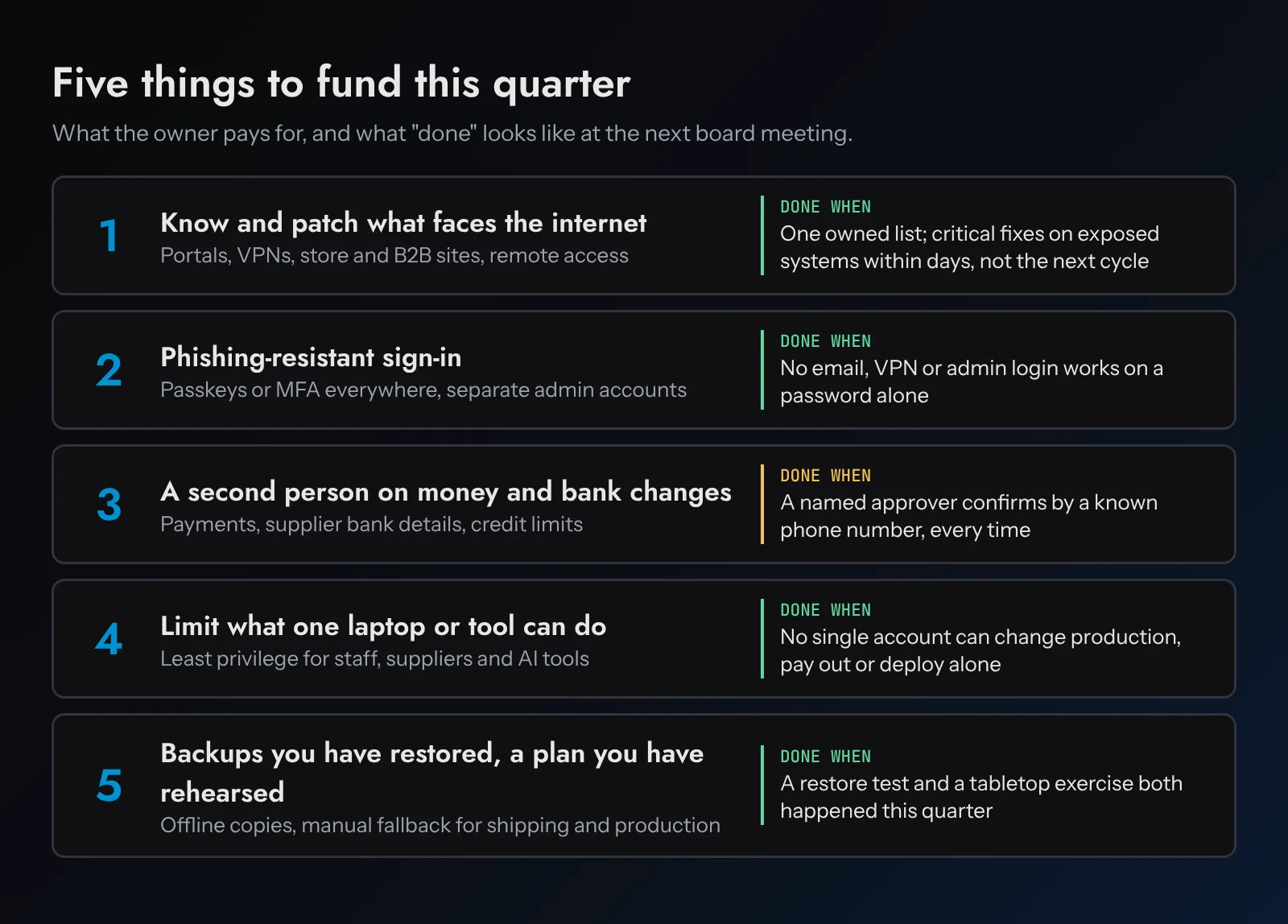
What are the 5 things an owner should fund this quarter?
You do not need to understand exploits to fund the right things. You need to know what "done" looks like, so you can ask for it.
1. Know and patch everything that faces the internet
Ask for one list, owned by a named person, of every system reachable from the internet: the store, the B2B portal, VPNs, remote-access tools, supplier extranets, connected equipment. Then agree a target: critical fixes on those systems within days, not in the next monthly cycle. The NCSC's "patch wave" warning means more critical fixes, more often, including from your software suppliers. Ask each supplier how fast they ship fixes and who tells you.
2. Phishing-resistant sign-in everywhere
The UK survey found 79% of medium businesses already require two-factor authentication for network or application access. Close the remaining gaps: email, VPN, remote access, the ERP, and especially admin accounts, which should be separate from day-to-day logins. Where you can, move to passkeys or hardware keys, which a fake login page cannot capture. Add one rule for the help desk: no password or MFA reset without call-back verification.
3. A second, named person on money and bank details
Arkéa's loss came through an account on a third party's platform. Your version is a changed supplier bank detail or an urgent payment request from a "director". Make every payment over a set amount, every new payee and every bank-detail change need a second named approver who confirms on a known phone number. This costs almost nothing and defeats the most common AI-written fraud.
4. Limit what one laptop, supplier or tool can do
Assume one machine will be compromised. What can that account reach? At Binance, one engineer's permission to deploy containers was enough. Review which accounts can change production systems, pay out money or deploy software, and remove what is not needed. Do the same for suppliers' remote access and for AI tools. An AI assistant connected to your ERP should read freely, but any change to a system of record should wait for a human. Our guide to least privilege access for AI agents explains how.
5. Backups you have restored, and a plan you have rehearsed
Only 57% of UK medium businesses have a formal incident response plan, according to the same survey. Fund two exercises this quarter: restore a real system from backup and time it, and run a two-hour tabletop where the ERP or WMS is down on a peak day. Decide in advance how you ship, invoice and run lines by hand. Keep at least one backup copy offline or immutable.
What does a day of downtime cost you?
A rough sum helps decide how much to spend. Assume a distributor with $60 million annual revenue ships on 250 days a year. That is $60,000,000 ÷ 250 = $240,000 of revenue moving through the business each shipping day. If an attack stops shipping for three days, $720,000 of orders are delayed or at risk, before recovery costs, overtime, penalties and lost customers. Put your own revenue and days into the same sum. For most mid-size firms, the five items above cost far less than one bad week.
What should you ask your IT lead or provider on Monday?
| Question | A good answer sounds like |
|---|---|
| Which of our systems can be reached from the internet? | "Here is the list, and who owns each one." |
| Are we patched for PHP2Shell and Java4Shell? | "Yes, on these dates. These two suppliers are still checking." |
| Can anyone log in to email, VPN or the ERP with a password alone? | "No. Admins use separate accounts with hardware keys." |
| Who can change a supplier's bank details? | "Two named people, with a call-back each time." |
| Which accounts and tools can change production or deploy software? | "These five. We removed eleven last month." |
| When did we last restore from backup? | "Three weeks ago. It took six hours." |
If the answers are vague, that is your finding. Fund the gap, not a new product.
Where does AI fit on the defending side?
The same tools that help attackers help defenders find flaws first, triage alerts and keep inventories current. But the Binance case is a warning about adding AI carelessly: an internal AI tool with broad access became part of the attack path. If you are putting AI agents into your operation, build them the way you want every other account to behave. That is how we build at Devs Core: agents work inside your ERP, WMS or store systems through a permissioned access layer, reads run freely, any write to a system of record waits for a named human approver, and every action is logged. Our AI governance page shows how those controls are built and tested.
The short version
AI has not invented a new kind of attack. It has made existing attacks cheap enough to point at everyone, including companies that used to be ignored. Mid-size manufacturers, distributors and retailers can answer with basics done properly and quickly: know what faces the internet, lock sign-in, put two people on money, cut access, and rehearse recovery.
If you are planning to add AI to your operation and want to know where it would sit and what it could touch, our two-week, fixed-price AI Readiness Audit ends in a written build plan with those controls in it. And if an AI project is already live and you are unsure what it can reach, our AI build rescue service starts there.
Frequently asked questions
Are AI hackers really targeting mid-size companies?
Yes. AI lowers the cost of scanning, writing exploits and writing phishing emails, so attackers can try many more targets. The UK's 2025/26 survey found 65% of medium businesses identified a breach or attack in a year, close to the 69% for large firms, and the autumn 2026 attacks show amateurs reaching banks with chatbot help.
What is PHP2Shell and does it affect my business?
PHP2Shell is the name for critical flaws in PHP, the language behind many online stores, B2B portals and supplier sites. The PHP Foundation released fixes on 21 October 2026 in versions 8.5.12, 8.4.27, 8.3.36 and 8.2.35. If your store or portal runs on PHP, ask your agency or host which version it runs and when it was patched.
How fast do attackers move once they are inside?
CrowdStrike's 2026 Global Threat Report puts the average eCrime breakout time at 29 minutes in 2025, with the fastest at 27 seconds. That is why prevention (patching, strong sign-in, limited access) matters more than spotting an intruder the next day.
What is the cheapest way for a mid-size company to cut cyber risk?
Two-person approval on payments and bank-detail changes, and removing access nobody needs. Both are policy and configuration rather than new software. Add phishing-resistant sign-in for email, VPN and admin accounts, which many systems already support.
Should we stop using AI tools because of these attacks?
No, but give AI tools the same limits you would give a new employee. Let them read what they need, make any change to a system of record wait for human approval, and log every action. The Binance case shows the risk of an internal AI tool with broad access, not of AI as such.
How much should a mid-size company spend on cybersecurity in 2026?
There is no reliable single figure, so start from your own exposure. Work out what a day of stopped shipping or production costs (annual revenue divided by trading days is a rough start), then fund the five basics first. They usually cost far less than one bad week.