
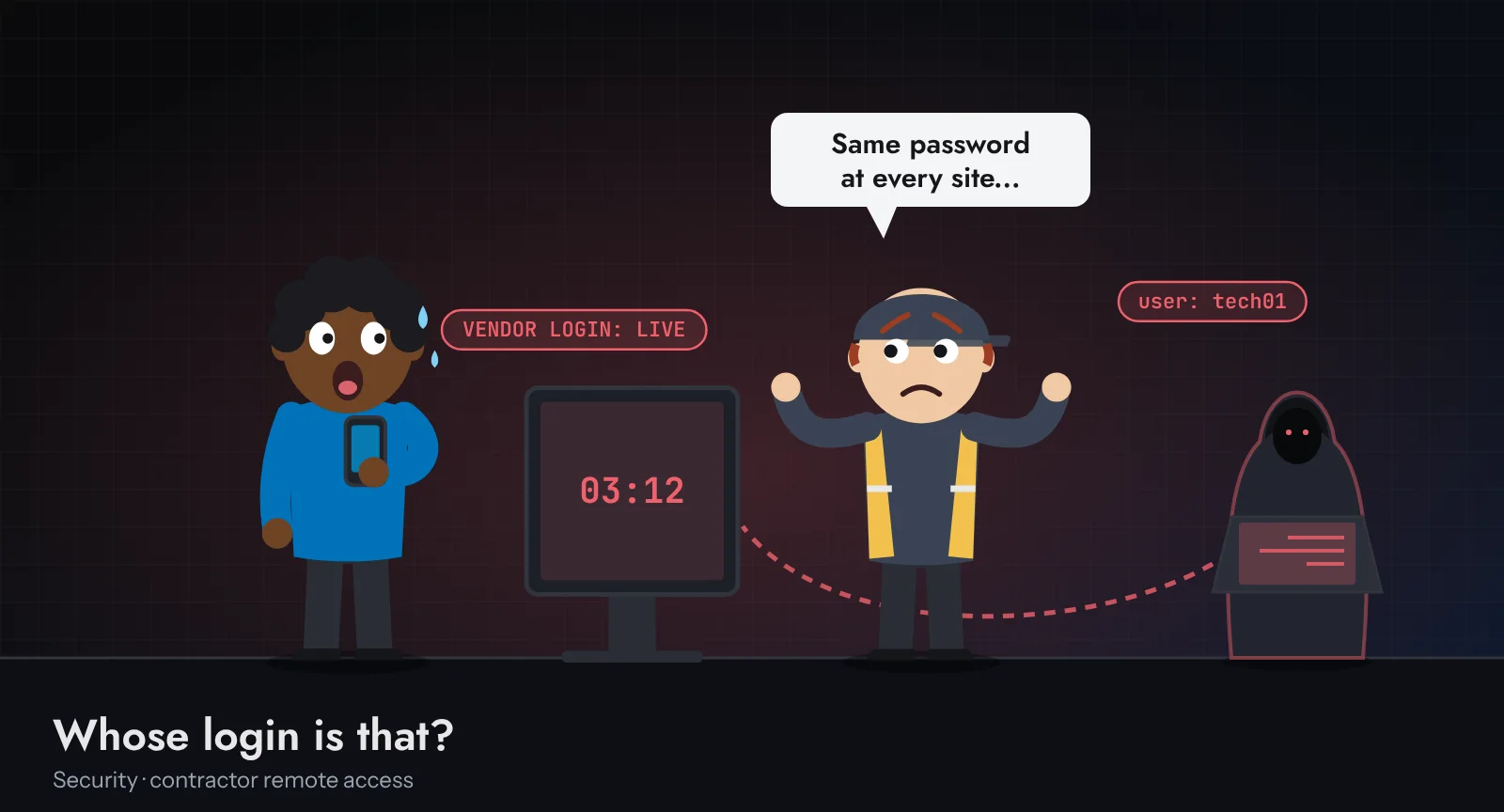
On the night of 1 to 2 November, someone changed the settings on cold rooms holding blood products for France's national blood service, the Établissement français du sang (EFS). Chambers that run at around −30°C were given a new target of 110°C. The attackers never touched the EFS network. They came in through Coolworld, the refrigeration company that maintains the storage containers. An on-call technician spotted temperatures rising, staff moved the products, and nothing was lost. Coolworld said only a limited number of its units were affected.
It worked out because someone was awake. The door the attackers used is one almost every plant, store and warehouse has: a contractor's remote access.
Contractor remote access security means taking every vendor-managed device off the public internet, sending all third-party sessions through one gateway with named accounts and multi-factor sign-in, switching access on only for an approved job, recording each session, and limiting each contractor to the specific operations their job needs: grant operations, not logins.
Key takeaways
- In Verizon's 2026 Data Breach Investigations Report, 48% of breaches involved a third party, a 60% rise on the year before.
- Forescout found 12,976 internet-exposed refrigeration management services in 99 countries in October 2026, most of them there so a contractor can connect.
- France's cyber agency put the supermarket fridge attacks down to three basics: equipment on the open internet, weak or default passwords, and old units that no longer get updates.
- CISA's guidance for industrial remote access says vendor accounts should be disabled until a job needs them and access should be read-only by default.
- You can inventory every contractor path, close the unused ones and change shared passwords in a week, mostly with staff time.
Why is contractor remote access the weakest door?
Because it was built for convenience, by someone else, and nobody inside owns it.
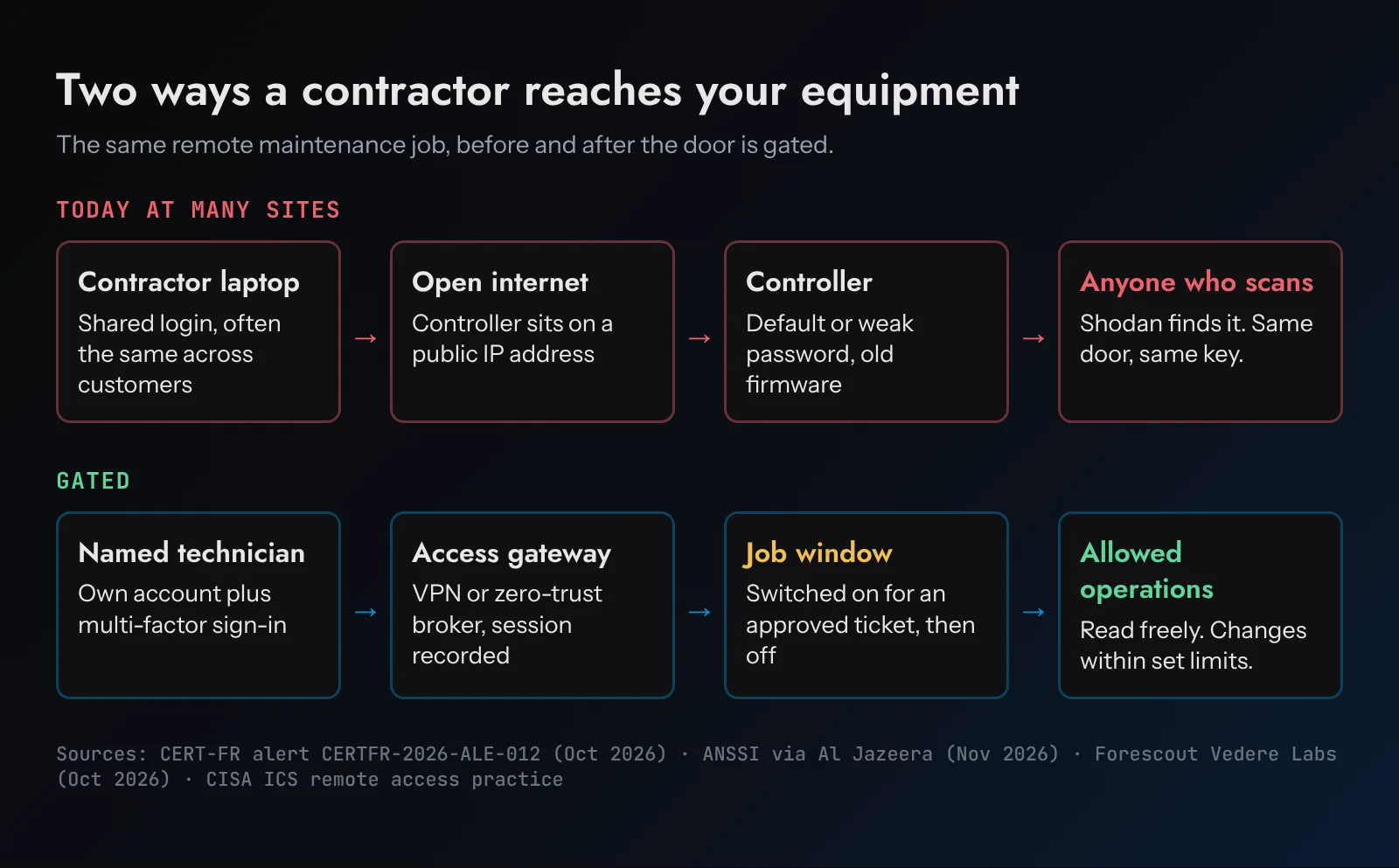
Al Jazeera's explainer on the fridge attacks puts it in one line: a supermarket's fridges and freezers are run from one control panel, which is connected to the internet so contractors can manage it remotely. Attackers reportedly found those panels with Shodan, a search engine for connected devices. Vincent Strubel, head of France's national cyber agency ANSSI, named the failures: the equipment was directly on the open internet, many systems had only weak or default logins, and many units were old models that no longer receive security updates. In France, about 700 stores were hit on 11 and 12 October. A second wave on 2 November reached supermarkets and food businesses in at least nine European countries. If you want the full story of those attacks, read our breakdown of the supermarket fridge hack.
The French computer emergency team's alert, CERT-FR CERTFR-2026-ALE-012, named the controller families involved (Danfoss AK-SM and AK-SC, Copeland XWEB and Dixell XWEB) and stated the principle bluntly: exposing a management interface on the internet goes against good practice. Its fix was to remove the internet exposure and restore the contractor's access only through a secure VPN or protected network. It also added a detail that tells you who owns this problem: check your insurance contract before you cut the data feed to your refrigeration contractor.
This is not only a refrigeration story, and it is not new. In 2013, attackers reached Target's network using credentials stolen from Fazio Mechanical Services, an HVAC and refrigeration contractor, according to the US Senate Commerce Committee's analysis. The committee noted Target could have disrupted that step by requiring two-factor authentication for its vendors.
The wider numbers have moved the wrong way since:
| Finding | Figure | Source |
|---|---|---|
| Breaches involving a third party | 48%, up 60% year on year | Verizon 2026 DBIR |
| Third parties that fully fixed weak cloud MFA | 23% | Verizon 2026 DBIR |
| Downstream victims per third-party breach | 5.28 in 2025 (2.46 in 2021) | Black Kite 2026 |
| Average delay before a vendor breach is disclosed | 117 days in 2025 | Black Kite 2026 |
| Industrial sites with an OT incident in 12 months | 34%, 1.7 times the 2025 rate | SANS 2026 ICS/OT survey |
| OT environments with four or more remote access tools | 55% (2024 research) | Claroty Team82 |
Two of those deserve a second look. A 117-day disclosure delay means your contractor may be breached for months before you hear. And the SANS survey found 58% of industrial sites would be down within a year if their main automation vendor vanished. You cannot simply cut contractors off. You have to let them in safely.
Which contractors have remote access to your systems?
Most operations directors cannot answer this without phoning around. That gap is the first finding. CISA's recommended practice for industrial remote access notes that vendor access is often granted by default based on historical relationships, and warns that vendors who deploy remote connectivity in a standard way may use credentials across many customers that are "very similar if not identical". One leaked password, many sites.
Build the inventory in one sheet
List one row per access path, not per vendor. A single contractor may have three.
| Column | What to write | Example |
|---|---|---|
| Contractor | Company and contact | Refrigeration maintenance firm |
| Equipment | What they reach | Store refrigeration supervisor |
| Path | How they get in | 4G router, public IP, vendor cloud portal, remote desktop tool, modem |
| Credential | Shared or named, MFA or not | One shared "service" account, no MFA |
| What it can change | Read, settings, users, firmware | Setpoints, defrost, alarms |
| Hours used | When they actually connect | Twice a month, weekdays |
| Internal owner | A named person | Facilities manager |
Typical contractors to ask about: refrigeration and cold-room maintenance, HVAC and building management, machine builders and PLC integrators, warehouse management system (WMS) and ERP vendors, conveyor and sortation suppliers, CCTV and access control installers, energy monitoring providers.
Look for the hidden paths too. Forescout's recommendations include reviewing public IP assignments, port-forwarding rules and internet-reachable management services, and looking for repeated configurations across contractor-managed sites. A free check is to ask your network provider or IT team which of your public addresses answer on management ports. Greece's cyber authority did the national version of this and wrote to supermarkets that at least 300 refrigeration controllers in the country remained exposed.
How should you gate vendor remote access?
Put one controlled gate in front of everything, and make every contractor use it. CISA's practice guide recommends standardising on one method of remote access, removing direct connections and modems, and keeping vendor authentication separate from your own staff's so you can lock a vendor out quickly.
The main options compared:
| Option | What it is | Good for | Watch out for |
|---|---|---|---|
| Firewall IP filtering | Only the contractor's office address may connect | An emergency stopgap | CERT-FR says it must not be treated as a lasting fix |
| Site-to-site or user VPN | Encrypted tunnel into your network | Standard, widely supported | Once inside, a user can often reach far more than one device |
| Zero-trust access broker (ZTNA) | Each user is checked and connected to one named application or device | Contractors who need one system | Needs an owner and a supported device list |
| Privileged access gateway with recording | Sessions go through a jump server that records screen and keystrokes | Changes to production equipment | Licence cost; recordings must actually be reviewed |
Whichever you choose, five controls matter more than the brand.
1. Named accounts with multi-factor sign-in
One account per technician, never one per company. Multi-factor authentication on the gateway, even if the controller behind it cannot support it. Verizon's figure that only 23% of third parties fully fixed weak MFA on their cloud accounts tells you not to assume your vendor has done this already.
2. Access only during an approved job
CISA's guidance is direct: vendor support may only need remote access rarely, so disable vendor user IDs until they are required and disable them again when the task is done. In practice the contractor raises a ticket, a named person on your side approves a time window, access opens, then closes by itself. Emergency call-outs follow the same path with a phone approval.
3. Session recording and logs you can read
Record who connected, when, from where and what changed. Forescout recommends correlating remote sessions with changes to defrost schedules, alarms, setpoints, users and network settings, and investigating anything that does not match a job.
4. No management interface on a public IP
This is the one CERT-FR, ANSSI, Forescout and CISA all agree on. CISA's practice goes further: controllers and PLCs should not be connected to the internet "even if they have a username and password set".
5. Retire what cannot be patched
CERT-FR warned that keeping an unpatched end-of-life device on the internet exposes it to a very high probability of compromise, and that a factory reset alone will not stop it being compromised again. Forescout notes the Danfoss AK-SM 800 has been end of life since May 2021.
What does "grant operations, not logins" mean?
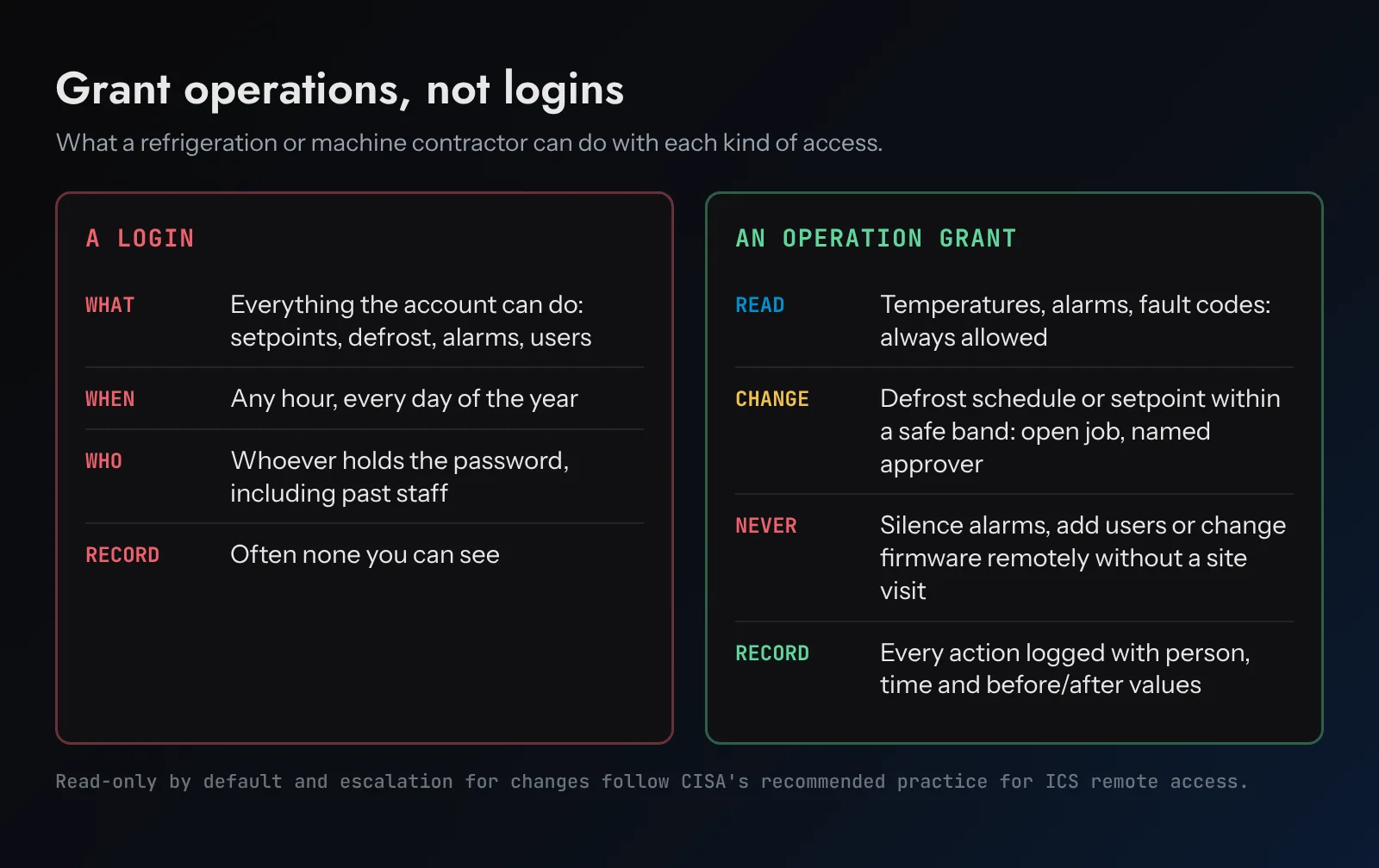
A login is a key to everything an account can do, at any hour, for whoever holds it. An operation grant is permission to do one named thing, under named conditions, with a record.
CISA's practice already points this way: read-only access should be the default level, and users must escalate their privileges to make changes. Forescout adds the practical step: document which roles can change setpoints, start a defrost, suppress alarms, modify users or enable gateways.
Applied to a refrigeration contractor, that looks like this:
- Always allowed: read temperatures, alarms and fault codes.
- Allowed with an open job and a named approver: change a defrost schedule or setpoint within a safe band.
- Not allowed remotely: silence alarms, add users, change firmware.
- Always: log the person, time and before and after values.
The blood bank case shows why the safe band matters. A setpoint of 110°C for a freezer is not a plausible maintenance change. A permission layer that only accepts setpoints inside a sensible range would have refused it, whoever held the password.
This is the same thinking we use when we build governed AI agents: reads run freely, writes that change a system of record wait for a named human approver, and every action is logged. It applies just as well to a contractor, a script or an agent. We wrote more about it in least-privilege access for AI agents, and our Access Layer package builds exactly this kind of per-operation permission, approval queue and audit trail in front of the systems a business already runs.
What should your contractor contracts say?
Contracts are where you make the controls stick. CISA's guide suggests using procurement language to agree a secure remote connection with the vendor and to demand that administrative credentials on equipment can be changed. Clauses worth asking your lawyer to adapt (this is not legal advice):
- Access route. All remote access goes through the client's gateway. No modems, 4G routers or remote desktop tools installed without written approval.
- Named people. Individual accounts per technician, multi-factor sign-in, and removal within one working day when someone leaves.
- No shared credentials across customers, and no default passwords left on delivered equipment.
- Job-based access. Sessions only against an approved ticket and time window.
- Logs. The vendor keeps its own access records and shares them on request.
- Breach notice. The vendor tells you promptly if its own systems or credentials are compromised. Given Black Kite's 117-day average disclosure delay, put a number of hours in the contract.
- End of life. The vendor tells you when equipment stops getting security updates and proposes a replacement.
- Insurance. Confirm that changing how the contractor connects does not break your cover or theirs, as CERT-FR advised.
What can you do this week?
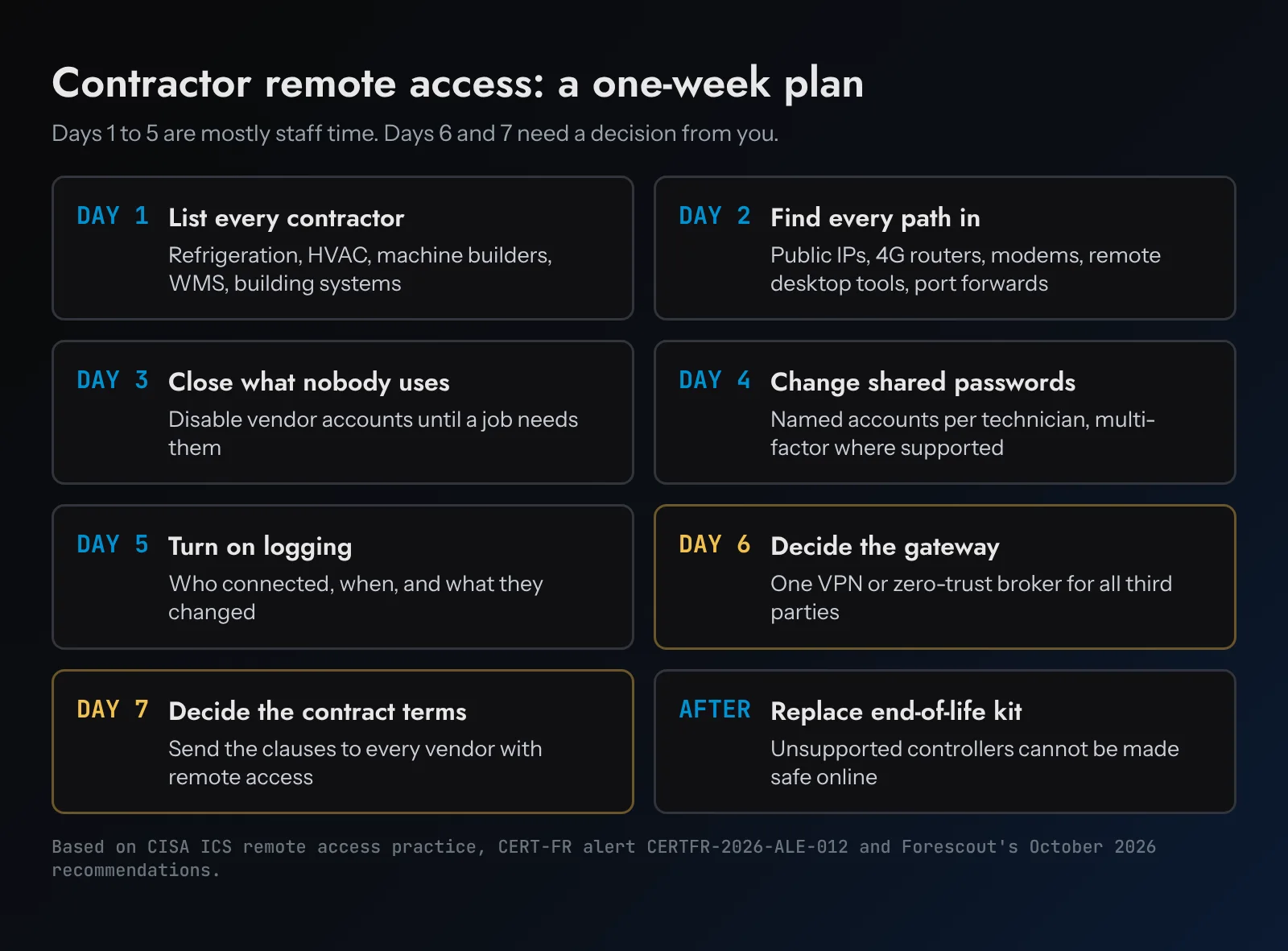
Days one to five are mostly staff time. Days six and seven are decisions only you can make. Two questions to ask your IT lead or managed service provider on Monday:
- "Which of our public IP addresses answer with a management login page, and who put each one there?"
- "If a contractor's laptop were stolen tonight, what could someone do on our equipment before we noticed?"
If you are planning to add automation or AI to the same systems your contractors touch, our AI Readiness Audit looks at where that automation would sit, what it should be allowed to do, and who approves its changes, and ends in a written build plan.
Frequently asked questions
What is contractor remote access security?
It is the set of controls that decide how outside vendors, such as refrigeration, HVAC, machine and software contractors, connect to your equipment from off site. Good practice is one gateway, named accounts with multi-factor sign-in, access only during approved jobs, recorded sessions, and permission for specific operations rather than full logins.
Is a VPN enough to secure vendor remote access?
A VPN is a big step up from a controller on a public IP address, and CERT-FR recommends restoring contractor access only through a secure VPN or protected network. On its own, though, a VPN often lets a user reach much more than the one device they need. Add named accounts, multi-factor sign-in, job-based access and logging.
How did hackers get into supermarket fridges?
According to ANSSI's head Vincent Strubel, the controllers were directly on the open internet, many used weak or default passwords, and many were old models without security updates. They were online so maintenance contractors could manage them remotely. Attackers reportedly found them with Shodan and used the controllers' own settings, such as defrost, to warm the units.
How do I find out which vendors have remote access to our systems?
Build a one-sheet inventory with one row per access path: contractor, equipment, connection method, credential type, what it can change, and an internal owner. Then ask your network team which public IP addresses expose management interfaces, and look for 4G routers, modems and remote desktop tools on site. Expect to find paths nobody remembers approving.
What is just-in-time access for contractors?
Just-in-time access means a contractor's account is disabled by default and only switched on for an approved job and time window, then switched off again. CISA recommends exactly this for vendor support accounts in industrial systems. It means a stolen password is useless most of the time.
What should a vendor remote access policy include?
It should name the single approved access route, require individual accounts and multi-factor sign-in, ban shared and default credentials, tie access to approved jobs, set logging and log-sharing rules, require prompt breach notice from the vendor, and cover end-of-life equipment. CISA also recommends that every remote user signs the policy before access is granted.