
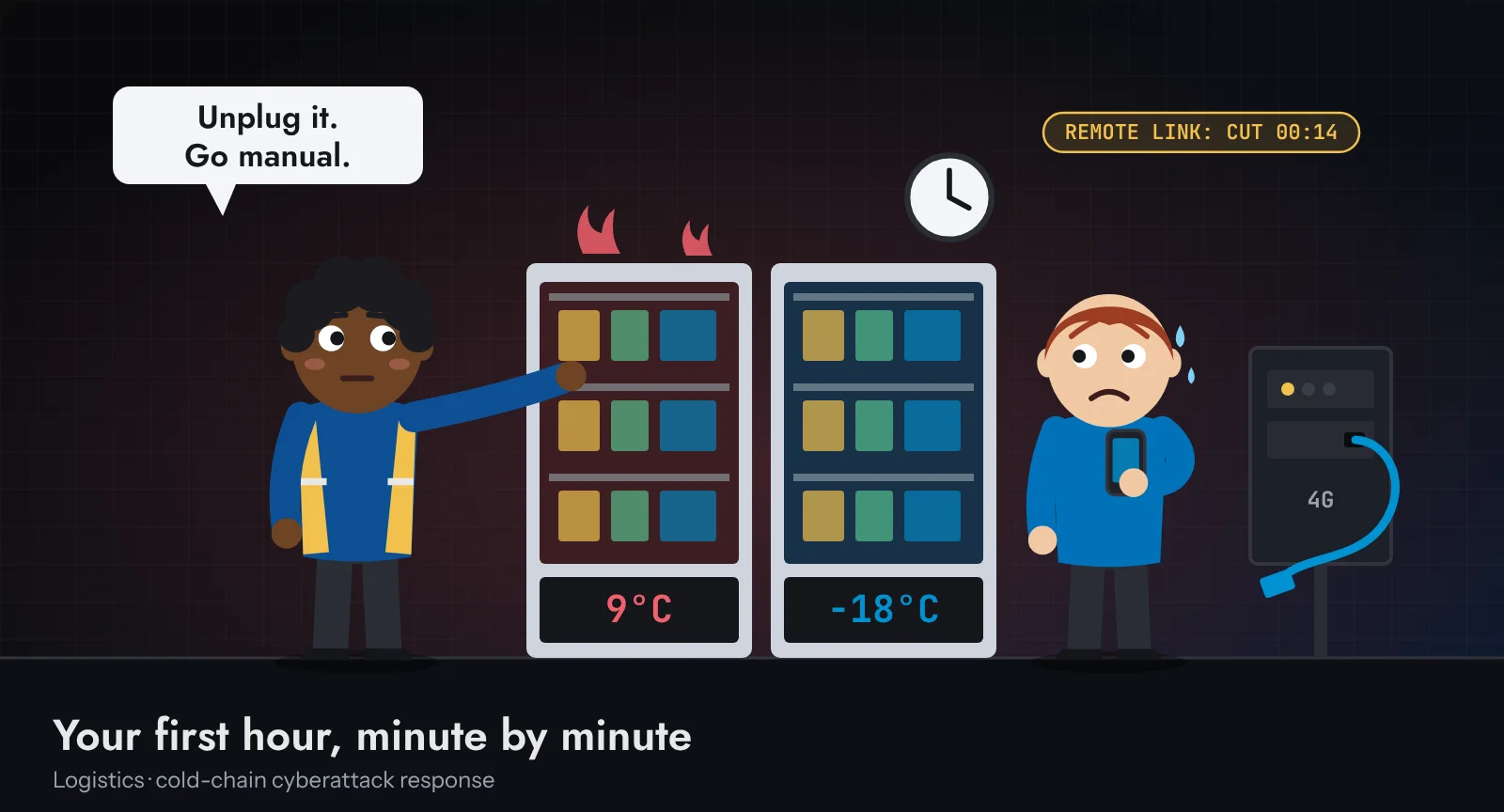
At 1 a.m. on Monday 2 November, Stephan Moelans started calling his technicians. His company, the Belgian refrigeration installer Sabcobel, had watched about 20 supermarket systems go wrong overnight. "We've been working all night and morning to disconnect the affected units from the network," he told Belga, as reported by Fortune. Hundreds of kilometres away in Estonia, another refrigeration firm dealt with the same kind of attack within minutes, with no significant damage.
Same attack. Very different nights. The difference was the first hour.
In the first hour of a suspected cold-chain cyberattack, confirm temperatures with an independent thermometer, cut the controllers' internet and 4G links, run the units locally, start a written temperature log and preserve evidence before anyone resets anything; the first day is then about food-safety decisions, insurance and reporting.
This runbook is for directors of 3PLs, cold stores and food distributors. It is not about how the hack works (we cover that in how hackers took over supermarket fridges). It is about what your people do when it happens to you.
Key takeaways
- France's 12 October attack reached about 700 of the country's 10,000 supermarkets, and in some stores temperatures stayed high for six hours overnight.
- An Estonian refrigeration firm stopped the same type of attack within minutes; France's blood service caught its own because monitoring raised the alarm quickly.
- France's CERT-FR says the first move is to remove internet exposure, then check every setting, especially defrost schedules, and warns that a factory reset alone is not enough on end-of-life controllers.
- USDA says food held above 40°F for more than 2 hours should not be eaten, so a timed temperature log decides how much stock you can save.
- US agencies (CISA, FBI, HHS, USDA, DOT) warned on 5 November 2026 that cold storage and refrigerated transport are targets, and asked operators to report incidents.
Why does the first hour decide what a cold-chain cyberattack costs?
Because the product does not wait. Once a controller is told to heat or defrost, every minute moves stock closer to the discard line.
Look at the spread of outcomes from the past six weeks:
- France, 12 October. Hackers pushed fridges and freezers at hundreds of supermarkets to as high as 50°C, and in some stores the heat lasted six hours overnight, causing fires and spoiled food. Two stores reported about €270,000 in combined damages. Intermarché's CEO estimated losses of "tens of millions of euros nationwide in a single day".
- Estonia, 2 November. Attackers reached a computer controlling a client's refrigeration and set it to 50°C. Kitman Coldtech's chief executive said the attack was addressed within minutes and caused no significant damage.
- France's blood service (EFS), early November. Attackers tried to raise plasma stores from minus 30°C to as high as 110°C. Monitoring systems detected it quickly, staff moved or secured the plasma, and no products were compromised.
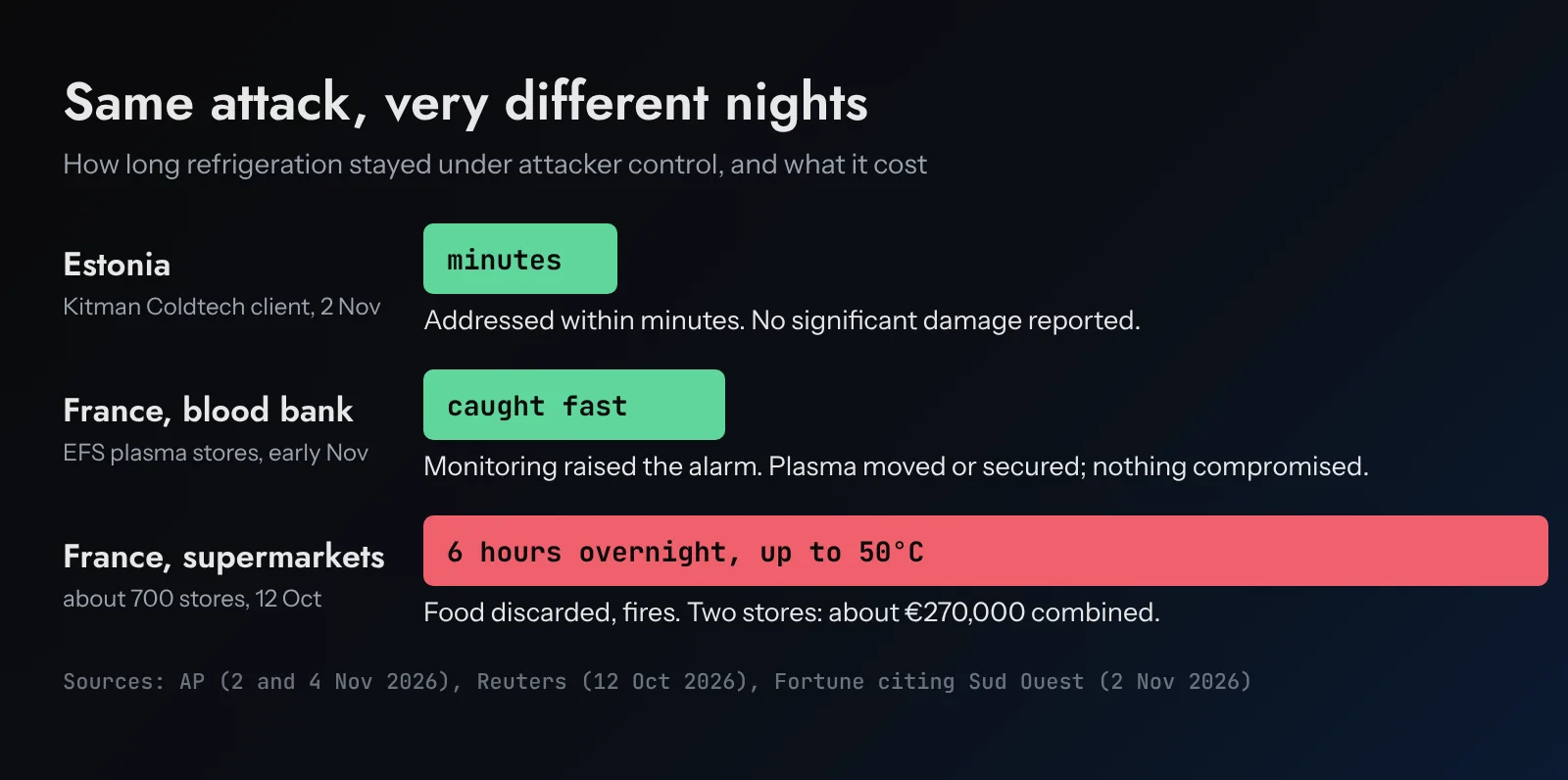
The fast responders had two things in common. Someone was watching temperatures at night, and someone knew how to disconnect the units. Neither needed new technology.
This is not only a supermarket problem. The joint US fact sheet of 5 November 2026 names cold storage facilities and refrigerated transport services, and the Food and Agriculture, Healthcare, Chemical and Transportation sectors. The GAO noted on 19 November that USDA and FDA have not run emergency exercises for cyberattacks on the sector since 2024. Do not wait for one.
What does a refrigeration cyberattack look like from the floor?
It usually looks like a refrigeration fault. That is the problem. The warning signs, drawn from the incidents and the advisories:
- Rooms warming while compressors sound normal. In Belgium, attackers switched units into defrost mode, so the heaters did the damage.
- Setpoints you did not set. The French and Swedish attacks used 50°C. A Greek butcher shop reported 150°C.
- Several units, or several sites, at once. A single broken unit is a fault. Twenty at 2 a.m. is not.
- A controller screen that says everything is fine. CISA warns of "loss of visibility into current temperatures (a denial-of-view condition)". If the screen and the probe disagree, believe the probe.
The last point is why every cold room needs an independent thermometer or data logger that does not report through the same controller.
What should you do in the first hour?
Here is the runbook. The time bands are our suggestion. The actions come from France's CERT-FR alert on refrigeration controllers (first issued 12 October, updated 16 October) and the US joint fact sheet.
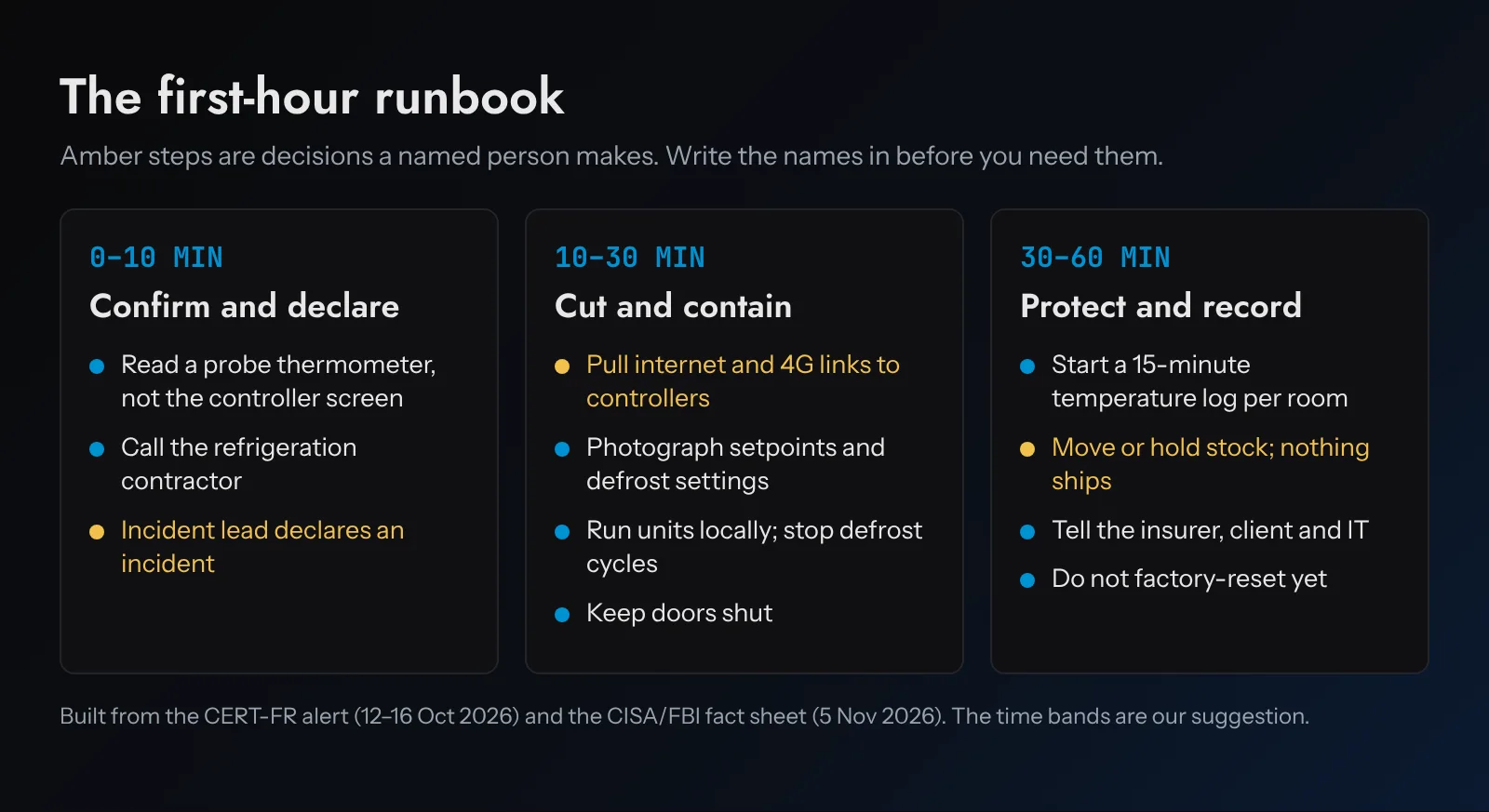
Minutes 0–10: confirm and declare
- Read an independent probe or logger in each affected room. Write down the time and reading.
- Call your refrigeration contractor's emergency line. They often hold the remote access and know the controller.
- Name an incident lead and say the words "this is a security incident". It changes what people do next: nobody "just reboots it".
Minutes 10–30: cut and contain
- Remove internet access to the controllers. CERT-FR's first step is to remove internet exposure from affected units and from every unit on a public IP address. Include the contractor's 4G or cellular modem, which may sit outside your own network. ICA said the affected stores used an external supplier with networks outside ICA's main network.
- Photograph every controller screen showing setpoints, alarms and defrost schedules before you change them. This is your evidence.
- Take local control. Set safe setpoints at the unit and check the whole configuration, especially defrost ranges, as CERT-FR advises. Disable scheduled defrost until a technician confirms the settings.
- Keep doors shut. A closed room buys time.
One catch. CERT-FR also says to check your insurance contract conditions before cutting the data feed to your refrigeration contractor. Some policies require that monitoring. Do that check this week, in calm conditions, and write the answer into the runbook so nobody hesitates on the night.
Minutes 30–60: protect and record
- Start the temperature log (next section).
- Move or hold product. Move stock into unaffected rooms or trailers if you have space. Put a shipping hold on everything from affected rooms. Nothing leaves until the food-safety lead releases it.
- Tell the people who own the risk: your insurer, your IT or security provider, and, for a 3PL, the clients whose stock is in those rooms.
- Do not factory-reset yet. CERT-FR does recommend rebooting or restoring compromised units, but only after you have captured settings and logs. It also warns that a reset alone is not enough on end-of-life equipment: the device stays vulnerable "and will certainly be compromised again".
How do you keep a temperature log that will stand up for food safety and insurance?
Your log answers one question: how long was each product above the line? Everything else (discard, release, claim) follows from it.
Record, for every room and every reading: the time, the location, the reading, the instrument used, and the name of the person who took it. Every 15 minutes is a sensible interval while temperatures are moving. That interval is our recommendation, not a regulation.
The lines your food-safety lead will measure against:
| Rule | Limit | Source |
|---|---|---|
| US: chilled food | Above 40°F for over 2 hours: do not eat | USDA FSIS |
| US: unit not running, door closed | Fridge about 4 hours; full freezer about 48 hours (24 half full) | FoodSafety.gov |
| UK (England, Wales, NI): chilled | 8°C or below is a legal requirement; up to 4 hours out, then throw away | GOV.UK food hygiene guidance |
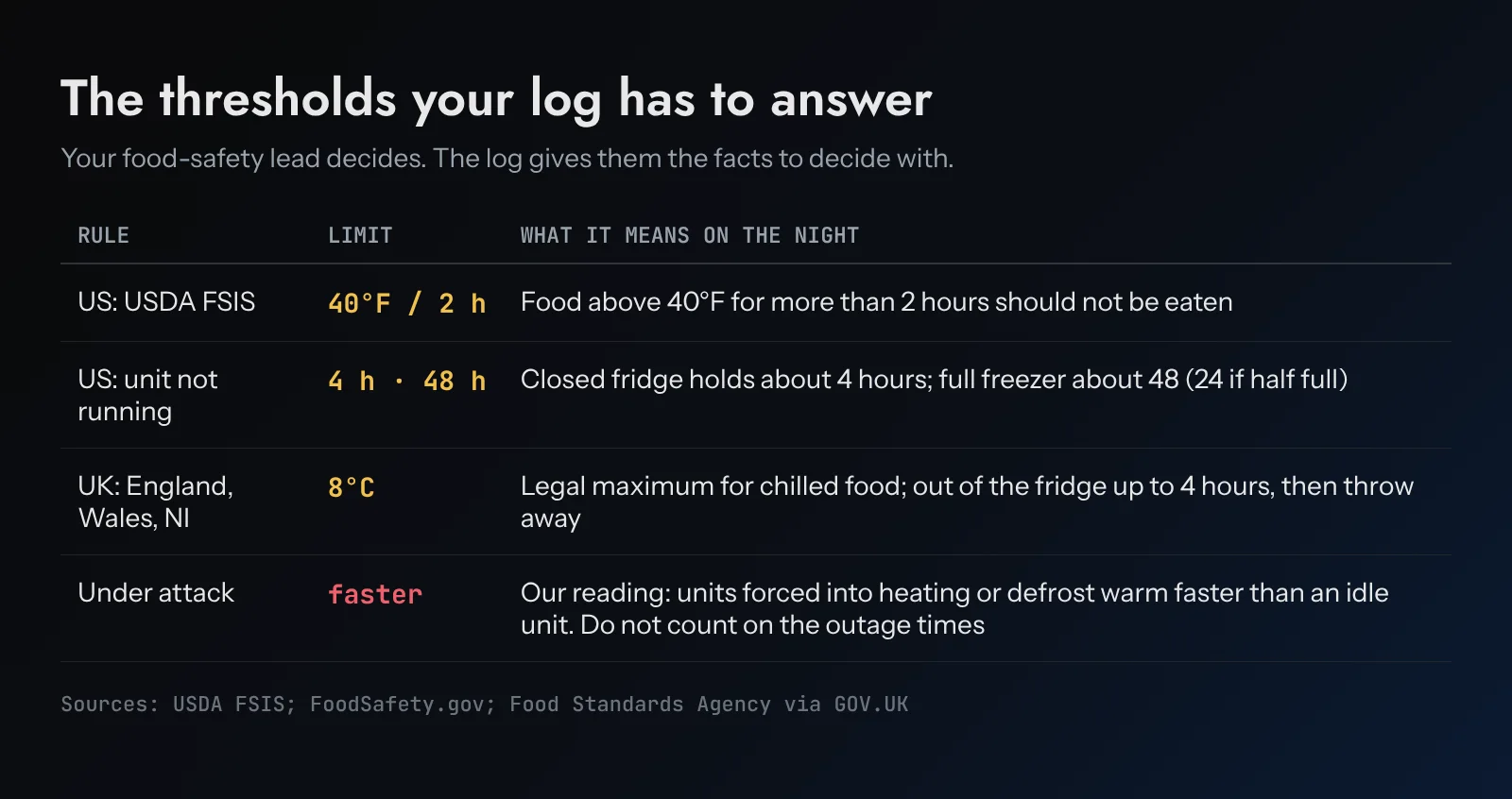
One caution. The outage times assume a unit that has simply stopped. An attacked unit may be actively heating or defrosting, so in our reading it will warm faster. Use the measured log, not the rule of thumb.
FoodSafety.gov adds that frozen food can be refrozen if it still contains ice crystals or is at 40°F or below, though quality may suffer. That is a decision for your food-safety lead, product by product, backed by the log.
What should you do in the first day?
Make the stock decisions
Your food-safety lead reviews the log room by room and decides: release, hold for testing, or discard. The Swedish ICA store in Sjöbo, whose units were set to 50°C, discarded its affected products. Ireland's Musgrave removed chilled and frozen products from sale at 13 SuperValu stores "as a precaution". Document every decision with the name of whoever made it. For a 3PL, agree each decision with the client who owns the stock.
Report it
In the US, the joint fact sheet asks organisations to contact CISA's 24/7 Operations Center (1-844-729-2472 or contact@cisa.dhs.gov) and to file with the FBI's IC3 or a local field office. Include the date, time and location, the type of activity, the equipment involved and a named point of contact. In the EU, organisations covered by the NIS2 Directive must report significant incidents to their national CSIRT or authority, as the ENISA and European Commission joint statement reminds them.
Keep attribution out of your own statements. France has blamed a cyber unit linked to Iran's Revolutionary Guard for the October attack. Authorities have not said who was behind the November wave, and reports on the US military commissary outages being investigated differ on the number: Fortune says half a dozen, Reuters about a dozen. Report what you saw. Let investigators say who did it.
Restore safely
CERT-FR's restore steps are short. Bring remote access back only through a secure VPN or protected network. In an emergency, a firewall rule allowing only your refrigeration contractor's source IP addresses is acceptable, but "should not be considered permanent". Update firmware, use the manufacturer's strict security mode where it exists, and change default passwords. Replace end-of-life controllers rather than putting them back online.
That matches what the UK's NCSC head Richard Horne said of the French stores: the fridges were connected directly to the internet with default passwords. For the longer job of controlling who can reach these systems, see contractor remote access security.
Who should be on the call list?
Write this down, print it, and tape it inside the plant room door. Phones and email may be part of the problem.
| Role | Why they are on the list | Call within |
|---|---|---|
| Night shift lead | Reads probes, keeps doors shut | Immediately |
| Incident lead (named person) | Declares the incident, owns decisions | 10 minutes |
| Refrigeration contractor | Holds remote access, knows the controller | 10 minutes |
| IT or security provider | Cuts links, preserves logs | 30 minutes |
| Food-safety lead | Hold, release or discard decisions | 60 minutes |
| Insurer | Policy conditions, claim evidence | 60 minutes |
| Clients who own the stock | Their product, their decision as well | Same day |
| CISA / FBI, or national CSIRT | Reporting and help | Same day |
What should you set up this week?
Most of the first hour is decided before the incident. A short list, drawn from the US fact sheet and CERT-FR:
- Find every controller that can be reached from the internet, including through a contractor's cellular modem. CISA's first mitigation is to eliminate public internet exposure.
- Separate refrigeration from the office network on its own VLAN.
- Install independent temperature monitoring with its own alarm route, so a hacked controller cannot hide a rising room.
- Set safe setpoint limits and alerts for any change outside them, as CISA recommends.
- Check your insurance terms on remote monitoring, and write the answer into the runbook.
- List end-of-life controllers and plan their replacement.
- Run a 30-minute drill: at 2 a.m. a room reads 12°C on the probe and 2°C on the screen. Who does what?
Note that Delhaize said its distribution centres were operating normally while stores were hit. Do not read that as "warehouses are safe". The US fact sheet names cold storage and refrigerated transport explicitly.
Where does automation help, and where must a person decide?
Software is good at the watching and the paperwork. It can compare independent sensor readings with controller setpoints every minute, notice when twenty rooms change at once, open the incident, page the named lead, and build the timed log that your insurer and food-safety lead need.
It should not, on its own, change a setpoint, release held stock or authorise a discard. Those are decisions with a name attached. When we build governed AI agents for distribution and logistics teams, that is the split: reads run freely, anything that changes a system of record waits for a named approver, and every action lands in an audit trail. It is the same rule as this runbook, written into software.
Not sure where your cold chain is exposed?
Start with the list above. If you want a second pair of eyes, our AI Readiness Audit is two weeks, fixed price, and looks at where automation and AI would sit in your operation, including which systems can be reached from outside and who approves what. It ends in a written plan you can act on with or without us.
Frequently asked questions
What is the first thing to do if a cold room is hacked?
Confirm the temperature with an independent probe, then cut the controller's internet and cellular connections. France's CERT-FR lists removing internet exposure as the first step. Photograph the settings before changing them, then run the units locally.
Should I factory-reset a hacked refrigeration controller?
Not until you have photographed settings and saved logs, because a reset wipes the evidence. CERT-FR recommends rebooting or restoring compromised units, but warns that a reset alone leaves end-of-life equipment vulnerable to being compromised again. Replace unsupported controllers rather than reconnecting them.
How long can chilled food stay above temperature after a refrigeration failure?
In the US, USDA FSIS says food held above 40°F for more than 2 hours should not be eaten. In England, Wales and Northern Ireland, chilled food must legally be kept at 8°C or below, and food out of the fridge for up to 4 hours can go back in. A timed temperature log is what lets you apply these rules product by product.
Who do I report a cold-chain cyberattack to in the US?
The joint CISA, FBI, HHS, USDA and DOT fact sheet of 5 November 2026 asks organisations to contact CISA's 24/7 Operations Center on 1-844-729-2472 or contact@cisa.dhs.gov, and to file with the FBI's IC3 or a local field office. Include the date, time, location, equipment and a named contact.
Are refrigerated warehouses and trucks at risk, or only supermarkets?
Both. The US fact sheet names cold storage facilities and refrigerated transport services among the users of the targeted systems. The European attacks hit stores, but the same controllers and remote-access set-ups are common in cold stores and distribution centres.
Can I cut the remote monitoring link without breaking my insurance?
Check before an incident. CERT-FR specifically advises verifying insurance contract conditions before cutting the data feed to your refrigeration contractor. Agree with your insurer now what you may disconnect in an emergency, and write it into your runbook.