
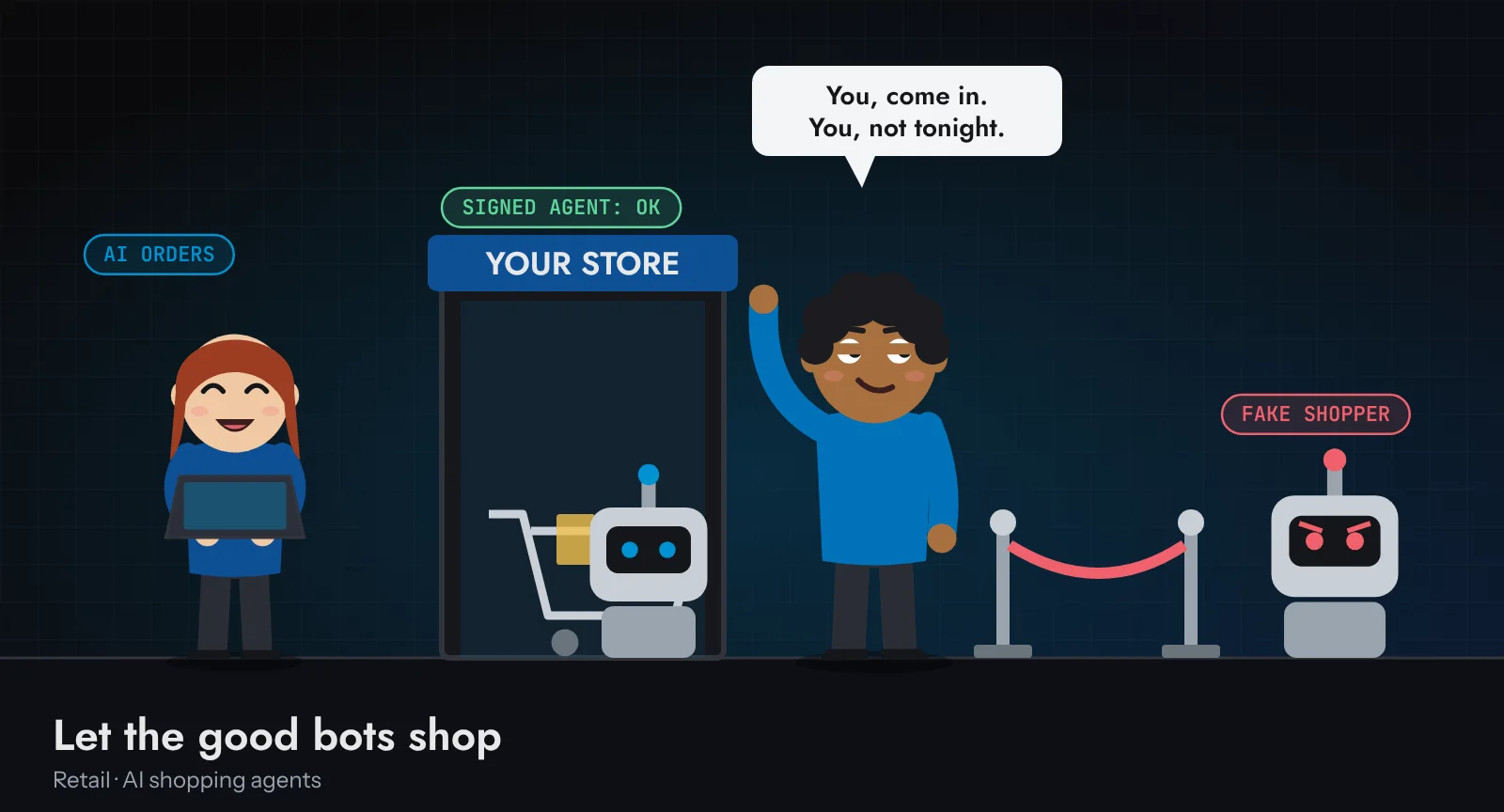
Call her Dana. She is made up, but nothing that happens to her is unusual. Dana runs a homewares store online, about 60 staff, most of her sales in the six weeks before Christmas. In the spring her developer turned on the "block AI bots" setting in the firewall, because a scraper had been hammering the site and the setting sounded sensible.
On Thanksgiving morning a customer emails: "I asked ChatGPT for a cast-iron casserole under $150. It recommended your competitor. Then I asked it to check your site, and it said it couldn't open it." Dana has the product, the price and the stock. The AI shopping agent simply could not get in.
AI shopping agents are already sending some of the most valuable visitors to US retail sites, so the right move is to let verified search crawlers and shopper-directed agents in, give them clean product data, and save your blocking for bad bots, which you identify by behaviour and verification rather than by a "block all AI" switch. This guide shows how, in plain steps you can check before Cyber Monday.
Key takeaways
- Adobe forecasts AI traffic to US retail sites will rise 130% year on year between 1 November and 31 December 2026, and 159% on Thanksgiving.
- In September 2026 AI traffic converted 90% better and earned 83% more revenue per visit than other traffic to US retail sites, according to Adobe.
- Bots made up 53% of web traffic in 2025 and bad bots 40%, and 20% of AI-enabled bot attacks targeted retail, according to Thales.
- From 15 September 2026, Cloudflare blocks Training and Agent bots by default on ad-carrying pages of new domains, so check what your own settings block.
- Google says Search does not use llms.txt; clean HTML, accurate product feeds and an open door to verified crawlers matter more.
What are AI shopping agents, and why are they at your store now?
An AI shopping agent is software that searches, compares and sometimes buys on behalf of one shopper, using the same web pages and checkout your human customers use. Three things changed in 2026.
First, the big platforms launched them at scale. Google's Universal Cart launched in the US on 15 October 2026 across Search and the Gemini app. It saves items from multiple retailers, tracks price drops and stock, and lets shoppers check out with Google Pay or move items to the merchant's own cart. Meta launched Muse in September, an agent that can find deals, track prices and handle returns. OpenAI now takes merchant product feeds and promotions through its Agentic Commerce Protocol, and in March 2026 said it would let merchants use their own checkout while it focuses on product discovery.
Second, the traffic is growing fast. Adobe's holiday forecast expects US online sales of $275.1 billion from 1 November to 31 December, up 6.7%, and AI traffic to US retail sites up 130% year on year, measured as shoppers clicking a link from an AI tool.
Third, those visitors buy. Adobe's October data, covering over 1 trillion visits to US retail sites, found that in September 2026 AI traffic converted 90% better and earned 83% more revenue per visit than non-AI traffic. In August 2025, AI traffic had converted 9% worse.
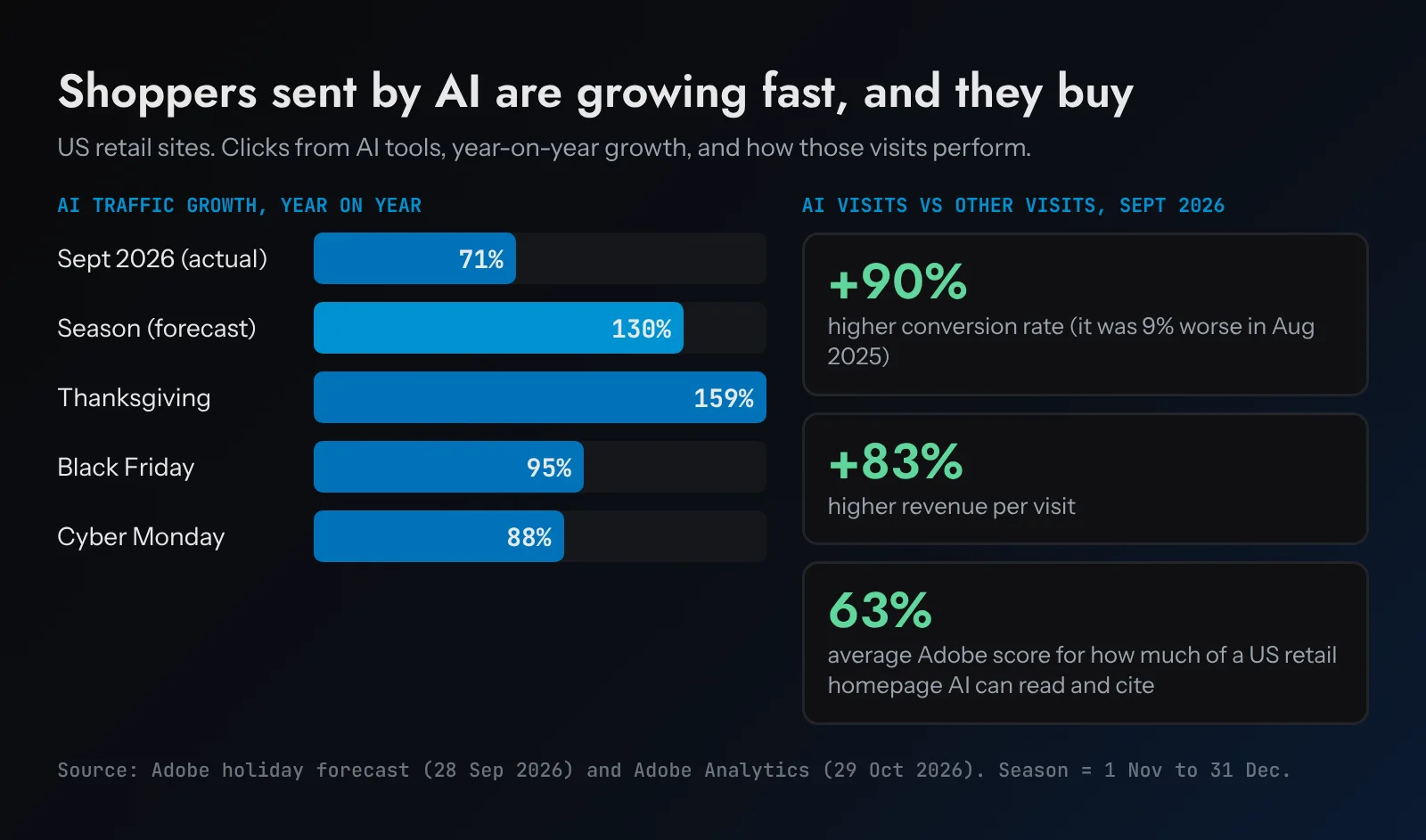
One caution on these numbers. Growth percentages from a small base look dramatic. AI is still a minority channel for most stores. But it is the channel growing fastest, and the visitors it sends arrive ready to buy.
Why would your own site block AI shopping agents?
Usually by accident. Three common ways:
1. A "block AI" switch that blocks more than you think
Cloudflare splits AI traffic into Search, Agent and Training. From 15 September 2026, for new domains, it blocks Training and Agent bots by default on pages that display ads, while Search stays allowed. The same post warns that crawlers which do both search and training, such as Googlebot, Applebot and Bingbot, will be blocked for customers who have chosen to block Training. A setting meant to stop model training can end up hiding you from search.
Your site may not run ads, and your domain may not be new. The point is that defaults and one-click options now exist across firewall and bot-management products, and somebody on your team or at your agency may have clicked one.
2. A robots.txt that treats every AI user agent the same
OpenAI runs separate user agents for separate jobs, and its crawler documentation is clear about each:
- OAI-SearchBot surfaces sites in ChatGPT search. Sites that opt out "will not be shown in ChatGPT search answers".
- GPTBot crawls content that may be used to train models. Disallowing it says your content should not be used for training.
- ChatGPT-User visits a page when a user asks ChatGPT to. Because these actions are started by a user, "robots.txt rules may not apply".
Google works the same way. Google-Extended controls whether your content is used to train Gemini models and to ground answers in Gemini Apps, and Google says it "does not impact a site's inclusion in Google Search". So a blanket Disallow for every AI name you can find may keep you out of ChatGPT search answers and Gemini, without stopping a single scraper that ignores robots.txt anyway.
3. Pages an agent cannot read
Adobe scores how much of a page AI systems can understand and cite. In September 2026 the average US retail homepage scored 63%: more than a third of its content was not visible to AI. General merchandise homepages scored 40%, because navigation-heavy, promotional layouts give AI little to work with. Prices loaded by JavaScript after the page renders, stock shown only in an image, and specs hidden behind tabs are common culprits.
How do you tell a good AI agent from a bad bot?
Not by the name it gives. Thales found that 41% of bot attacks in 2025 used Chrome to appear as legitimate traffic, and anyone can type "ChatGPT-User" into a request header. There are three better tests.
Verify the source. OpenAI publishes the IP ranges for OAI-SearchBot, GPTBot and ChatGPT-User. A request claiming to be one of them from any other address is not them. Ask your vendor whether it verifies Google and Bing crawlers the same way.
Check the signature. Web Bot Auth is a newer method where an agent signs each request cryptographically, so a site can confirm which operator sent it. Cloudflare documents how it verifies these signatures, and created a signed agents category whose first cohort included ChatGPT agent, Block's Goose, Browserbase and Anchor Browser. Ask your firewall or bot-management vendor whether they support it and how you set a rule for verified agents as a group.
Watch the behaviour. A shopper's agent looks at a handful of products, compares prices and maybe adds to cart. A bad bot tries thousands of passwords, tests gift-card numbers, holds limited stock in carts, or scrapes your entire catalogue every hour. Thales says 21% of bot attacks targeted business logic, meaning the rules of your site rather than its code, and 27% targeted APIs such as login, payments, search and inventory. Its own conclusion: the question is "no longer whether traffic is automated, but whether it aligns with business intent".
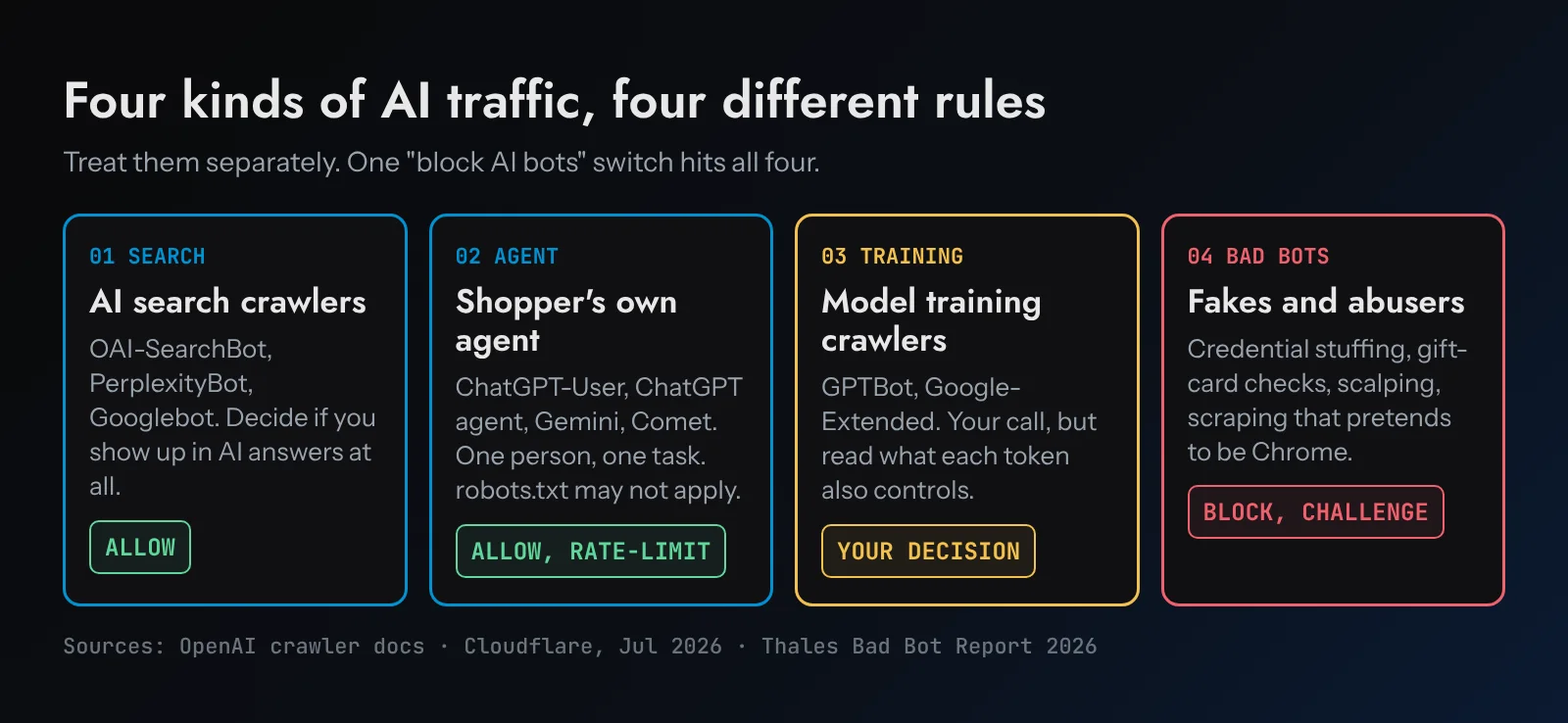
| Traffic | Example | What to do |
|---|---|---|
| AI search crawler | OAI-SearchBot, Googlebot | Allow. Verify by IP range. |
| Shopper-directed agent | ChatGPT-User, ChatGPT agent, signed agents | Allow on product and cart pages. Rate-limit. Challenge only at high risk. |
| Training crawler | GPTBot, Google-Extended | Your business decision. Read what each token also controls. |
| Bad bot | Credential stuffing, gift-card testing, scalping | Block or challenge, based on behaviour, on login, gift-card and checkout paths. |
Can retailers stop AI agents from shopping on their site?
Legally, it is unsettled. Amazon sued Perplexity in November 2025 over its Comet browser's agent, which logs into users' accounts and places orders for them. In March 2026 a federal judge granted Amazon a temporary injunction, finding "strong evidence" Comet accessed the site without Amazon's authorisation. On 4 August 2026 the 9th Circuit overturned that ban, saying it was Perplexity's users, using its agents, who "accessed" Amazon under the federal computer-hacking law. The case continues.
Amazon and eBay have chosen to block consumer AI agents. They can afford to: shoppers go to them directly. A mid-size retailer is in the opposite position. The agent is often how a shopper who has never heard of you finds you. Blocking is a choice, but for most stores it is an expensive one.
Does llms.txt help AI shopping agents find your products?
Not for Google. Google's own guide to its generative AI features says you "don't need to create new machine readable files, AI text files, markup, or Markdown to appear in Google Search (including its generative AI capabilities), as Google Search itself doesn't use them", and names llms.txt as something you can ignore. It also says structured data is not required for AI features, but is still worth keeping because it makes you eligible for rich results.
An llms.txt file does no harm and takes an hour. But if you have a week, spend it on the things below first.
What should you do before Cyber Monday?
Let good agents in
-
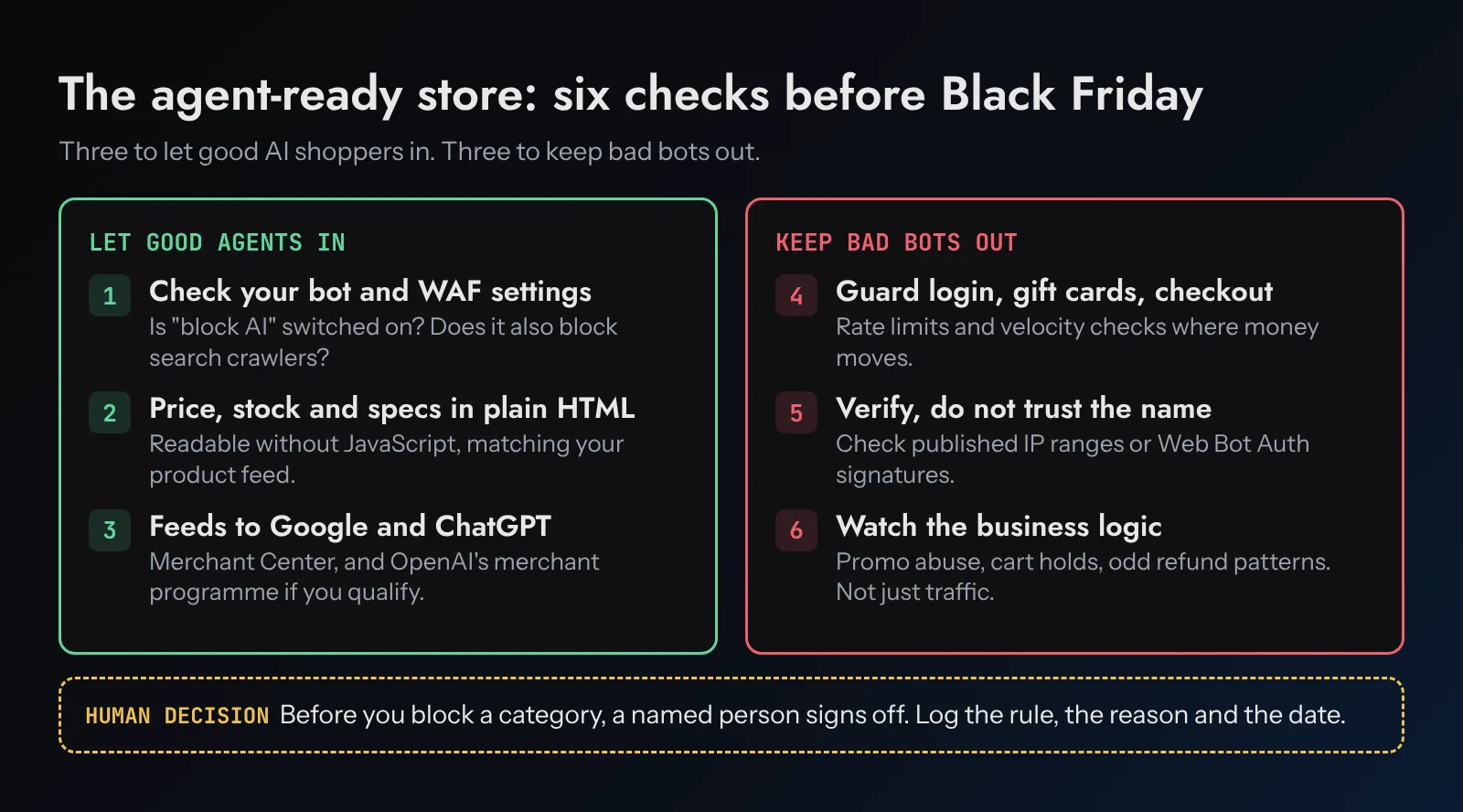
Open your firewall and bot settings with whoever manages them. Write down every AI-related rule: what it blocks, on which pages, and when it was turned on. Check specifically whether a training block also blocks search crawlers.
-
Review robots.txt by purpose, not by fear. Allow the search crawlers (OAI-SearchBot, Googlebot, Bingbot, PerplexityBot). Decide on training crawlers separately. A simple starting point:
User-agent: OAI-SearchBot
Allow: /

User-agent: GPTBot
Disallow: /

User-agent: *
Disallow: /checkout/
Disallow: /account/
Change the GPTBot line to
Allowif you are happy for your content to be used in training. This is a policy choice, not a technical one. -
Make price, stock and specs readable as plain HTML. Load your top 20 product pages with JavaScript turned off. If the price or "in stock" disappears, an agent may not see it either. Keep product structured data and your feeds (Google Merchant Center, and OpenAI's merchant programme if you qualify) matching what the page says. A feed that says $129 and a page that says $149 is how an agent learns to distrust you.
-
Test it. Ask ChatGPT, Gemini and Perplexity to find a specific product of yours and check its price. Our free AI Visibility Checker tests whether the main AI engines can read your site, and our guide on getting your website on ChatGPT covers the content side.
Keep bad bots out
- Protect where money moves. The DevPro Journal Black Friday checklist puts it well: rate limits and velocity checks on payment, gift-card and login endpoints, and bot management at the edge so a real shopper sees a challenge only when the risk is high.
- Verify before you trust. Turn on verified-bot and signed-agent handling in your bot tool, and check claimed AI user agents against published IP ranges.
- Watch business logic, not just volume. Promo codes used hundreds of times from new accounts, carts holding your last 50 units, refund requests that look scripted. These are the attacks that look like customers.
- Make blocking a named decision. Before anyone blocks a whole category of traffic during peak, one named person signs off, and the rule, the reason and the date go in a log. That turns a panic click at 2 a.m. into a decision you can review in January.
Where does governed AI fit on your side of the counter?
Agents are not only arriving at your store. Many retailers are now building their own, to answer stock questions, chase late deliveries or triage returns. The same rule applies on both sides: let automation read freely, but make anything that changes money, stock or a customer record pass a check and a named human.
That is how we build AI agents for retailers at Devs Core: reads run freely, writes that change a system of record wait for an approver, and every action is logged. Our guide to human-in-the-loop AI agents shows the pattern, and our AI governance page explains how we test the controls. If you want to know where AI would sit safely in your own systems, the AI Readiness Audit is a two-week, fixed-price review that ends in a written build plan.
Before any of that, though, run the AI Visibility Checker on your store. It takes a minute, and it tells you whether the agents bringing this season's best buyers can get through your door.
Frequently asked questions
Should I block AI bots on my e-commerce site?
Block bad bots, not AI as a category. AI search crawlers and shopper-directed agents bring visitors who, according to Adobe, converted 90% better than other traffic in September 2026. Decide separately on training crawlers such as GPTBot, and block abuse by behaviour on login, gift-card and checkout paths.
How do I know if my firewall is blocking ChatGPT or Gemini?
Check your bot-management settings for any "block AI" or "AI crawlers" option, and look in your logs for requests from OAI-SearchBot, ChatGPT-User and Googlebot that received 403 errors or challenges. Then ask ChatGPT to open one of your product pages. If it says it cannot access the page, something is blocking it.
What is the difference between GPTBot, OAI-SearchBot and ChatGPT-User?
GPTBot crawls content that may be used to train OpenAI's models. OAI-SearchBot decides whether your site appears in ChatGPT search answers. ChatGPT-User visits a page only when a user asks ChatGPT to, so OpenAI says robots.txt rules may not apply to it.
What is Web Bot Auth?
Web Bot Auth is a proposed standard where a bot or AI agent signs its web requests cryptographically, so a site can verify which operator sent them instead of trusting the user-agent name. Cloudflare verifies these signatures and groups signed agents, such as ChatGPT agent, into their own category for firewall rules.
Do I need an llms.txt file for AI shopping agents?
Not for Google. Google's guidance says Google Search, including its AI features, does not use llms.txt or other special AI files. Readable HTML with accurate prices and stock, matching product feeds, and not blocking verified crawlers do more for AI visibility.
Can AI shopping agents legally buy from my store?
As of November 2026 the law is unsettled. In the Amazon v Perplexity case, a US appeals court overturned a temporary ban in August 2026, saying the users, through their agents, were the ones accessing Amazon. The case is ongoing. Most mid-size retailers benefit more from letting verified agents in than from trying to block them.