
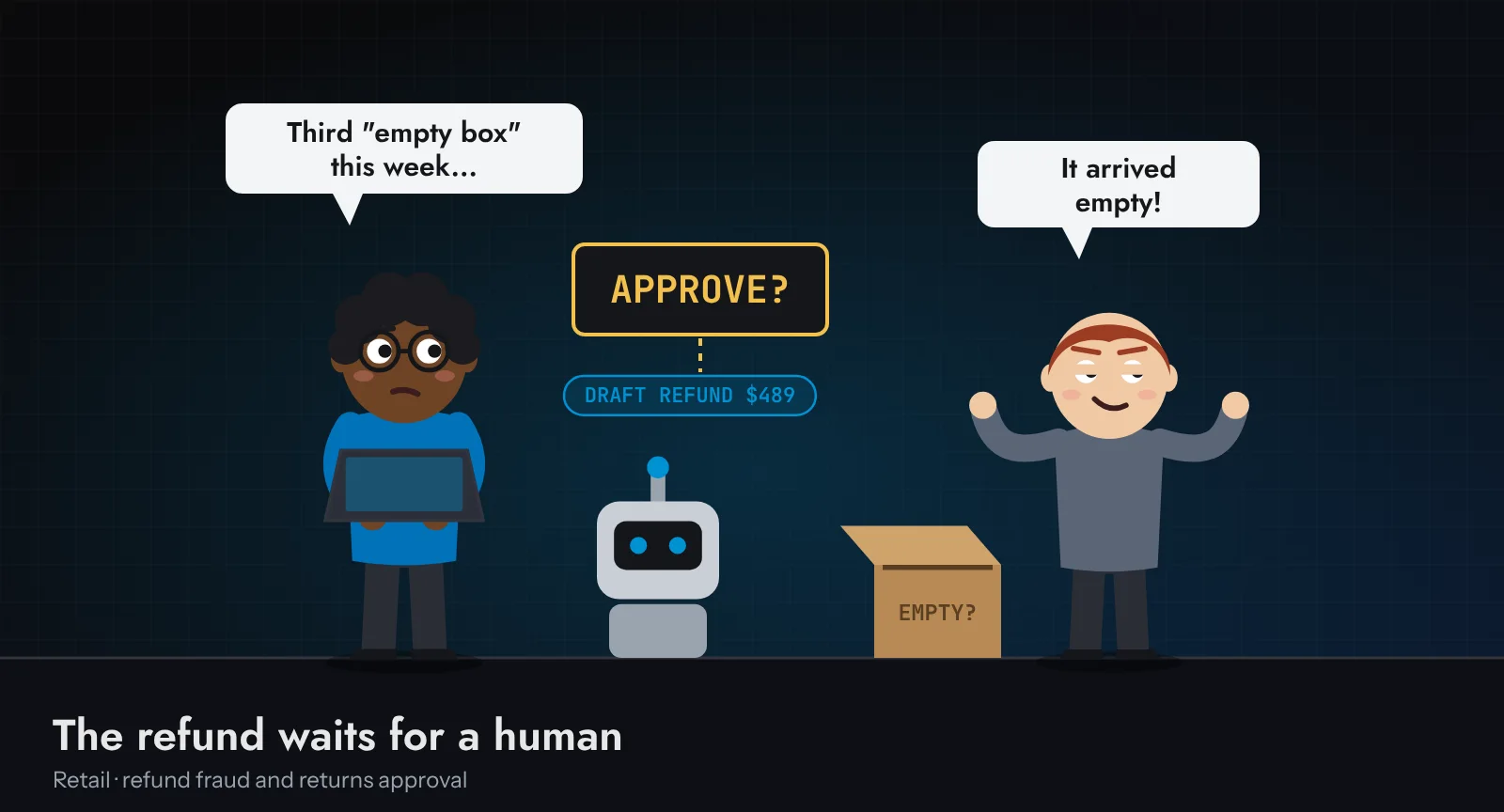
Earlier this year Scott Tannen, chief executive of the bedding brand Boll & Branch, opened a customer service ticket about a set of sheets that had "arrived torn". The rip did not look like the way cotton frays, and one photo still carried an AI watermark. His team asked the customer to show the damage over a FaceTime call. The customer never replied, Modern Retail reported. A review of recent tickets found a handful more.
That check took one person a few minutes. Now multiply it by the returns that start arriving after Black Friday on 27 November, with temporary staff on the desks and fraud crews who are counting on you being too busy to look.
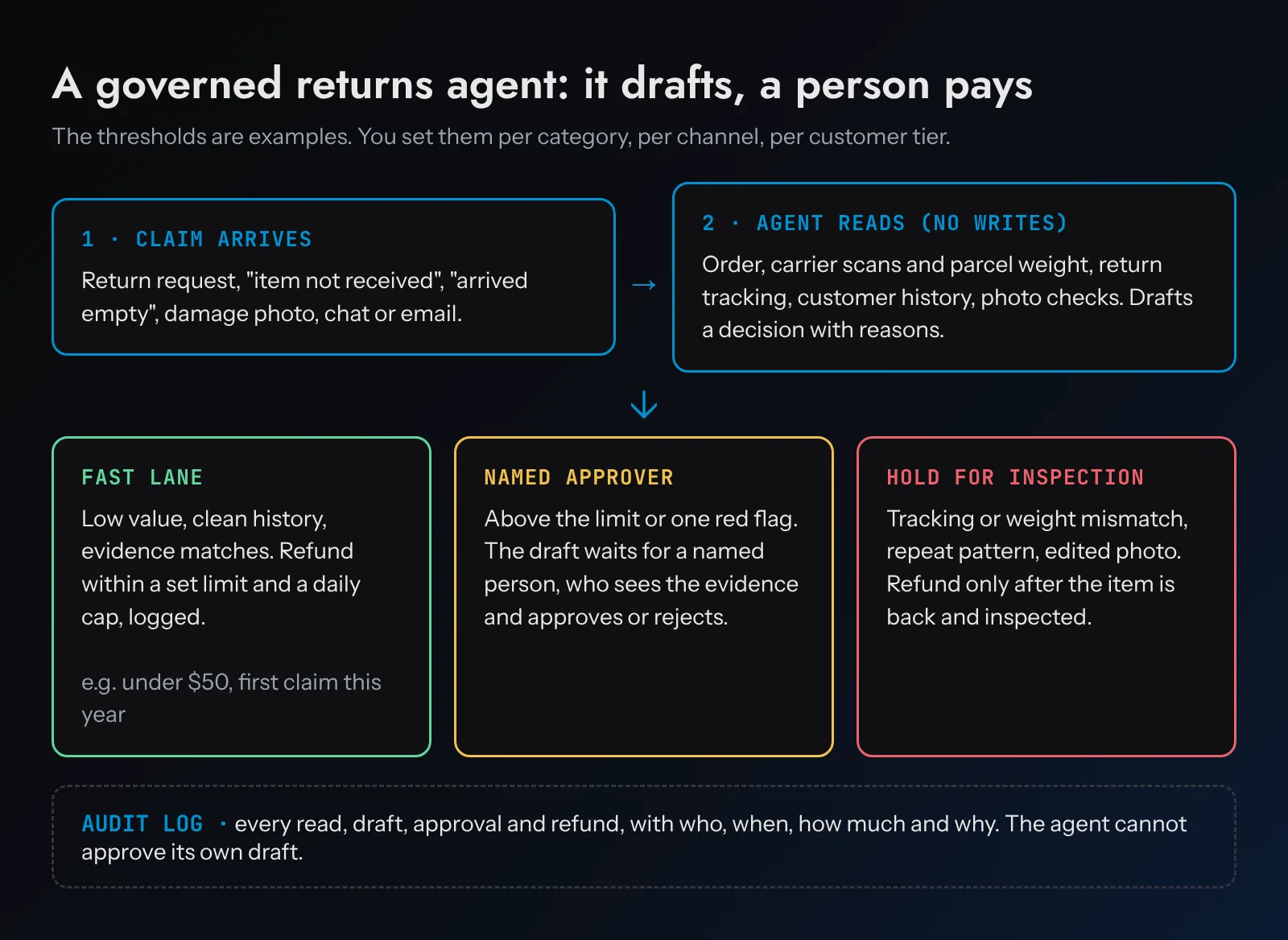
The safe way to use AI against refund fraud is to let it triage returns, not pay them: an agent reads the order, tracking and history and drafts each refund, small clean claims go through within a hard limit, and everything else waits for a named approver, with every step logged.
This guide is for retail operations and customer service directors. It covers what refund fraud looks like this season, why "auto-approve everything" and "check everything by hand" both fail at peak, and how to set up an AI returns process that is fast for honest customers without handing a model the till.
Key takeaways
- Retailers surveyed by NRF and Happy Returns say 9% of all returns are fraudulent, and they expect 17% of holiday sales to be returned.
- Appriss Retail puts preventable returns fraud and abuse at $100 billion in 2025, or 14.2% of the $706 billion returned, of which $14 billion is outright fraud.
- Flashpoint counted underground Black Friday fraud chatter rising from 98 posts in October 2025 to 674 in November, nearly sevenfold.
- In September 2026 Flashpoint found 135 posts recruiting retail insiders, many seeking staff who can approve refunds or issue gift cards.
- An AI agent should read freely and draft refunds, but money should only move within a set limit or after a named person approves, with a full audit log.
How big is refund fraud in 2026?
It depends on the definition, and the sources disagree, so it is worth being precise.
- NRF and Happy Returns estimate US returns at $849.9 billion in 2025, 15.8% of sales, and say 9% of all returns are fraudulent. Retailers that track it saw rises in overstated return quantities (71%), empty box or "box of rocks" returns (65%) and decoy returns such as counterfeits (64%).
- Appriss Retail's 2026 Total Retail Loss report uses a lower total, $706 billion returned in 2025, and says 14.2% ($100 billion) was preventable fraud and abuse: $14 billion of outright fraud (2% of returns) and $86 billion of abuse (12%), such as wardrobing and bracketing.
- Chargebacks911's 2026 field report says 27.1% of merchant returns involve some form of abuse, and 62% of merchants call refund abuse a moderate or significant concern.
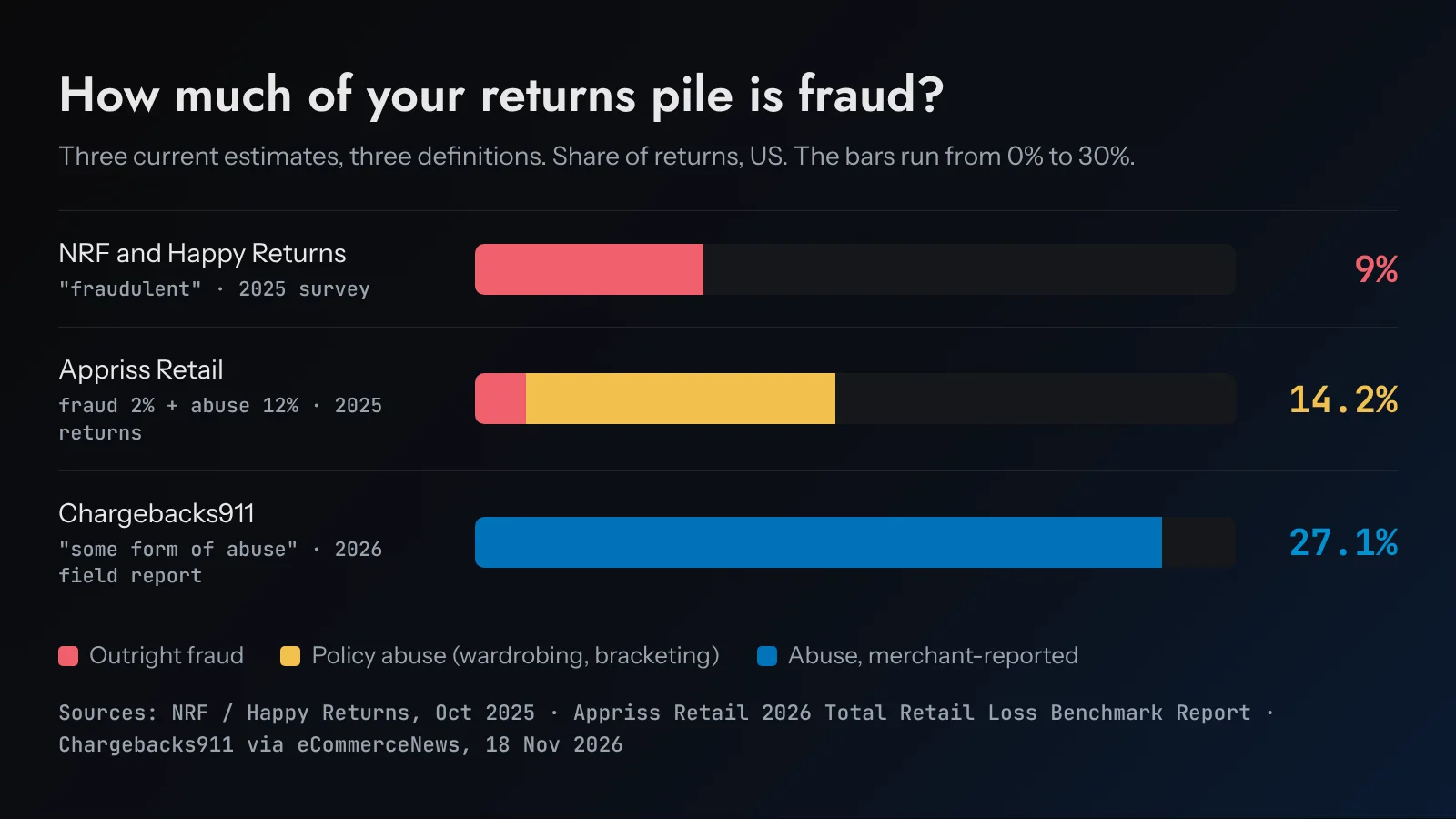
The practical reading: a small slice is criminal, a larger slice is customers bending your policy, and most claims are honest. Any process you design has to treat those three groups differently.
The money is also about to get bigger. NRF forecasts US holiday sales of $1.013 trillion for November and December 2026, up 4.2%. Retailers in the NRF returns survey planned to cope with holiday returns and fraud by leaning on third-party logistics partners (49%), hiring seasonal returns staff (43%) and extending return windows (37%). Each of those adds people and gaps between systems.
What refund fraud methods are being sold ahead of the holidays?
Refund fraud is now a service you can buy. Flashpoint's November 2026 briefing describes "refund fraud as a service" menus priced by retailer and method, and one Telegram channel selling a two-tier course with mentorship and a list of more than 80 target retailers. A search of its collection returned more than 7,000 results about fake tracking IDs (FTID) in 30 days.
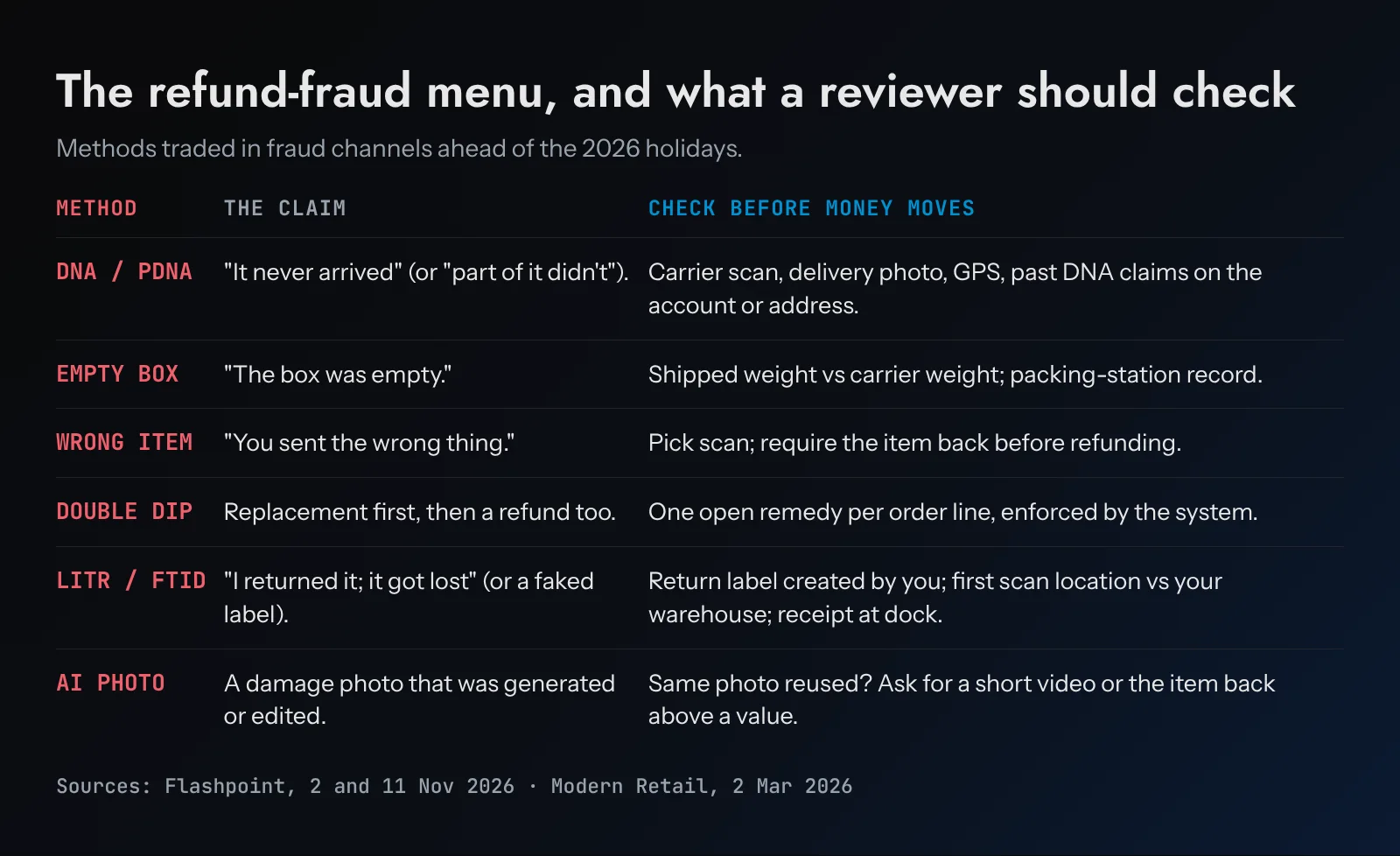
Flashpoint's holiday report on retail fraud lists the methods traded most often:
- Did not arrive (DNA) and partial DNA: "it never came" or "part of it was missing".
- Empty box: the parcel arrived but "contained nothing".
- Wrong item: "you sent the wrong thing", sometimes returning a cheaper substitute.
- Double dip: a replacement is sent, then a refund is claimed as well.
- Lost in transit return (LITR): "I sent it back and the carrier lost it".
Two newer twists matter for anyone thinking about automation. Fraudsters use generative AI to fake damage photos, shipping receipts and even police reports, according to retailers and fraud vendors interviewed by Modern Retail. And Signifyd told the same publication that fraudsters use language models to write waves of "highly optimised, irate" messages designed to make customer service give in.
Why do fraudsters target peak season and the people on the desk?
Because peak season removes the two things that stop them: time and attention.
Flashpoint counted underground posts using Black Friday and related fraud terms rising from 98 in October 2025 to 674 in November. One actor talked about running fake-tracking refund fraud during Black Friday precisely because retailers would be "overwhelmed by return requests".
The people who approve refunds are targets too. In September 2026 Flashpoint identified 135 insider recruitment posts aimed at retail, the largest industry category that month, looking for staff able to approve refunds, issue gift cards or access customer accounts. Appriss Retail notes that professional fraudsters will "socially engineer the associate or call centre" into an override, and puts employee theft, including fake refunds and unauthorised voids, at $26 billion of shrink.
The lesson for an operations director is not "trust nobody". It is that the refund button is the asset. Whoever or whatever can press it needs limits, a second pair of eyes above those limits, and a record of every press.
Should you let an AI agent approve refunds on its own?
Not without limits. The pressure to do so is real: 76% of consumers say they are more likely to choose a return option that gives an instant refund or exchange, and brands are replacing human agents with automation to cut costs. But a model that can issue refunds on its own judgement is exactly what the fraud menus are written for.
Three reasons to keep the till out of the model's hands:
- The input is adversarial. Photos can be generated, receipts forged and chat messages written to persuade. An agent that reads a message saying "your manager already approved this" must treat it as data, not an instruction. That is the prompt injection problem, and the only reliable fix is structural: the agent simply cannot pay beyond its limit, whatever it is told.
- Automated workflows are being targeted directly. Thales told Retail Insider that retail accounted for 24% of business logic attacks in its 2026 Bad Bot Report and that 27% of bot attacks hit APIs. Its advice applies to refunds: "authentication tells you who or what is making a request, but it doesn't necessarily tell you whether that request is appropriate."
- Over-blocking costs money too. Appriss Retail found 47% of shoppers have held back from a purchase over return policy concerns, and Chargebacks911 warns that tighter rules push some losses into chargebacks. An agent tuned to say no to everything is not a win either.
So the answer is in the middle: an agent that does the reading and drafting at machine speed, inside rules you set, with people deciding where judgement and money meet. This is the pattern we describe in human-in-the-loop AI agents.
How do you set up an AI returns process that cannot empty the till?
1. Give the agent read access, not refund access
The agent should be able to read the order, the pick and pack scans, the shipped weight, carrier tracking, the return label, past claims on the account and address, and the photos. It should not hold credentials for your payment processor or e-commerce admin. It reaches the refund function through one narrow operation, "draft refund", that your system controls. This is least privilege for AI agents applied to the returns desk.
2. Have it draft a decision with reasons
For every claim the agent produces a draft: approve, approve after the item is back, ask for more evidence, or refer. Each draft lists the evidence it used, for example "carrier weight 0.42 kg matches shipped weight 0.43 kg, first claim in 24 months". A reviewer should be able to agree or disagree in seconds.
3. Set a fast lane with hard limits
Honest customers want speed, so let the cleanest claims through without a person, but only inside limits enforced by your system, not by the prompt:
- a value ceiling per refund (set per category; high-value goods get a lower one or none),
- a daily cap on the total the fast lane can pay,
- conditions such as "evidence matches and no claim in the last 12 months",
- one open remedy per order line, so a replacement and a refund cannot both go out.
When the daily cap is reached, everything waits for a person. That one rule turns a bad day into a contained one.
4. Route everything else to a named approver
Above the limit, or with any red flag, the draft goes to a named person with the evidence on one screen. They approve or reject, and the decision is recorded against their name. The agent cannot approve its own draft, and staff should not approve claims on their own accounts or for people they know. Given the insider recruitment Flashpoint found, consider a second approver for refunds above a higher threshold.
5. Hold suspicious claims until the item is back
Tracking that ends nowhere near your warehouse, a weight mismatch, a reused or edited photo, a pattern across accounts at one address: these go to "refund on receipt and inspection". Bogg and Boll & Branch both moved to requiring the product back for suspicious claims, according to Modern Retail. Appriss suggests a "warn and approve" middle step for customers whose behaviour is drifting towards abuse; its claim that this cuts abusive returns by 90% is the vendor's own figure.
6. Log every step
Every read, draft, approval, rejection and refund should be logged with who, when, how much and why. The log is how you spot a reviewer approving far more than their peers, how you answer a chargeback, and how you decide later whether the fast-lane limit can safely rise. Our guide to an AI agent audit trail covers what to keep.
What does this save at peak? A worked example
These numbers are assumptions to show the arithmetic, not results. Swap in your own.
- Assume a retailer receives 2,000 refund claims in the first week of January.
- Assume a person needs 6 minutes to check a claim properly by hand: 2,000 × 6 = 12,000 minutes, or 200 hours of desk time.
- If NRF's 9% holds, about 180 of those claims are fraudulent (2,000 × 9%).
- Now assume the agent's draft lets 60% of claims through the fast lane, and a person reviews the other 40% (800 claims) in 2 minutes each, because the evidence is already gathered: 800 × 2 = 1,600 minutes, or about 27 hours.
On those assumptions the desk goes from 200 hours to about 27, and every claim with a red flag still meets a human. The figure that matters most is not the hours saved. It is that the fast lane's exposure is capped by your daily limit, whatever happens.
We have run this approval pattern in a live demonstration. In Ware, our simulated warehouse and press shop running real orders from open data, the agent acts on its own within a delegation, anything that spends goes to the right manager, and it cannot approve its own request. On the peak day 52 of 59 orders shipped with Ware on duty against 34 with nobody acting. It is a demonstration we built, not a client, and returns are a different workflow, but the control pattern is the same.
What should you do before the returns surge?
This week, before Friday:
- Write down who can issue a refund today, in which systems, up to what amount, and whether anyone sees it. Include contractors and seasonal staff.
- Set or lower override limits for temporary staff, and require a second approver above a threshold.
- Check you can see the shipped weight and first carrier scan for every order. Without them, empty-box and LITR claims are guesswork.
- Join returns and chargeback data, or at least give one person both reports, as Chargebacks911 recommends.
- Brief the desk on the menu: DNA, empty box, wrong item, double dip, FTID and AI-edited photos, plus a standard reply asking for video or the item back.
Through December and January:
- Watch refunds per reviewer and per address daily.
- Track how many fast-lane refunds later became chargebacks or failed inspection, and tighten the limit if the number climbs.
- Only raise limits on evidence from the log, one step at a time.
Where Devs Core fits
We build governed AI agents that work inside the systems a retailer already runs, such as the order system, the WMS, the helpdesk and carrier APIs. Reads run freely, anything that moves money waits for a named approver beyond the limits you set, and every action is logged. If you want to know where an agent like this would sit in your own returns process, our AI Readiness Audit maps it in two weeks and ends in a written build plan. More on retail work is on our e-commerce and retail page.
Frequently asked questions
What is refund fraud?
Refund fraud is getting money back for goods that were not returned, not missing or not faulty. Common forms are false "did not arrive" claims, empty-box claims, wrong-item claims, double dipping and fake return tracking. It sits alongside policy abuse such as wardrobing, which bends the rules without always breaking the law.
How common is return fraud in 2026?
Retailers surveyed by NRF and Happy Returns say 9% of all returns are fraudulent. Appriss Retail puts fraud and abuse together at 14.2% of returns in 2025, worth $100 billion, of which $14 billion is outright fraud. The figures differ because the definitions differ.
Can AI detect fake damage photos in refund claims?
Sometimes. Retailers have caught AI-generated photos from watermarks, duplicated images and damage that does not match the material. Detection is not reliable on its own, so for higher-value claims ask for a short video or the item back before refunding.
Should AI automatically approve customer refunds?
Only within hard limits set in your system: a value ceiling, a daily cap and clean-evidence conditions. Above those limits the AI should draft the refund and a named person should approve it. The AI should never be able to approve its own draft, and every step should be logged.
How do I stop fake tracking (FTID) refund fraud?
Create return labels yourself rather than accepting customer-supplied tracking, check the first scan location against your warehouse, and only refund after the parcel is received and inspected at your dock for claims that match the pattern. Flashpoint found more than 7,000 FTID-related results in its collections in 30 days, so expect attempts.
Do stricter return policies reduce refund fraud?
Not reliably. eMarketer research cited by Chargebacks911 found 44% of merchants that introduced return fees saw fraud rise, while 42% saw it fall, and stricter rules can push losses into chargebacks. Targeted checks on risky claims usually work better than making returns harder for everyone.