
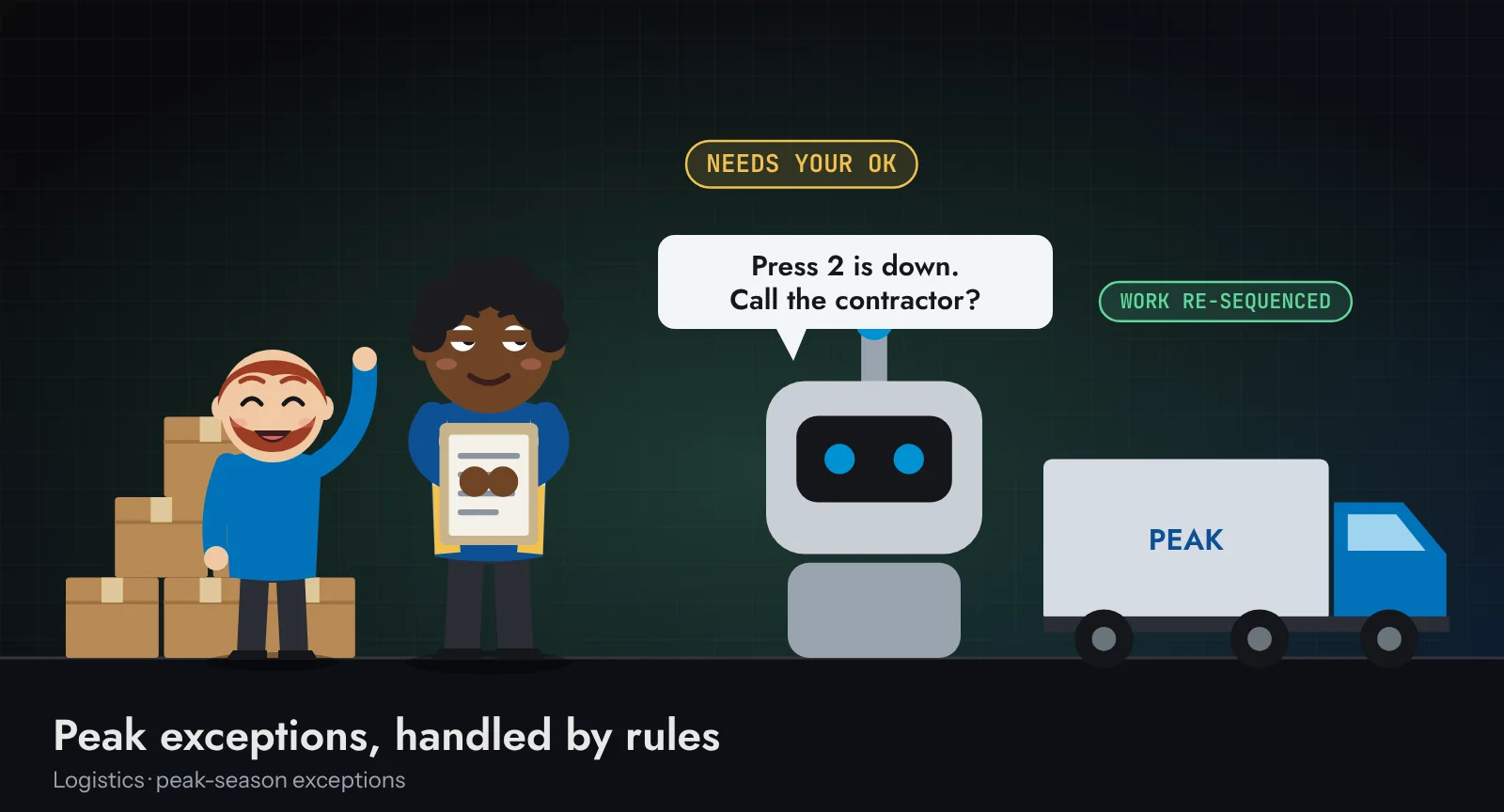
It is 07:40 on the Monday after Black Friday. Call her Maria. She is made up, but nothing that happens to her is unusual. She runs operations at a distributor with one warehouse and a small assembly line. Overnight, 41 orders went short of a part. A carrier has flagged a batch of parcels as delayed. Press 2 tripped its light curtain at 06:55. Two seasonal pickers did not turn up. Maria's phone has 14 unread messages, and every one of them is an exception: something that has gone off plan and needs a person to find out what happened, work out what it affects, and decide what to do.
That is what peak season exceptions feel like. The volume is not the problem. The exceptions are. Yes: an AI agent can work most peak season exceptions (shortages, delays, breakdowns) inside rules you set, as long as it can only act through a permissioned layer that lets it read freely, act on small things alone, and wait for a named manager before it spends money or changes a customer promise. This post shows what that looks like, what it did on a real peak day in our own demonstration, where it did not help, and what to set up before the next rush.
Key takeaways
- NRF forecasts US holiday retail sales of $1.013 trillion for November and December 2026, up 4.2%, while US warehousing employment stood at 1,839,200 in October 2026, essentially flat on a year earlier.
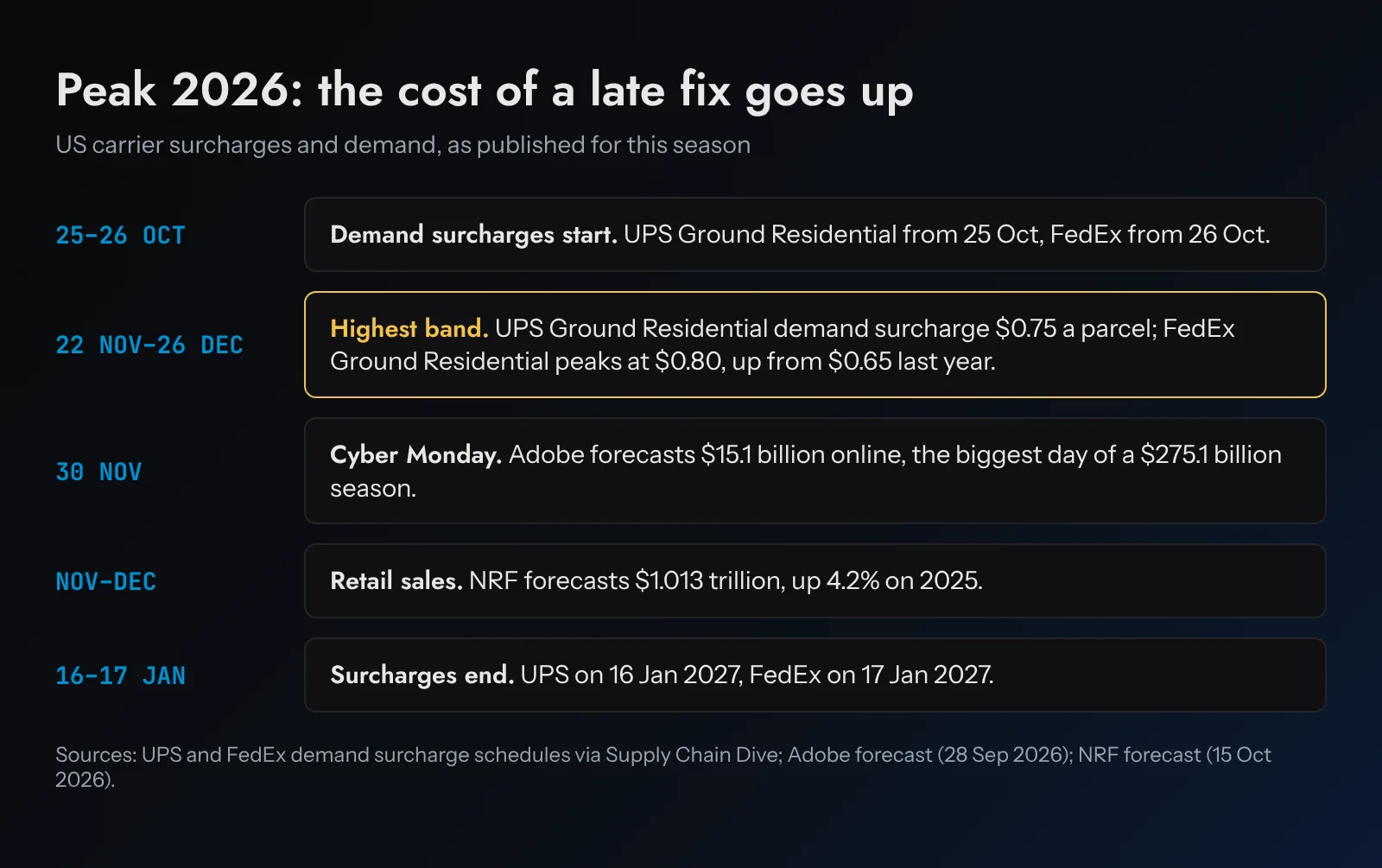
- FedEx's Ground Residential demand surcharge peaks at $0.80 a parcel in 2026, up from $0.65, so every exception that ends in a re-shipment costs more in the peak weeks.
- In our Ware demonstration on real order data, an AI agent on duty shipped 52 of 59 orders on the peak day, against 34 with nobody acting, for $0.76 of AI.
- The same agent did not help on a day when one customer ordered 6,408 units: no amount of re-sequencing creates press capacity that does not exist.
- The safe pattern is "reads pass, small writes run, spending waits": the agent proposes, policy decides, a named manager approves anything that costs money, and every action is logged.
Why are peak season exceptions worse in 2026?
Three things are landing at once: more volume, dearer fixes and thinner cover.
More volume. The National Retail Federation forecasts November and December 2026 retail sales of $1.013 trillion, up 4.2% on 2025. Adobe forecasts $275.1 billion of US online spending from 1 November to 31 December, up 6.7%, with Cyber Monday on 30 November expected to be the biggest single day at $15.1 billion. Every one of those orders is a chance for something to go short, late or wrong.
Dearer fixes. Carriers price peak capacity up, and a parcel that has to be re-sent or upgraded pays it again. FedEx's Ground Residential demand surcharge peaks at $0.80 a parcel this season, against $0.65 last year, and its overnight demand surcharges run from $1.30 to $2.55 a package. UPS set Ground Residential demand surcharges of $0.50 to $2.50 from 25 October to 16 January 2027, with large-package surcharges of $96.25 to $117.50, and volume-based charges of up to $9.35 a package for customers billed for more than 20,000 packages in a week. In the busiest weeks, a residential Ground parcel carries a $0.75 (UPS) or $0.80 (FedEx) demand surcharge on top of the regular residential surcharge. Amazon Shipping's additional-handling fee is $11.90 from 22 November to 26 December.
Thinner cover. US warehousing and storage employment was 1,839,200 in October 2026 (preliminary), essentially unchanged from a year earlier. Seasonal help is arriving later: warehouses are hiring roughly two weeks before they need people, and UPS is keeping seasonal hiring roughly flat at more than 100,000, while Amazon aims for more than 300,000. Retail Dive reports that about a third of large employers' postings were labelled seasonal last September, against around 20% this year. Fewer experienced hands, and new ones who do not yet know where anything is.
Then there are the outages. In the six days to 17 November, Politico counted six major outages, from Microsoft 365 and an FAA ground stop to delayed bank payments and an Apple failure that hit Apple Pay and in-store software. None was a logistics system. All of them created exceptions downstream: payments that did not clear, flights that did not leave, emails that did not arrive.
What counts as a shipment exception, and why do they eat the day?
A shipment exception is any order, delivery or job that has left the plan and needs a decision before it can carry on. In a warehouse or a plant, the common ones are:
| Exception | What someone has to work out | Typical fix |
|---|---|---|
| Order short of stock | Is it anywhere else? Is anyone making it? When? | Release or re-sequence work; split the order |
| Material or inbound late | Which jobs does it block? What can run instead? | Hold the job, run the next; expedite |
| Machine or station breakdown | How long? Which orders miss their truck? | Call a technician or contractor; re-plan |
| Carrier delay or failed pick-up | Which customers are affected? Is there a promised date? | Rebook, upgrade, or tell the customer |
| Quality failure | Which batches? Is it the machine or the material? | Hold work, change the die or tool, re-make |
Each exception is small. The work is the finding out: the facts sit in the ERP, the WMS, the carrier portal, a spreadsheet and somebody's head. Carriers get most parcels there on time. ShipMatrix data reported by FreightWaves put December 2025 on-time delivery at 97.2% for UPS and 95.3% for FedEx Express. The trouble is the rest, multiplied by peak volume.
A worked example, with assumptions labelled. Assume a distributor ships 3,000 parcels a day in peak, and assume 2% of orders hit an exception of some kind (short, late, damaged, address problem). That is 60 exceptions a day. Assume each takes a supervisor 10 minutes to look up, decide and action. That is 600 minutes: ten hours of a skilled person's day, every day of the peak, spent on lookups rather than on the floor. Your numbers will differ. Count them for a week before you buy anything.
Can an AI agent handle exceptions on its own?
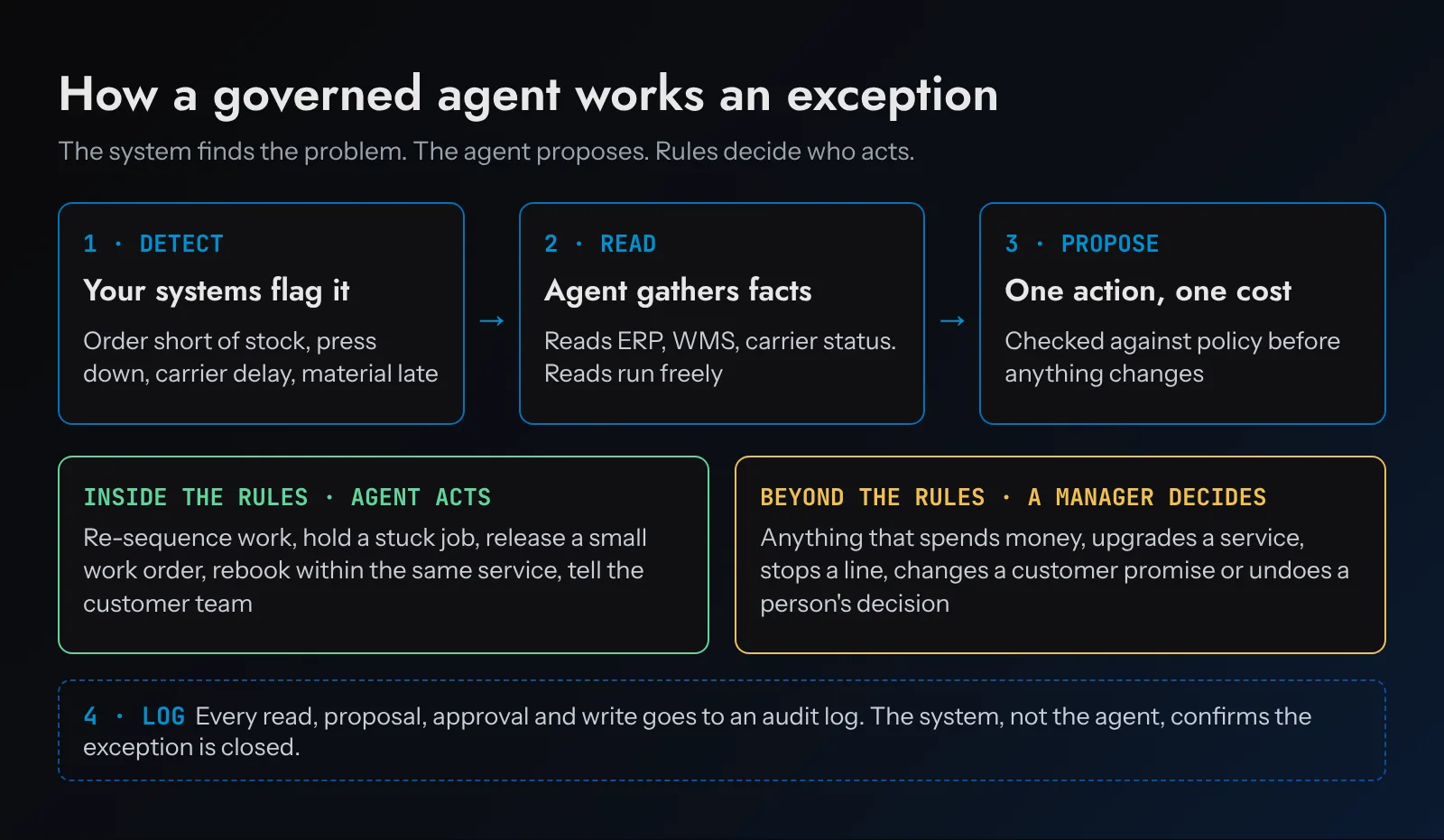
Some of them, within limits, and that is the point. An AI agent is software that reads your systems, works out what an exception affects, and proposes or takes an action through the same tools a person would use. The question is not whether the model is clever enough. It is what you let it do without asking.
We built Ware to answer that on real data. Ware is our own live 3D warehouse and press shop, not client work. It replays every order of three real days from an open dataset (a UK giftware wholesaler's orders), with presses failing at the rates real machines recorded. An AI agent works the exceptions the simulation finds, within rules:
- It may act alone to release a work order of up to 120 units, run work next, hold a stuck job and re-sequence.
- It must ask the Production, Logistics, Maintenance or Quality Manager before anything larger: a bigger work order, an express delivery, a contractor call-out, a 40-minute die change.
- It never undoes a person: changing anything a person acted on in the last simulated hour needs that person's manager.
- The engine, not the model, decides when an exception is closed. A model may claim "handled"; Ware accepts it only when the simulation shows it.
In one logged run of the peak day, inspection broke down at 09:08 with a 20-minute repair. At 09:10 the agent asked the Maintenance Manager for a contractor call-out. It was approved, and the repair was cut to about ten minutes. That is the shape you want: the agent did the finding out and the asking; a person made the spending decision in seconds.
What happened on the peak day, and where did it not help?
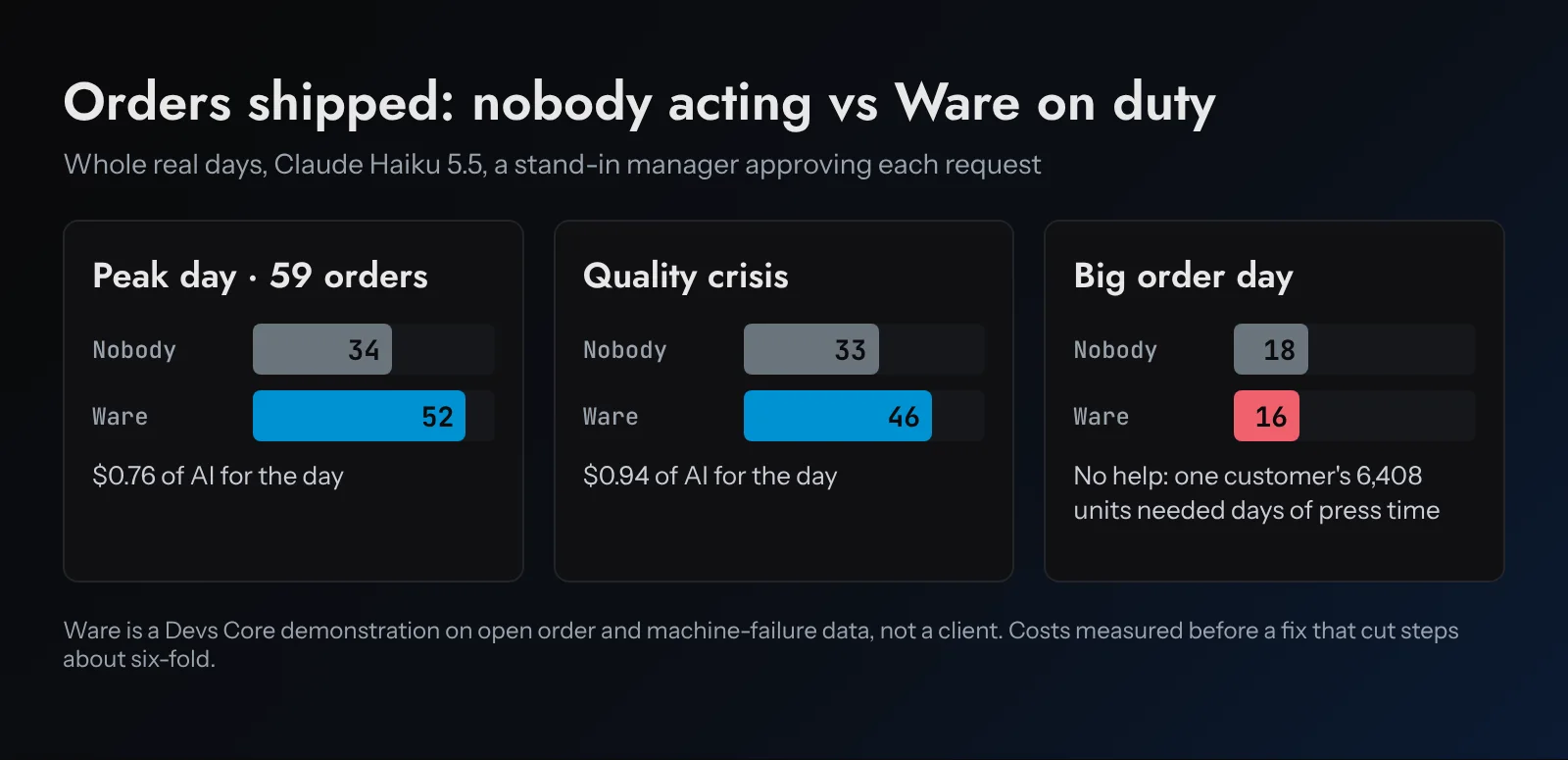
We ran each real day from 07:00 to 20:00 with a stand-in manager approving every request, and compared it with the same day run with nobody acting. With Claude Haiku 5.5 on duty:
| Day (orders shipped / still short) | Nobody acting | Agent on duty | AI cost for the day |
|---|---|---|---|
| Peak day (59 orders) | 34 / 25 | 52 / 7 | $0.76 |
| Quality crisis | 33 / 25 | 46 / 12 | $0.94 |
| Big order day | 18 / 18 | 16 / 20 | $1.54 |
On the peak day and the quality crisis, the agent shipped far more orders, by working the shortages the morning plan did not cover and getting breakdowns repaired sooner. On the big order day it did not help. One customer ordered 6,408 units, far more than the press line makes in a day. No re-sequencing creates capacity that is not there, and the agent traded one ordinary order for another. We publish that result because it is the honest boundary: an agent is good at the many small exceptions, not at a capacity problem that needs a commercial conversation.
Two more honest notes. Those costs were measured before a fix that cut the agent's steps about six-fold on our scripted runs, and we have not yet re-measured the bill with a real model. And Ware is a simulation of the plant: the orders and failure rates are real; the plant, its stock and its people are not.
What rules should an exceptions agent follow?
Write the rules before you write any code. They fit on one page, and they are the part your finance director and your operations director need to sign.
1. Reads run freely
The agent can look up orders, stock, carrier status, machine status and job queues without asking. Reading is where most of the time goes, and it changes nothing. Give it read access to exactly the systems the exception list needs, not the whole estate.
2. Small, reversible writes run within a limit
Re-sequencing work, holding a stuck job, releasing a small work order, rebooking on the same service level, drafting a customer update for the team to send. Set a number for each (Ware's is 120 units per work order) and a budget per exception and per day.
3. Anything that spends or promises waits for a named person
Express freight, a service upgrade, overtime, a contractor, cancelling or splitting a customer order, changing a promised date. The agent proposes one action with its cost; the right manager approves that exact action. This is human-in-the-loop design, and in peak it is faster than it sounds: the agent has done the lookup, so the decision takes seconds.
4. Every action goes through one gate and one log
The agent's actions and people's actions should pass the same checks: valid, not a duplicate, not stale, within policy, approved if needed, logged. If the floor changed since the agent made its plan, the action is refused. Our AI governance page sets out how we build and test these controls.
5. Your system, not the agent, says when it is fixed
An agent's "done" is a claim. Close the exception only when the WMS shows the parcel booked, the work order released or the contractor on the way.
6. A person can take any exception back
"I've got this" should take one exception off the agent at once, and a stop button should take the agent off duty and void its pending requests. In peak, people will want to step in. Let them.
What should you do this week?
You will not deploy a new agent in the middle of peak, and you should not try. You can get ready for the next one, and get some value now.
- Count your exceptions for five working days. Type, time to resolve, who resolved it, what it cost. A tally sheet is fine. This is the business case.
- Write down who decides what. For each exception type: who may act, up to what amount. If nobody owns a decision, it ends in a phone call, and an agent will have nobody to ask.
- Check what your systems can tell a program. Can the WMS and ERP expose order, stock and job status through an API or a database view? If the answer is "only on screen", that is the first project.
- Decide your spending limits now. Express freight, overtime and contractor call-outs: what is the most anyone should approve without a second person?
- Plan for the outage. If your carrier portal or email is down for two hours, as several services were in mid-November, what is the manual fallback? An agent should fail safe: stop acting, keep the log, hand back to people.
- Pick one exception type for January. The commonest, cheapest one. Prove the pattern there before widening it.
If you want help with steps 2 to 4, our AI Readiness Audit is two weeks, fixed price, and ends in a written build plan that shows where an agent would sit in your systems and what it would be allowed to do. When you are ready to build, an agent pilot puts one exception type on duty with approvals and logging from day one, and our AI agent development work extends it one rung of autonomy at a time.
Peak season will always bring exceptions. What can change is who does the finding out. See how Ware works the exceptions of a real day in our Ware case study, or read how we approach distribution and logistics operations.
Frequently asked questions
What is a shipment exception in logistics?
A shipment exception is any order or delivery that has left the plan and needs a decision before it can continue: a stock shortage, a late inbound, a carrier delay, a failed pick-up, damage or a quality hold. Each one is usually small, but finding the facts across the ERP, WMS and carrier systems takes a person's time, and peak volume multiplies it.
Can an AI agent handle shipment exceptions without human approval?
It can handle the small, reversible ones alone if you set limits, such as re-sequencing work or releasing a work order up to a set size. Anything that spends money, upgrades a service or changes a customer promise should wait for a named manager. In our Ware demonstration, the agent asked the Maintenance Manager before every contractor call-out.
How much does it cost to run an AI agent on exceptions for a day?
In Ware, our demonstration on real order data, a whole peak day with Claude Haiku 5.5 on duty cost $0.76 of AI, and $4.03 with Claude Sonnet 5.5. That was measured before a fix that cut the agent's steps about six-fold. Building and connecting the agent to your systems is the larger cost; our agent development work starts from $6,500.
Should we deploy an AI agent during peak season?
No. Changing how exceptions are handled in the middle of peak adds risk at the worst moment. Use peak to count your exceptions and write down who decides what, then pilot one exception type in January, when volumes fall and people have time to review what the agent does.
What happens if the AI agent or our systems go down during peak?
A well-built agent fails safe: it stops acting, keeps its log and hands the open exceptions back to people, and the operation runs on as it did before. In Ware, with the AI switched off, the budget used up or every provider down, the day carries on and nothing is charged. Plan your manual fallback either way, because outages like those of mid-November 2026 will happen again.