
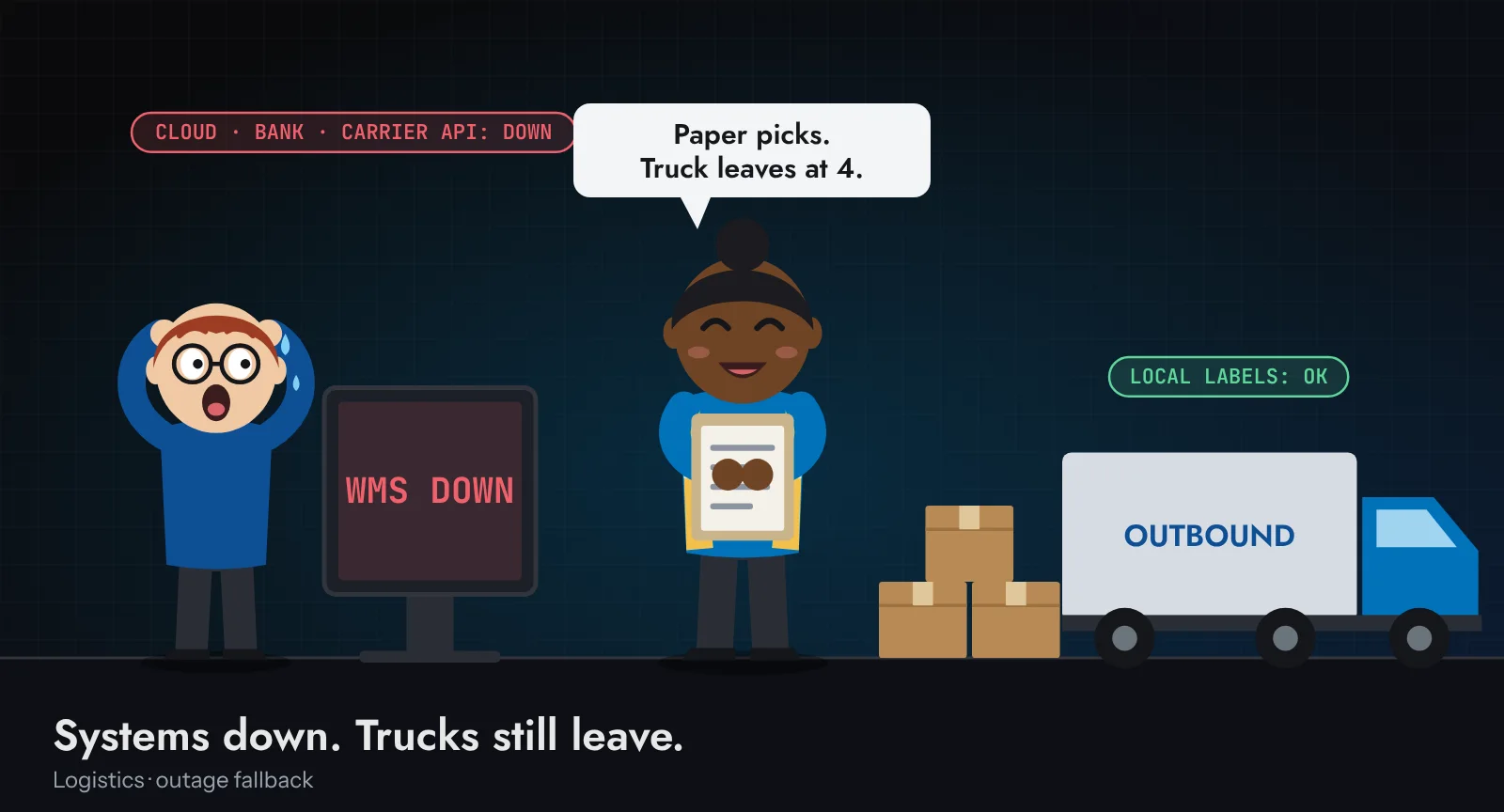
Call her Dana. She is made up, but her Thursday is not unusual. She runs the outbound dock at a mid-size distribution centre. At about half past twelve Eastern on 12 November, Outlook stops connecting. Orders from two wholesale customers arrive by email, so they stop arriving. The carrier booking confirmations stop too. Next day, the FAA grounds every departure in the country and her air freight sits. On Monday, a customer's payment is stuck in a bank's queue and the order is on hold. None of it is her fault, and none of it is in her building.
Yes, your warehouse can keep shipping through a cloud, bank or carrier outage, but only if you have decided in advance what runs offline, who calls the switch, and you have practised it once before peak. This is a plan for a warehouse IT outage: what to keep local, what to queue, and what to test this month.
Key takeaways
- Four major US system failures hit in four consecutive business days, 12 to 17 November 2026, and officials and companies ruled out cyberattacks (CNBC).
- 57% of operators said their most recent major outage cost more than $100,000, and one in five said more than $1 million (Uptime Institute, 2026).
- About two-thirds of publicly reported outages over nine years came from third-party providers, so most risk to your dock sits with suppliers.
- A warehouse that degrades in four steps (normal, degraded, manual, recovery) keeps trucks leaving; one that has only "normal" stops.
- Run a two-hour fallback drill before the December peak: the UK NCSC warns that "many plans fail in practice" until they are exercised.
What actually went down in November 2026?
It started on Thursday 12 November. ThousandEyes saw Outlook connections failing from around 17:30 UTC, and service "was not fully restored until shortly before 14:00 UTC on November 13". Sign-in and the Microsoft 365 portal were disrupted too. Microsoft blamed an issue introduced during an earlier network capacity upgrade.
On Friday 13 November the FAA stopped every departing flight in the US. USA Today reported it lifted "more than four hours after the stoppage began"; CBS News said about five. CBS sources said a network update caused a reboot and crash, and officials said new security patches appeared to overwhelm old routers. For freight, Sourcing Journal reported that UPS paused all flight operations "until further notice" and Expeditors warned of a backlog through the weekend.
On Monday 16 November, Chase customers and others reported problems. Chase said "some transactions are taking longer than usual to complete" and that a software bug affected other institutions when Chase was party to a transaction. United Airlines had a separate outage the same afternoon.
On Tuesday 17 November, the NSA's internal network went down. CBS News reported that the Director of National Intelligence linked it to patching after the PHP2Shell vulnerabilities. Apple cited "an internal update", and cleveland.com's running list records outage reports for Gmail, Apple Pay, iCloud, Charles Schwab and Cloudflare that day.
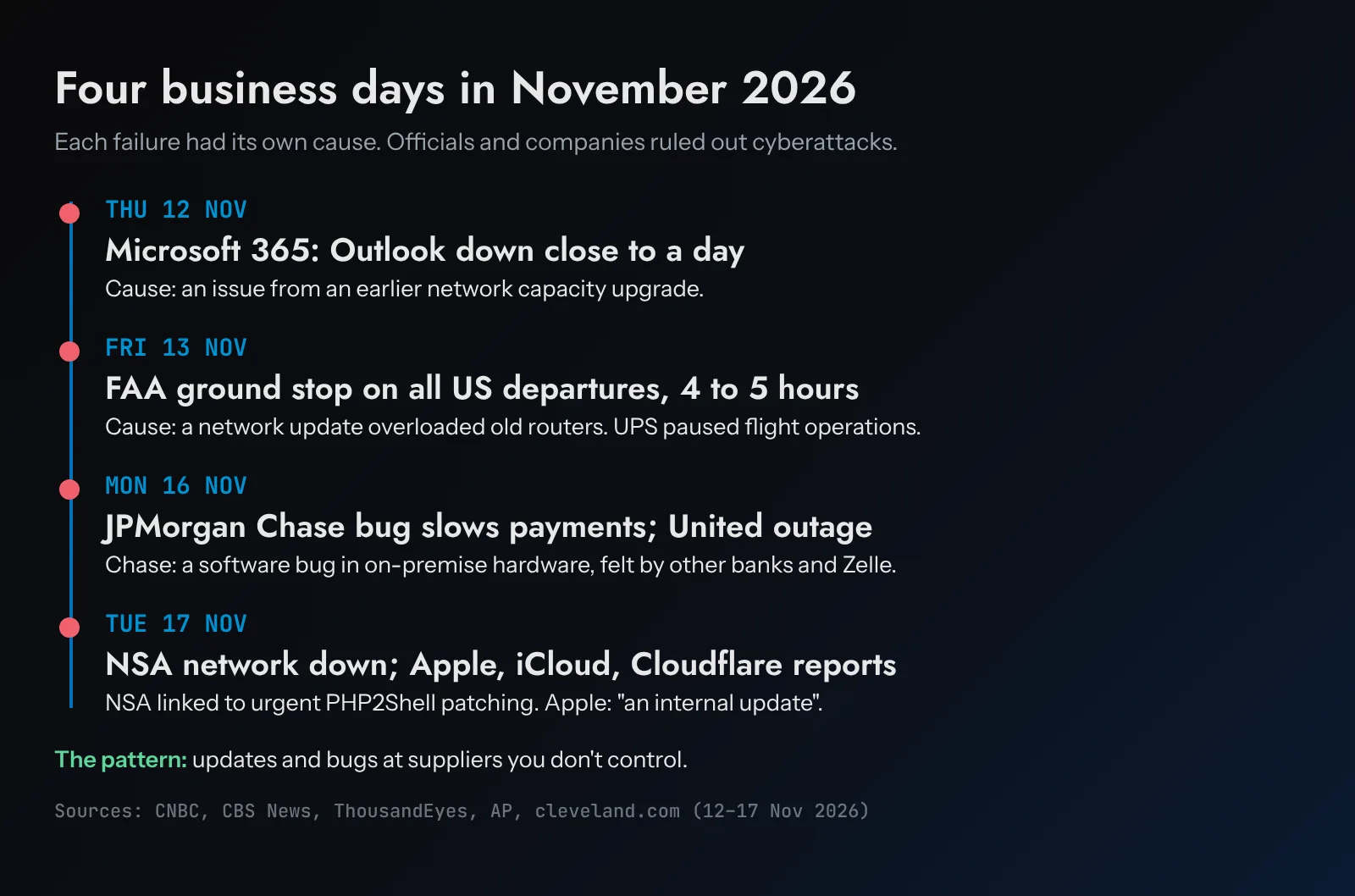
The Associated Press found travellers asking whether it was all a cyberattack. Officials said no, which is the more uncomfortable answer: ordinary changes and bugs at your suppliers, which will happen again.
Why should a warehouse director care about an Outlook or bank outage?
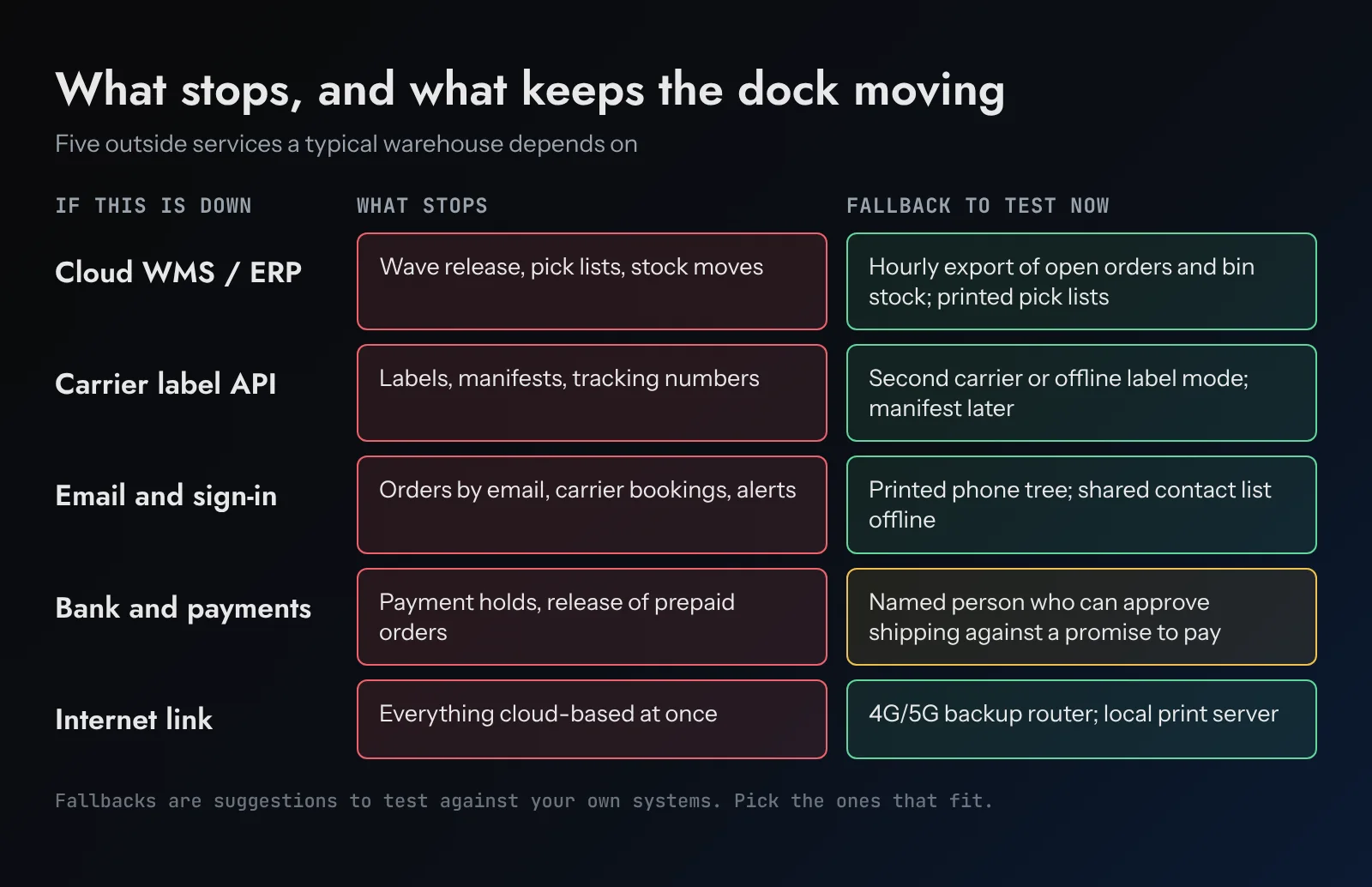
Because your warehouse runs on other people's systems. A typical mid-size site depends on a cloud WMS or ERP, carrier label APIs, email and single sign-on, a bank and a payment processor, and one internet line. Each one can stop the dock on its own.
The Uptime Institute's 2026 outage analysis puts numbers on this. Over nine years of publicly reported outages, third-party providers (cloud and internet giants, telecoms, colocation) account for about two-thirds. Outages linked to fibre and connectivity are rising and are more likely to run long. And costs keep edging up: 57% of respondents said their most recent major outage cost more than $100,000.
Small failures in shipping happen too. In January, eBay sellers reported being charged for labels that were never generated, while eBay warned that FedEx, USPS and UPS labels were "experiencing issues". If your only route to a label is one web service, one bad afternoon stops your outbound.
The timing makes it worse. The NRF forecasts November and December 2026 retail sales of $1.013 trillion, up 4.2%, with 325,000 to 375,000 seasonal hires. New temporary staff and peak volume are exactly when a manual fallback is hardest to improvise.
Sam Rubin of Palo Alto Networks' Unit 42 put it plainly to CNBC: "You need to think about how you continue to operate in the face of one of your IT systems going down."
What is graceful degradation in a warehouse?
Graceful degradation means the warehouse drops to a simpler, slower way of working when a system fails, instead of stopping. You lose speed and some visibility. You keep picking, packing and loading.
The practical version has four modes:
- Normal. Live WMS, live carrier APIs. Exports of open orders and stock run on a schedule in the background.
- Degraded. One service is down. Scanners hold transactions locally and send them later. Labels come from a local printer, an offline carrier mode or a second carrier.
- Manual. The WMS is unreachable. Pickers work from paper lists printed from the last export, and every pick is written in a hand log.
- Recovery. Systems return. Queued transactions are replayed once, the paper log is keyed in, and someone counts what does not reconcile.
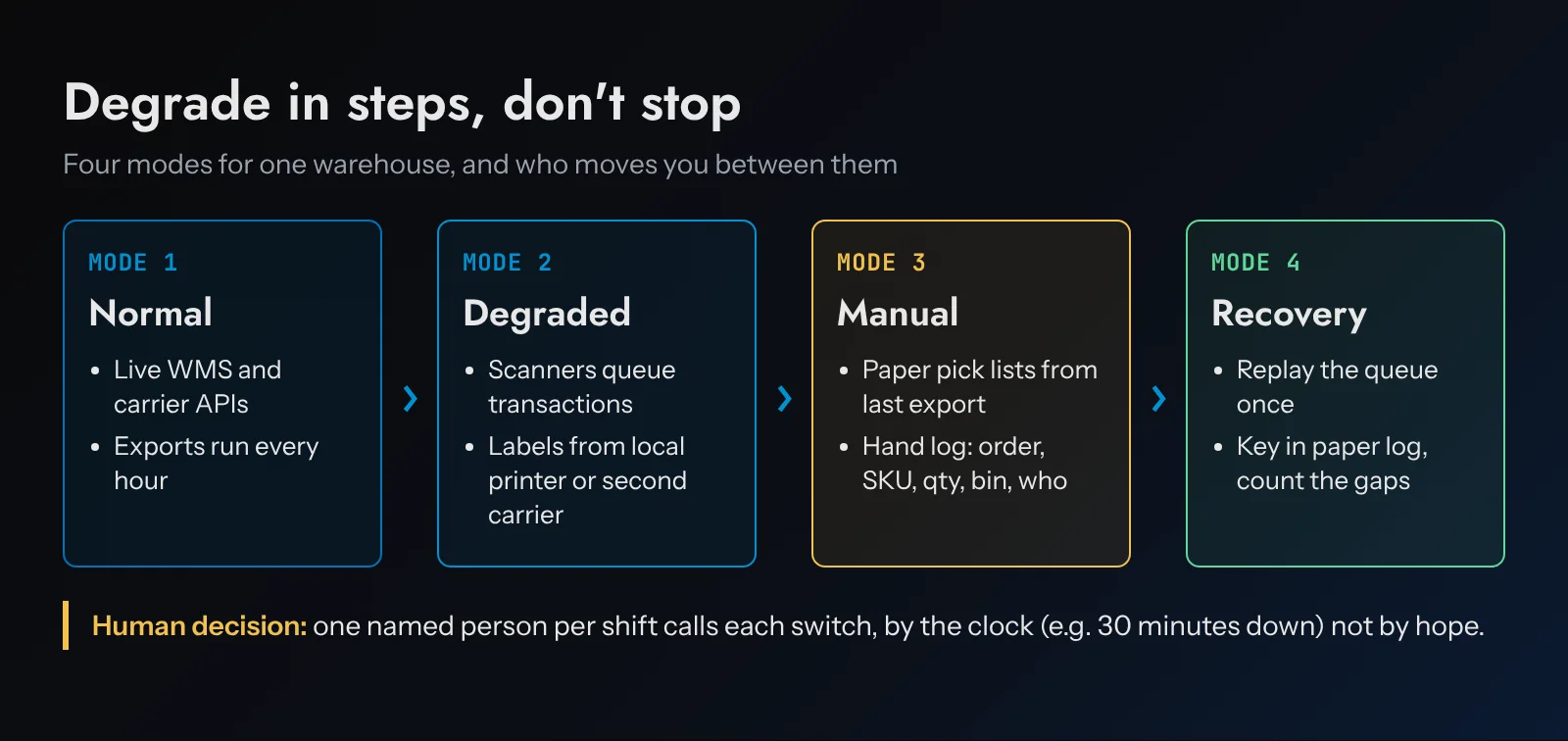
The most important part is not in any system. It is one named person per shift who decides when to switch modes, using a time rule agreed in advance, for example "30 minutes down, we go to paper". Without that, teams wait, refresh and hope, and the truck leaves half empty.
Can your warehouse still ship if the WMS, carrier API or bank is down?
Take each dependency in turn and ask two questions: what stops, and what is the fallback?
Keep an offline copy of today's work
Schedule an export of open orders, pick locations and bin stock every hour to a machine on site, and keep a printable pick-list template that reads it. If the WMS disappears at 11:00, you have the 10:00 picture. That is good enough to keep picking the orders you already know about.
Make sure labels can print locally
Ask your shipping software vendor whether it has an offline or batch mode, and test it. Keep a second carrier account live, with a few days of label stock and a working login, even if it is more expensive. Check that your label printers are reachable from the floor without going through the cloud.
Queue, don't block
Handheld scanners and the apps on them should be able to store scans and send them when the connection returns. Ask your WMS vendor two questions: what happens to a scan taken while the server is unreachable, and how is a duplicate prevented when it is sent twice? If the answer is "the scan fails", you need paper for that step.
Decide who can release a held order
When a payment is stuck in a bank's queue, as it was for some Chase transactions on 16 November, someone must decide whether a known customer's order ships. Write down who can make that call, and up to what value. That decision belongs to a person, not a rule in a system that is currently down.
Keep a way to talk that does not need email
Print a phone tree with carriers, key customers, your WMS vendor's emergency line and your IT contact. If orders or carrier bookings arrive by email, agree a second channel with those customers and carriers now, before the next Outlook outage.
How much does a day without shipping cost?
Do the sum for your own site before you decide how much the fallback is worth. Here is a worked example. Every figure below is an assumption, not data.
Assume a distribution centre ships 2,000 orders on a normal peak day. Assume half are same-day promises, and a missed promise costs an average of $8 in refunds, credits or upgraded shipping. Assume overtime to catch up the next day costs $3,000.
- Orders missing their promise: 2,000 × 50% = 1,000
- Cost of missed promises: 1,000 × $8 = $8,000
- Catch-up overtime: $3,000
- Total for one lost day: about $11,000, before any lost customers
Now assume the same site in manual mode ships 60% of its normal volume. Missed promises fall to 400 × $8 = $3,200, plus a smaller catch-up. The fallback is worth roughly $6,000 to $7,000 a day in this example. Set that against the cost of a backup router, a second carrier account and a two-hour drill, and the decision is usually easy.
Recovery also takes longer than the outage. Flights were still being cancelled the day after the FAA's ground stop ended, which is why the hand log and the reconciliation step matter as much as the fallback itself.
What should you test this month before peak?
The UK's National Cyber Security Centre says it directly: business continuity plans "should be tested regularly and with a full exercise where possible, as many plans fail in practice". It also asks you to understand "how long you can operate without" each important service. Its free Exercise in a Box gives a structure for a tabletop session.
A two-hour drill you can run on a quiet shift this week:
| Step | What you do | Pass if |
|---|---|---|
| 1 | Shift lead announces "WMS down" at a set time | Switch to manual is called within 30 minutes |
| 2 | Print pick lists from the latest export | Lists are under 60 minutes old and readable |
| 3 | Pick and pack 20 real orders on paper | Every pick is in the hand log with initials |
| 4 | Print labels with the internet unplugged from the label station | Labels scan at the carrier, or second carrier used |
| 5 | Call two carriers and one customer from the printed phone tree | All three numbers work |
| 6 | "Restore" and key in the hand log | Stock and orders reconcile, gaps are listed |
Score it honestly. Every step that fails is a job for before Black Friday, not after.
Should you stop patching until January?
No. Patch, but plan the change. CISA told organisations on 21 October to patch the PHP2Shell vulnerabilities immediately, and to take PHP systems offline if they could not. PHP sits inside a lot of web software, including some store and portal systems. The NSA outage shows the other side: a patch that left systems not coming back up as expected.
The answer for a warehouse is a peak change freeze with one exception, actively exploited vulnerabilities. Apply those on a quiet shift, with a tested rollback, and with the manual fallback ready. Ask every SaaS supplier for their own peak freeze dates and emergency change process. Our checklist for patching faster than AI-found vulnerabilities spread covers the security side.
Where does automation help, and where must it stop?
Automation can make an outage less painful. A well-built agent can watch the exports, notice a carrier API failing, switch labels to the backup carrier within rules you set, and draft the customer messages. It can also make an outage worse, if it keeps writing to a system of record that is half up, or retries a payment five times.
That is why we build agents with a permissioned access layer. Reads run freely; writes that change a system of record wait for a named human approver; every action is logged. In an outage, the agent's job is to queue and to tell people, not to improvise. In Ware, our warehouse demonstration, an agent works shortages and breakdowns within set rules and asks a manager before it spends. On its peak day, with real orders from open data, 52 of 59 orders shipped with the agent on duty against 34 with nobody acting. It is a demonstration we built, not a client, and it does not test cloud outages, but it shows the pattern: autonomy inside limits, a human for the decisions. Our post on human-in-the-loop AI agents explains how approval steps work.
Not sure what your warehouse depends on?
Start with the table above and the two-hour drill. If you want help mapping it, our distribution and logistics work starts from the systems you already run. The AI Readiness Audit is two weeks at a fixed price, looks at where automation would sit in your operation and what it would depend on, and ends in a written plan you can act on with or without us.
Frequently asked questions
What should a warehouse do when the WMS goes down?
Switch to manual mode at a time agreed in advance, for example after 30 minutes. Print pick lists from your most recent export, keep a hand log of every pick, and print labels locally or through a second carrier. When the WMS returns, key in the log and reconcile stock before releasing new waves.
Were the November 2026 outages cyberattacks?
Officials and the companies involved said no. Microsoft blamed a network capacity upgrade, the FAA outage was linked to a network update that overloaded old routers, Chase cited a software bug, and the NSA outage was linked to patching after the PHP2Shell vulnerabilities. CNBC counted four major system problems in four consecutive business days.
How much does an IT outage cost a business?
In the Uptime Institute's 2025 survey, published in its 2026 outage analysis, 57% of respondents said their most recent major outage cost more than $100,000, and one in five said more than $1 million. Your own cost depends on volume and promises; multiply missed orders by the cost of each missed promise, then add catch-up labour.
How do you print shipping labels when the carrier API is down?
Check whether your shipping software has an offline or batch mode and test it before you need it. Keep a second carrier account active with label stock and a working login. Make sure label printers can be reached from the warehouse floor without depending on a cloud service.
Should we freeze IT changes during peak season?
Yes, with one exception: actively exploited vulnerabilities, such as those CISA lists in its Known Exploited Vulnerabilities catalogue. Apply those on a quiet shift with a tested rollback and the manual fallback ready. Ask your SaaS suppliers for their own freeze dates.
How often should we test our warehouse outage plan?
At least once before each peak, and after any change to your WMS, carriers or network. The UK NCSC advises testing continuity plans regularly, with a full exercise where possible, because many plans fail in practice. A two-hour drill on a quiet shift is enough to find the gaps.