
On Monday 16 November, an email went round the US Department of Agriculture's farm production business centre. Its security operations centre had "uncovered a security incident", and IT had to "reset all database passwords in all environments", Nextgov/FCW reported. Farm payment tools went offline for days. On the Thursday, while those systems were still coming back, the Government Accountability Office published a report warning that the food sector's federal cyber defenders are short of people and practice.
If you run grocery stores or a food distribution business, that week is the story in miniature.
The GAO food cybersecurity report says the agencies that protect the US food supply cannot yet give the sector real-time threat warnings or practised emergency plans, so grocers and distributors should build their own: know every connected device, close remote access, practise running manually, and be ready to report an incident within 72 hours.
Key takeaways
- GAO found USDA and FDA only partially met or did not meet 5 of 16 federal cyber requirements for the food and agriculture sector, all in information sharing and emergency preparedness (GAO-27-108656, 19 November 2026).
- The Food and Ag-ISAC recorded 227 ransomware incidents in the sector from January to July 2026, after 295 in all of 2025.
- The two co-lead agencies have not run a cyber emergency exercise for the sector since 2024, and both said a lack of staff and resources held them back.
- A coming federal rule (CIRCIA) would require covered critical-infrastructure organisations to report cyber incidents within 72 hours and ransom payments within 24 hours.
- Most of the fixes a grocer needs this quarter are free or cheap: an asset list, closed remote access, a call-back rule for payment changes, and a two-hour tabletop exercise.
What did the GAO food cybersecurity report actually find?
The report is called Critical Infrastructure Protection: Further Action Needed to Enhance Cybersecurity of the Food and Agriculture Sector. GAO checked the two agencies that lead federal cyber work for food and agriculture, USDA and the Food and Drug Administration, against 16 requirements set by the Fiscal Year 2021 National Defense Authorization Act.
They did most of it. Sector coordination, risk management, risk assessment and incident support were all met. The gaps are narrower, and more important to a store operator:
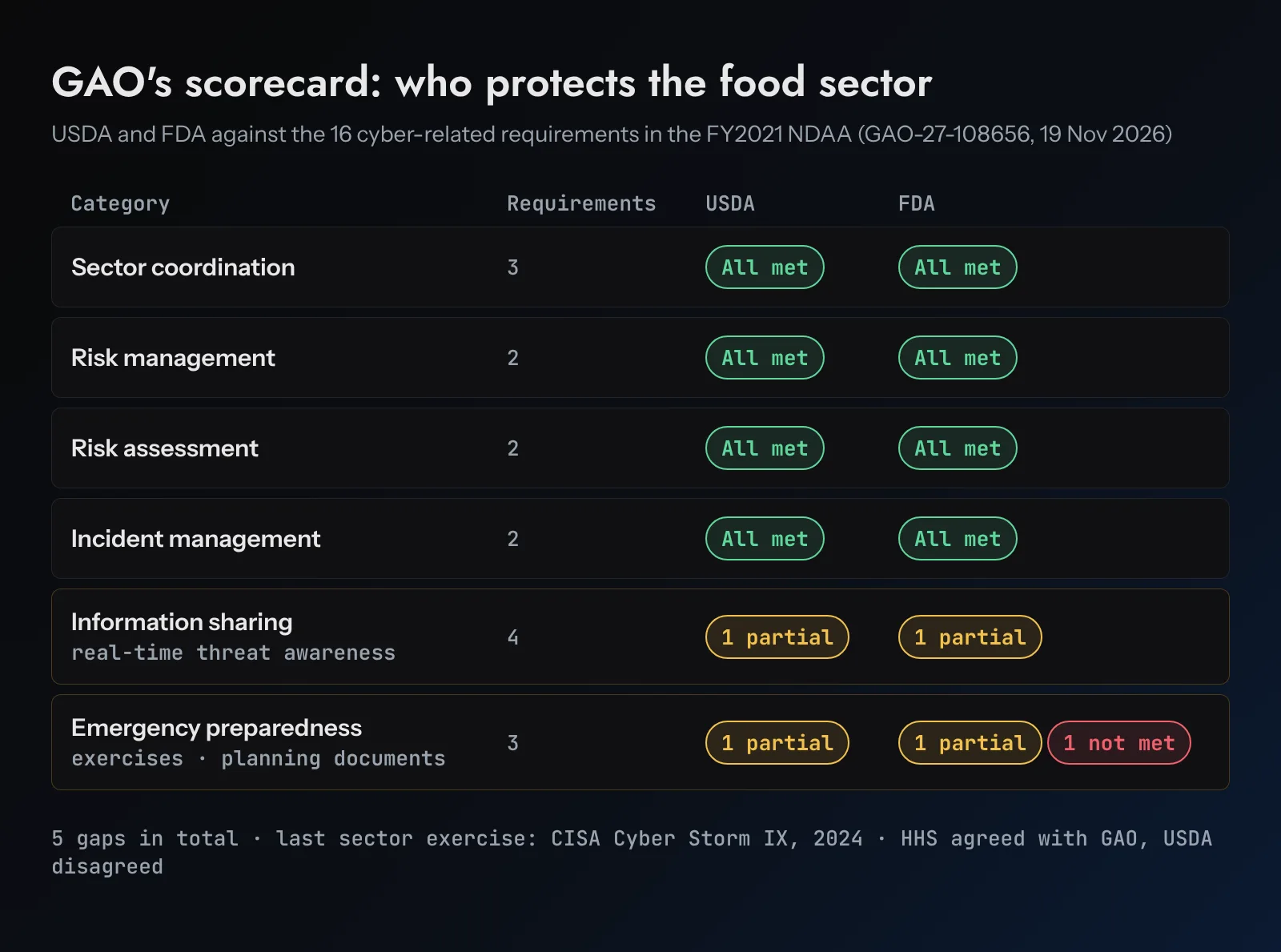
- Real-time warnings. Both agencies only partially met the requirement to give CISA and the sector "ongoing, and where possible, real-time awareness" of threats, vulnerabilities and fixes. The full report says FDA "has no structured mechanism for continuously collecting cybersecurity data".
- Exercises. Both only partially met the requirement to run or facilitate emergency exercises. The last one GAO records is CISA's Cyber Storm IX in 2024.
- Emergency planning. FDA did not meet the requirement to develop planning documents for coordinated action in a disaster or emergency.
GAO made five recommendations: three to HHS (FDA's parent department), two to USDA. HHS agreed. USDA disagreed with both of its recommendations and asked GAO to remove or redirect them, arguing among other things that its Office of Homeland Security lacked the funding, authorities and expertise to fill the gaps. GAO kept them.
Why should a grocer care about a report on federal agencies?
Because it tells you who will not be calling you.
In a large attack, the help you would hope for from government is an early warning ("this controller model is being hit, close port X") and a practised plan for keeping food moving. The report says both are thin. The GAO WatchBlog adds what industry told the auditors: staff turnover and layoffs in key federal cyber roles "have been disruptive", and one organisation's main contact for help had left the agency.
The private-sector interviews in the full report are blunter. Two organisations said the end of the Critical Infrastructure Partnership Advisory Council had "stifled communications" with government. Many food companies have no in-house cyber expertise and rely on third parties. And a Food and Ag-ISAC official said artificial intelligence "is identifying vulnerabilities at machine scale, while their processes for mitigating them operate at human speed."
GAO also notes that USDA and FDA cannot require sector-wide incident reporting, so the true number of attacks is higher than anyone has counted. Put plainly: the warning system is partly blind and partly short-staffed. Plan as if your first warning will be your own alarm.
What attacks has the food sector already seen?
GAO lists incidents from 2021 onwards. Several reached grocery shelves.
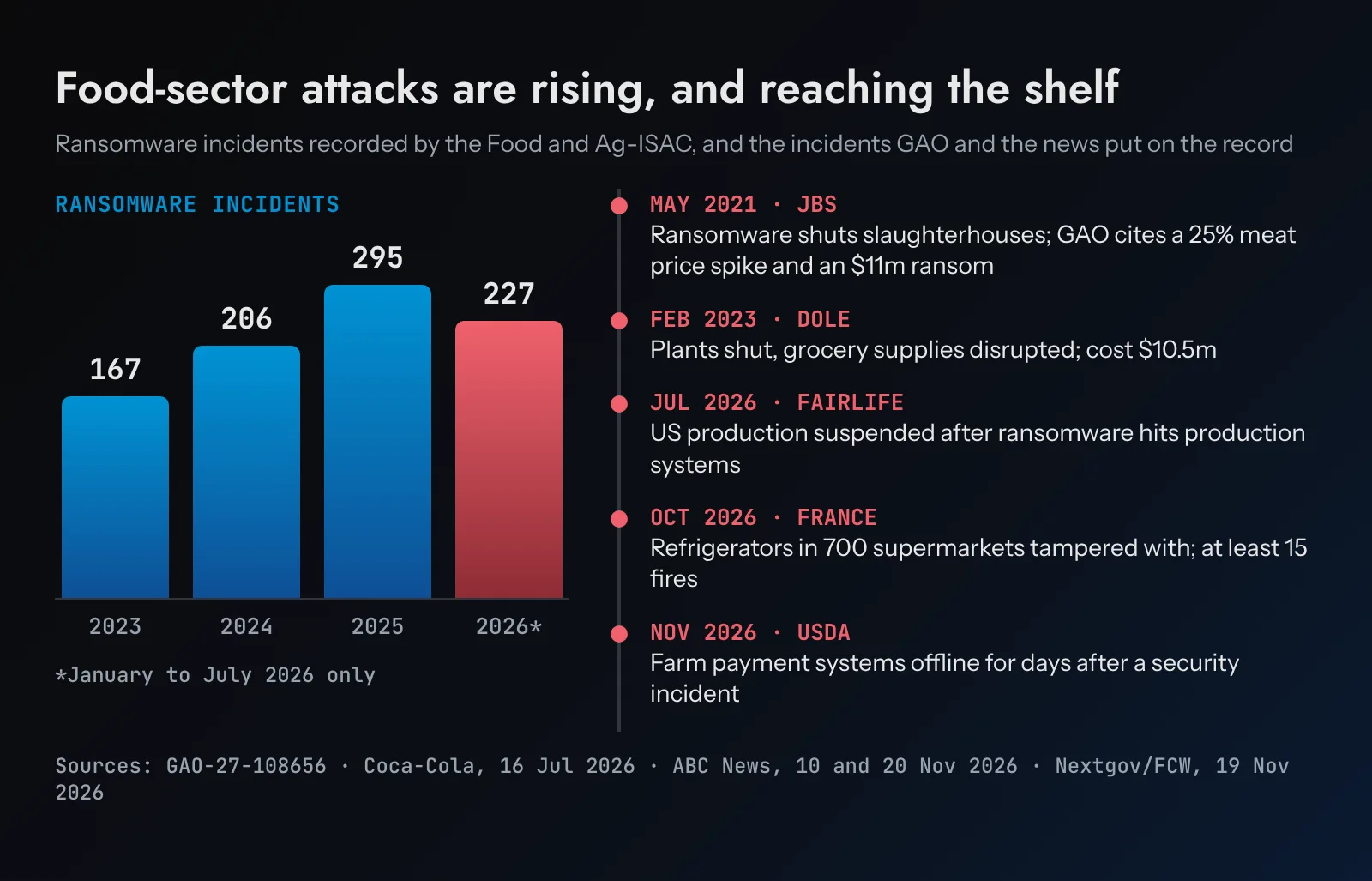
- JBS, May 2021. Ransomware shut slaughterhouses in the US and abroad. GAO cites a 25% meat price spike and an $11 million bitcoin ransom.
- Dole, February 2023. An attack on legacy servers and staff computers shut production plants and disrupted US grocery supplies. Cost: $10.5 million.
- Business email compromise, 2022. Criminals used lookalike email domains and real employee names to order food that was never paid for. GAO lists losses of $600,000, $160,000 and $100,000 in single cases. The FBI, FDA and USDA issued a joint advisory on BEC schemes used to steal food shipments in December 2022.
- Fairlife, July 2026. Coca-Cola said a third party had accessed "a portion of its systems, including its production-related systems, in connection with a ransomware event", and that fairlife's US production was temporarily suspended. The company said product quality and safety were not affected.
- French supermarkets, October 2026. Attackers turned off or heated refrigerators in 700 supermarkets across France, with at least 15 fires, ABC News reported. French authorities blamed units of Iran's Revolutionary Guard; Iranian officials called the accusations "baseless and biased".
The trend line matters more than any single case. The Food and Ag-ISAC counted 167 ransomware incidents in 2023, 206 in 2024 and 295 in 2025, then 227 in just January to July 2026, according to Industrial Cyber's summary of the report.
GAO's own example of the risk is worth reading twice: a failure to change default passwords could let an attacker "manipulate data related to food quality, contamination testing, or traceability", leading to unsafe food, recalls and reputational damage. That is not a server problem. It is a food safety problem.
What are regulators likely to ask grocers next?
No new rule in this report applies to private companies. GAO audits agencies, not stores. But three things are already moving, and they point in the same direction: prove you know your systems, prove you can report quickly, and prove your records can be trusted.
| What | Status (as of November 2026) | What it will ask of you |
|---|---|---|
| CIRCIA incident reporting rule | CISA submitted the final rule for White House review on 1 October 2026; publication expected early 2027, and likely effective no sooner than 60 days after that | Report covered cyber incidents to CISA within 72 hours and ransom payments within 24 hours, if you are a covered entity |
| FDA Food Traceability Rule (FSMA 204) | Congress directed FDA not to enforce it before 20 July 2028 | Keep reliable lot-level traceability records for listed foods. Records an attacker can change are a liability |
| CISA sector advisories | The June 2026 advisory on hardening automatic tank gauge systems names Food and Agriculture as a user sector | Take controllers off the open internet, change default passwords, log changes to alarm thresholds |
Two cautions. First, the final CIRCIA text has not been published, so who exactly is covered, and whether a mid-size grocer or distributor falls in, is not yet confirmed. Do not wait to find out; a 72-hour clock is hard to meet without a plan. Second, our reading of where this goes next is analysis, not a forecast from GAO: if the agencies follow the recommendations, expect more advisories, more exercises you are invited to, and more questions from insurers and large retail customers about the same controls.
The grocer and distributor readiness checklist
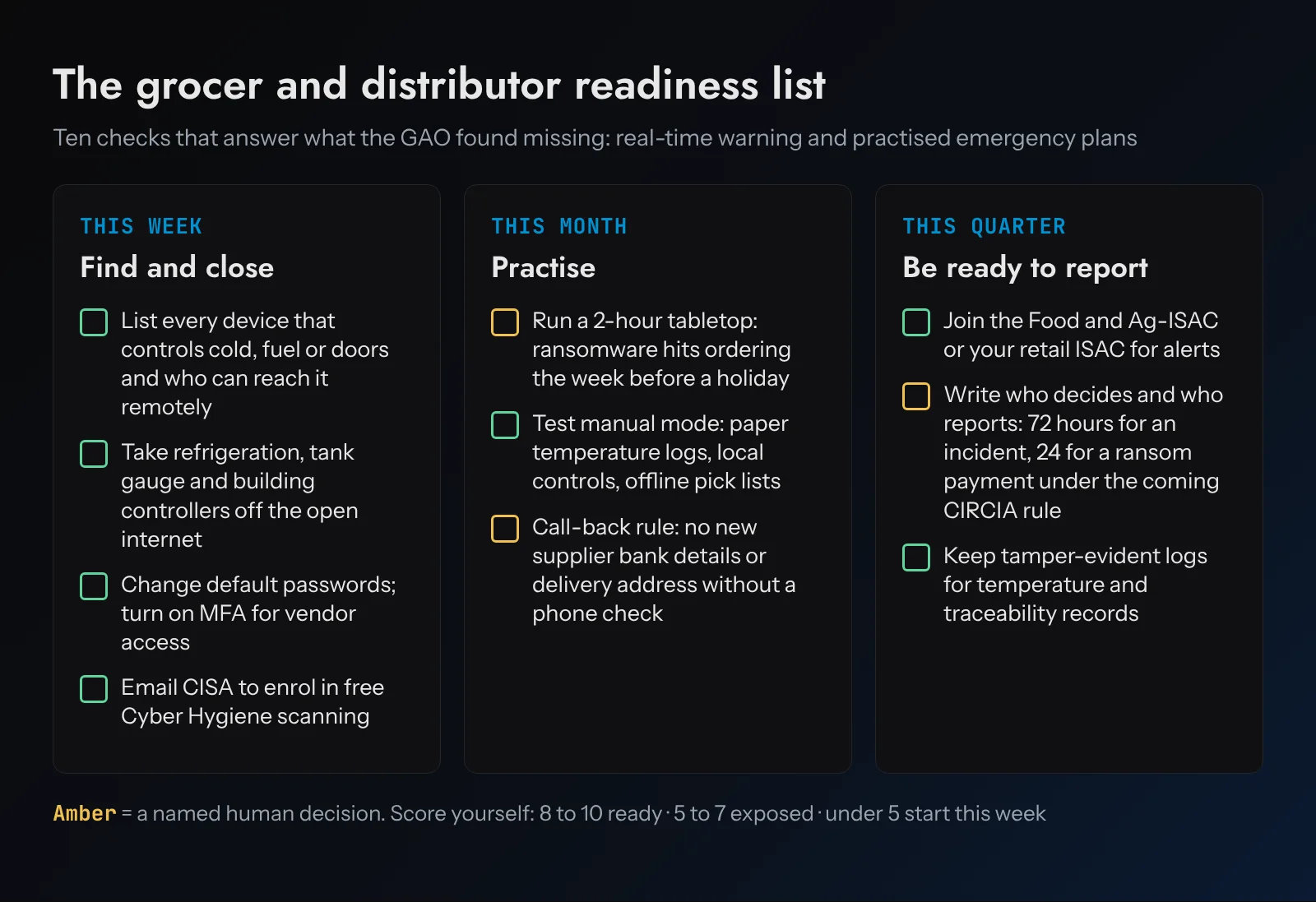
The GAO found two things missing at federal level: real-time warning and practised emergency plans. The list below builds both inside your own business. Score one point for each item you can show evidence of today.
This week: find and close
- List every connected device that controls cold, fuel or doors. Refrigeration and building-management controllers, tank gauges, door access, dock equipment. Next to each, write who can reach it remotely: your team, the installer, a maintenance contractor.
- Take those controllers off the open internet. CISA's tank gauge advisory is the template: no device interface exposed directly to the internet; if remote access is needed, put it behind a firewall, access list or VPN.
- Change default passwords and add multi-factor authentication for every vendor and contractor login. GAO names default passwords explicitly.
- Enrol in free scanning. CISA's Cyber Hygiene services are open to private critical-infrastructure organisations "at no cost". It scans your internet-facing addresses weekly and alerts you to risky services. Enrolment is an email.
This month: practise
- Run a two-hour tabletop exercise. Scenario: ransomware hits ordering and the warehouse system the week before a holiday. Who decides to shut systems down? Who calls customers? Who talks to the insurer? Write down the names.
- Test manual mode for real. Can a store keep paper temperature logs every hour? Can someone switch a refrigeration controller to local control? Can the warehouse print pick lists and labels offline? Among the incidents GAO lists, an April 2023 attack damaged irrigation controllers on systems that had not been switched from remote to manual operation. Find out now how long the switch takes.
- Adopt a call-back rule. No new supplier bank details, delivery address or large unusual order is accepted on email alone. A named person phones a known number first. This single rule blocks the BEC pattern behind the 2022 food thefts.
This quarter: be ready to report
- Join an information-sharing group. The Food and Ag-ISAC, or the Retail and Hospitality ISAC. If federal warnings are slow, peer warnings are the next best source.
- Write the reporting plan. Who decides an incident is reportable, who files with CISA and the FBI, who tells customers. Assume the 72-hour and 24-hour clocks will apply to you.
- Make temperature and traceability records tamper-evident. Logs that are written once, timestamped and backed up off-site. If an attacker changes a setpoint or a lot record, you need to prove what the real value was.
Scoring: 8 to 10, you are ahead of most of the sector. 5 to 7, you are exposed in at least one place an attacker would look. Under 5, start with items 1 to 4 this week; they cost little more than time.
Where does AI fit in, and where can it make things worse?
The Food and Ag-ISAC's warning about AI finding weaknesses "at machine scale" cuts both ways. Attackers use it. So can you, if you are careful about where it sits.
Useful jobs for software agents in a grocer or distributor are the boring ones: watching temperature feeds and flagging drift before a human notices, checking every supplier email that asks to change bank details against your vendor master, keeping an up-to-date list of which devices are reachable from outside. These are reads. They change nothing.
The risk is giving any new tool, AI or not, write access to ordering, payments or controllers. That creates exactly the kind of door this report worries about. Our rule when we build governed AI agents is simple: reads run freely, any change to a system of record waits for a named human approver, and every action is logged. That is the same principle as the call-back rule above, applied to software. We cover the detail in human-in-the-loop AI agents and building an audit trail for AI agents, and the access pattern in our access layer package.
What should you do on Monday?
Pick one owner for this list. Give them two hours on Monday to do items 1 and 4, and book the tabletop for next month. Send the CISA enrolment email the same day. Then ask your refrigeration and building-management contractors one question in writing: "Which of our devices can you reach from outside, and how?" Their answer will tell you most of what you need to know.
If you are planning to add automation or AI to ordering, stores or the warehouse, our two-week AI Readiness Audit maps where it would sit in your systems, what it could touch, and what controls it needs, and ends in a written build plan. For sector context, see our pages for retail and e-commerce and distribution and logistics.
Frequently asked questions
What is the GAO report on food and agriculture cybersecurity?
It is GAO-27-108656, published on 19 November 2026. It assessed USDA and FDA against 16 federal cyber requirements for the food and agriculture sector and found five partially met or not met, all in information sharing and emergency preparedness. GAO made five recommendations; HHS agreed and USDA disagreed.
Does the GAO report create new rules for grocery stores?
No. GAO audits federal agencies, so the recommendations are addressed to USDA and HHS, not to private companies. The rules that may reach grocers come from elsewhere, mainly the coming CIRCIA incident reporting rule and FDA's Food Traceability Rule, which Congress has told FDA not to enforce before 20 July 2028.
How many ransomware attacks hit the US food sector in 2026?
The Food and Ag-ISAC recorded 227 ransomware incidents in food and agriculture from January to July 2026, as cited by GAO. That compares with 295 in all of 2025 and 206 in 2024. GAO notes the real number is higher, because reporting is voluntary.
Do grocers have to report cyberattacks to the government?
Not under a sector-wide federal rule today; GAO notes USDA and FDA lack authority to require it. The CIRCIA final rule, sent for White House review on 1 October 2026, would require covered critical-infrastructure entities to report incidents within 72 hours and ransom payments within 24 hours. Who is covered will be confirmed when the rule is published.
What is the cheapest way for a grocer to improve cybersecurity quickly?
Take refrigeration, tank gauge and building controllers off the open internet, change default passwords, add multi-factor authentication for vendor access, and enrol in CISA's free Cyber Hygiene scanning. Add a call-back rule for any change to supplier payment details. None of these needs new software.
Was the November 2026 USDA outage a cyberattack?
USDA Under Secretary Richard Fordyce described it as a "cyberthreat", not a software update, according to ABC News. Internal emails reported by Nextgov/FCW describe a security incident that forced a reset of all database passwords. As of 20 November it was not public who was responsible or whether data was taken.