
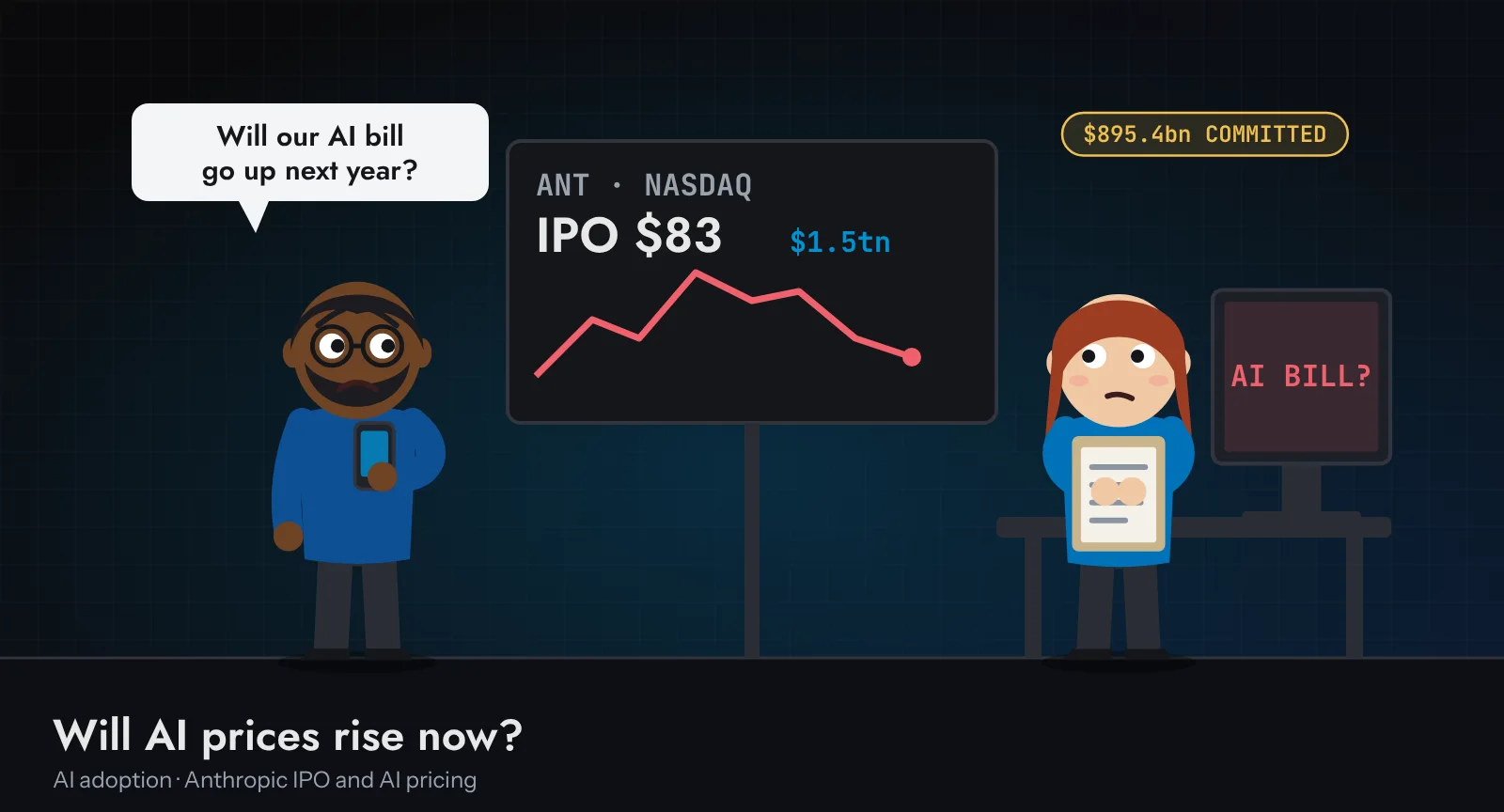
Call her Dana. She is made up, but her week is not unusual. She is finance director at a 400-person distributor that started using Claude and two other AI models this year: an agent that reads supplier emails and drafts purchase-order changes, and a few dozen staff on chat subscriptions. On Thursday her chief executive forwarded a headline: Anthropic's shares opened at $111.50 and closed at $97.17, after an IPO priced at $83. By Friday they were back at $88.91. Underneath the forward, one line: "Does this mean our AI bill goes up?"
It is the right question, asked for the wrong reason. The share price does not set what you pay. The Anthropic IPO filing tells you a lot more about where AI prices are heading.
The short answer: per-token AI prices have been falling and Anthropic's own filing shows why, but a company with roughly $895bn of committed compute spend and public shareholders will work hard to protect margins, so expect changes to how AI is priced (usage limits, agent pricing, contract terms, model retirements) more than a simple rise in list prices. You protect a budget with controls you own, not with a forecast.
Key takeaways
- Anthropic priced its IPO at $83 a share on 18 November 2026, valuing it at $1.5 trillion and raising $81bn before the underwriters' extra shares.
- The amended S-1 shows about $895.4bn of committed spend, mostly compute, with about $69.8bn due in the next 12 months, plus $6.2bn of debt.
- Anthropic spent $0.48 on compute and infrastructure for every $1 of revenue in Q2 2026, down from $2.51 in Q1 2025 (our arithmetic from the S-1).
- The filing says Anthropic may change pricing models, usage limits and rate limits, and flags that agent workloads use more compute than chat.
- Model choice moves a bill far more than any likely price change: in our worked example the same agent costs $180 a month on Haiku 5.5 and $7,200 on Opus 5.5.
A note before we start: we build AI agents on several models, Claude among them. This is a buyer's reading of public documents, not investment advice.
What happened with the Anthropic IPO?
According to the Associated Press, via PBS, Anthropic priced its offering at $83 a share on 18 November, above its $70 to $78 range, valuing the company at $1.5 trillion. It sold 980 million shares and raised $81bn. Reuters reports the total rose to $93.5bn after underwriters bought additional shares, the largest listing on record.
The debut landed in a bad week for AI stocks. The Guardian reported that the Nasdaq erased all its 2026 gains and Nvidia fell 14% on the Friday. Reuters quotes a US Bank Asset Management executive saying the valuation, about 40 times the last 12 months' sales, "assumes years of rapid growth".
That last phrase is the one a buyer should notice. Investors are paying for growth and, eventually, margin. Both come from customers.
What does the Anthropic S-1 filing say about AI costs?
An S-1 is the prospectus a company files with the US Securities and Exchange Commission before selling shares. It has to disclose finances and risks in plain terms. Three things in Anthropic's S-1 matter to anyone buying AI.
Revenue is growing fast, and it is mostly metered
Revenue was $16.3bn in the first half of 2026, up from $1.2bn a year earlier. Yahoo Finance reports the amended filing shows $33.2bn for the first nine months of the year. In the first half, 80% of revenue was consumption-based ("pay-for-intelligence", metered in tokens and priced by model) and 20% was subscriptions. For the first nine months, no single customer was more than 10% of revenue and the top five were about 25%.
For a business, consumption pricing means the bill moves with three things: how much you use, which model you call, and the price list. You control the first two.
The commitments are enormous
The amended S-1, as reported by Yahoo Finance, discloses about $895.4bn of commitments, "primarily" for compute and infrastructure, with $69.8bn due in the next 12 months. AP rounds this to "$900 billion" and notes Anthropic already has $6.2bn of debt, which the company itself calls "substantial". These are largely fixed obligations. The filing describes take-or-pay terms that "obligate us to pay for resources regardless of actual utilization".
Fixed costs of that size have to be covered by revenue. That is the pressure behind any future pricing change.
Serving AI is getting much cheaper per dollar earned
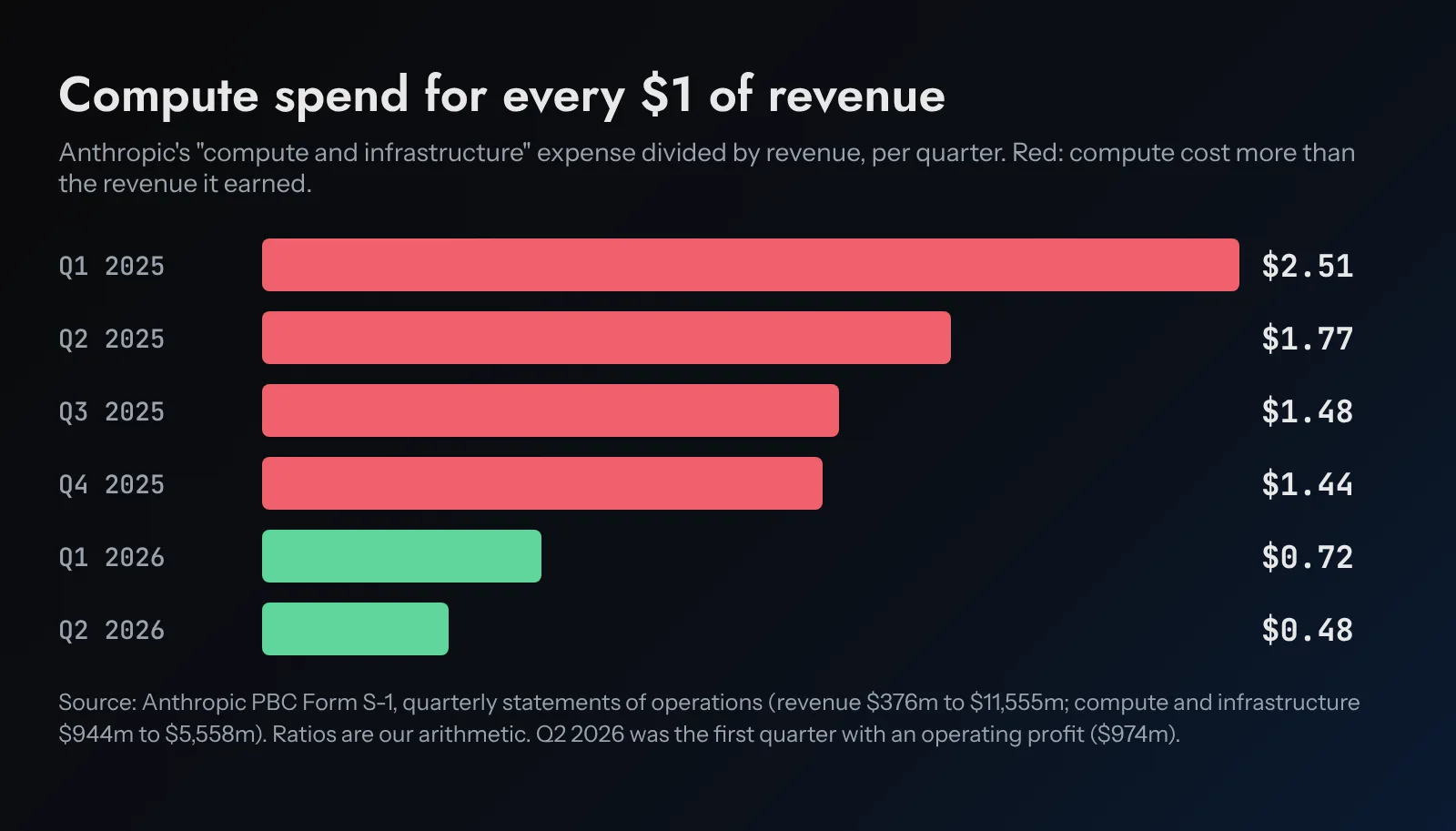
Divide the S-1's quarterly "compute and infrastructure" expense by revenue and the trend is stark. In Q1 2025 Anthropic spent $944m on compute to earn $376m: $2.51 for every dollar. By Q2 2026 it spent $5,558m to earn $11,555m: $0.48. That quarter produced an operating profit of $974m, the first in the quarters the S-1 shows. It did not last the year, though: Yahoo Finance reports an operating loss of $1.3bn for the first nine months of 2026.
The S-1 also explains how prices fit in. When Anthropic launched Opus 4.5 in November 2025 "with greater capabilities and a lower price and cost per task", quarter-on-quarter revenue growth accelerated from 48% to 132%. Lower prices brought more usage, and more usage brought more revenue.
Will AI prices go up after the Anthropic IPO?
Nobody outside the company knows, and anyone who tells you a number is guessing. What the public evidence supports is this.
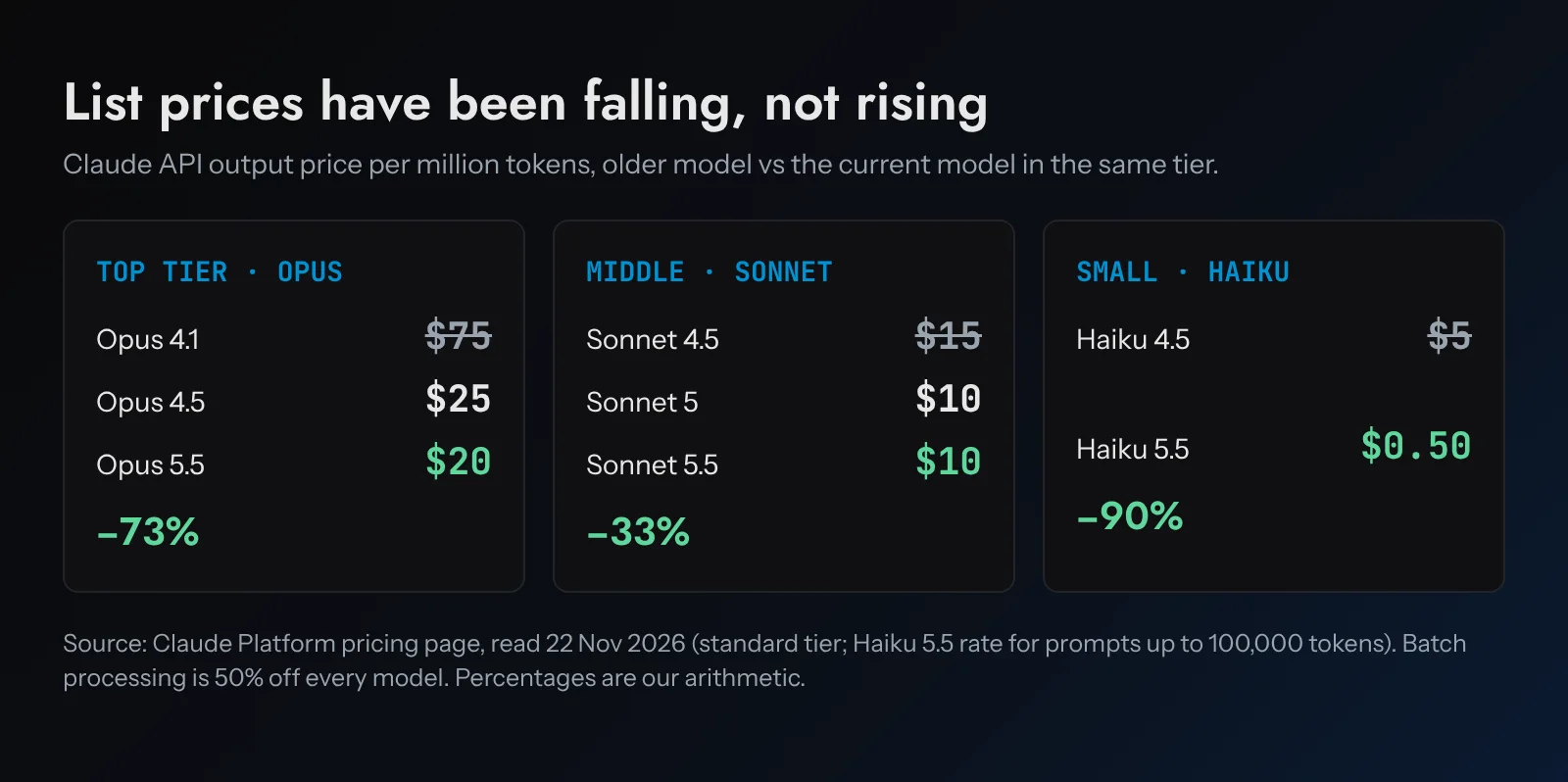
List prices per token have been falling. On the Claude pricing page today, Opus 5.5 costs $4 per million input tokens and $20 per million output tokens. Opus 4.1, still on the price list, costs $15 and $75. Haiku 5.5 costs $0.10 and $0.50 for prompts up to 100,000 tokens, against $1 and $5 for Haiku 4.5.
The filing reserves the right to change how pricing works. In its risk factors Anthropic writes that it "may change" its pricing models and "may be required to reduce our prices, offer shorter contract durations or offer alternative pricing models, such as outcome or task-based pricing". In the same passage it warns that "agentic offerings are structurally more compute-intensive" and that if it cannot price them to reflect that, profitability could suffer. Elsewhere it says it has changed, and may change, "usage limits, rate limits, or model and product capabilities", and that customers may be affected when older models are retired.
Competition pushes the other way. The S-1 lists open-weight models as a source of "pricing pressure", and notes that customers may prefer "multi-vendor AI strategies in order to limit dependence on any single provider".
Put together, the most likely direction for a business buyer is cheaper tokens on new models, with more change in the structure around them: tighter usage limits on subscriptions, separate or higher pricing for heavy agent workloads, and older models retired on a timetable you do not set. A commentary in Times Square Chronicles makes the same point from the market side: if compute costs rise, vendors "may raise prices, tighten usage limits, or change plan structures".
This is not specific to Anthropic. AP notes that Anthropic, OpenAI and SpaceX's AI division have all lost more money than they have made because of the cost of building AI. Anthropic is simply the first of the big model makers to publish its numbers in a prospectus.
How much could a price change cost your business?
Here is a worked example. All of these are assumptions, chosen to be typical of an operations agent, not taken from a client.
- The job: an agent that reads incoming supplier emails and drafts purchase-order changes for a buyer to approve.
- Volume: 2,000 tasks a day, 30 days a month.
- Size: each task sends 20,000 input tokens (the email, order history, rules) and gets back 2,000 output tokens.
- Prices: standard Claude list prices as of 22 November 2026.
So each day uses 40 million input tokens and 4 million output tokens.
| Model | Input cost a day | Output cost a day | Per month (30 days) |
|---|---|---|---|
| Haiku 5.5 | 40 × $0.10 = $4 | 4 × $0.50 = $2 | $180 |
| Sonnet 5.5 | 40 × $2 = $80 | 4 × $10 = $40 | $3,600 |
| Opus 5.5 | 40 × $4 = $160 | 4 × $20 = $80 | $7,200 |
Now suppose, purely as a scenario, that Sonnet prices rose 25%. The monthly bill would go from $3,600 to $4,500: an extra $900. Moving the same work to the Batch API, which the pricing page lists at 50% off for work that can wait, would take it from $3,600 to $1,800. And the gap between the smallest and largest model is 40 times.
The lesson is uncomfortable but useful. The decisions inside your own walls (which model, how much context, whether work can be batched) move the bill more than anything a vendor is likely to do to its price list. If the bill matters, you need those decisions to be deliberate, written down and enforced.
How do you protect your AI budget from price changes?
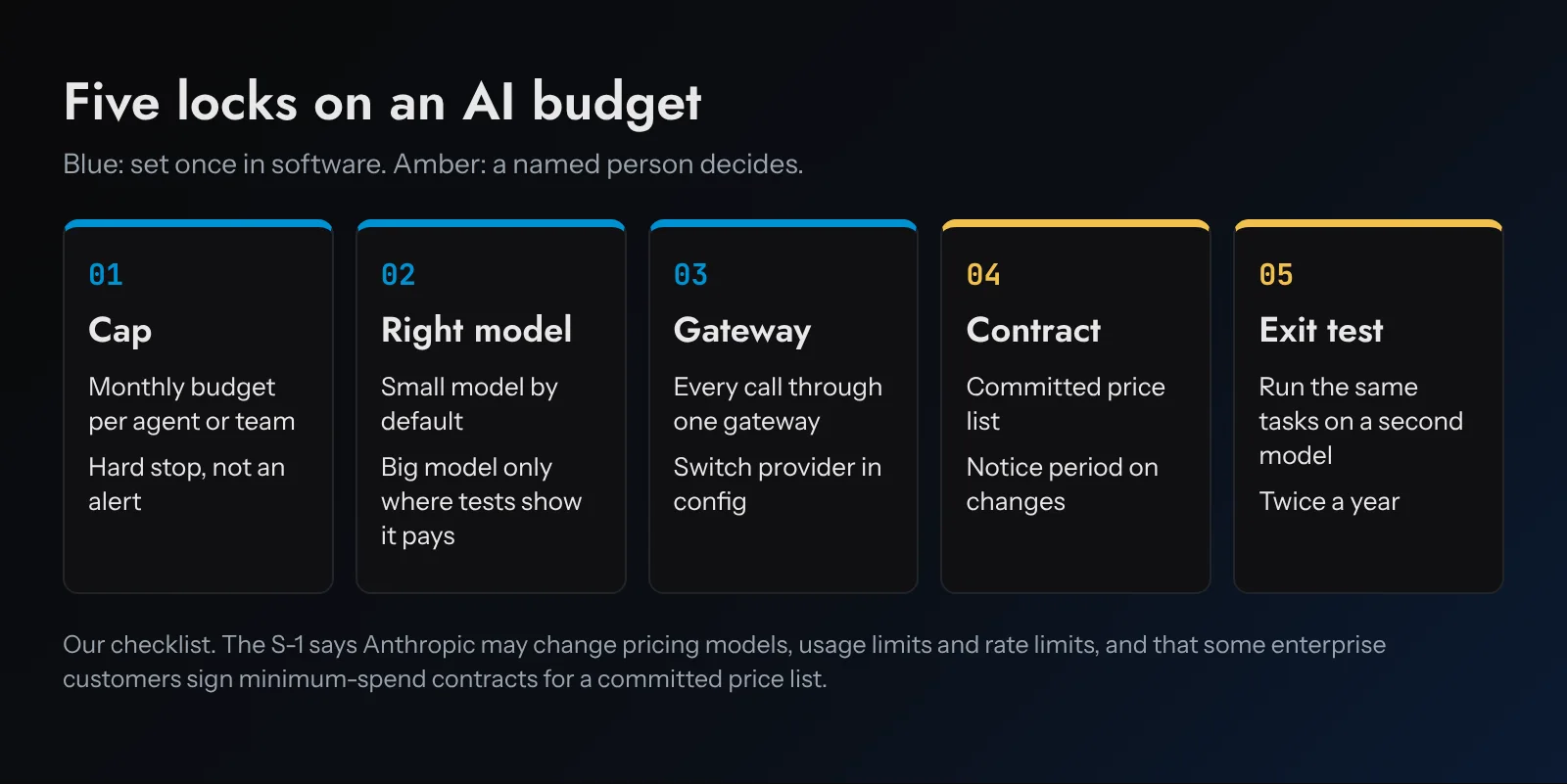
1. Put a hard cap on every agent and team
Give each agent or team its own key with a monthly budget that stops calls, not one that sends an email after the money is gone. We wrote up how to do this, with a test that shows where budgets leak, in how to stop runaway AI agent costs with an AI gateway.
2. Make the small model the default
Start every task on the cheapest model that passes your tests. Move a task up a tier only when a test shows the bigger model is worth it. In the example above, that single rule is the difference between $180 and $7,200 a month.
3. Route every call through a gateway you control
A gateway sits between your software and every AI provider. It holds the keys, enforces the caps and logs the spend, and it lets you switch provider or model by changing configuration rather than code. Keep prompts, business rules and data in your own systems, not inside one vendor's product. If a price or usage limit changes, you can move within days.
4. Read the contract before you sign the next one
The S-1 says a growing number of enterprise customers sign annual or multi-year contracts with minimum spend "in exchange for a committed price list". That is worth asking about if your spend is steady. Ask your vendor or reseller:
- Is our price fixed for the term? How much notice do you give before a change?
- What happens to our usage limits if the plan changes?
- How long will the model we build on stay available, and what is the notice before it is retired?
- Is agent or automated use priced differently from chat?
- If we commit to a minimum, what happens if our use falls?
A named person in finance or operations should own these answers, and the renewal date should be in their calendar.
5. Run an exit test twice a year
Run the same set of real tasks on a second model and compare quality and cost. It keeps your prompts portable, gives you real numbers for any price negotiation, and tells you how long a switch would take.
What should you do this week?
- Pull last month's AI invoices and list every model and subscription you pay for, with the owner of each.
- Check that every agent has a hard monthly cap. If any key is shared or uncapped, fix that first.
- For your largest workload, work out cost per task on your current model and one tier down, using the table above as a template.
- Find the renewal date and price-change clause in each AI contract.
- Write down, in one paragraph, how you would move your main AI workflow to another model if you had to.
None of this needs a forecast of the AI market. It needs controls that work whichever way prices go.
If you want a second pair of eyes, our AI Readiness Audit is two weeks at a fixed $2,400 and ends in a written build plan that includes model choice and running costs. When we build AI agents, budgets, model routing and approvals are part of the build, not an afterthought; our AI governance page shows how. And if a project is stalling because nobody trusts the cost, why agentic AI projects get cancelled is a good place to start.
Frequently asked questions
Will ChatGPT and Claude get more expensive after the Anthropic IPO?
There is no public announcement of a price rise. Claude's per-token list prices have fallen with each model generation; the top-tier output price dropped from $75 to $20 per million tokens. The S-1 does say Anthropic may change pricing models, usage limits and rate limits, so watch plan structures and limits as closely as the headline price.
How much did Anthropic raise in its IPO?
Anthropic priced 980 million shares at $83 on 18 November 2026, raising $81bn and valuing the company at $1.5 trillion, according to AP. Reuters reports the total rose to $93.5bn after underwriters exercised their option to buy extra shares, making it the largest IPO on record.
What is Anthropic's $895bn compute commitment?
The amended S-1 discloses about $895.4bn of purchase commitments and leases, primarily for compute and infrastructure, with about $69.8bn due in the next 12 months. Many are take-or-pay terms, meaning Anthropic pays whether or not it uses the capacity. Revenue has to grow to cover them.
Should my business switch AI providers because of the IPO?
Not because of the IPO alone. A listing does not change the product you use. It is a good prompt to make sure you could switch: route calls through a gateway, keep prompts and rules in your own systems, and test a second model twice a year.
How do I cap AI spending for my company?
Give each agent or team its own key with a hard monthly budget, enforced by a gateway before calls are sent. Add rate limits and a list of allowed models per key. Review spend monthly against the cost per task you expected.
Is agent use priced differently from chat?
Today both are billed per token on the API. Anthropic's S-1 warns that agent workloads are "structurally more compute-intensive" and that it may need pricing models that reflect this, including outcome or task-based pricing. Ask your vendor how automated use is treated before you scale an agent.