
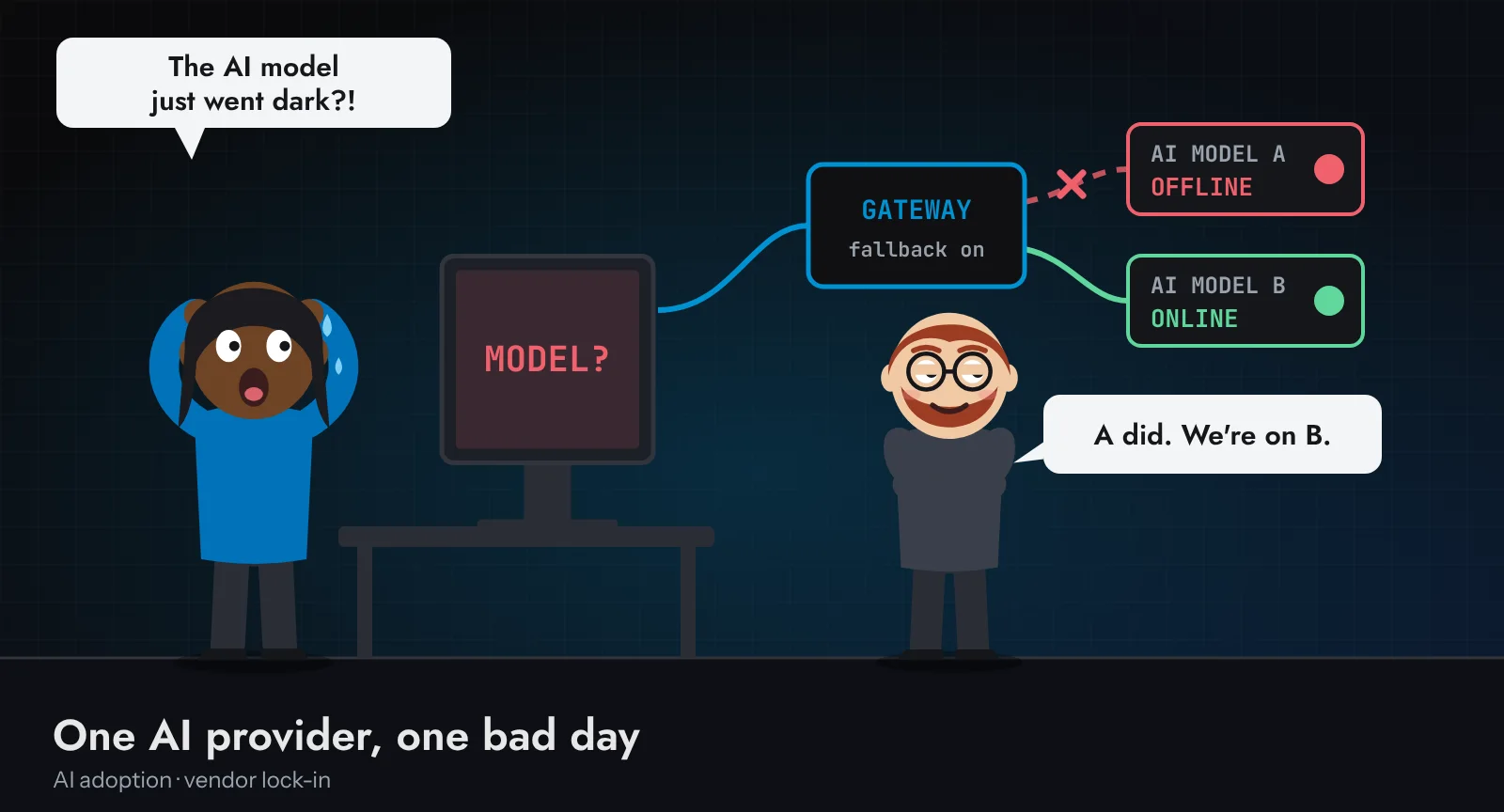
At 5:21 pm Eastern on Friday 12 June, Anthropic received a letter from the US government. Within hours it had switched off its newest model, Claude Fable 5, for every customer in the world, three days after launch. The directive barred access by any foreign national, and Anthropic said it had no reliable way to check nationality in real time. Access came back on 1 July, 19 days later.
If your returns desk, your exception queue or your purchase-order matching had been rebuilt around that one model, those were 19 hard days. Nothing was wrong with your systems. Something changed upstream, at a company you do not control.
AI vendor lock-in is the risk that one AI provider's outage, price change, model retirement or government order stops a process you depend on; you avoid it by routing every AI call through a gateway you control, keeping your business rules and data outside the model, testing a second model against your own cases every quarter, and writing exit terms into the contract.
A note before we start: we build on several models, including Claude. Anthropic appears often below because 2026 was an unusually turbulent year for it, not because other providers are safer. OpenAI and Google retire models on their own schedules too.
Key takeaways
- Claude Fable 5 was unavailable to every customer for 19 days in June 2026 after a US export-control directive, while Anthropic's older models kept running.
- OpenAI shut down GPT-3.5 Turbo, GPT-4, GPT-4 Turbo, o1, o3-mini and o4-mini on a single day, 23 October 2026, after notice on 22 April.
- In a 2026 study of 5,139 matched migrations, 82% of moves away from retired models happened after the shutdown date, and 94% of the apps had the model name hard-coded.
- Enterprise API spend moved quickly in a year: Google's share fell from 21% to 9% and Anthropic's rose from 40% to 55%, according to Menlo Ventures.
- Portability is cheap to build in at the start and expensive to retrofit in a crisis: a gateway, rules outside the prompt, a test set, a tested fallback and a manual mode.
What is AI vendor lock-in, and why does it matter now?
AI vendor lock-in means your process only works with one provider's model, so you cannot move without rewriting prompts, code and checks under pressure.
For three years most companies treated the model as a utility: pick the best one, call it, move on. In 2026 the utility started to behave like a supplier with its own politics, pricing and calendar. Lockheed Martin put the lesson in one sentence when the Pentagon dropped Claude in March: it expected "minimal impacts as Lockheed Martin is not dependent on any single LLM vendor for any portion of our work". That is the position to aim for.
What went wrong with single AI providers in 2026?
Six events this year show the range. None of them was caused by the customer.
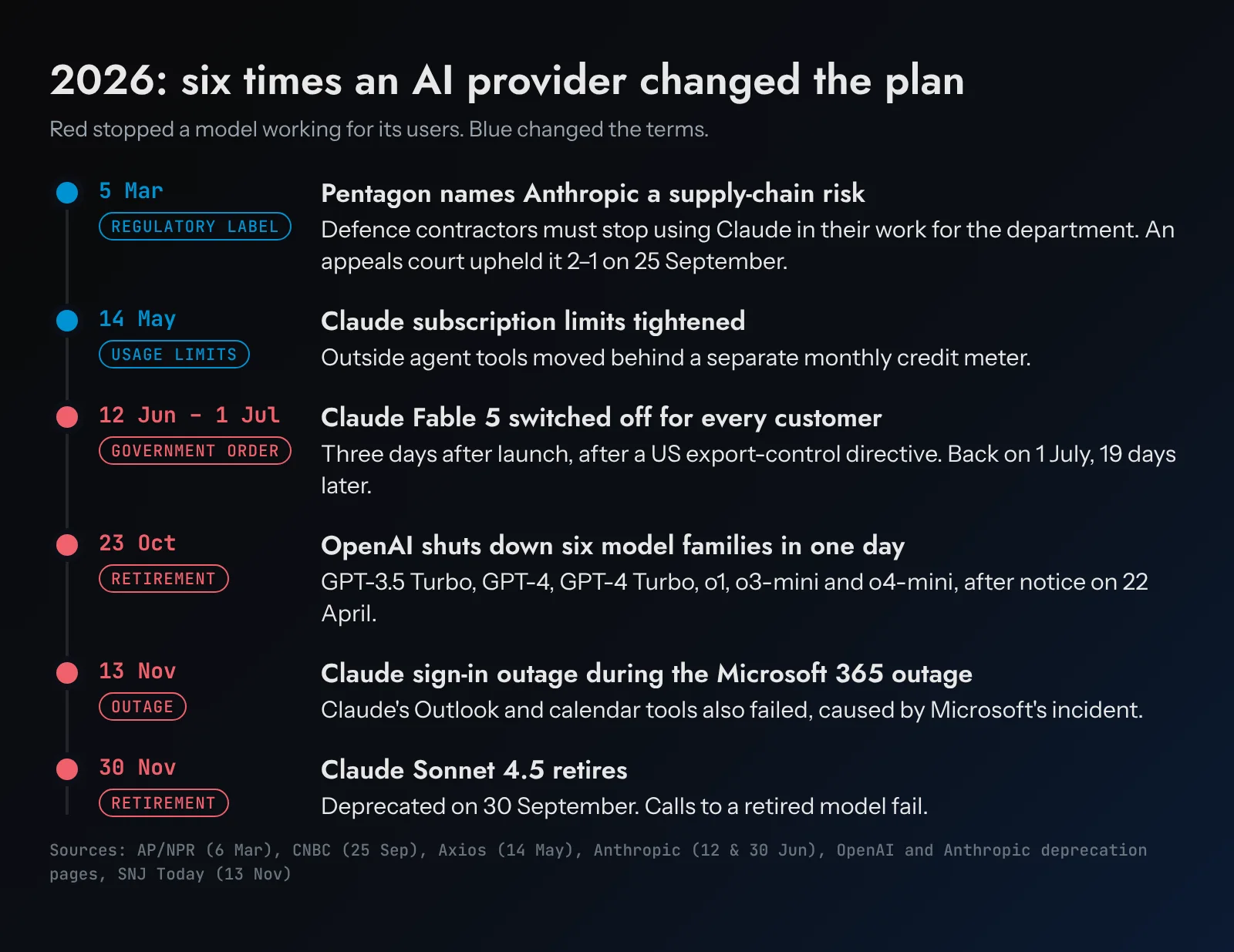
- A regulatory label. On 5 March the Pentagon told Anthropic its products were a supply-chain risk "effective immediately". On 25 September a federal appeals court upheld that designation 2–1, which blocks defence contractors from using Claude in their work for the department. A separate federal judge in San Francisco had ruled a related designation illegal in August, so the legal picture is mixed. If you make parts for defence primes, this is not abstract.
- Changed limits. In May, Anthropic tightened what paying subscribers could do, putting outside agent tools behind a separate monthly credit meter.
- A government order. Fable 5, above.
- Retirements. OpenAI's deprecations page lists six model families shut down together on 23 October 2026, and GPT-5.1 is scheduled to shut down on 1 April 2027.
- Outages. On 13 November, Claude users could not log in to the app or Claude Code for part of the morning. At the same time, Claude's Outlook and calendar tools were failing because of a Microsoft 365 incident. Your AI depends on other people's systems too.
- Prices move both ways. In September OpenAI's new GPT-6 tiers cut API prices by 50% against GPT-5.6 promotional pricing. Good news, unless your contract or your code stops you taking it.
The 17 November week made the wider point. Microsoft, the FAA, JPMorgan Chase, United, the NSA and Apple all had problems in four consecutive business days, none of them blamed on attacks. "You need to think about how you continue to operate in the face of one of your IT systems going down," Palo Alto Networks' Sam Rubin told CNBC. Your AI provider is now one of those systems.
Analysts expect more change, not less. After the November AI sell-off, a Times Square Chronicles analysis warned that vendors may raise prices, tighten usage limits or change plans if data-centre costs rise, and advised businesses to keep prompts, data and records in systems they control. That is analysis, not a forecast, but it matches the year.
How fast do AI models get retired?
Faster than most software. Anthropic promises at least 60 days' notice before retiring a publicly released model. OpenAI gave six months for the October shutdowns. Compare that with an ERP release, which you can often stay on for years.
The problem is not the notice. It is what teams do with it. A 2026 study by Hyungjin Lukas Kim of Myongji University, When the Model Retires, matched 5,139 code changes in open-source apps to official retirement dates from OpenAI, Anthropic and Google. It found:
| Finding | Figure |
|---|---|
| Migrations made after the shutdown date (app already failing) | 82% |
| Median delay after shutdown | 39 days |
| Apps with the model name hard-coded | 94% |
| Migrations that switched provider | 8% |
| Late migrations among apps already using an abstraction layer | 70% |
| Effort: prompt-only apps vs fine-tuned apps (median lines added) | 6 vs nearly 700 |
Two lessons for an operations director. First, a gateway or abstraction layer makes the fix smaller, but on its own it does not make the fix happen on time: someone has to own the calendar. Second, fine-tuning a model on your data makes you far stickier than writing good prompts. Fine-tune only when you have measured that prompts cannot do the job.
Is your AI dependency a regulatory risk too?
It can be, from two directions. Governments can restrict a provider, as the Pentagon designation and the Fable 5 directive showed. And some sectors already have to prove they can leave a supplier.
The EU's Digital Operational Resilience Act is the clearest example. Article 28 of DORA requires financial firms to have exit strategies for critical ICT services, so they can leave a provider "without disruption to their business activities", with exit plans that are "documented" and "sufficiently tested and reviewed periodically". DORA does not apply to a distributor or a manufacturer. But it is a good, free template: if the AI step in your order-to-cash process is critical, you should be able to show the same three things.
How do you build AI that can switch providers?
Six steps. None needs a big programme, and most cost far less at the start than in a hurry later.
1. Put one gateway between your systems and every model
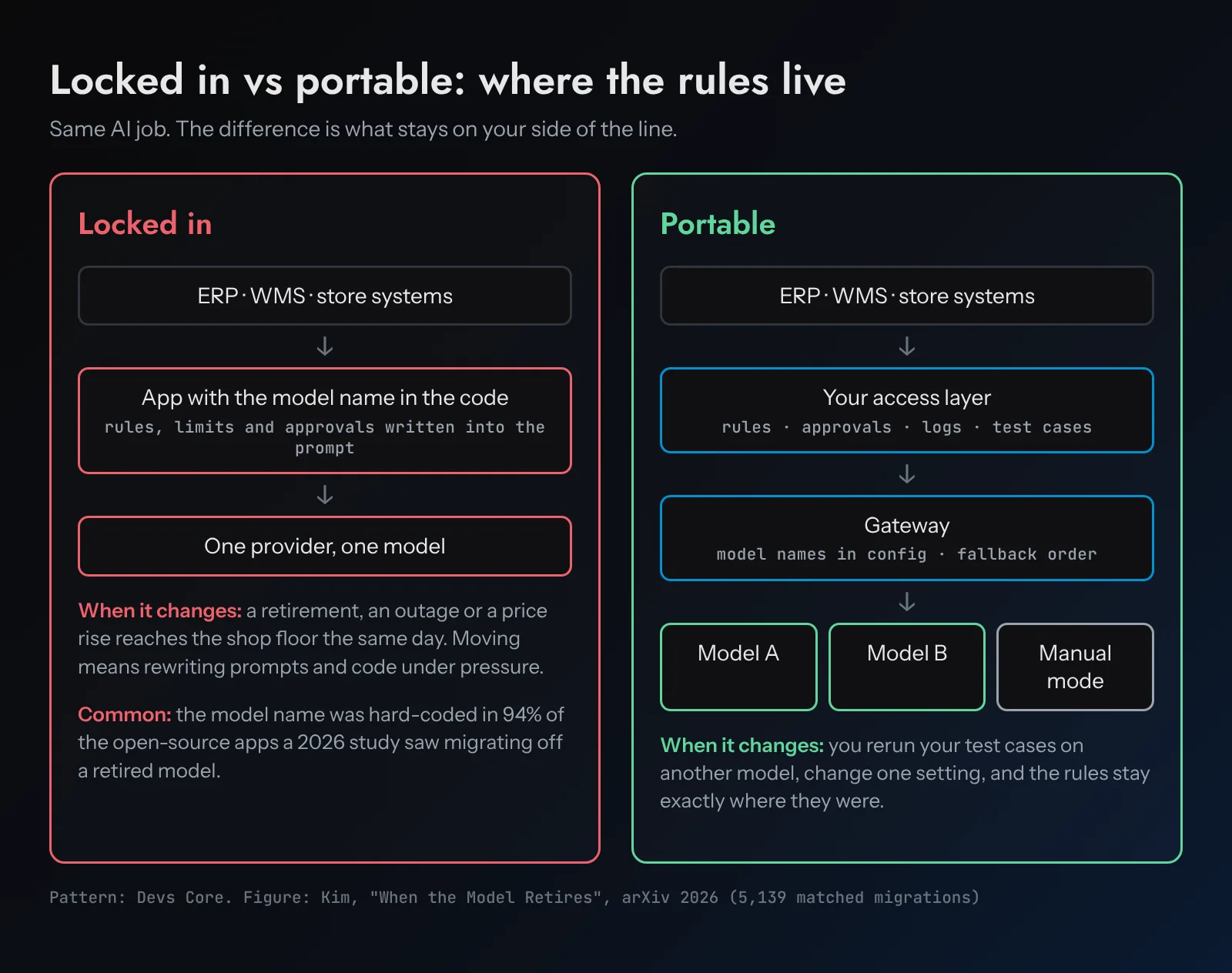
Every AI call goes through one service you control, which holds the model names, keys, budgets and fallback order. Gateways such as Vercel AI Gateway, LiteLLM or Portkey do this. Vercel's documentation shows the idea: it fails over to other providers serving the same model when one is unavailable, and model fallbacks try a backup model when the first fails. We covered how to set budgets and limits in the same place in our AI gateway cost-control guide.
2. Keep business rules, approvals and data outside the model
This is the step that matters most. If "never refund over $500 without a supervisor" lives in a prompt, it leaves with the model. If it lives in your own code, every model has to obey it. In Ware, our warehouse and press-shop demonstration, the model only proposes actions. A governed command service on our side decides what is allowed, sends the rest to the right manager and writes the audit log. That is what our access layer package builds for real systems.
3. Keep prompts plain and model names in configuration
Write prompts as clear instructions a competent new hire could follow, not tricks tuned to one model's quirks. Store them with version numbers. Put model names in a settings file, never in code. It is the cheapest fix for the 94% problem.
4. Build a test set from your own work
Collect 50 to 200 real cases with known right answers: past exceptions, invoices, customer emails. Score any model against them before it touches live work. This also saves money. When we ran Ware through whole simulated days on two models, the smaller Claude Haiku 5.5 did about as well as Claude Sonnet 5.5 for a fifth to a third of the cost. On the peak day it shipped 52 orders for $0.76 of model cost against 49 for $4.03. Without the test, we would have paid for the bigger model by default.
5. Test a fallback and a manual mode
Set a fallback order: a second model from another provider, then an older model, then a manual queue. Then switch the main model off on a quiet afternoon and watch what happens. Fable 5's suspension did not touch Anthropic's other models, so even a same-vendor fallback would have helped there. A regulatory designation, by contrast, needs another provider. When Ware loses every provider, the day runs on without it and nothing is charged. Your process needs the same floor.
6. Give someone the calendar
Name one person who watches the status and deprecation pages of every provider you use, with retirement dates in a shared calendar and a migration started on the day of the notice, not the day of the shutdown.
What does a day without your AI cost?
Work it out before you need to. Here is an illustration with clearly made-up inputs.
Assume an agent drafts replies to 300 delayed-shipment exceptions a day, and doing one by hand takes 5 minutes. That is 300 × 5 = 1,500 minutes, or 25 staff-hours a day. If the only model it can use disappears for 19 days, as Fable 5 did, that is 25 × 19 = 475 staff-hours. At an assumed loaded cost of $35 an hour, 475 × $35 = $16,625, before late shipments and customer complaints. Put your own volumes in. For most mid-size operations, a few engineer-days a quarter to keep a second model tested is the cheaper side of that sum.
What should your AI contract say?
| Clause | What to ask for |
|---|---|
| Model retirement notice | A minimum notice period in writing, and named replacements |
| Price and limit changes | Notice before rates, rate limits or plan terms change; price held for the contract term |
| Data use and retention | No training on your data; retention terms stated per model |
| Data export | Your prompts, logs, test sets and outputs exportable in a standard format |
| Exit | Right to end the contract if the provider is restricted by a regulator or government |
| Service levels | Uptime commitments and credits for the API you use, not just the chat app |
Retention deserves a closer look. Anthropic requires 30-day retention of customer data with Fable, a policy it says has real costs with customers. Terms can differ model by model within one vendor, so check each model you plan to use.
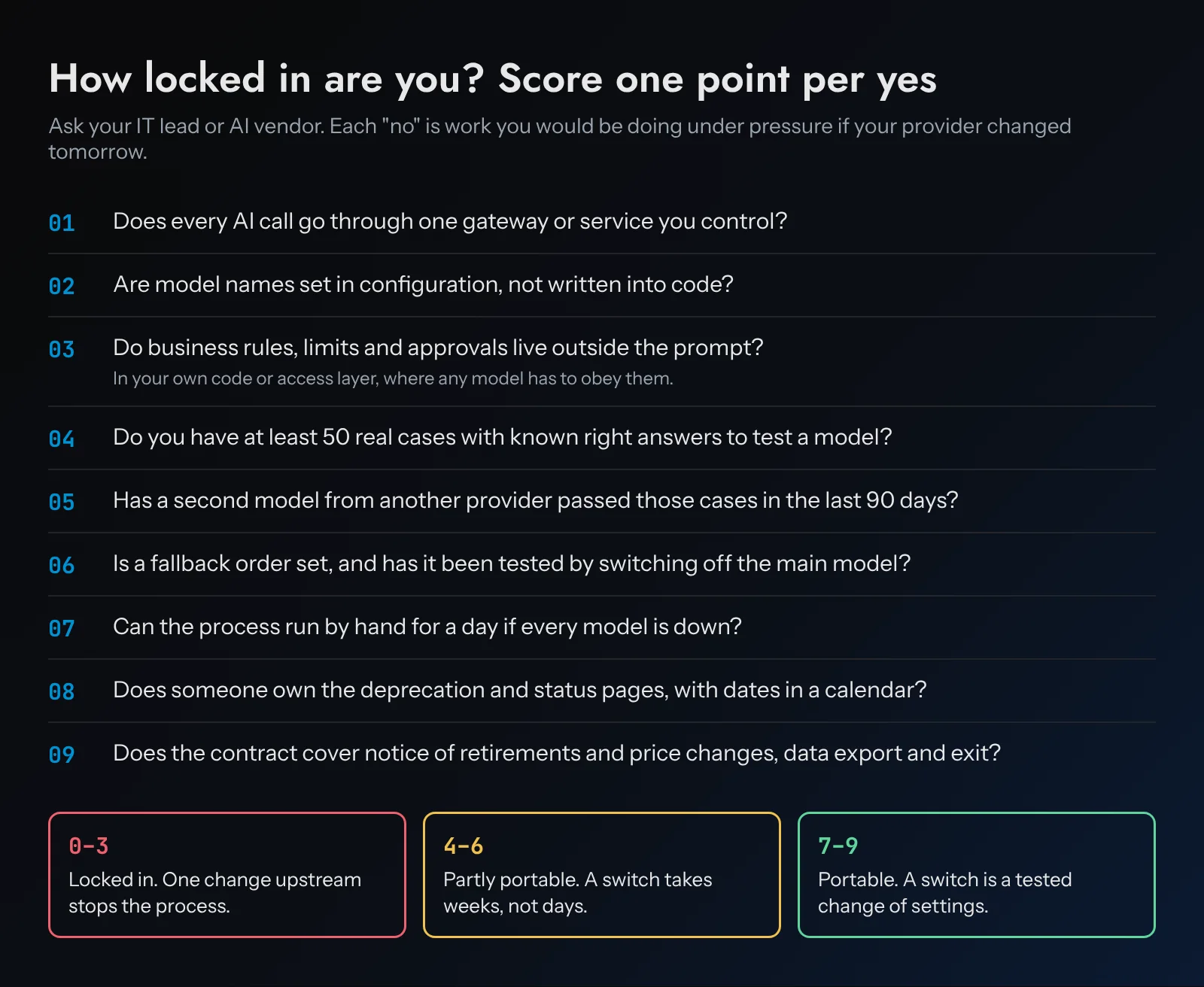
How locked in are you?
Run this scorecard with your IT lead or your AI vendor. It takes 15 minutes.
What should you do this week?
- List every process that calls an AI model, which model, and who owns it.
- Check the deprecation pages for each model on that list and put the dates in a calendar.
- Ask one question of every AI vendor: "If your model were switched off tomorrow, what would our process do?"
- Pick your most important AI process and collect 50 real cases with known answers.
- Agree the manual mode: who does the work by hand, and how they find out.
If you want help with the build, our AI integration services put a gateway, rules outside the model and tested fallbacks into the systems you already run. If you would rather start with a map, the two-week AI Readiness Audit looks at where AI sits in your operation and ends in a written plan, portability included.
Frequently asked questions
What is AI vendor lock-in?
AI vendor lock-in is when a process only works with one AI provider's model, so a price change, outage, retirement or government order at that provider stops your work. The usual causes are model names hard-coded in software, business rules written into prompts and fine-tuning on one vendor's model.
How do I avoid being locked in to one AI provider?
Send every AI call through a gateway you control, keep model names in configuration, and keep rules and approvals in your own code rather than in prompts. Then keep a test set of your own cases, pass a second provider's model against it every quarter, and test a fallback and a manual mode.
How much notice do AI providers give before retiring a model?
It varies. Anthropic promises at least 60 days for publicly released Claude models, and OpenAI gave six months before shutting down GPT-4 and five other model families on 23 October 2026. Start migrating on the day of the notice: a 2026 study found 82% of migrations happened after the shutdown date.
Is using several AI models more expensive?
Not necessarily. A gateway adds little cost, and testing models against your own cases often shows a smaller, cheaper model does the job. In our Ware demonstration, Claude Haiku 5.5 matched Claude Sonnet 5.5 on the peak day for a fifth of the cost.
Can a government stop my company using an AI model?
Yes, in some cases. In 2026 the Pentagon barred defence contractors from using Claude in their defence work, and a US export-control directive took Claude Fable 5 offline for every customer for 19 days. A second, tested provider is the practical protection.
Does an AI gateway solve lock-in on its own?
No. A gateway makes switching smaller, but the 2026 retirement study found that 70% of apps already using an abstraction layer still migrated after the shutdown date. You also need rules outside the prompt, a test set, and someone who owns the deprecation calendar.