
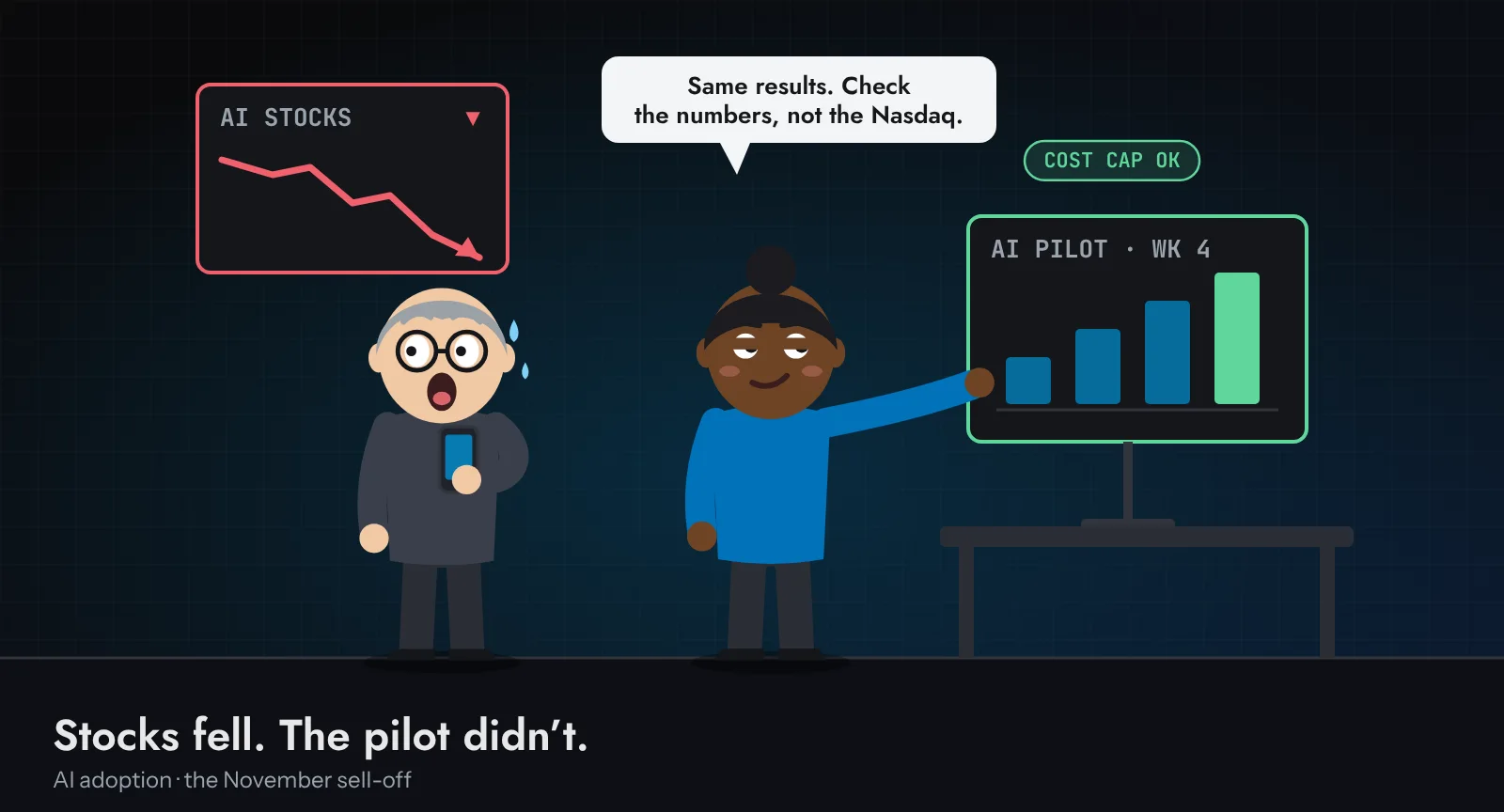
Call her Ruth. She is made up, but her Friday is not unusual. Ruth is managing director of a 400-person distributor, and on 20 November a board member forwards her a headline: the Nasdaq has erased all its 2026 gains as the AI sell-off dampens Anthropic's second day of trading. His note is one line. "Should we pause the AI project?"
Her project is a four-week-old pilot that helps two coordinators clear shipment exceptions. It has nothing to do with the Nasdaq. But the question deserves a real answer, because the board will ask it again.
No, you should not pause an AI project because AI stocks are falling. The sell-off is a market story about the cost and financing of building AI infrastructure; it does not make the tools you buy worse or dearer this month. Pause or stop a project only when it fails its own business test: no baseline, no owner, no cost cap and no written kill criteria.
Key takeaways
- The Nasdaq fell 5.5% on 5 November 2026 and had erased its 2026 gains by 20 November, but Nvidia still reported quarterly revenue of $115.8bn, up 103% on a year earlier.
- Epoch AI estimates the price of a given level of AI performance has fallen about 13× a year since 2023, so the sell-off is not a reason to expect your model bill to jump next month.
- McKinsey's 2026 survey found only 37% of respondents say AI has contributed to EBIT, unchanged from 2025. Most AI projects fail on operations, not on markets.
- A 96% market-implied chance of a December rate hike matters for long-payback capital projects, and very little for a software pilot that pays back in months.
- Fund AI in stages of two to four weeks, with a written stop condition at each gate, and the share price stops being part of the decision.
What actually happened to AI stocks in November 2026?
Four separate stories piled on top of each other in three weeks.
A spending scare. UBS's chief investment office noted on 2 November that US stocks fell sharply as investors scrutinised potential returns on the AI investment cycle. The scale is the worry: UBS cites aggregate AI capital spending forecasts of $1.0 trillion in 2026, $1.4 trillion in 2027 and $1.5 trillion in 2028.
A political and rates shock. On Thursday 5 November the Nasdaq fell 5.5%, its worst day since April 2025, closing about 11.9% below its 6 October record. AMD dropped 17.3% and Nvidia 9.3%. The trigger was as much political as financial: midterm results, talk of limits on data-centre building, and rising rates.
A leadership scandal. On 9 November Nvidia's chief executive admitted an extramarital affair and the company said it was investigating reports he was the target of a foreign intelligence effort. The shares closed at $178.67, down 4% on the day and 25% from their October peak, erasing roughly $192bn of market value. Jensen Huang then resigned, with finance chief Colette Kress named interim CEO. The Guardian also reports that Nvidia shares fell after California served the company with a subpoena over whether its chips ended up in China.
A record IPO that did not lift the mood. Anthropic priced its IPO at $83 a share, valuing it at $1.5 trillion. Reports differ on how much it raised: PBS/AP says $81bn, Reuters says $93.5bn. The shares jumped 17% on day one, then closed at $88.91 on Friday, 8.5% below Thursday's close. By that Friday the S&P 500 and Dow had closed in correction territory, according to The Guardian.
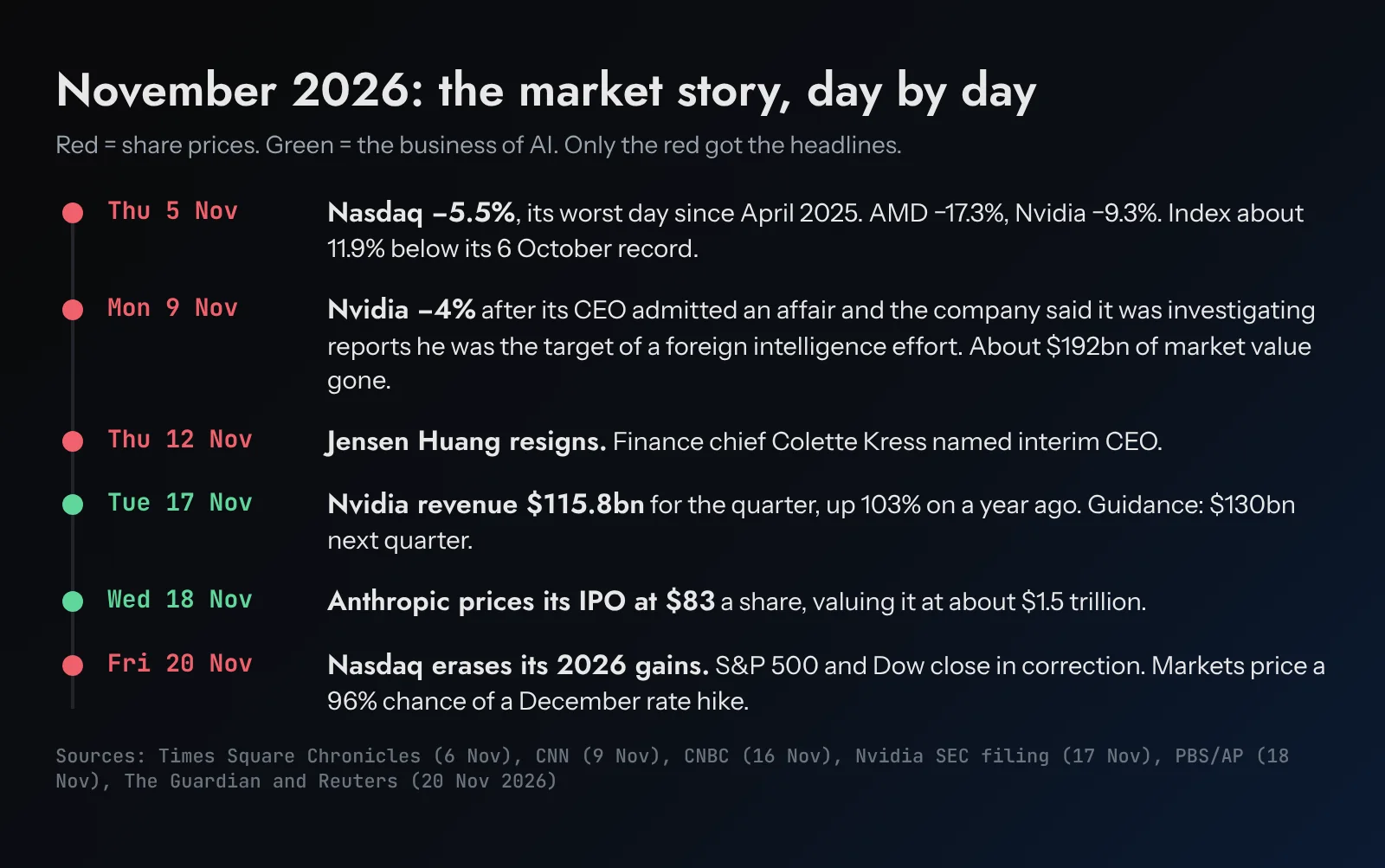
Look at the green entries. In the same week the shares fell, Nvidia reported quarterly revenue of $115.8bn, up 103%, with data-centre revenue of $107.6bn and guidance of $130bn for the next quarter. Demand for AI is not what investors are fighting about. They are fighting about price. As one portfolio manager told Reuters: "Investors still believe in AI but are becoming more selective about what they will pay for that growth."
That is exactly the right attitude for you, too.
Does the AI sell-off change anything for a business that uses AI?
Less than the headlines suggest, but not nothing. Split it into two lists.
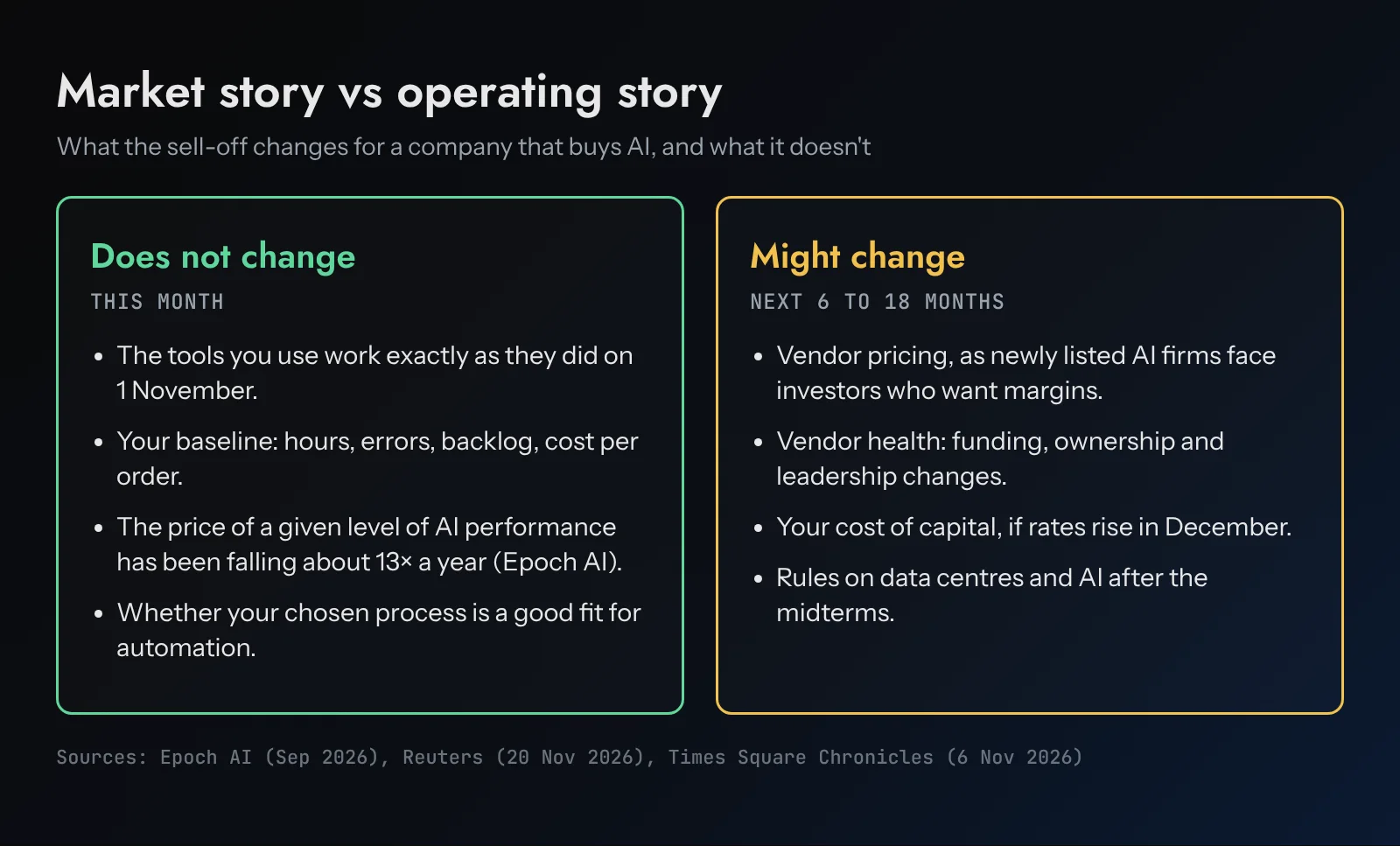
What does not change
The software you use works the same as it did on 1 November. Your baseline (hours spent, error rates, backlog, cost per order) is the same. And the long-run price trend for buyers still points down. Epoch AI estimates that the cost of a given level of AI performance has fallen about 47% per quarter, or 13× a year, since 2023. Epoch is careful to say that real users switch models less often than its frontier measure assumes, so your own saving will be smaller. But a falling share price does not reverse that trend overnight.
What might change over the next 6 to 18 months
- Vendor pricing. Newly public AI companies answer to investors who want margins. PBS notes Anthropic is unprofitable under standard accounting. Expect price lists, usage tiers and limits to move. Not this week, but within the life of a contract.
- Vendor health. Leadership changes, funding squeezes and acquisitions are more likely in a falling market. A small AI start-up you depend on is a bigger risk than a model provider.
- Your cost of capital. Reuters reports markets priced a 96% chance of a 25-basis-point December rate hike as of 20 November. That hits projects with long paybacks hardest.
- Regulation. Coverage of the sell-off points to a promised moratorium on new data-centre building in Texas and talk of tighter AI rules after the midterms.
None of those is a reason to stop a small project. All of them are reasons to build it so you can change model, cap spend and walk away cheaply. Our guide to controlling AI agent costs with a gateway covers the mechanics.
When should you actually pause an AI project?
Pause it when the project itself fails, not when the market does. The good news is that most of the failure modes are visible early.
Gartner predicted in June 2025 that over 40% of agentic AI projects will be cancelled by the end of 2027 "due to escalating costs, unclear business value or inadequate risk controls". None of those three reasons is a share price. We covered what kills pilots in detail in why agentic AI projects get cancelled.
McKinsey's latest survey points the same way. In The state of AI in 2026 (1,719 participants, surveyed May to June 2026), 44% of respondents say AI is scaling across their enterprise, but only 37% say it has contributed to EBIT, essentially unchanged from a year earlier. The 6% it calls high performers are twice as likely to have defined processes to measure the impact of their AI work, and nearly three-quarters of them have fundamentally redesigned workflows, against about one-quarter of everyone else.
So the question to ask of each project is operational. Use this table.
| Signal | What to do |
|---|---|
| No measured baseline for the process | Pause. Measure for two weeks, then decide. |
| No named business owner | Pause until someone signs up to the number. |
| Run cost unknown or uncapped | Keep it running only after you add a cap. |
| Scope is "AI across the business" | Cut it to one process with a checkable answer. |
| Depends on one small vendor with no exit | Keep going, but write the exit plan now. |
| Large up-front capital spend, payback over three years | Re-test the payback at higher rates. |
| Small, measured, reversible pilot on track against its baseline | Carry on. The market is not your problem. |
How do you fund an AI project with kill criteria?
Treat the money like a series of small options, not one big bet. Each stage costs a few weeks, buys one piece of evidence, and ends at a gate where a director decides whether to buy the next one.
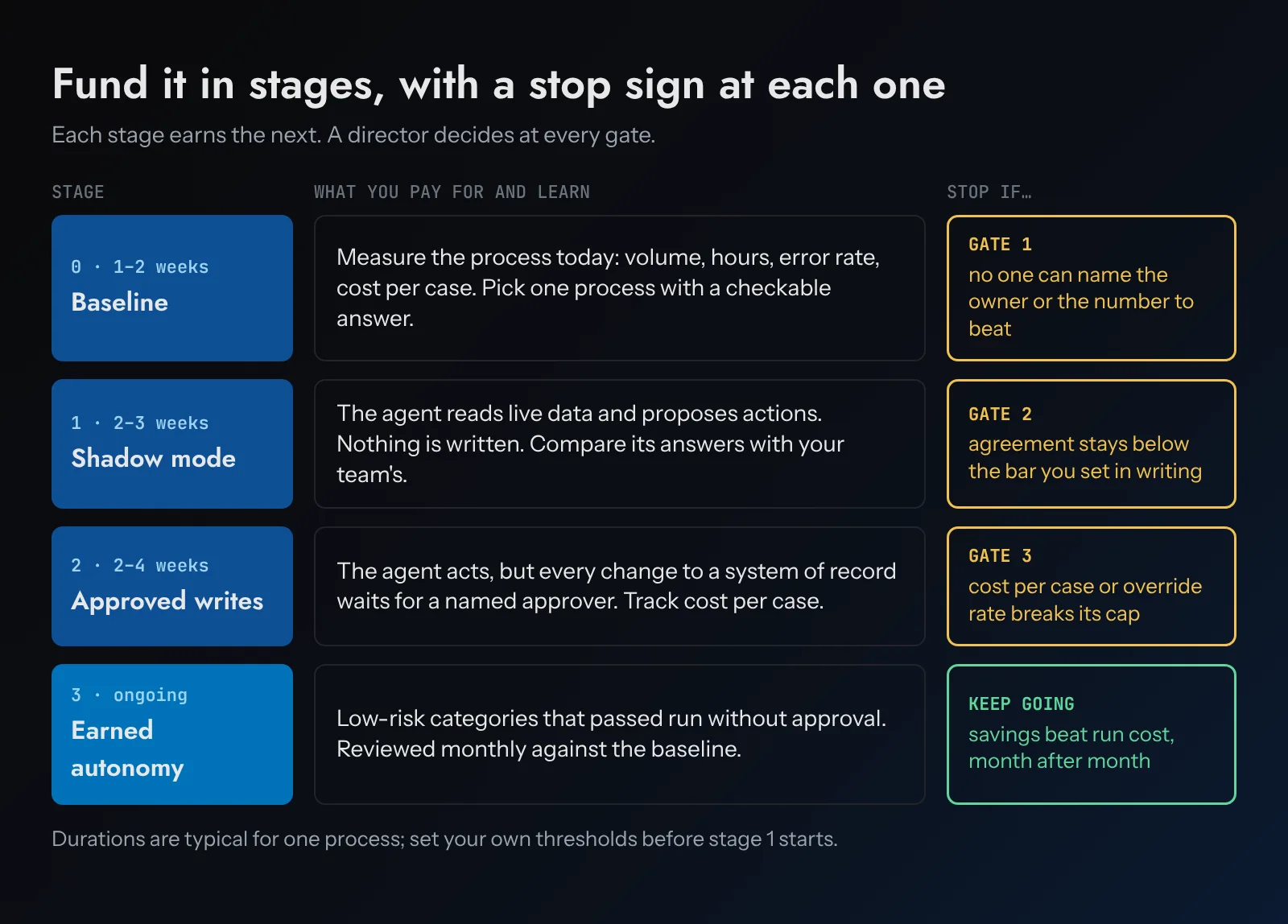
A kill criterion is a written condition, agreed before work starts, under which you stop the project and keep what you learned. Good ones are numbers, not feelings:
- "If, after three weeks in shadow mode, the agent agrees with our coordinators on fewer than 85% of carrier-delay exceptions, we stop."
- "If cost per handled exception goes above $1.50 in any week, we stop and review."
- "If the approver overrides more than one in ten proposed writes in month two, autonomy does not expand."
The thresholds above are examples. Set your own, write them down, and get the board to sign them. That piece of paper is what lets you answer the "should we pause?" email in one line.
A worked example, with the assumptions labelled
Here is the arithmetic Ruth could send her board. Every input is an assumption for illustration. Replace them with your own.
- Assume two coordinators spend a combined 6 hours a day on shipment exceptions, at a loaded cost of $35 an hour, for 250 working days: 6 × $35 × 250 = $52,500 a year.
- Assume that, once writes are approved, the agent takes 40% of that work: 0.4 × $52,500 = $21,000 a year.
- Assume model and hosting costs of $200 a month ($2,400 a year), and a reviewer spending 30 minutes a day approving writes: 0.5 × $35 × 250 = $4,375 a year.
- Net saving: $21,000 − $2,400 − $4,375 = $14,225 a year, or about $1,185 a month.
- Assume a fixed build cost of $8,900 (a pilot plus an up-front audit). Payback: $8,900 ÷ $1,185 ≈ 7.5 months.
Now apply the rate scare. If the build were financed and the rate rose by a quarter point, the extra interest on $8,900 is about $22 a year. On a $250,000 piece of automation equipment, the same quarter point is $625 a year, on a payback measured in years. That is the real lesson of rising rates: favour short-payback, reversible software projects over long-payback capital ones, not "stop everything".
For a sense of what a measured result looks like, our own demonstration, Ware, runs a 3D warehouse and press shop on real orders from open data with an AI agent on duty within set rules. On the peak day, 52 of 59 orders shipped with Ware on duty against 34 with nobody acting, and it cost $0.76 of model spend on Claude Haiku 5.5, measured before a fix that cut its steps about sixfold. It is a demonstration we built, not a client result, but it shows the shape of the evidence a gate should ask for: a baseline, a comparison and a cost.
What should you do on Monday?
- Write one paragraph for the board that separates market risk (share prices, IPOs, chip makers) from operating risk (your baseline, your vendor, your controls). Most of the anxiety goes away when the two are on separate lines.
- Run every AI project through the table above. Pause the ones with no baseline or owner. Shrink the ones with vague scope.
- Put a hard spending cap on every model account and a weekly cost-per-case figure on someone's dashboard.
- List your AI vendors and how you would leave each one. Check contract terms on price changes and notice periods.
- Re-run the payback on anything capital-heavy at a higher rate. Move it behind a software pilot if the numbers get thin.
- Write the kill criteria for each live project and get them signed.
None of this needs the market to recover first.
If you want a second pair of eyes, our two-week AI Readiness Audit looks at where AI would sit in your systems, measures the baseline and ends in a written build plan with stop conditions. If you already know the process, an Agent Pilot proves one process on your live data in four to six weeks, with every write approved by a named person. Either way, you decide on your numbers, not the Nasdaq's.
Frequently asked questions
Is the AI bubble bursting in November 2026?
Nobody can call that with confidence. What is measurable is that the Nasdaq erased its 2026 gains by 20 November while Nvidia still reported revenue of $115.8bn, up 103% on a year earlier. Investors are repricing AI companies; they are not reporting that businesses have stopped using AI.
Will AI prices go up after the Anthropic IPO?
Possibly, for some products, over the life of a contract. Newly public AI companies face investors who want margins, so price lists and usage limits may change. Against that, Epoch AI estimates the cost of a given level of AI performance has fallen about 13× a year since 2023. Protect yourself with spending caps, the freedom to switch models, and notice periods in your contracts.
Should a mid-size company wait for AI to get cheaper before starting?
Waiting saves less than you think. Model costs are usually a small share of a project; the integration, process design and change management are most of it, and they do not get cheaper by waiting. Start small, measure, and switch to cheaper models as they arrive.
How do I justify an AI project to my board during a market sell-off?
Show the baseline, the expected saving with labelled assumptions, the payback period, the spending cap and the written kill criteria. A project with a payback of under a year and a clear stop condition is easier to defend in a falling market than a large, open-ended programme.
What is a kill criterion for an AI project?
A kill criterion is a written condition, agreed before work starts, under which you stop the project. Good ones are numbers, such as an agreement rate with your staff, a cost per case or an override rate. They protect the budget and make the decision to continue defensible.
Do rising interest rates make AI projects a bad investment?
Rising rates raise the bar for projects with long paybacks and large up-front spend, such as automation equipment. A small software pilot that pays back in months is barely affected: a quarter-point rise on an $8,900 build costs about $22 a year in extra interest.