
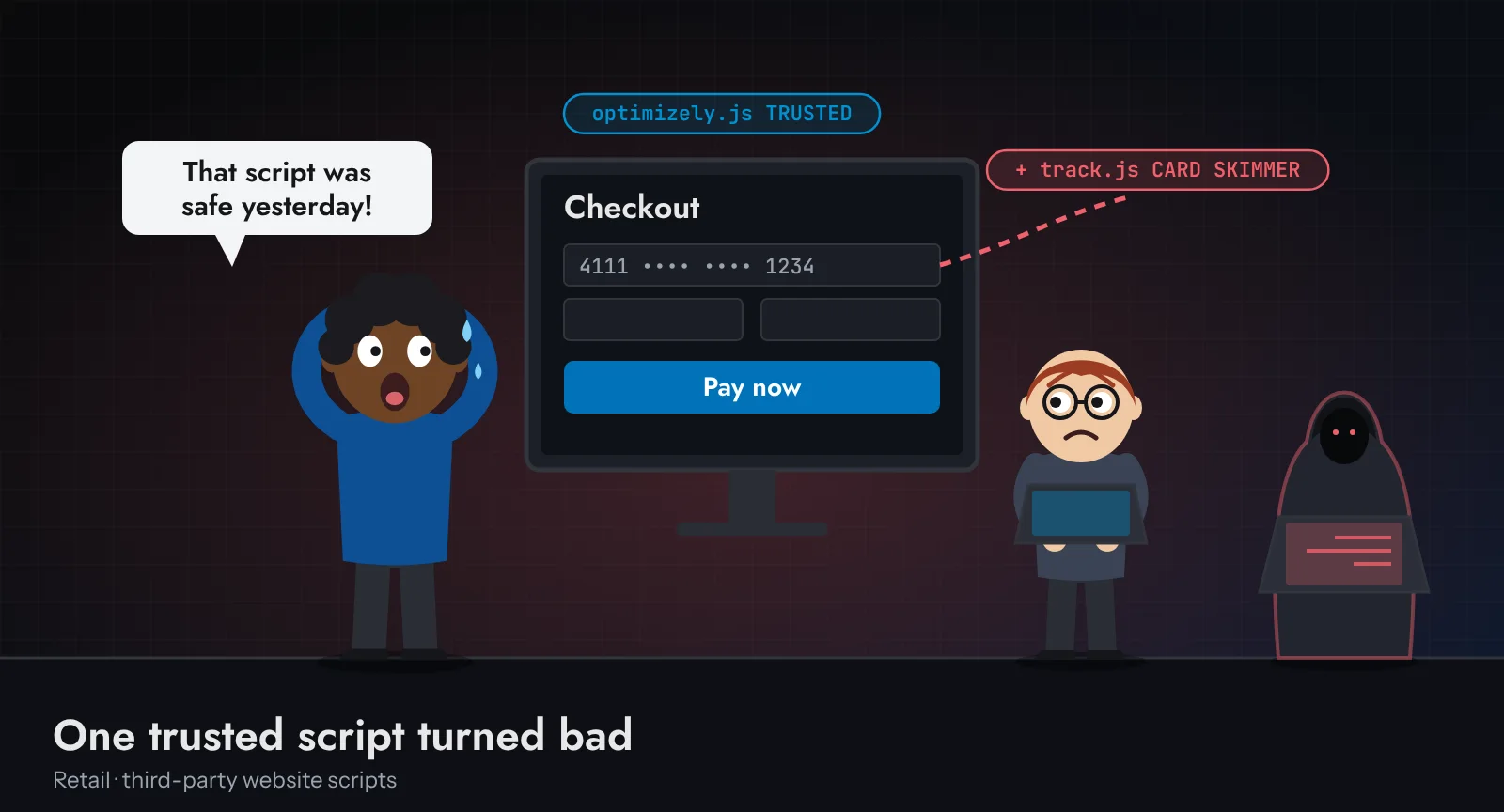
Call her Priya. She is made up, but nothing that happens to her is unusual. She runs e-commerce for a mid-size homeware retailer. On Monday 17 November she opens her news feed and sees a list of 20 retailers, including IKEA, ASOS, Mattel, American Eagle and a string of Levi's country sites, whose websites served malware to shoppers the day before. None of them was hacked in the usual way. A testing tool they all trusted was. Priya's first question is the one every retail director should ask: how many tools like that run on our checkout, and who approved them?
Retail website malware now arrives mostly through third-party scripts: if a vendor's script runs on your checkout, its compromise is your compromise, so you need an inventory of every script, a strict Content Security Policy, and alerts when any script changes. That is also what PCI DSS Requirements 6.4.3 and 11.6.1 already ask of payment pages.
Key takeaways
- On 16 November 2026, malicious JavaScript reached visitors of 178 organisations through one vendor, Optimizely, including 20 retail and fashion organisations, according to Report URI's investigation.
- The code skimmed cards typed into a site's own form fields, swapped crypto wallet addresses, stole cookies and screenshots, and targeted older iPhones; cards entered in hosted payment iframes were out of its reach.
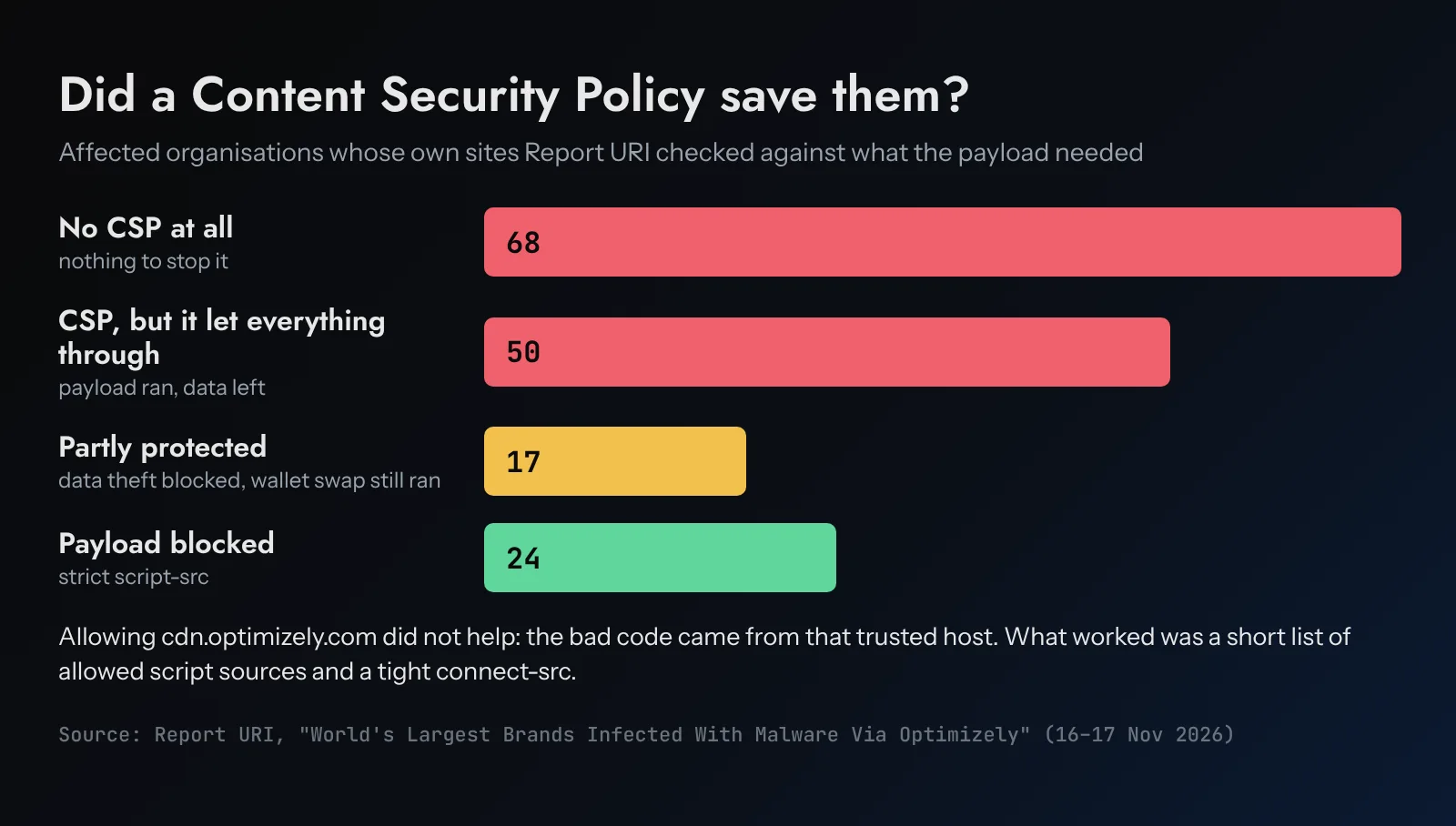
- Of the affected organisations Report URI checked, only 24 (15%) had a Content Security Policy that blocked the payload; 68 had no CSP at all.
- PCI DSS 6.4.3 requires every payment page script to be authorised, integrity-checked and listed with a written justification; 11.6.1 requires tamper alerts at least weekly.
- The fastest win for most retailers is removing marketing and testing scripts from checkout pages altogether.
What happened in the Optimizely website malware attack?
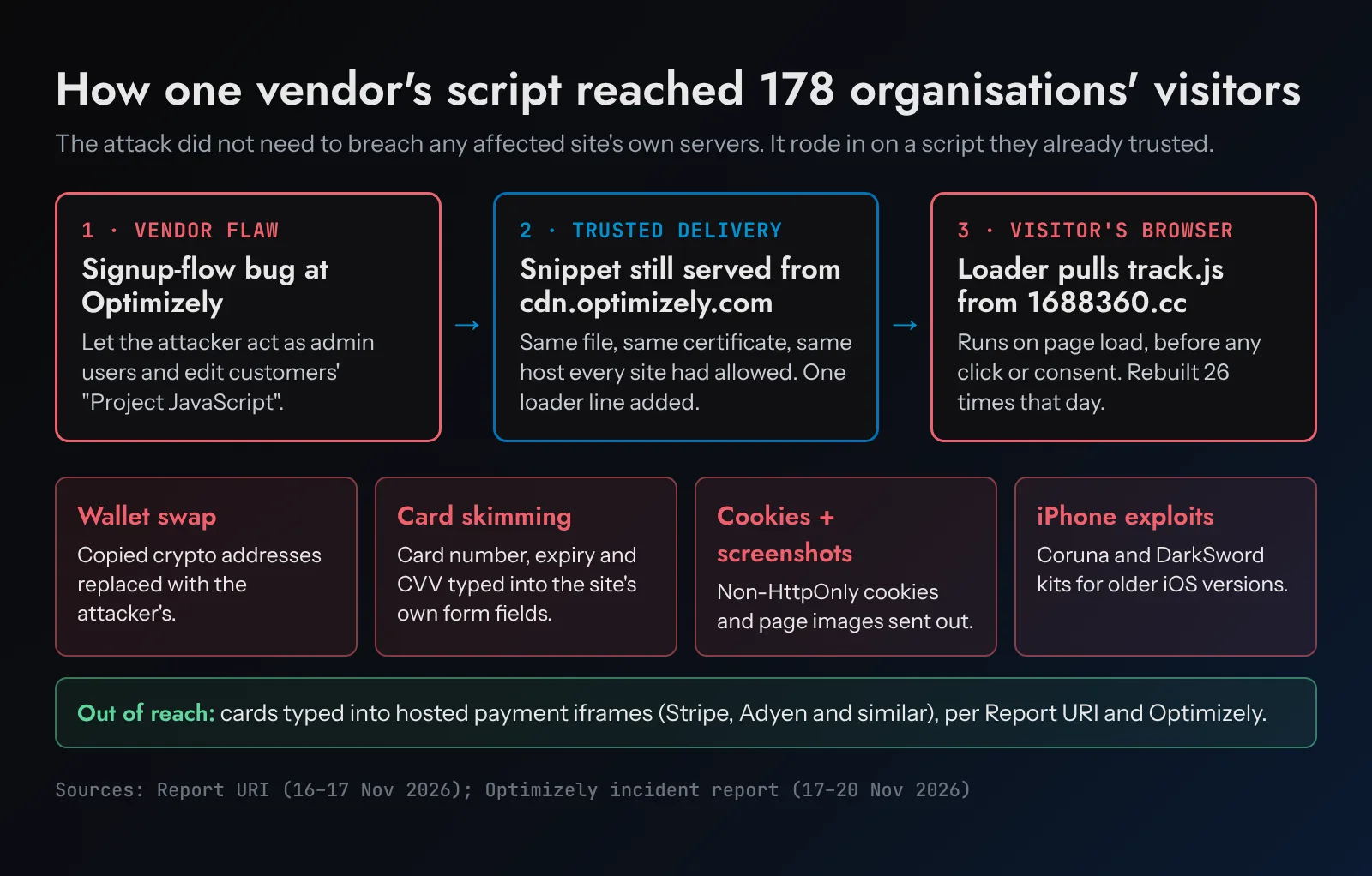
Optimizely Web is an A/B testing tool. Each customer site loads a JavaScript "snippet" from Optimizely's servers, and that snippet includes an optional field called Project JavaScript: custom code that runs on every page.
According to Optimizely's own incident report, an unauthorised party exploited a flaw in the Web Experimentation account signup flow that let them "impersonate users and insert malicious JavaScript into the Project JavaScript of some customer projects". Optimizely says this was not a compromised administrator account and not a credentials breach. Newsweek reported that the company's security report described thousands of attempts to guess employee email addresses before the attacker got in.
Researcher Scott Helme at Report URI found the code in 188 of the 1,611 Optimizely snippets his team checked, belonging to 178 organisations. The file was still served from cdn.optimizely.com, with Optimizely's certificate. One line had been added: a loader that fetched a script called track.js from an attacker-controlled domain.
Reuters reported that Salesforce and IKEA were investigating, Zoom disabled Optimizely across its production environments, and Equifax stopped using the platform. Apple told Reuters that the iOS vulnerabilities targeted had been fixed the year before and up-to-date devices were protected.
What did the malicious script do to shoppers?
Report URI's analysis lists four jobs, all active at once:
- Crypto address swapping. Any valid wallet address on the page or in the clipboard was replaced with the attacker's.
- Card skimming. Added at 13:43 UTC. It watched form submissions for a card number, expiry and CVV, then sent them out. Cards typed into hosted payment iframes such as Stripe or Adyen were out of reach. Cards typed into a site's own form fields were not.
- Cookie and screenshot theft. Cookies not marked
HttpOnly, plus a rendered image of the page. - iPhone exploits. Older iOS devices were sent to the Coruna and DarkSword exploit kits.
Krebs on Security quoted Infoblox researcher Zach Edwards on why this spread so easily: testing snippets are placed at the top of the page and fire on load, before any consent banner, so no shopper had to click anything.
How long was the window open?
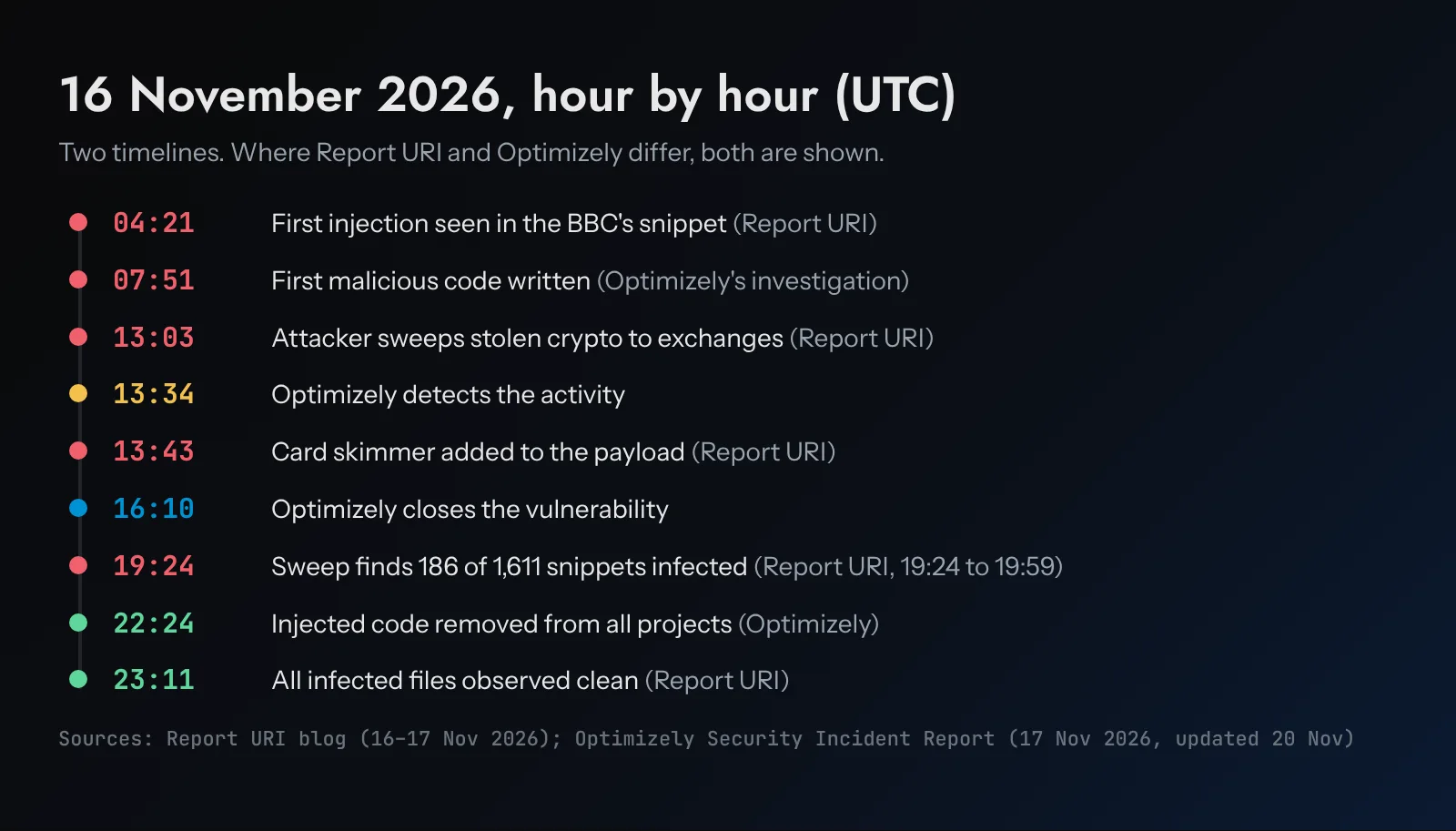
The two main accounts do not agree on when it started. Report URI saw the first injection in the BBC's snippet at 04:21 UTC. Optimizely's investigation says the first malicious code was written at 07:51 UTC. Both agree it was cleaned up the same night.
It was also not a one-off. Report URI traced the same actor's injector through three other third-party script vendors (Kissmetrics, StorifyMe and Minute Media) from 13 November. Netskope Threat Labs dates the wider campaign back to September. The two firms give slightly different first-seen dates for the injector domain (12 and 17 September), but the point stands: this operator works through whichever vendor script it can reach.
How much damage did it do?
Nobody knows yet, and the honest answer matters. Report URI counted about $7,040 in crypto reaching the attacker's wallets by the evening of 16 November. Helme told Newsweek the code may have been served during roughly 34 million page visits, with a wide range of 6 million to 150 million, and stressed that this "counts visits that loaded the code, not people who lost money or data". Card numbers, cookies and iPhone infections cannot be counted from the outside.
Experts also disagree on how the attack was built. Helme told Newsweek his team saw "no evidence of AI involvement". Peter Lowe of ZeroFox said he "wouldn't be surprised" if it turned out to be an AI-assisted attack. For a retailer, it does not change what to do.
Why are third-party scripts the weak point on retail websites?
A modern storefront is assembled from other people's code: analytics, A/B testing, reviews, chat, personalisation, ad pixels, consent banners, tag managers. Krebs, citing HTTP Archive's 2025 Web Almanac, notes the median homepage loads at least 22 JavaScript files. Each one runs with the same power as your own code. It can read what a shopper types and send it anywhere the browser allows.
You did not need to make a mistake to be hit on 16 November. As Lowe put it to Newsweek, "If a party you trust is compromised then effectively you are." Optimizely's own report put the dividing line plainly: sites with a strong Content Security Policy were protected.
Would a Content Security Policy have stopped it?
A Content Security Policy (CSP) is a header your site sends that tells the browser which sources it may load scripts from and send data to. Report URI checked the affected organisations' own sites against what the payload needed.
Three lessons from that data:
- Trusting the vendor's domain did nothing. The bad code came from
cdn.optimizely.comitself. - A strict
script-srcwon. Sites that listed only the script hosts they needed blocked the attacker's domain. Two common settings let it through:'strict-dynamic', which trusts anything a trusted script loads, and'unsafe-eval', which Report URI says Optimizely's documentation tells customers to allow. HSBC's CSP blockedtrack.js, but an inline fallback copy still ran througheval. connect-srclimits the damage. The 17 partly protected sites stopped card and cookie data leaving, because they restrict where the page can send data. Address swapping, which happens inside the page, still worked.
Helme's own crawler data, cited by Krebs, puts CSP deployment across the busiest websites at only about 10%.
What does PCI DSS require for scripts on payment pages?
Card rules already cover this. PCI DSS v4.x added two requirements aimed at exactly this kind of e-skimming, and the PCI Security Standards Council published guidance on them in March 2025. They became mandatory on 31 March 2025, as Report URI's PCI guide notes.
Per the Council's guidance document:
- Requirement 6.4.3: every payment page script loaded in the shopper's browser must have a method confirming it is authorised, a method assuring its integrity, and a place in an inventory with a written business or technical justification.
- Requirement 11.6.1: a change- and tamper-detection mechanism must alert staff to unauthorised changes to the scripts and security-impacting HTTP headers of payment pages as the browser receives them, at least weekly or at a frequency set by a targeted risk analysis.
The guidance is candid about the tools. CSP is good for authorisation and partly for integrity, but it keeps no baseline and cannot alert on header changes by itself. Subresource Integrity (SRI), a hash that blocks a script if its content changes, "is not practical for rapidly changing scripts", and it "fails silently". An A/B testing snippet changes every time marketing edits an experiment, so SRI alone would not have caught this attack.
If you use a hosted payment form and file the short SAQ A, do not assume this is someone else's problem. Report URI notes that 6.4.3 and 11.6.1 were replaced in SAQ A in early 2025 by a condition that your site is not susceptible to script attacks, and the provider's assurance covers their form, not the tags your team puts around it.
What should retailers check on their storefront this week?
These steps are ordered by how much risk they remove per hour of work. Most need your web team and one marketing owner in the same room.
1. Strip non-essential scripts from checkout pages
Optimizely's own advice after the incident was to remove its snippet from any page that handles payment or sensitive input and is not running an experiment. Apply that to every vendor. A checkout page needs your code and your payment provider's code. Testing, heatmaps, chat and most pixels can go.
2. Build the script inventory
List every script on your checkout, basket, login and account pages: URL, vendor, owner, why it is there, and who can change it. Include what your tag manager loads, because a tag manager is a script that loads other scripts. This list is the 6.4.3 inventory and the backbone of everything else.
3. Lock down who can change vendor-hosted code
The Optimizely attack wrote into a field the customer controls. Review user accounts, API tokens and integrations in every tag manager and testing tool. Remove leavers, enforce multi-factor sign-in, and make sure a change to live code needs a named approver.
4. Deploy a CSP, starting in report-only mode
Start with Content-Security-Policy-Report-Only so nothing breaks, collect the reports for two weeks, then enforce. Aim for a short explicit script-src list, no 'unsafe-eval' on payment pages, and a tight connect-src and frame-src.
5. Turn on change detection
Something must notice when a script's content changes or a new destination appears, and alert a person. That is 11.6.1. Commercial client-side monitoring tools exist; whichever you choose, test that the alert reaches someone who can act out of hours.
6. Check the basics that limit the blast radius
Mark session cookies HttpOnly and Secure, keep card entry inside your provider's hosted iframe, and keep web, CDN and CSP report logs. Optimizely asked customers to retain logs covering at least 16 November for their own investigations.
| Control | What it stops | What it does not stop | Effort |
|---|---|---|---|
| Remove scripts from checkout | Everything that script could do there | Attacks through scripts you keep | Low |
| Hosted payment iframe | Skimming of card fields | Cookie theft, wallet swaps, fake card forms on your page | Low to medium |
Strict CSP script-src |
New attacker domains loading | Bad code inside an allowed vendor file | Medium |
Tight CSP connect-src |
Stolen data leaving the page | In-page tampering such as address swaps | Medium |
| SRI hashes | Changes to static, versioned scripts | Dynamic vendor snippets; fails silently | Low per script |
| Change detection (11.6.1) | Silent changes going unnoticed | Nothing by itself; it alerts, a person acts | Medium |
What should you ask your script vendors?
Send these five questions to every vendor whose code runs on your checkout or account pages:
- Who, on your side and ours, can change the code our site loads, and how is that access protected?
- Will you notify us within hours if your delivery platform is compromised, and how?
- Does your snippet work without
'unsafe-eval'and'strict-dynamic'in our CSP? - Can you serve a versioned, hashable file for pages where we need SRI?
- Do you need to run on payment pages at all?
A vendor who cannot answer the first two clearly should not be on your checkout.
Where do AI tools and agents fit into this?
The same pattern is coming to AI. Chat assistants, shopping agents and personalisation tools are often added to storefronts as one more script or integration, sometimes by a team that never talks to IT. The lesson from 16 November applies directly: anything that can act on your site or your systems needs a named owner, the least access it needs, a human approval step for changes that matter, and a log. We have written more about that in our AI vulnerability discovery checklist and in how we build governance into AI systems.
At Devs Core we build governed AI agents and integrations for retail and e-commerce businesses, with those controls designed in from the start. We do not run security monitoring or incident response. If you are planning to add AI to your storefront or back office and want to know where it would sit and what it could touch, our two-week AI Readiness Audit maps that out and ends in a written build plan.
The short version for Monday: count your checkout scripts, cut the ones you do not need, and make sure someone gets an alert the next time one changes.
Frequently asked questions
Was my retail website affected by the Optimizely attack?
If your site loaded an Optimizely Web Experimentation snippet on 16 November 2026, check directly. Optimizely says it has confirmed with each customer whether they were affected; if you have not heard, contact your customer success manager. Report URI also published the full list of 178 organisations and the attacker's domains to search your logs for.
Do I need a Content Security Policy if I use a hosted payment page?
Yes, if shoppers enter anything sensitive on pages you serve. A hosted iframe protects the card fields, but the scripts on your own page can still steal cookies, swap wallet addresses or inject a fake card form. A CSP limits which scripts can run and where data can be sent.
What is PCI DSS requirement 6.4.3?
It requires that every script loaded on a payment page is confirmed as authorised, has its integrity assured, and is listed in an inventory with a written justification for why it is needed. It has been mandatory since 31 March 2025 and was written to stop e-skimming attacks like this one.
What is the difference between PCI DSS 6.4.3 and 11.6.1?
6.4.3 gets the payment page into a known-good state by controlling which scripts run. 11.6.1 keeps it there by requiring a mechanism that alerts staff to unauthorised changes to scripts and security headers, at least weekly or as often as your risk analysis sets.
Can Subresource Integrity stop third-party script attacks?
Only for scripts whose content does not change. SRI blocks a file whose hash no longer matches, which suits versioned libraries. Testing and tag-manager snippets change whenever someone edits them, so SRI is impractical there, and the PCI guidance notes it fails silently with no alert.
How do I find out which scripts run on my checkout page?
Open the checkout in a browser's developer tools and list every script request, then repeat with your tag manager's preview mode to see what it injects. For an ongoing view, CSP report-only mode will send you a report of every script and destination the page actually uses.