
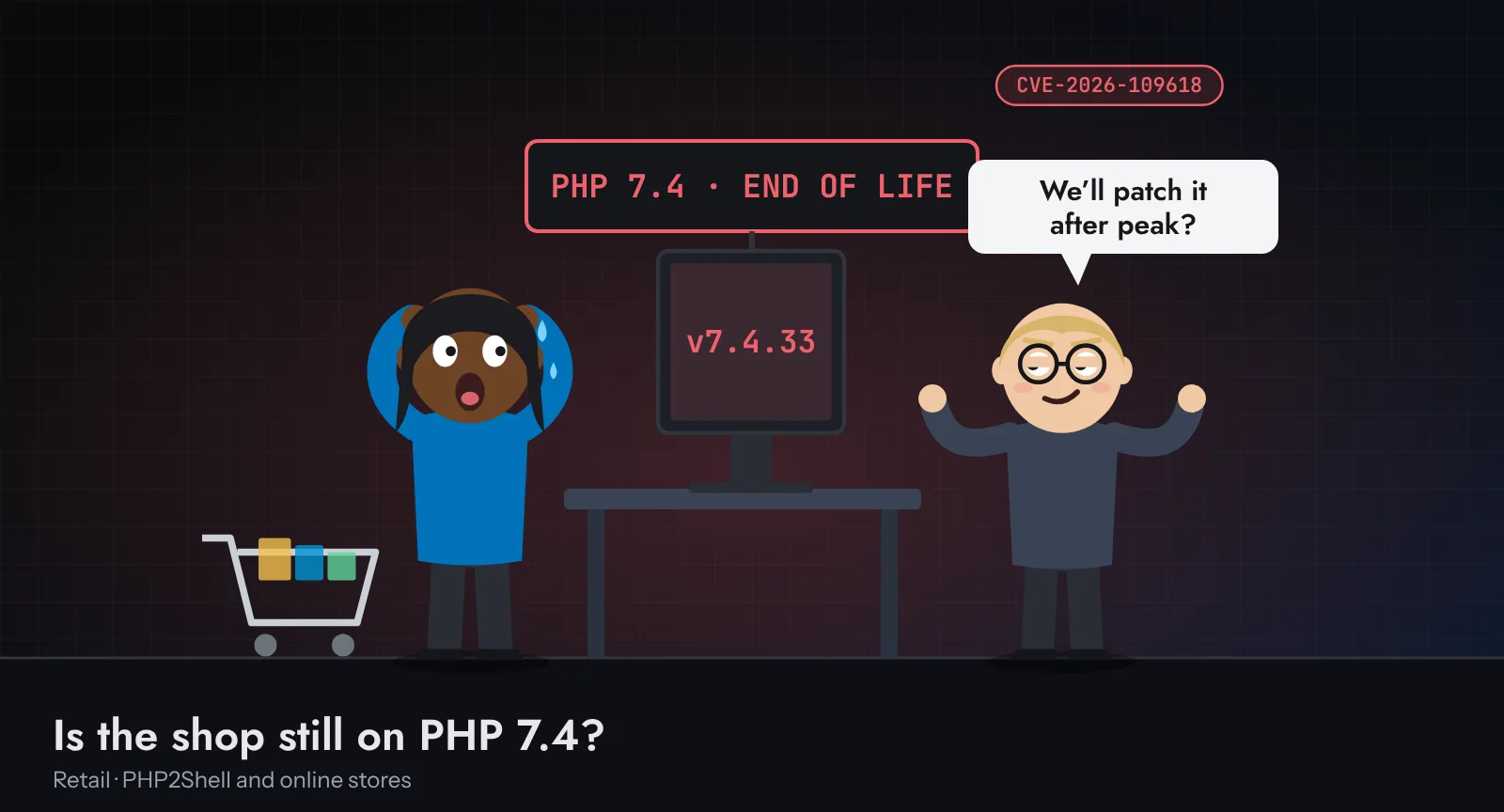
Call her Dana. She runs a wholesale distributor with 120 staff, and most of its trade customers order through a custom PHP portal an agency built in 2019. Dana is made up, but nothing that happens to her is unusual. On 21 October she read that government websites across Europe had gone offline because of a flaw in PHP. She emailed the agency. The reply came a week later: "We'll look at it after peak." The portal still runs PHP 7.4.
If your online store or B2B portal runs PHP 8.1 or older without a vendor backport, or a supported version below 8.2.35, 8.3.36, 8.4.27 or 8.5.12, it is still exposed to PHP2Shell, and since 19 November the versions to ask your host for are 8.2.36, 8.3.37, 8.4.28 or 8.5.13. This post explains what PHP2Shell is, how to check your store in ten minutes, what to ask your agency or host, and what to do if you are stuck on an old version.
Key takeaways
- PHP2Shell is two critical flaws in PHP itself (CVE-2026-109618 and CVE-2026-109619, both rated 9.2), so WooCommerce, Magento, PrestaShop and custom portals are all in scope, whatever their own code looks like.
- On 22 November 2026, Censys still counted 26,440,575 internet-facing PHP services on an affected version, including 7,991,914 on PHP 7.4, which has no official fix.
- Updating PHP is not enough on its own: running PHP workers keep the old code in memory until they are restarted.
- On 19 November PHP fixed 18 more flaws, seven critical, so an October patch is already out of date.
- If you cannot update or mitigate, the UK NCSC's advice is to consider taking the system offline until you can.
What is PHP2Shell, in plain words?
PHP is the programming language that runs most online shops: WordPress and WooCommerce, Magento and Adobe Commerce, PrestaShop, Drupal, and a great many custom trade portals. PHP2Shell is the name researchers gave to two memory-handling bugs in the PHP engine. Under the right conditions, a stranger with no login can send a crafted request and run their own code on your server.
Two things make it different from the usual plugin bug. First, the flaw is below your application. Wiz, one of the teams that found it, showed that even a simple "Hello World" page on an affected PHP version can be vulnerable, and that one of the bugs can leak server memory containing passwords, tokens and API keys without running any code at all. Second, it is old. Tenable lists every branch back to PHP 5.4 as affected, with official fixes only for 8.2 to 8.5.
AI played a part on both sides. Calif and Wiz found the bugs with the help of AI models, and the PHP Foundation says it receives far more reports than before because of AI-assisted research. We covered what that does to patch timing in AI finds vulnerabilities faster than teams patch.
What has happened since the October fix?
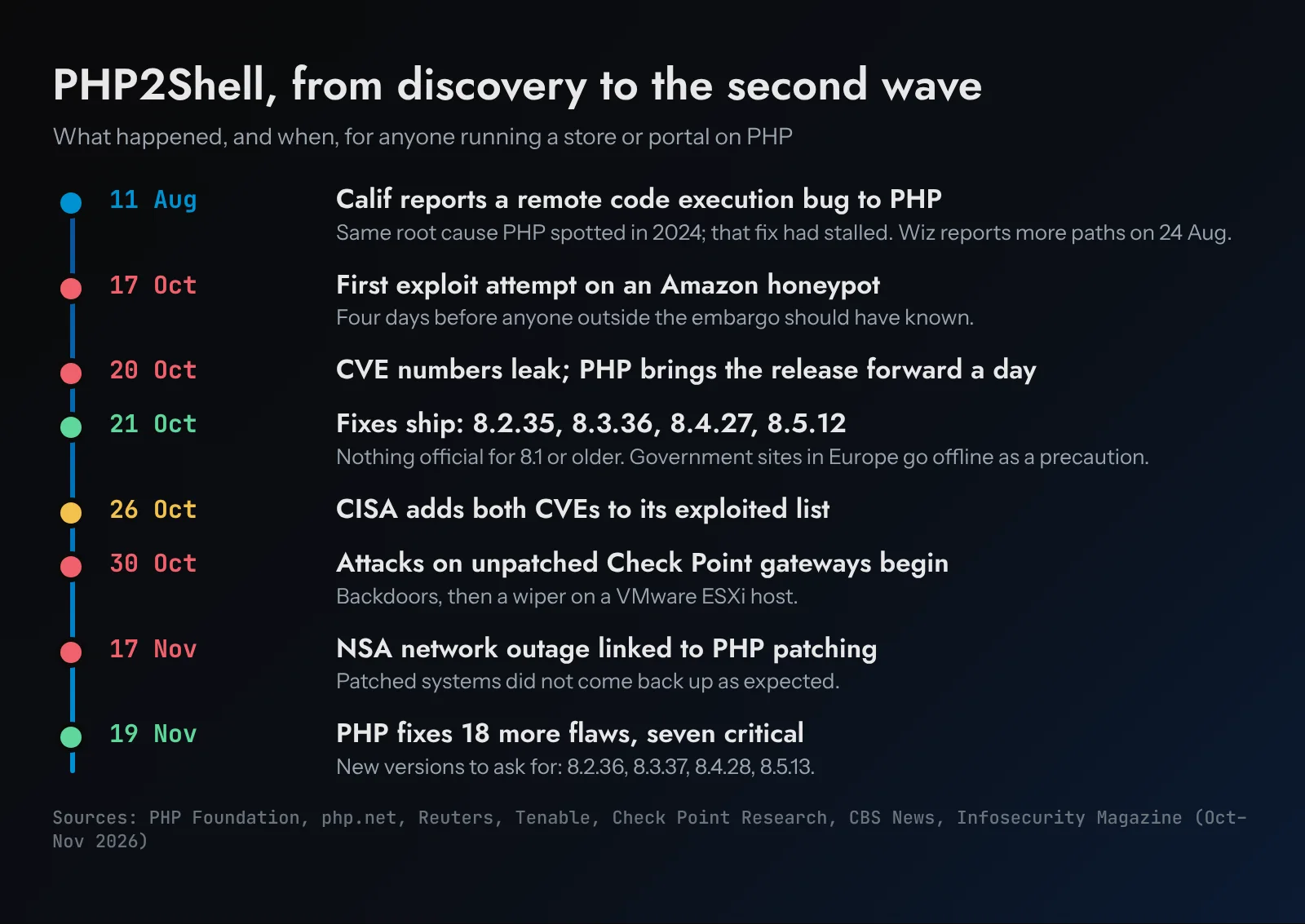
The short version, with each date from the people involved:
- 17 October. Amazon saw an exploit attempt on one of its honeypots, four days before public disclosure.
- 20 to 21 October. The CVE numbers leaked, PHP brought the release forward by a day, and fixes shipped at 14:00 UTC on 21 October. The FBI recommended taking sites offline if operators could not update immediately, and Cloudflare's CEO reported "millions" of exploit attempts within hours.
- 26 October. CISA added both CVEs to its Known Exploited Vulnerabilities catalogue.
- From 30 October. Check Point Research documented attackers using PHP2Shell against unpatched Check Point gateways, then installing backdoors and a wiper on a VMware ESXi host. Palo Alto Networks' Unit 42 confirmed attacks on internet-exposed PAN-OS management interfaces.
- 17 November. The Director of National Intelligence linked an NSA network outage to PHP patching, which had "caused some of these systems to not come back up when you patch them as expected".
- 19 November. PHP released fixes for 18 more vulnerabilities, seven marked critical, in 8.2.36, 8.3.37, 8.4.28 and 8.5.13.
Two honest caveats. The sources do not agree on how easy mass exploitation is. Sansec, which specialises in e-commerce security, wrote on 21 October that an attack needs specific knowledge of the target server and that public proof-of-concept exploits did not work against a default install. Bitsight's honeypots found that most observed traffic lacked the structure needed for exploitation. And as of 22 November we have not found a public report of an online store confirmed as breached through PHP2Shell. The confirmed compromises so far are firewalls and gateways that bundle PHP.
That is not a reason to relax. As Wiz observed, widespread attacks start against packaged products where many customers run the exact same build. A popular store platform on a popular host image is not so different.
How many stores are still exposed?
Nobody knows exactly, and the numbers you read will disagree. On 21 October Reuters reported Censys data showing about 1.5 million out of 2.6 million hosts on a PHP version with no fix. A week later Censys explained why counts differ by an order of magnitude: an IP, a service and a website are different things, many servers hide their PHP version, and distributions backport fixes without changing the version number. Bitsight measured 29.2 million PHP hosts, 18.4 million (63.1%) showing a vulnerable version before the release. Kaspersky put the unpatched figure at nearly 30 million servers two weeks on.
What the numbers agree on is the shape. Supported versions were patched fast: Bitsight found 85% of supported-branch hosts on a fixed build by 27 October. Old versions were not, because there is no official release to install.
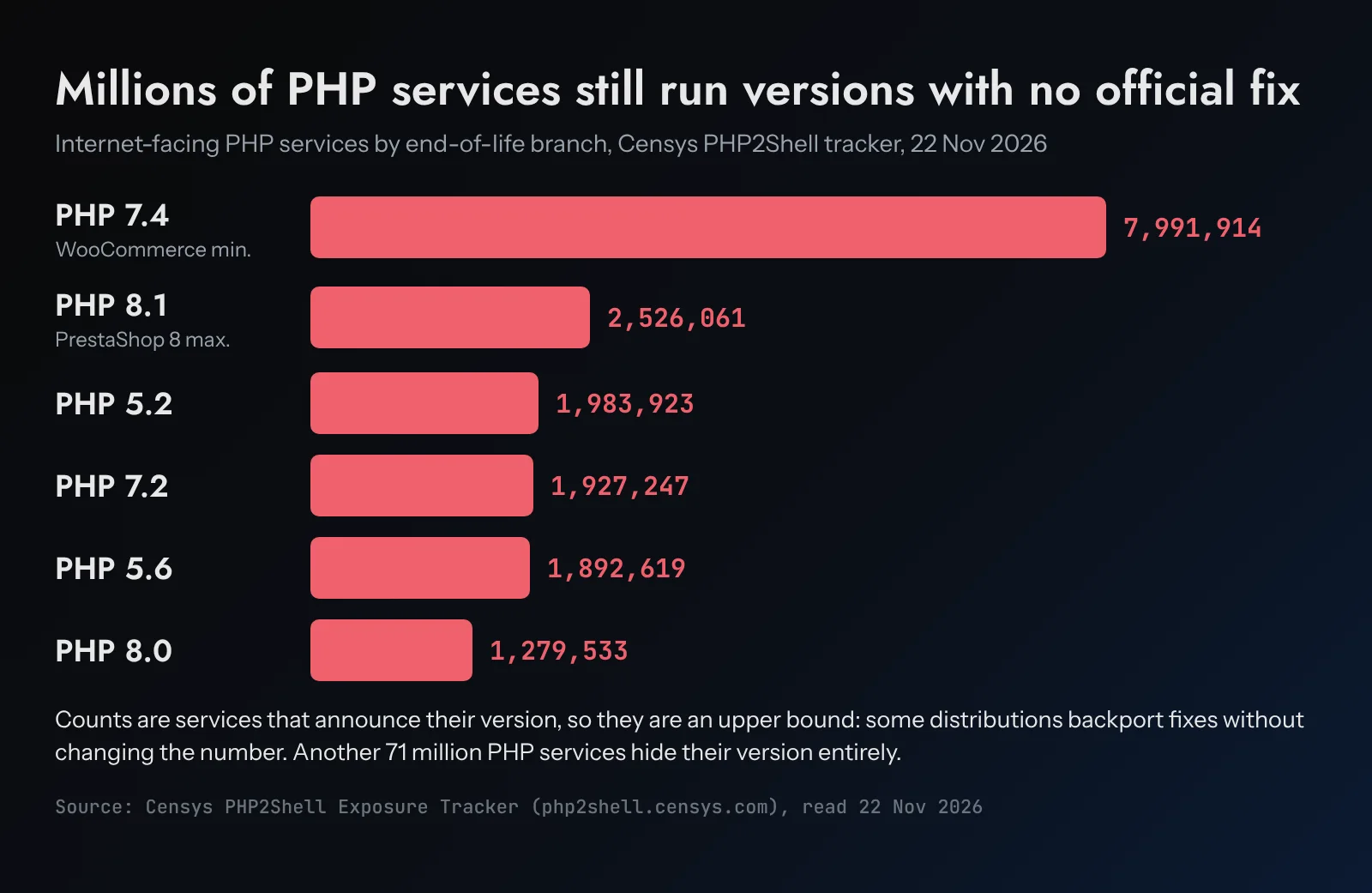
Retail sits right in that long tail. WooCommerce's minimum is still PHP 7.4, and the PrestaShop help centre notes that PrestaShop 8.0 to 8.2 support PHP 8.1 at most and 1.7.8 supports 7.4 at most. Custom B2B portals are often worse: built once, pinned to the PHP of the day, and maintained by an agency that has moved on.
How do you check your store's PHP version?
It takes ten minutes. Check the version the live website uses, not the one on someone's laptop.
| Platform | Where to look | What you need to see |
|---|---|---|
| WooCommerce / WordPress | Tools › Site Health › Info › Server | 8.2.36, 8.3.37, 8.4.28, 8.5.13 or later |
| PrestaShop | Advanced Parameters › Information › Server information | Same; 1.7 and 8.x stores will show 8.1 or older |
| Magento / Adobe Commerce | Your host's control panel, or php -v over SSH |
Same; confirm the web server's PHP, not the CLI's |
| Custom PHP portal | Ask the agency for the PHP version and the package changelog | Written confirmation, with the CVE numbers |
| Fully hosted (e.g. WordPress.com) | Your provider's status page | A statement that the platform is protected |
If the number is lower than you expected, do not panic yet. Linux distributions often backport fixes into an older-looking version. Sansec explains how to confirm by searching the package changelog for CVE-2026-109618. Your host can do that in a minute.
If you are on a fully hosted platform, the platform patches PHP for you. Automattic said its hosted sites, including WordPress.com and WooCommerce stores on its infrastructure, were already protected on 21 October.
What should you ask your host or agency?
Most store owners do not run their own servers, so the fix is someone else's job. Make it a written one. The PrestaShop help centre publishes a good template; this is our version, extended for the 19 November release:
- Which PHP version serves our live store and admin, and does it include the fixes for CVE-2026-109618 and CVE-2026-109619?
- Does it also include the 19 November 2026 security fixes (8.2.36, 8.3.37, 8.4.28 or 8.5.13, or a backport)?
- Have all PHP processes been restarted since the update? On what date?
- If our version is end-of-life, whose backport are you using, and until when will it be maintained?
- Is there a web application firewall in front of the store, and is its PHP2Shell rule set to block?
- Did anything else on our account run PHP: staging sites, old microsites, phpMyAdmin, a control panel?
Question three matters more than it looks. Installing new PHP packages does not patch processes already running: PHP-FPM and Apache keep the vulnerable code in memory until restarted. And the NSA's outage is a reminder that patched systems do not always come back up. Ask for a test order after every patch, not just a green tick.
Question six is where B2B portals get caught. The UK NCSC tells organisations to identify every system running PHP, not only outdated ones, and to watch for appliances that bundle PHP. That includes the firewall and VPN portal that were the confirmed targets.
What if you are stuck on PHP 8.1 or older?
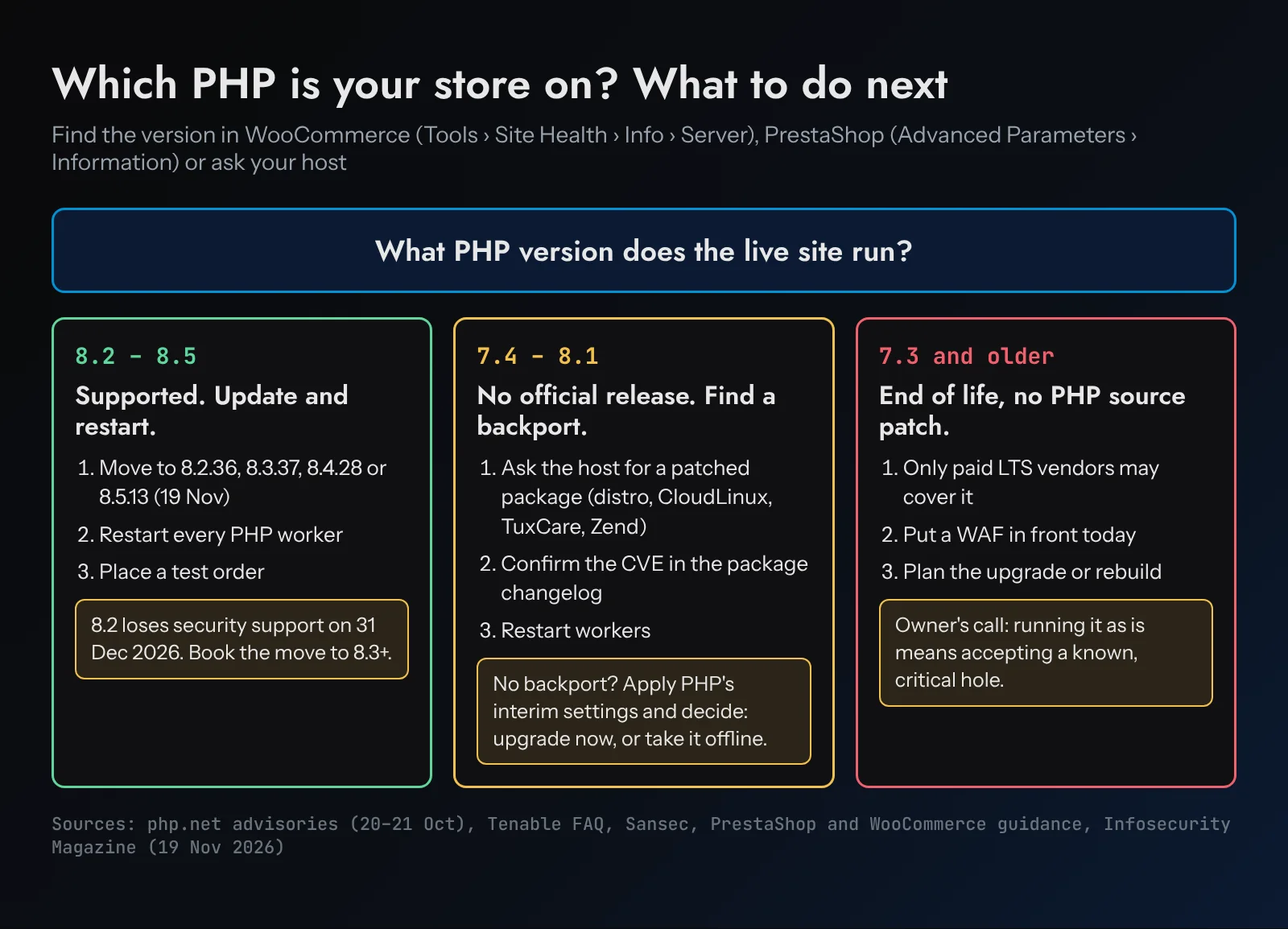
The PHP project does not publish fixed releases for 8.1 or older. Its advisory says some distributions and long-term support vendors provide backports, and tells users to contact their vendor or upgrade. The PHP security team also published minimal source patches for 7.4, 8.0 and 8.1. Sansec lists the main sources: Ubuntu, the deb.sury.org packages, Freexian ELTS for older Debian, AlmaLinux, CloudLinux for cPanel hosts, and paid long-term support from TuxCare and Zend.
So there are three honest options, in order of preference:
- Upgrade PHP, and the platform with it if needed. For PrestaShop 1.7 or 8 stores that means PrestaShop 9; for a custom portal it means testing the code on PHP 8.3 or newer. Note that PHP 8.2 loses security support on 31 December 2026, so skip it.
- Install a maintained backport and confirm the CVE in its changelog. This buys time. It is not a plan for 2027.
- Apply interim settings and reduce exposure while you do one of the above. PHP lists them in its advisory, including turning off
session.upload_progress.enabledand cappingpost_max_size, and it is blunt: "There are no complete mitigations, updating is the only safe choice." Sansec also describes blocking file-upload requests at the web server, which breaks product image uploads and some checkouts, so test an order afterwards.
If none of that can happen this week, the NCSC's guidance is to consider taking the system offline until it can be fixed. For a trade portal, that may be less painful than it sounds: a few days of orders by email and phone is a known cost. A compromised portal that holds customer pricing and ERP credentials is not.
Why is a B2B portal a bigger risk than a brochure site?
Because of what sits in its memory. One of the PHP2Shell bugs can return chunks of server memory to an attacker, and Sansec notes that memory can hold passwords, session tokens, API keys and TLS private keys. A trade portal usually holds the keys that matter most: the connection to your ERP or WMS, the payment gateway, the shipping carrier.
If your portal ran an unpatched PHP after 21 October, we would treat those keys as possibly seen:
- Rotate the ERP, payment and carrier API keys the portal uses, and the admin passwords.
- Check for the signs PrestaShop lists: unknown or recently changed
.phpfiles, admin accounts nobody created, changed payment pages. - Ask whoever holds your logs to look for unusual multipart requests followed by memory errors or repeated HTTP 500 responses, which Wiz names as signals.
If you find anything, bring in an incident response firm. The NCSC links to assured providers. That is not something to improvise.
The longer-term lesson is about design. A portal that holds a standing, all-powerful ERP key becomes a master key when it is breached. Narrow credentials that can only do what the portal needs, such as reading stock and creating draft orders, limit what a stolen key is worth. It is the same principle we apply to AI agents in least-privilege access for AI agents.
What should you do this week?
- Monday: find the PHP version for every site you own: store, portal, staging, old microsites.
- Monday: send the six questions above to your host or agency. Ask for answers in writing by Wednesday.
- By Friday: every supported site on 8.2.36, 8.3.37, 8.4.28 or 8.5.13, restarted, with a test order placed.
- By Friday: every 8.1-or-older site either on a confirmed backport with interim settings applied, or offline.
- Before year end: a dated plan to move off PHP 8.2 and anything older, and a maintenance contract that says who applies PHP security updates and how fast.
Peak trading is the worst time for this and the time attackers count on. "After peak" means January, and that is a long time to run a known critical hole.
If your store or trade portal is the one nobody quite owns any more, we can help. Devs Core builds and maintains web applications and B2B portals, and our maintenance plans include keeping the runtime patched, restarted and tested. If you are planning to connect that portal to AI agents later, our AI Readiness Audit looks at exactly these credentials and connections first.
Frequently asked questions
Is WooCommerce affected by PHP2Shell?
Yes, because WooCommerce runs on PHP, but the flaw is in PHP, not in WooCommerce. WooCommerce said no plugin update is required or planned; the fix is updating PHP on the server. Check your version under Tools › Site Health › Info › Server.
Will updating Magento, PrestaShop or my plugins fix PHP2Shell?
No. The attack can happen before your store's code runs, so no platform or plugin update can block it. Only a PHP update (or a patched package from your host) fixes it. A web application firewall helps in the meantime but can be bypassed.
Which PHP version is safe from PHP2Shell?
PHP2Shell was fixed in 8.2.35, 8.3.36, 8.4.27 and 8.5.12 on 21 October 2026. PHP then fixed 18 more vulnerabilities on 19 November, so the versions to run now are 8.2.36, 8.3.37, 8.4.28 or 8.5.13 or later, or a vendor package with those fixes backported.
What if my host says PHP 8.1 is patched?
That can be true. Distributions and long-term support vendors backport fixes without changing the version number. Ask your host which backport they use, ask them to confirm the CVE number in the package changelog, and plan an upgrade anyway, because 8.1 receives no official updates.
Do I need to take my online store offline?
Only if you cannot update PHP or apply the interim mitigations quickly. That is the advice from the UK NCSC and the FBI. Sansec's view for stores that can patch is that going offline is not necessary. Patch, restart and test first.
Has any online store been hacked through PHP2Shell?
As of 22 November 2026 we have not found a public report of a store confirmed as breached through PHP2Shell. Confirmed attacks have hit firewalls and gateways that bundle PHP. CISA lists both flaws as exploited, so treat an unpatched store as at risk.