
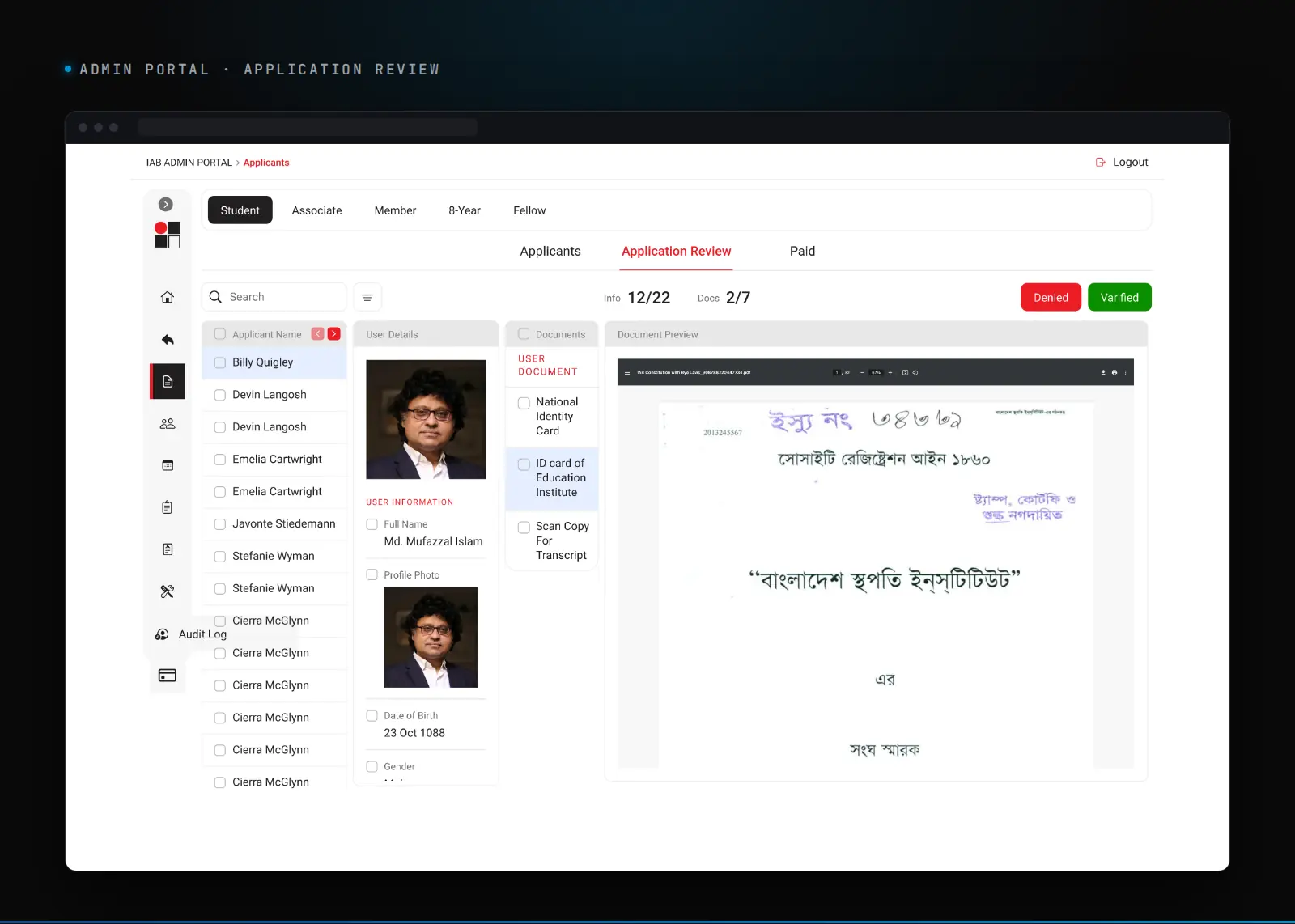
A membership management system for associations puts the whole member loop in one place: people apply, get verified, pay, renew and update their details online, and the office reviews and approves instead of collecting paper and chasing replies. When it works, members stop visiting the office for routine tasks, and staff spend their day deciding rather than re-typing.
This guide is for executive directors and office managers of membership bodies whose office still runs by hand. It covers what the system replaces, what it must do, how to move paper records across, and when a packaged product is the better answer. Our example throughout is the member portal we built for the Institute of Architects Bangladesh, which serves more than 10,000 members.
Key takeaways
- The office inbox is the product. If most of your staff's day is answering, forwarding and re-keying member requests, the system should remove that loop, not add a screen to it.
- Members do the typing; the office approves. Every change a member makes waits for a named person in the office before it goes live, and is logged.
- Migration is the hard part. Moving thousands of records, many on paper or in spreadsheets, takes more planning than any feature.
- Check the packages first. Membership software is a mature category. Build only for what the packages genuinely cannot do.
What does a membership office look like before the system?
Before IAB's portal, almost everything ran by hand. Members came to the office to apply or to change their details. Changes meant printing a form and getting it signed. Payments were taken manually, and every confirmation went out as a separate email or phone call. The staff were buried in work that was mostly carrying information from one place to another.
It is a common picture, and the surveys say the pressure is time rather than money:
- In the GrowthZone 2026 annual survey of more than 1,000 association and chamber professionals in the US and Canada, chambers named lack of time as their biggest obstacle, and limited staff capacity was among the barriers to adopting new tools.
- The Associations Forum 2026 membership survey of 216 Australian organisations found that stagnant team sizes are creating operational bottlenecks.
When the core loop runs on visits, signatures, phone calls and spreadsheets, the office spends its whole year chasing it.
What should a membership management system do?
It should cover every step a member and the office go through, in one system, so nothing is re-typed between tools. At IAB that meant three parts on one database:
- A member portal (web and mobile) where members apply or upgrade, upload documents, pay, request ID cards and certificates, register for events and keep their profile current, and follow the status of each request.
- An admin portal where the office reviews, approves, schedules interviews or exams, and runs reports, with chapter admins who see only their own chapter's members.
- A public website and directory that reads live from the same records, so anyone can check whether a person is a registered member.
Payments go through a gateway (IAB uses aamarPay), so a fee is confirmed when it is paid and the receipt sits in the member's history. A later phase added an accounts system for invoices, dues and reports, which replaced the last spreadsheet.
How do members apply and change details without visiting the office?
They do it online, and every change waits for the office to approve it. That second half is what makes the move safe.
- Applications arrive complete. The applicant picks a grade, sees the requirements and uploads documents. The office no longer collects an application; it reviews one, with details and documents side by side.
- Profile changes are proposals. A member edits their education, experience or contact details, and a named person in the office approves or rejects the change before it goes live. Nothing in the record changes silently.
- Every action is logged. An audit log records who changed what and when, so the office can answer "who approved this?" without searching an email thread.
- Confirmations are automatic. Status updates, interview dates and receipts appear in the member's portal instead of going out one email or phone call at a time.
At IAB, applications that took months of calls and emails now close in days. In the surveys IAB ran among its members in 2024, 91% rated the new portal more effective than the old system and 96.1% valued being able to do things themselves.
How do you move paper and spreadsheet records into the new system?
Treat migration as its own project, planned before the build, not a task at the end of it.
- Collect what exists. At IAB we could not get access to the old portal's database, so the office exported its members to a spreadsheet. Paper-only records have to be typed or scanned in first.
- Validate before importing. We wrote an import script with validation checks, so every record was checked against the rules (grade, required fields, duplicates) before it entered the new system.
- Let members confirm their own records. Once the portal is live, members can see their record and propose corrections, which the office approves like any other change.
The full first version of IAB's system, migration included, went live in four months.
Should an association buy membership software or build its own?
Buy, unless a requirement the packages cannot meet is central to how you work. Membership software is a mature category, and for a standard join, pay and renew loop a packaged product is usually cheaper and faster.
Build when the gap is structural, not habit. Ask what breaks if you adapt to the package's standard way. IAB's reasons were specific: membership grades with interviews and written exams, chapter-based admin roles, and a government regulator (RAJUK) that verifies architects against IAB's records through an API. A package could not do all of that in one system.
Whichever you choose, compare three years of cost on both sides, including maintenance and support, not just the first invoice. And own your data: a system you cannot export from is a migration you will repeat.
What does it take to keep the system useful?
Plan for it to grow. An association's needs change every year, and adding to one system beats adding tools beside it.
IAB has worked with us across nine engagements over three years: new features in 2025, a rebuilt events module, payment history and chapter roles in early 2026, and the accounts system in mid-2026. Each went into the same system. Membership growth is not guaranteed either way: in Marketing General's 2025 Membership Marketing Benchmarking Report, 45% of association executives reported an increase in membership over the past year, down from 47% the year before. A system that frees staff time for members is one of the few levers fully in the office's control.
Frequently asked questions
What is a membership management system?
It is the software an association uses to run its member loop: applications, verification, payments, renewals, records, events and communication. A good one lets members do their own tasks online while the office reviews and approves.
How much does a membership management system cost?
Packaged products charge a subscription, usually by number of members or features. A custom system costs more up front; ours start from $14,000 for custom software, and the cost depends on the processes, roles and integrations involved. Compare three years of total cost on both sides.
How long does it take to set up?
IAB's first version, including the member portal, the admin portal and migrating more than 10,000 records, took four months. Events, chapter roles and accounting came later as separate phases.
Can members update their own records safely?
Yes, if every change waits for approval. At IAB a member's edit is a proposal until a named person in the office approves it, and the audit log records who changed what.
Do we need to keep the signed paper forms?
Check with your legal adviser and any regulator first. Many bodies keep a scan of historic signed forms attached to the member's record and stop creating new paper once applications move online.
Still running your members on paper, phone calls and spreadsheets? Book a 30-minute call and we will tell you whether a package or a custom system fits, or see how we approach AI and software for institutions and membership bodies.