
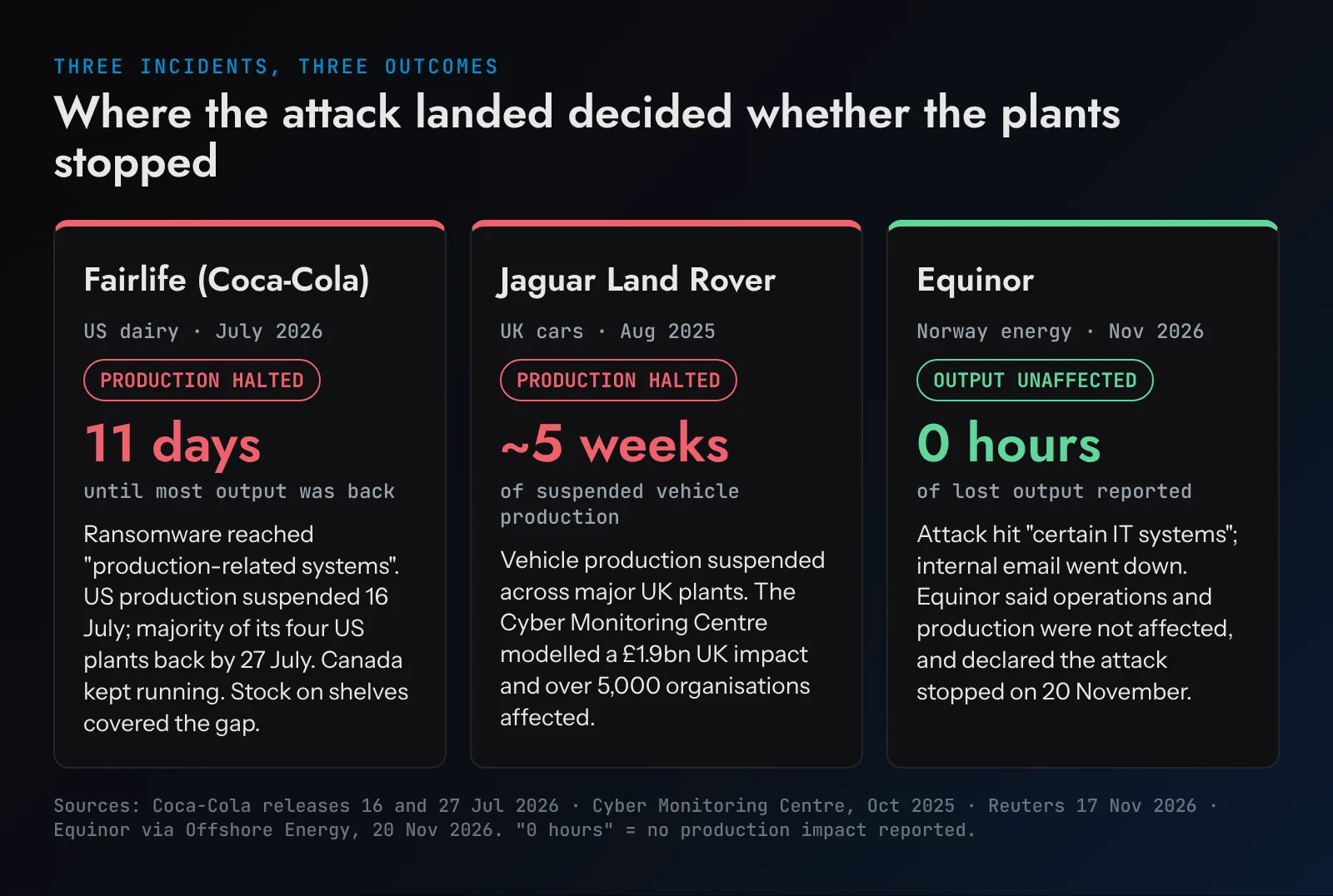
On 16 July 2026, Coca-Cola announced that its dairy business Fairlife had found an unauthorised third party inside "a portion of its systems, including its production-related systems". The cause was ransomware. US production was suspended. Fairlife's Canadian plants kept running. Eleven days later the company said it had resumed most production at its four US facilities, and that shelves had stayed stocked from existing inventory.
Four months later, on 17 November, Norway's Equinor found an attack on its IT systems. Internal email went down. Equinor said oil and gas production was not affected.
Yes, a cyberattack can stop your production line, and the most likely cause is not hackers touching your machines. It is how far your plant depends on office IT, and whether you have proved it can run without it. That is the IT/OT question this post answers in plain language, with a test you can run this quarter.
Key takeaways
- In the SANS 2026 ICS/OT survey, only 15% of 696 practitioners said critical processes could run safely by hand for more than 48 hours, while every security leader who answered expected operations to continue.
- 34% of respondents had an ICS/OT cyber incident in the past 12 months, and 72% of those incidents caused facility or system downtime.
- Manufacturing made up 69% of industrial ransomware incidents in Q3 2026, up from 62% in Q1, according to Dragos.
- About 68% of manufacturing ransomware and extortion victim claims tracked by Intel 471 in 2026 involved firms with annual revenue below $50 million.
- The practical test for a mid-size plant: can you run your critical line for 72 hours with the office network switched off, and have you actually tried?
Can a cyberattack really stop a production line?
It already has, several times. The US Government Accountability Office noted on 19 November that the 2021 JBS ransomware attack shut some slaughterhouses, that a 2023 attack on Dole temporarily shut production plants and cost $10.5 million, and that Fairlife halted US plants in 2026.
The largest recent case is Jaguar Land Rover. After an attack at the end of August 2025, vehicle production was suspended for approximately five weeks across its major UK plants. The UK's Cyber Monitoring Centre modelled the UK financial impact at £1.9 billion, in a range of £1.6 billion to £2.1 billion, affecting more than 5,000 UK organisations. It added that the loss could be higher "if operational technology has been significantly impacted".
And the volume is rising. Dragos counted 1,266 ransomware incidents against industrial organisations in Q3 2026, up 11% on the previous quarter, with 876 in manufacturing and 473 in the US.
What is the difference between IT and OT?
IT (information technology) is the office side: ERP, email, order entry, scheduling, finance, file shares, the VPN. OT (operational technology) is the plant side: the PLCs that run machines, the HMI screens operators use, SCADA, the historian, and often the MES that holds recipes and work orders.
IT/OT separation means a problem on the office side cannot spread to the plant, and the plant can keep running if the office side is down. In practice that needs two things. First, a network boundary: the plant sits in its own zone, and the only way between the two is a controlled middle zone (a DMZ) where data is copied out, not reached into. Second, an operational boundary: the line has what it needs locally to keep making product for a set period.
Most mid-size plants have the first in a drawing and not quite in reality. Very few have tested the second.
Why do plants stop when the attack is only on IT?
From the public cases, an attack stops a line in one of three ways. This is our framing, not a regulator's, but each one shows up in the incidents above.
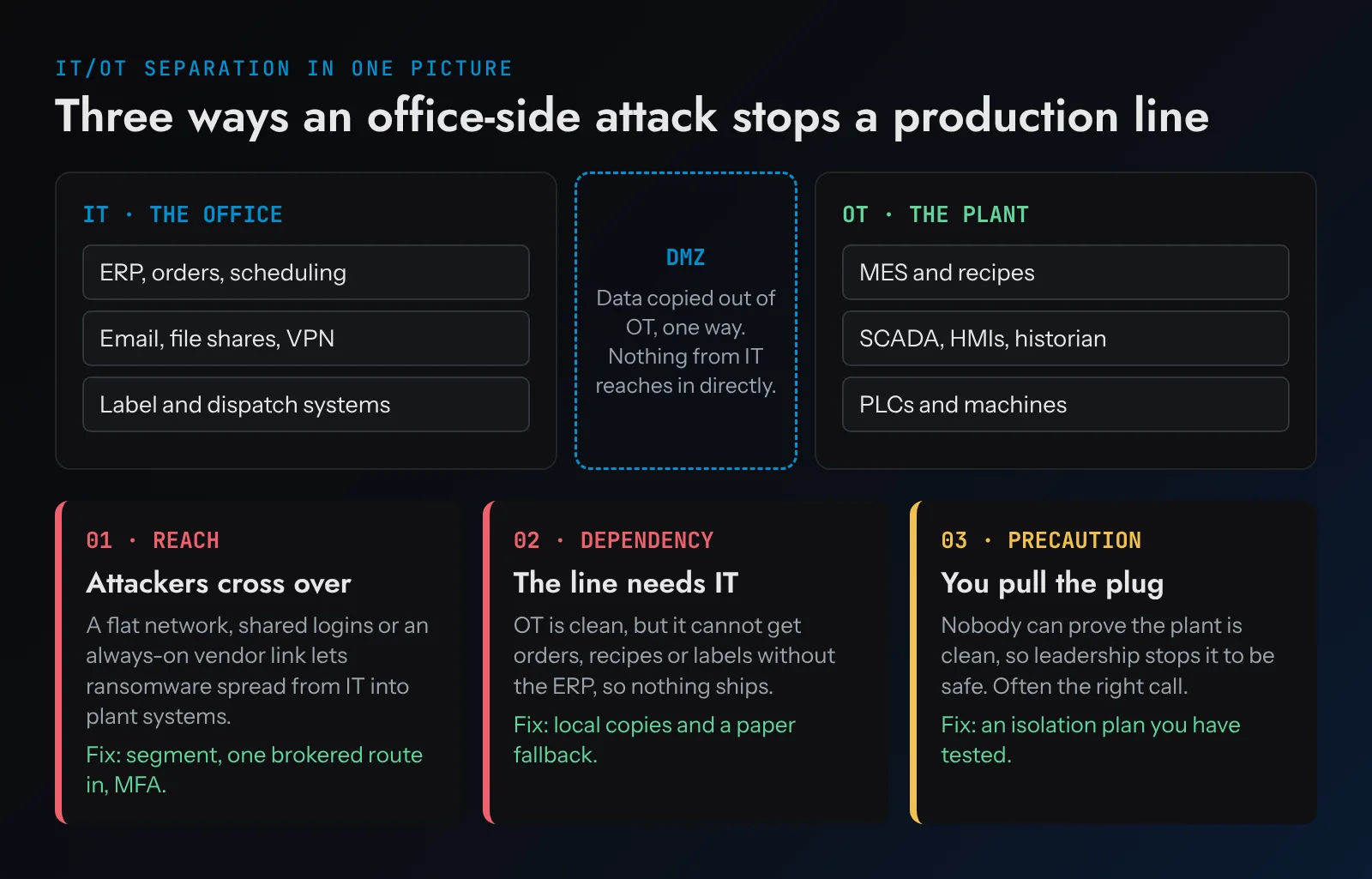
1. Reach: the attacker crosses into the plant
Flat networks, shared passwords and always-on vendor connections let ransomware move from the office into plant systems. Fairlife's attackers reached "production-related systems". Claroty's November 2026 research found more than 65,000 consumer devices, including games consoles and connected cars, on networks that support critical infrastructure. It called this a sign of "ongoing deficiencies in network governance and segmentation". If a games console can sit next to a PLC, so can an attacker.
The way in is usually remote access. Intel 471 found that of the access to manufacturers sold by initial access brokers in 2026, VPN services made up the largest share at 28.5% of examined cases, followed by Microsoft RDWeb at 9.9%.
2. Dependency: the line cannot work without IT
The plant network is clean, but the line takes orders from the ERP, recipes from a server in the office, and prints labels through a system that is now encrypted. Nothing is wrong with the machines. They have nothing to make and no way to ship it.
3. Precaution: you stop it yourself
Nobody can prove the plant is clean, so leadership halts it while investigators work. With food safety or worker safety at stake this is often the right call. It is still a stoppage, and it lasts as long as it takes to prove the plant is clean. Good logs and a clear boundary shorten that time.
Equinor is the useful contrast. It has not explained how it was attacked, so we cannot say why production was spared. Its statements do show the outcome every plant wants: an incident confined to "certain IT systems", internal email down, and production running. On 20 November it said the attack had been stopped with no data breach or impact on production.
Are we as ready as our security team thinks?
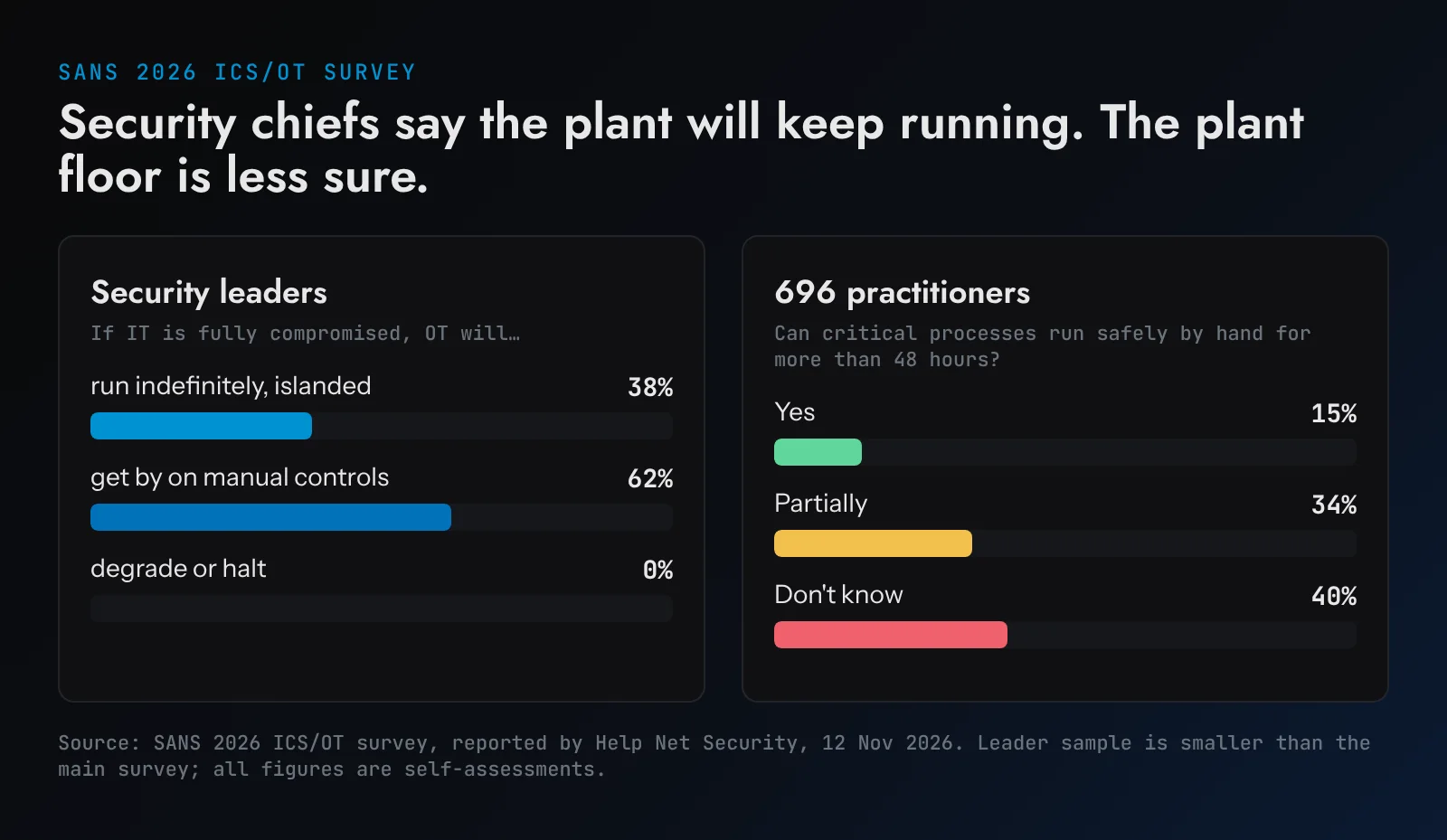
Probably not, and the best evidence comes from this month. The SANS 2026 ICS/OT survey asked industrial security leaders whether their plants would keep running through a full IT compromise. Every one who answered said yes: 38% expect to run indefinitely on islanded OT systems and 62% expect to get by on manual controls. None expected degradation or a halt.
The 696 practitioners, the people who would run those manual controls, disagreed. Only 15% said critical processes could run safely by hand for more than 48 hours. 34% said partially. 40% did not know.
Other findings from the same survey point the same way:
- Only 14% of leaders reported routine technical testing. SANS notes the leader sample is smaller than the main survey.
- Plant managers and front-line operators are required in only 58% of ICS/OT tabletop exercises. Enterprise IT security is required in 83%.
- 68% said losing one or two veteran employees would delay response or create severe operational risk.
- Of organisations that test resilience at least yearly and fully fold OT into business continuity, 46% said they could restore their most critical facility within a day. Across all respondents the figure was 27%.
The report's author, Jason Christopher, put it in one line: "An untested assumption is not a capability."
What does "run manually for 72 hours" actually mean?
CISA and the FBI tell critical infrastructure operators to practise and maintain the ability to operate OT systems manually, and to routinely test backups, fail-safes and islanding. We suggest 72 hours as a working target for a mid-size plant. It covers a weekend, it is longer than the 48 hours most practitioners in the SANS survey could not confirm, and three days usually gives an incident team time to decide what is clean.
"Running manually for 72 hours" does not mean pen and paper on every machine. It means you can answer yes to each of these with the office network unplugged:
| Question | What "yes" looks like |
|---|---|
| Do we know what to make? | A printed or locally stored production plan for the next 72 hours, refreshed daily |
| Do the machines have their recipes? | Recipes and PLC programmes stored on the plant side, with an offline backup copy |
| Can operators see the process? | HMIs and local historian work without any office server or cloud login |
| Can we record quality and traceability? | Paper or local batch records that can be entered into the ERP afterwards |
| Can we label and ship? | A local label printer with templates, and a manual dispatch note process |
| Do people know how? | A named shift lead per line who has done it in a drill, not only read it |
| Can we cut the link? | A written, tested isolation plan: who unplugs what, in what order |
The last row matches the eighth principle in the January 2026 Secure Connectivity Principles for OT from the UK NCSC, CISA, the FBI and partner agencies: establish an isolation plan, link it to business continuity, and test it.
What does a stoppage cost a mid-size plant?
Here is a rough worked example. Every input is an assumption, so swap in your own figures.
- Assume a plant with $120 million annual revenue and 250 production days: $120m ÷ 250 = $480,000 of revenue per day.
- Assume a contribution margin of 35% (revenue minus materials and other costs that stop when the line stops): $480,000 × 0.35 = $168,000 of lost contribution per day.
- An 11-day stoppage, roughly Fairlife's time to restore most output, is $168,000 × 11 = about $1.85 million. Five weeks, or 25 production days as at JLR, is $168,000 × 25 = $4.2 million.
That leaves out overtime to catch up, expedited freight, penalties, recovery consultants and lost customers. It also assumes no finished stock. Fairlife's shelves stayed full because of inventory, which is a resilience control in its own right.
Set that against the cost of a segmented boundary, a tested isolation plan and a weekend drill. For most plants the comparison is short.
What should a plant do this quarter?
Prioritise in this order. Each step is doable for a 50 to 2,000-person manufacturer without a large OT security team.
Week 1 to 2: know what you have
Build a plant asset list: every PLC, HMI, server, switch, remote access box and vendor connection, with its location, owner and how it connects. CISA's OT asset inventory guidance gives the fields to collect. Mark which assets the line cannot run without.
Week 2 to 4: close the obvious doors
- Change every default password on plant devices. CISA lists this first.
- Remove anything plant-side that faces the internet directly.
- Put all vendor and remote access through one brokered route with phishing-resistant MFA, switched on only when needed. Intel 471's data shows remote access is how most access is sold.
- Move non-plant devices (TVs, consoles, personal kit) off the plant network.
Month 2: draw the boundary
Separate the plant network from the office with a DMZ. Data flows out of OT to a copy in the DMZ, and the office reads the copy. Nothing in IT should connect straight into a PLC or HMI. The NCSC/CISA principles describe this pattern, including replicating the OT historian into the DMZ one way.
Month 3: run the 72-hour drill
Pick one critical line. Unplug the IT link in a planned window, small at first (two hours, then a shift, then a weekend). Use the table above as the checklist. Put plant managers and operators in the room, not only IT. Write down every point where someone said "we'll need the ERP for that", then fix those first.
Where does AI fit in a plant that has to survive an attack?
Many plants are now connecting AI tools to the ERP, MES or maintenance system. Done carelessly, that adds exactly the kind of always-on, broadly permissioned connection the guidance warns against.
The rules that keep a plant safe apply to AI agents too. An agent should get named operations, never raw logins. It should read freely, but any write that changes a system of record should wait for a named person to approve it. Every action should be logged, and the agent should sit on the IT side of the boundary, reading OT data from the DMZ copy, never reaching into a PLC. That is how we build governed AI agents, and the access layer is that permissioned layer. Our post on least-privilege access for AI agents goes deeper.
If you are planning automation in a plant and want to know where it would sit relative to your OT boundary, our AI Readiness Audit maps that over two weeks and ends in a written build plan. We do not run penetration tests or incident response. For those, use a specialist OT security firm. More on our work with plants is on our manufacturing page.
Frequently asked questions
Can ransomware stop a factory even if it never reaches the machines?
Yes. If the line depends on the ERP for orders, a server for recipes or an office system for labels, encrypting those systems stops production even when every PLC is untouched. Companies also halt plants as a precaution until they can prove the plant network is clean.
What is IT/OT separation in simple terms?
It means the office network (IT) and the plant network (OT) are kept apart, with one controlled middle zone between them, so an attack on one cannot spread to the other. It also means the plant can keep running for a set period if office systems are down.
How long should a plant be able to run without IT?
There is no single legal standard. CISA says operators should practise and maintain the ability to run OT manually. We suggest 72 hours as a working target for mid-size plants because it covers a weekend. Only 15% of practitioners in the SANS 2026 survey said they could run safely by hand beyond 48 hours.
Are small and mid-size manufacturers really targeted by ransomware?
Yes. Intel 471 found that about 68% of manufacturing ransomware and data extortion victim claims it tracked in 2026 involved organisations with annual revenue below $50 million. Firms earning $10 to $50 million were the largest group.
What is the first thing a plant manager should do after reading about Fairlife?
Ask for a list of every way someone can connect into the plant network from outside, including vendor remote access, and who approves each one. Then schedule a short, planned test of running one line with the office link unplugged.
Should we connect AI tools to our MES or ERP?
You can, safely, if the AI gets scoped operations rather than logins, writes wait for a named human approver, every action is logged, and nothing on the IT side connects directly into plant controllers. Keep AI on the office side of the boundary and let it read plant data from a one-way copy.