
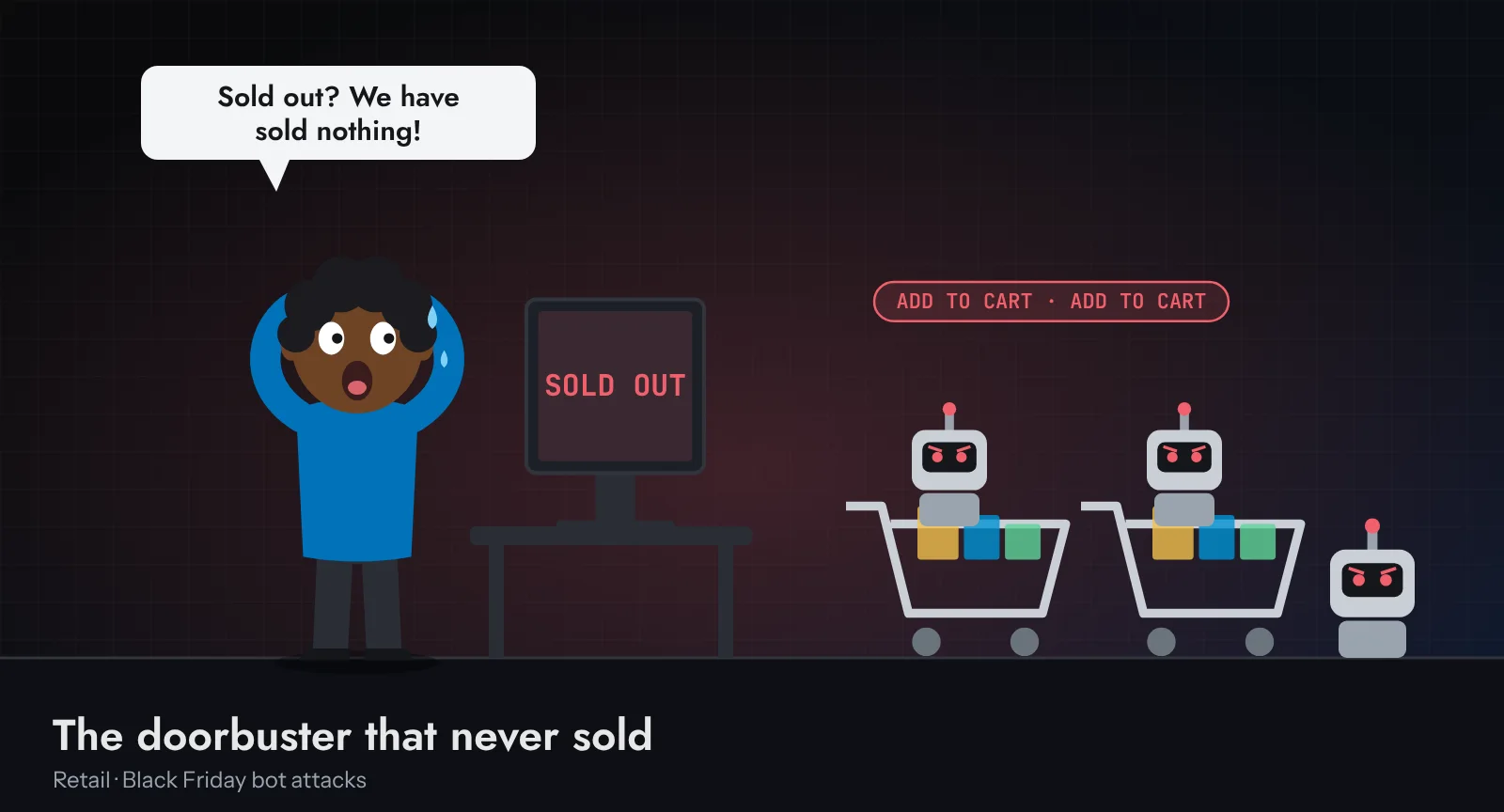
Call her Dana. She is made up, but nothing that happens to her is unusual. Dana runs e-commerce for a 400-person homeware retailer. At 6 a.m. on Black Friday the doorbuster air fryer shows "sold out" on the website. The warehouse system says 900 units are still on the shelf. Orders placed: 31. Thousands of carts hold the item, and none of them will ever check out. By the time the cart holds expire, the shoppers who came for the deal have bought it somewhere else.
That is inventory hoarding, one of five Black Friday bot attacks that hit retailers every year. Black Friday bot attacks are automated scripts that hoard deal stock in carts, break into customer accounts with stolen passwords, open fake accounts to farm new-customer offers and test gift-card numbers until one works, and the data says they peak in the weeks before Black Friday, not on the day, so the controls need to be on this week. Black Friday falls on 27 November 2026. Here is what the numbers say and what to switch on before then.
Key takeaways
- Bad bots made up 41% of observed retail web traffic in 2025, and AI-driven bot attacks rose 12.5 times year on year, according to the Thales 2026 Bad Bot Report.
- In F5's retailer group, 54.2% of ecommerce add-to-cart transactions were automated in the 2025 season, the signature of inventory hoarding.
- Automation ran at 31.9% of transactions in the weeks before November 2025, against 14.6% on Black Friday itself: bots come early.
- 27% of bot attacks in 2025 went straight at APIs, so protecting only the website leaves the back door open.
- The fix is a short list: cart limits, MFA and breached-password checks, rate limits on gift-card balance checks, tighter permissions for apps and agents, and a named person who can pause a promotion.
How big is the Black Friday bot problem in 2026?
Big enough to show up in every report published this month. The 2026 Thales Bad Bot Report, discussed by Thales's Tim Chang in a Retail Insider interview on 16 November, found that bad bots accounted for 41% of observed retail web traffic in 2025. Retail was the most targeted industry for AI-driven bot attacks, with 20% of the total, and the leading industry for business logic abuse, with 24% of those attacks. AI-driven bot attacks rose 12.5 times year on year.
Across all industries, Imperva's summary of the same report says automated traffic made up more than 53% of all web traffic in 2025, up from 51% the year before, and that 27% of bot attacks targeted API endpoints.
The second source is more granular. F5 Labs' Black Friday bot report, published on 18 November, studied three seasons (2023 to 2025) of traffic to retailers using its bot defence, across fashion, ecommerce and quick-service restaurants. Overall automation rose from 17.4% of transactions in 2023 to 18.5% in 2024 and 28.6% in 2025. F5 is careful here, and so should we be: the group of retailers changed between seasons, and the 2024 rise is explained by that change. The bigger 2024 to 2025 jump, though, held among retailers measured in both seasons, where the like-for-like rate went from 16.7% to 29.8%.
Meanwhile the money at stake keeps growing. Adobe forecasts US online sales of $275.1 billion between 1 November and 31 December 2026, with $12.9 billion on Black Friday and $15.1 billion on Cyber Monday (30 November). Bots go where the stock and the discounts are.
What are the five bot attacks hitting retailers?
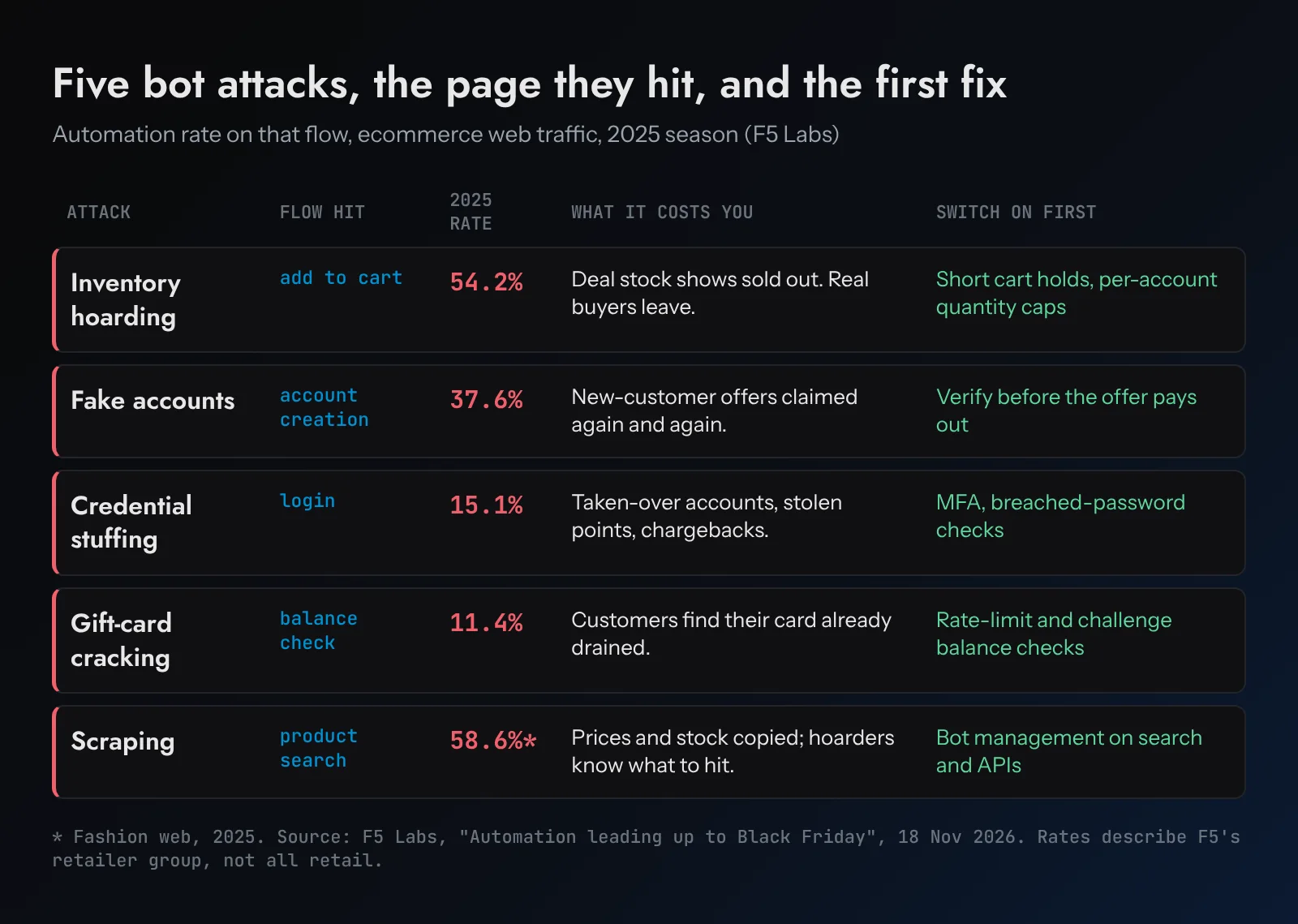
F5 grouped the abuse it saw by the part of the site it hit, which it calls a flow. That is a useful way for a non-engineer to think about it: each attack has a page it lives on, and each page has a fix.
1. Inventory hoarding (add to cart)
Bots add a deal item to thousands of carts and never pay. The product looks sold out and real customers leave. Thales describes exactly this: bots "adding products to shopping carts without completing purchases, creating artificial scarcity". In F5's ecommerce group, add to cart was the most automated flow every season: 75.7% in 2023, 51.7% in 2024 and 54.2% in 2025.
2. Fake account creation
Bots open new accounts to claim "first order" discounts, free shipping or sign-up points again and again. This is the fastest-growing abuse in F5's data: automated account creation on ecommerce web went from 8.3% in 2023 to 15.3% in 2024 and 37.6% in 2025. On ecommerce mobile apps it rose from 13.4% to 27.1% between 2024 and 2025.
3. Credential stuffing and account takeover (login)
Attackers take username and password pairs leaked from other sites and try them on yours at machine speed. Every customer who reused a password is a stolen account, with saved cards, loyalty points and an address to ship to. Ecommerce login automation in F5's group held at 3.9% in 2023 and 2024, then reached 15.1% in 2025.
4. Gift-card cracking (balance check)
Bots feed card numbers into your balance checker until one comes back with money on it, then spend it before the customer does. Ecommerce gift-card balance-check automation was 0.8% in 2023 and 11.4% in 2025. In quick-service restaurants it was 10.1% in 2025. The same theft has a human-facing version too: the Wall Street Journal reported on 28 October that thieves are building mock balance-check websites to trick people into giving up card numbers and PINs.
5. Scraping (product search)
Bots copy your prices, stock levels and product pages. On its own it costs you server capacity and margin. It also tells hoarders which items to hit. In F5's fashion group, 58.6% of product-search transactions were automated in 2025, up from 17.1% in 2023.
When do Black Friday bots actually attack?
Earlier than most teams expect. This is the most useful finding in the F5 report, and it changes the plan.
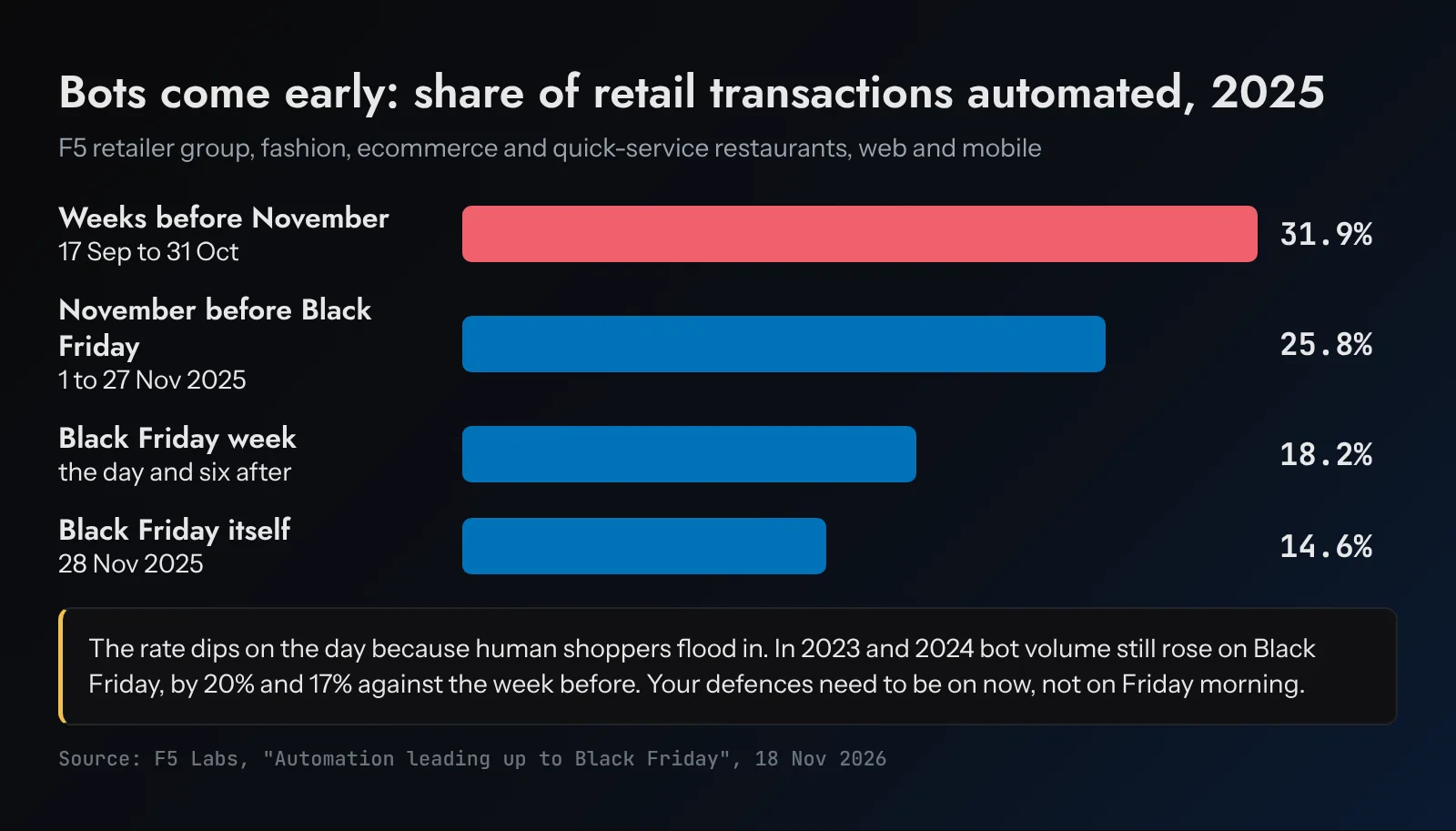
In the 2025 season, 31.9% of transactions were automated in the weeks before November, 25.8% in November before Black Friday, 18.2% in Black Friday week and 14.6% on Black Friday itself. The same shape held in 2023 and 2024.
Do not read the dip as bots taking the day off. F5 explains that the rate is a share, and it falls when humans pour in. Measured in raw volume, automated transactions on Black Friday ran 20% above the previous seven days' average in 2023 and 17% above it in 2024. Only in 2025 did automated volume fall on the day, by 22%, while human volume rose 43%. By Cyber Monday the rate had climbed back to 17.6%.
F5 also found no reliable "bot day" to defend. The busiest day for automated volume fell 23 days before Black Friday in 2023, the day after it in 2024, and 38 days before it in 2025. In the report's own words, three seasons give "no basis for predicting when the busiest day will fall in 2026".
The practical reading: if your bot controls go live on Thursday night, the scrapers have already mapped your deals and the fake accounts are already sitting in your customer table. That fits what the Retail & Hospitality ISAC said in its 2025 holiday report: fraud is the most widespread threat to consumer-facing businesses in the fourth quarter, with bot-driven schemes that "rapidly scoop up high-demand items" among the main concerns.
Why don't normal bot defences stop AI-driven bots?
Because the bots no longer look like bots, and some of them do not even use your website.
Chang's point in the Thales interview is that classic bot detection looks for odd traffic volumes, suspicious IP addresses and repetitive behaviour. AI lets attackers vary timing and behaviour, and Thales saw bots "adjusting their tactics within hours of new security measures being deployed".
The bigger gap is the back door. A stolen API key, a compromised staff login or an over-permitted integration can send requests that are perfectly formatted and fully authenticated. As Chang puts it, "authentication tells you who or what is making a request, but it doesn't necessarily tell you whether that request is appropriate". His example: an inventory system that lets authorised applications reserve stock or trigger fulfilment. If an attacker gets those permissions, the requests look valid and the damage is real.
This matters more every year as retailers connect more software, and now AI agents, to their order, stock and refund systems. The same rule applies to all of them: an inventory app should not be able to issue payments or change delivery addresses unless it truly needs to. We wrote about this in least-privilege access for AI agents, and it is the core of how we design an access layer: reads run freely, but any write that changes a system of record goes through limits and, above a threshold, waits for a named person.
What should retailers switch on before Black Friday?
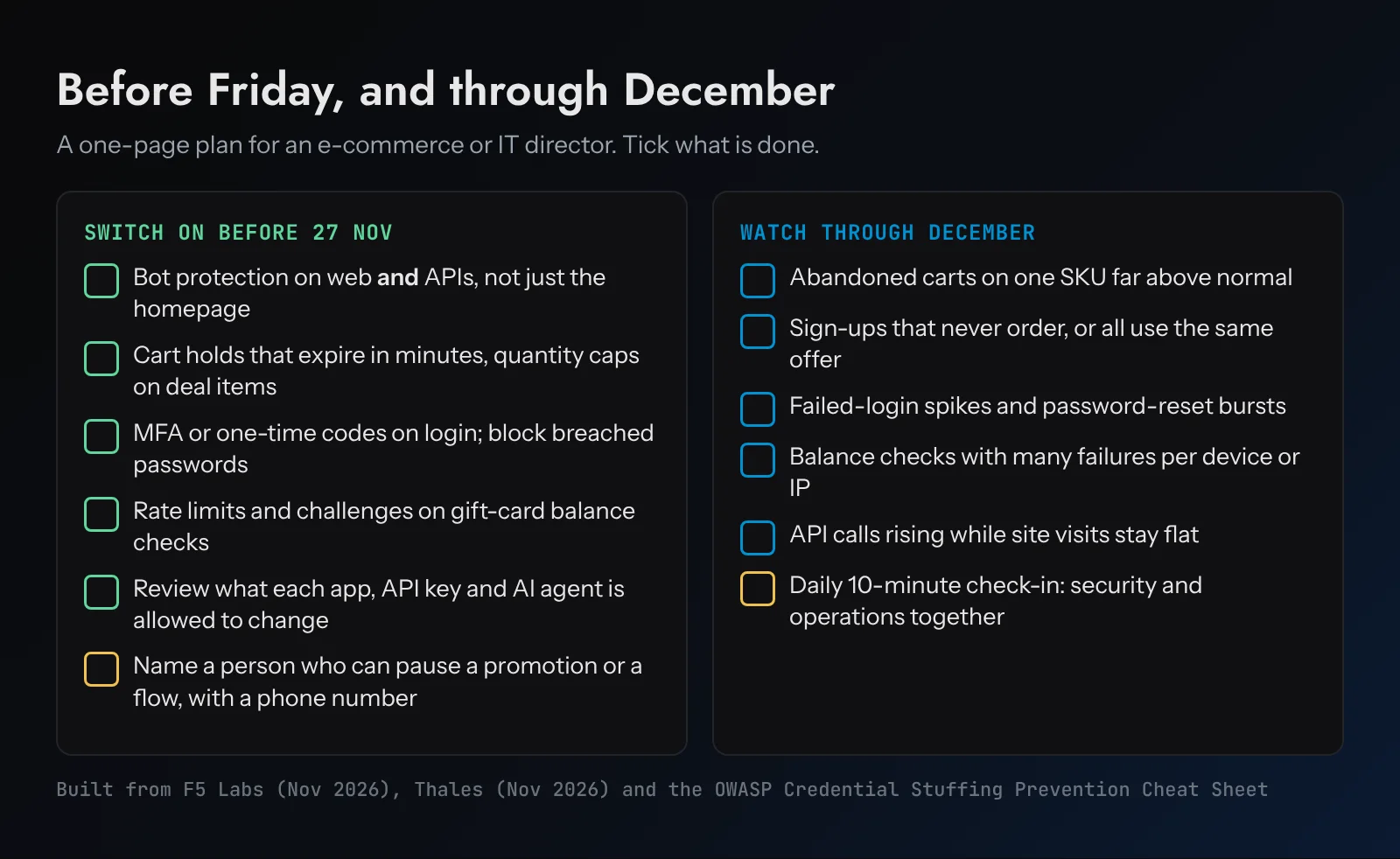
Five working days is enough for most of this, because most of it is configuration, not new software. Give each item an owner and a deadline of Wednesday 25 November.
1. Put bot protection on APIs, not only the website
Ask your platform or CDN provider one question: "Is bot protection on for our mobile app API and our checkout, login, account creation and gift-card endpoints, or only the web pages?" F5 notes that its web traffic was more automated than mobile APIs only where both were equally protected. Where the API is weaker, it becomes the main target.
2. Limit carts on deal items
Set cart reservations on doorbuster SKUs to expire in minutes, not hours. Cap the quantity per account, per card and per delivery address. If your platform allows it, reserve stock at payment, not at add to cart, for the handful of items you advertise hardest.
3. Harden login
Turn on multi-factor authentication or one-time codes for customer accounts, at least when a login comes from a new device. The OWASP Credential Stuffing Prevention Cheat Sheet calls MFA "by far the best defense" against credential stuffing, and recommends checking new passwords against breached-password lists, varied rate limits rather than one predictable threshold, and alerting customers to unusual activity.
4. Lock down gift-card balance checks
Require a challenge after a small number of failed checks, rate-limit by device and IP, and require the PIN as well as the number. Watch the failure rate on this endpoint daily. A balance checker with thousands of misses an hour is being cracked.
5. Make offers harder to farm
Tie new-customer discounts to something a bot cannot cheaply fake: a verified email or phone number, a first order that actually ships, or a payment card not seen before. Pay loyalty points out after the return window, not at sign-up.
6. Review what every app, key and agent can change
List the integrations, service accounts, API keys and AI tools that can reserve stock, change prices, issue refunds, create gift cards or edit addresses. Remove anything they do not need for peak. Rotate keys you cannot account for. Put a value limit on refunds and gift-card issues that any automated system can make without a person signing it off.
7. Name the person who can pull the plug
Decide now who can pause a promotion, switch a flow to "challenge everyone" or take a SKU off sale at 3 a.m., and make sure security and operations both have the phone number. Thales's advice is the same: security can spot odd API traffic, but operations knows what normal buying looks like.
What should you watch through December?
F5's data shows automation recovering within days of Black Friday. Hold a 10-minute daily check-in between security and operations and look at five signals:
| Signal | What it may mean | First response |
|---|---|---|
| Abandoned carts on one SKU far above normal | Inventory hoarding | Shorten cart holds, cap quantity, challenge add to cart |
| Sign-ups that never order, or all claim the same offer | Fake account creation | Hold offer payout, require verification |
| Spikes in failed logins or password resets | Credential stuffing | Step-up MFA, block breached passwords, warn customers |
| Many failed balance checks per device or IP | Gift-card cracking | Challenge and rate-limit, freeze cards under attack |
| API calls rising while site visits stay flat | Bots bypassing the website | Check which key or client, rate-limit or revoke |
Is this only a big-retailer problem?
No, and the surveys say smaller firms are feeling it. A Verizon Business survey of 600 US small businesses, fielded from 30 October to 9 November 2026, found that a third expect to increase cybersecurity investment compared with last holiday season. Dark Reading reported that 11% of those firms said they had dealt with a cyberattack or data-security incident during the holidays, and that a VikingCloud survey of security and IT leaders claimed 86% had faced at least one successful attack in the past 12 months. Those are self-reported survey figures, not measured incidents, but the direction is clear.
Where does AI help, and where does it need a leash?
AI is on both sides of this. Attackers use it to make bots harder to spot. Retailers can use it to triage the flood: flag suspicious account clusters, draft the daily signal report, and prepare refund or reservation decisions for a person to approve. The rule we follow, and recommend, is that an AI agent working inside your e-commerce and retail systems gets the same treatment as any other integration: least privilege, value limits, a named approver for anything that moves money or stock, and a log of every action. Our AI governance page explains how we build and test those controls in.
If you are planning to connect AI to your order, stock or refund systems in 2027 and want to know where it would sit and what it should be allowed to change, our AI Readiness Audit looks at exactly that in two weeks, at a fixed $2,400, and ends in a written build plan.
Frequently asked questions
What is a Black Friday bot attack?
It is automated traffic that abuses a retail site during the holiday season: hoarding deal stock in carts, trying stolen passwords on customer accounts, opening fake accounts to claim offers, testing gift-card numbers and scraping prices. Thales found bad bots made up 41% of observed retail web traffic in 2025.
When do bots attack retailers most during the holiday season?
Before Black Friday, not on it. F5 Labs found 31.9% of transactions were automated in the weeks before November 2025, against 14.6% on Black Friday itself, and the busiest day for bot volume moved by weeks from year to year. Controls need to be on from mid-November at the latest.
How do I stop bots from hoarding inventory in carts?
Set short cart reservations on deal items, cap quantity per account, card and address, and put bot protection on the add-to-cart endpoint and its API. For your most advertised items, consider reserving stock at payment rather than at add to cart.
How can retailers prevent credential stuffing on customer accounts?
Turn on multi-factor authentication or one-time codes, at least for new devices, and block passwords that appear in known breach lists. OWASP also recommends varied rate limits rather than one fixed threshold, and warning customers when their account sees unusual activity.
What is gift-card cracking?
It is bots entering card numbers into a retailer's balance checker until they find cards with money on them, then spending the balance. Stop it with challenges after a few failed checks, rate limits per device and IP, and requiring the PIN as well as the card number.
Do AI agents make bot attacks on retailers worse?
Thales measured a 12.5-fold rise in AI-driven bot attacks in 2025, so attackers are already using AI. Retailers' own AI tools add risk only if they have broad permissions: give them least privilege, value limits and a named human approver for anything that changes stock, prices or refunds.