
ChatGPT is good for business where people already know how to use it: developers, marketers and other desk roles that write, research and summarise all day. For the operations work most companies run on — orders, stock, invoices, member requests — buying seats rarely changes anything, because most staff were never trained to use AI and the tool cannot reach the systems where that work happens.
"We bought AI seats; nothing changed in operations" is one of the sentences we hear most on first calls. This article is for business owners and operations leads who have heard it inside their own company. It covers who is getting value from ChatGPT, why everyone else is not, and what it takes to move operations work rather than just writing.
Key takeaways
- Use is wide; training is thin. Three in four knowledge workers use generative AI at work, but only 39% of those users were trained by their company.
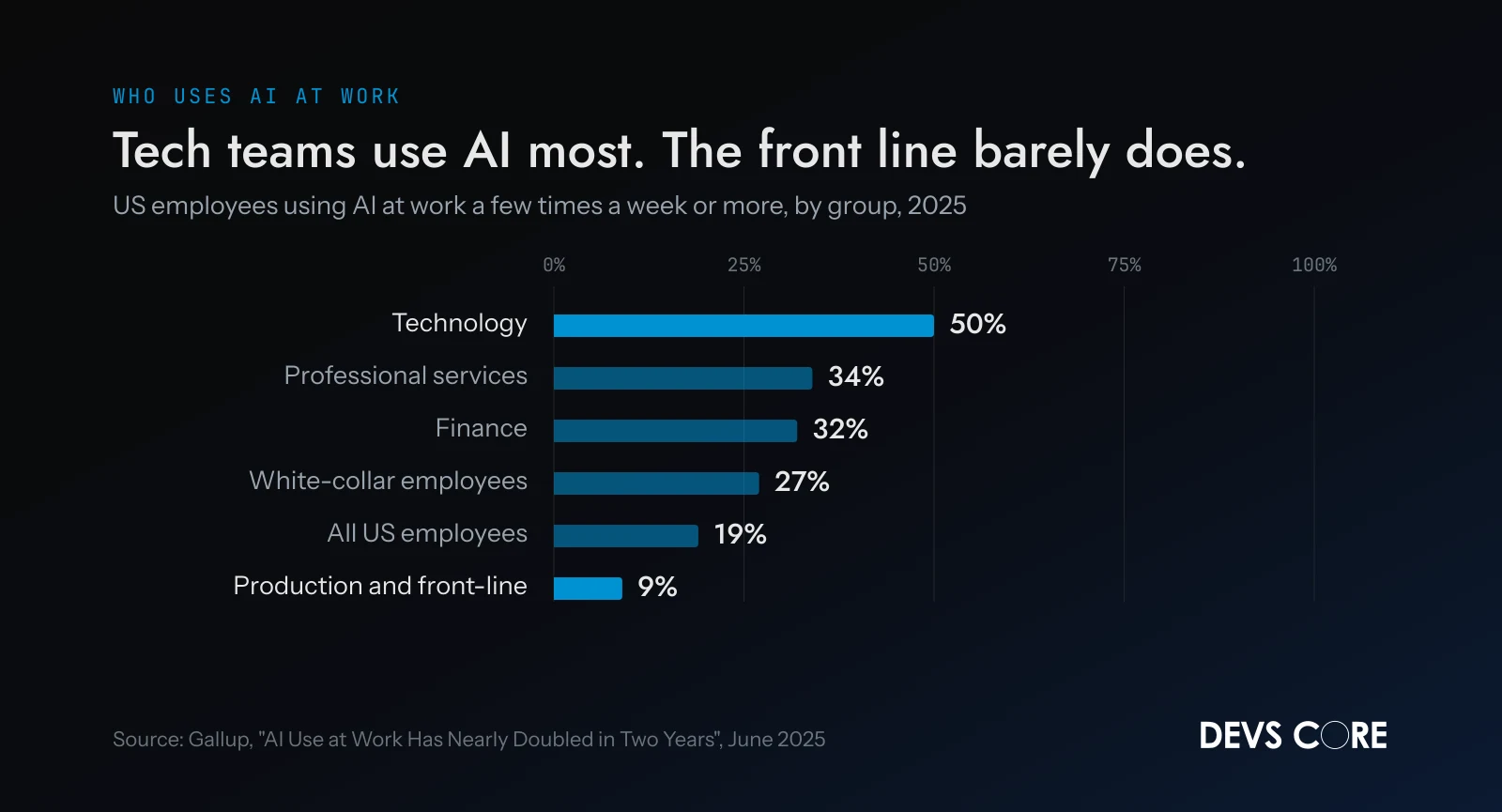
- The value sits with a few roles. Half of US technology workers use AI at work several times a week; fewer than one in ten production and front-line workers do.
- A chat window is not a process. ChatGPT answers the person typing. It does not read your ERP, update an order or know who is allowed to approve a change.
- Operations need an agent inside the systems, with scoped permissions and a person approving every change, plus training for the people who work beside it.
Who is actually getting value from ChatGPT at work?
Developers and marketers, mostly, and the data is consistent on it.
- Developers: in the Stack Overflow Developer Survey 2025, 84% of respondents were using or planning to use AI tools in their development process, and 50.6% of professional developers used them daily.
- Marketers: in Salesforce's State of Marketing, 10th edition, a survey of 4,450 marketers, 75% of marketing organisations were using at least one form of AI.
- Everyone else, much less. Gallup's 2025 study of US employees, charted at the top of this page, shows the split by group:
| Group (US employees, 2025) | Use AI a few times a week or more |
|---|---|
| Technology | 50% |
| Professional services | 34% |
| Finance | 32% |
| White-collar employees | 27% |
| All US employees | 19% |
| Production and front-line workers | 9% |
Source: Gallup, "AI Use at Work Has Nearly Doubled in Two Years", June 2025. Gallup describes front-line use as essentially flat since 2023.
The pattern makes sense. Writing code, drafting campaigns and summarising research all happen inside the chat window. The output is text, and the person typing is the person who uses it.
Why don't most employees get value from ChatGPT?
Because most were never trained, and the people who use it are working it out alone.
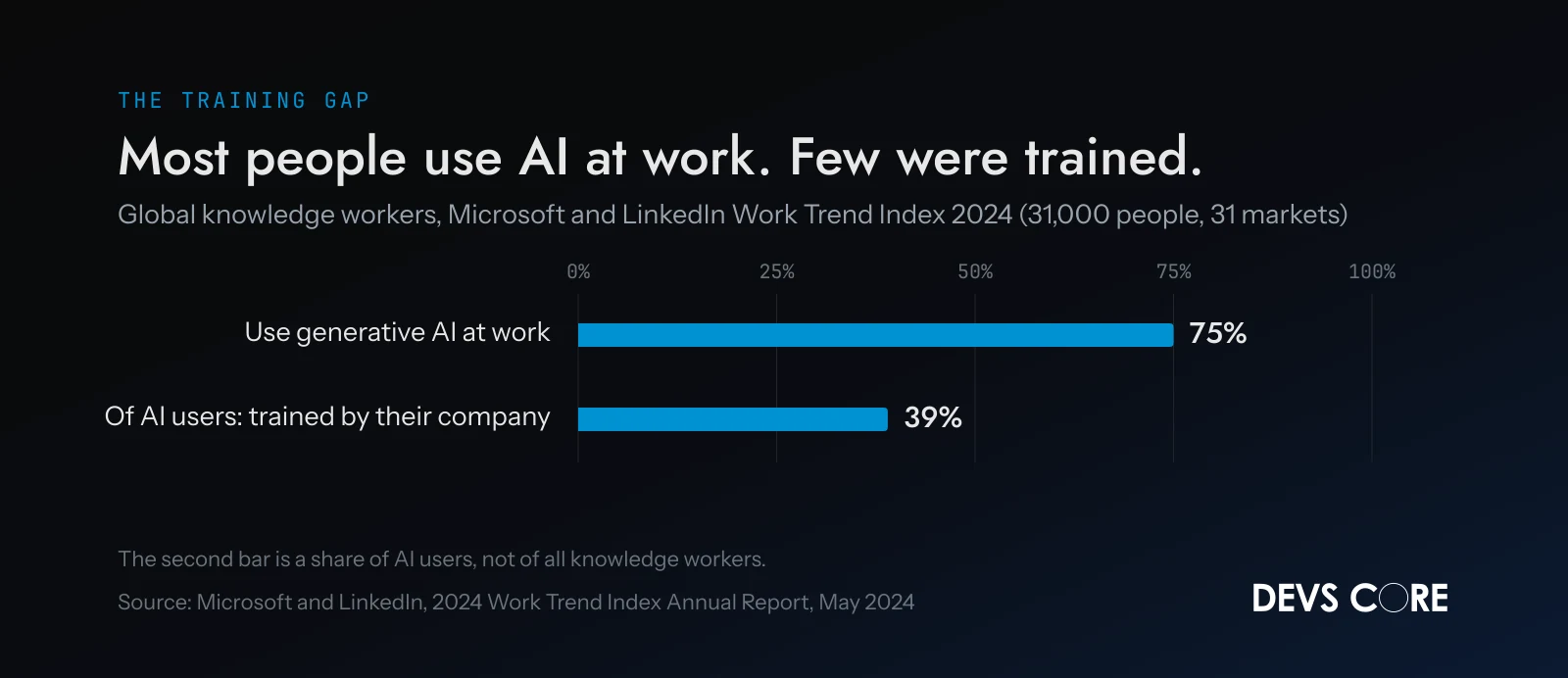
In the Microsoft and LinkedIn 2024 Work Trend Index, a survey of 31,000 knowledge workers in 31 markets:
- 75% of knowledge workers were using generative AI at work.
- 78% of AI users were bringing their own AI tools to work.
- Only 39% of people who use AI at work had received AI training from their company.
- Only 25% of companies were planning to offer training on generative AI that year.
A year later, BCG's AI at Work 2025 survey of more than 10,600 employees found the same gap: only one third said they had been properly trained, and regular use among front-line employees had stalled at 51%. On agents specifically, just 13% of employees saw them deeply integrated into their daily workflows.
So when a company buys seats and nothing changes, the usual reason is not the tool. People were handed it without being shown what to use it for, on which tasks, with which data, and what not to trust. Only 3.1% of developers in the Stack Overflow survey said they highly trust the accuracy of AI output, and they are the most practised users there are.
Why doesn't buying ChatGPT seats change operations?
Because operations work does not happen in a chat window. It happens in the ERP, the CRM, the inventory sheet and the helpdesk, and ChatGPT is not connected to any of them.
Take a distributor where half the order book arrives on WhatsApp. ChatGPT can help a salesperson write a polite reply. It cannot read the message, check stock in the ERP, draft the order, and put it in front of the person who approves orders. Someone still copies every line by hand. The seat saved them a minute of typing; the process is unchanged.
Three things are missing between a chat assistant and an operations result:
- Access to the systems. The AI has to read live data from the systems of record, through a connector that exposes only the operations it needs, never a full login.
- A person who approves each change. Reads can run freely. Anything that changes a record waits in a queue for a named person to approve, so nothing goes wrong silently.
- A log of every action. Who asked, what ran, what came back, who approved it. Without it, finance will not let the AI write to anything, and they are right.
Gartner predicted in June 2025 that over 40% of agentic AI projects will be cancelled by the end of 2027. The projects that survive tend to be the ones that solved these three problems before they scaled.
What does it take to move operations work with AI?
An agent built into the workflow, and people trained to work beside it. Not more seats.
In our own work, the clearest example is a customer support agent we built for a US direct-to-consumer brand. Its team was answering 2,000–3,000 tickets a day, and most answers already sat in the brand's help articles. The agent answers only from that content, and hands anything it is unsure of to the team in their helpdesk, Front, with the transcript and category attached. It now handles 40% of support volume. It was live 45 days after we started. (Read the case study.)
That worked for the reasons above: it was connected to the real system, it had a clear limit on what it may do, and the team knew exactly which tickets were theirs.
If you are deciding where to start:
- Pick one process with a named owner and a measurable cost, such as orders re-keyed from messages, invoices matched by hand, or the same forty support questions answered all day.
- Start the agent supervised. It reads and drafts; a person approves every change. That is the second and third rungs of our Autonomy Ladder.
- Train the people beside it on what it does, what it must not do, and how to correct it.
- Let it earn more freedom with evidence: an approval record and a measured error rate, not a good demo.
Frequently asked questions
Is ChatGPT good for small businesses?
Yes, for writing, research, summaries and first drafts, where a person checks the output before it is used. It does not connect to your accounting, stock or order systems on its own, so it will not change those processes without integration work.
Is ChatGPT Business or Enterprise enough to automate operations?
No, not by itself. The business plans add admin controls and data protections, but the assistant still works inside a chat window. Automating an operations process needs a connection to your systems, rules on what the AI may change, and a person approving each change.
Why are my employees not using the AI tools we bought?
Most were never trained. In Microsoft and LinkedIn's 2024 survey, only 39% of people who use AI at work had been trained by their company. Show each team the two or three tasks it is good for, with their own data, and what not to trust it with.
What is the difference between ChatGPT and an AI agent?
ChatGPT answers the person typing. An AI agent takes actions inside your systems, such as reading an order, checking stock or drafting an invoice. A governed agent does that under scoped permissions, with a named person approving every change and every action logged.
Where should a business start with AI beyond ChatGPT?
With one process that costs you money every week and has a clear owner. Our AI Readiness Audit ranks your processes by hours and cost and tests whether your systems can actually be connected, before anything is built.
Bought the seats and nothing changed in operations? Book a 30-minute call and tell us the process, or see how we build AI agents that work inside your systems.