
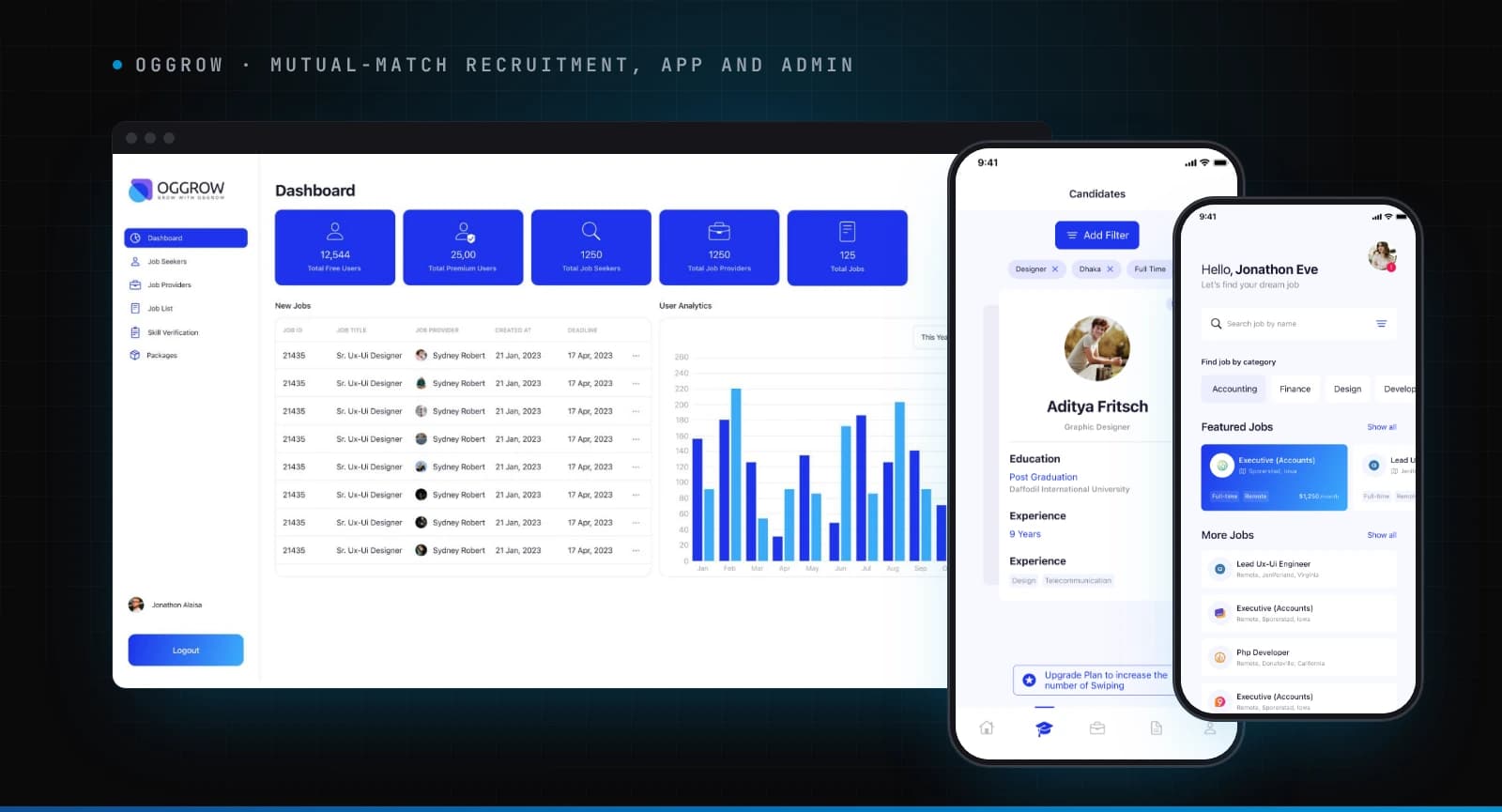
A talent company lives on introductions: the right candidate in front of the right company. Oggrow was making those introductions by email and phone calls, one at a time. In 2024 we built a recruitment matching app for iOS and Android where companies swipe through candidates, candidates show interest in jobs, and a connection opens only when the interest is mutual. Companies pay a subscription to see more candidates and their contact details. Around the app we built an admin web app for the Oggrow team and a brand website.
At a glance
- Client: Oggrow, a talent company connecting companies with candidates
- What we built: a Flutter app for iOS and Android (mobile app development), an admin web app with analytics, and a brand website (web development)
- Users: companies hiring, candidates looking for work, and Oggrow's own team
- Replaced: matching by email and phone calls
- Business model: subscription packages for companies: more swipes, and access to candidates' contact details
- Timeline: 2 months of design and development, in 2024
- Team: a UI designer, a Flutter developer, a React and Node.js developer and a project manager
- Stack: Flutter, React, Node.js
The challenge: matchmaking by inbox and phone
Oggrow's value is the match. But every match depended on the team doing it by hand.
- Everything ran through email and calls. CVs, job details, follow-ups and introductions moved one message at a time.
- Every introduction was manual. Each match between a company and a candidate needed someone on the team to make it happen.
The work Oggrow sold was matching people. The work it spent its time on was sending emails.
What we built: one matching platform, three parts
- Mobile app, for companies and candidates: sign-up with LinkedIn or Google, profiles and CVs, job posts, swipe to match, shortlists and skill verification, on iOS and Android from one Flutter codebase
- Admin web app, for the Oggrow team: users, jobs, connections, skill verification, subscription packages and analytics
- Brand website, for everyone else: Oggrow's brand in public
The app does the matching, the admin app runs the business, and the website introduces Oggrow.
For candidates: one profile, verified skills
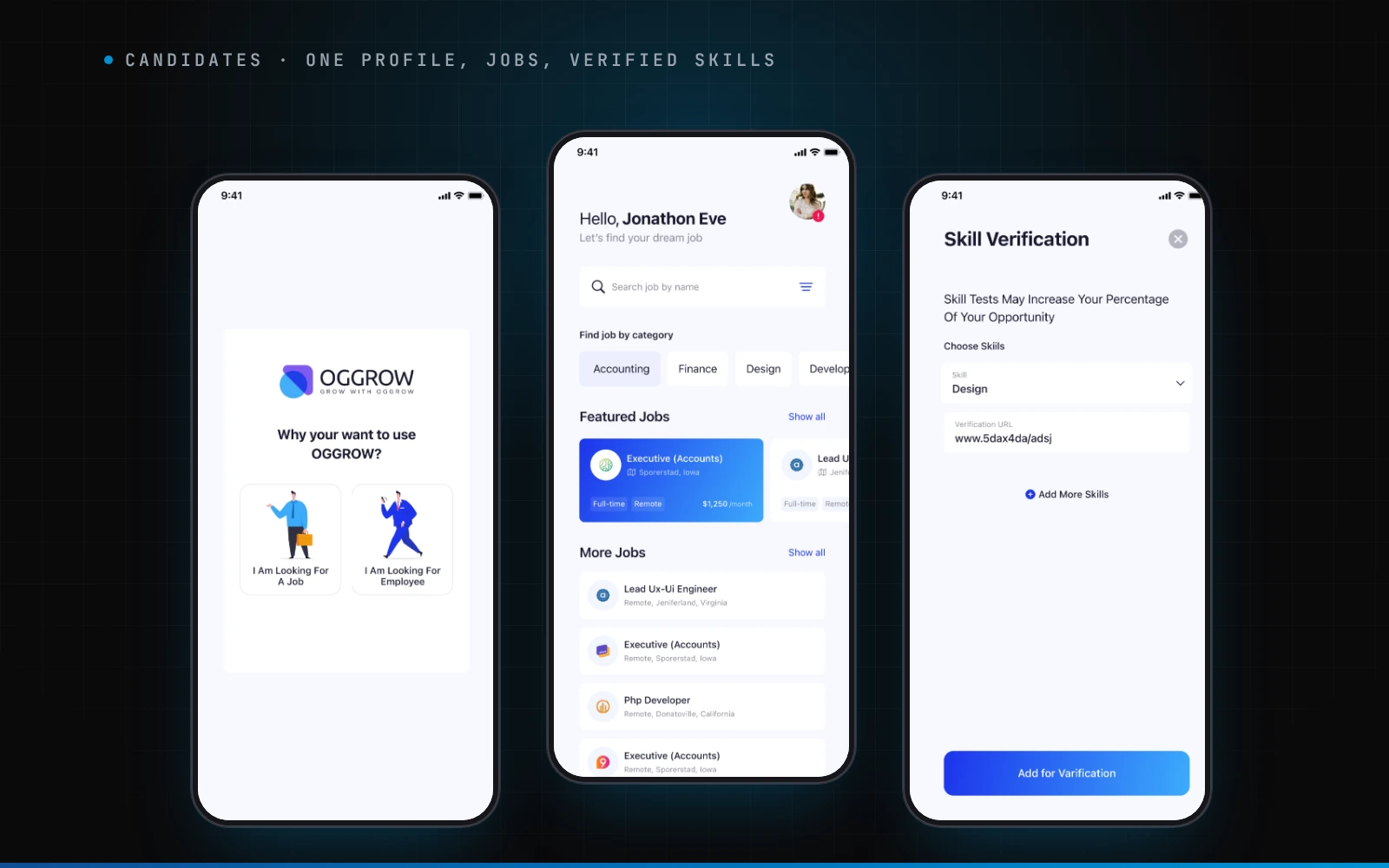
- Sign up in a tap with LinkedIn or Google, then build one profile with a CV, instead of emailing CVs around.
- Find jobs by search, category and filters: employment status and on-site, remote or hybrid.
- Show interest in a job from its details page; a connection opens only when the company is interested too.
- Get skills verified by Oggrow. Candidates add a skill with a link, and Oggrow marks it verified, so companies can trust it.
For companies: swipe through candidates who want to talk
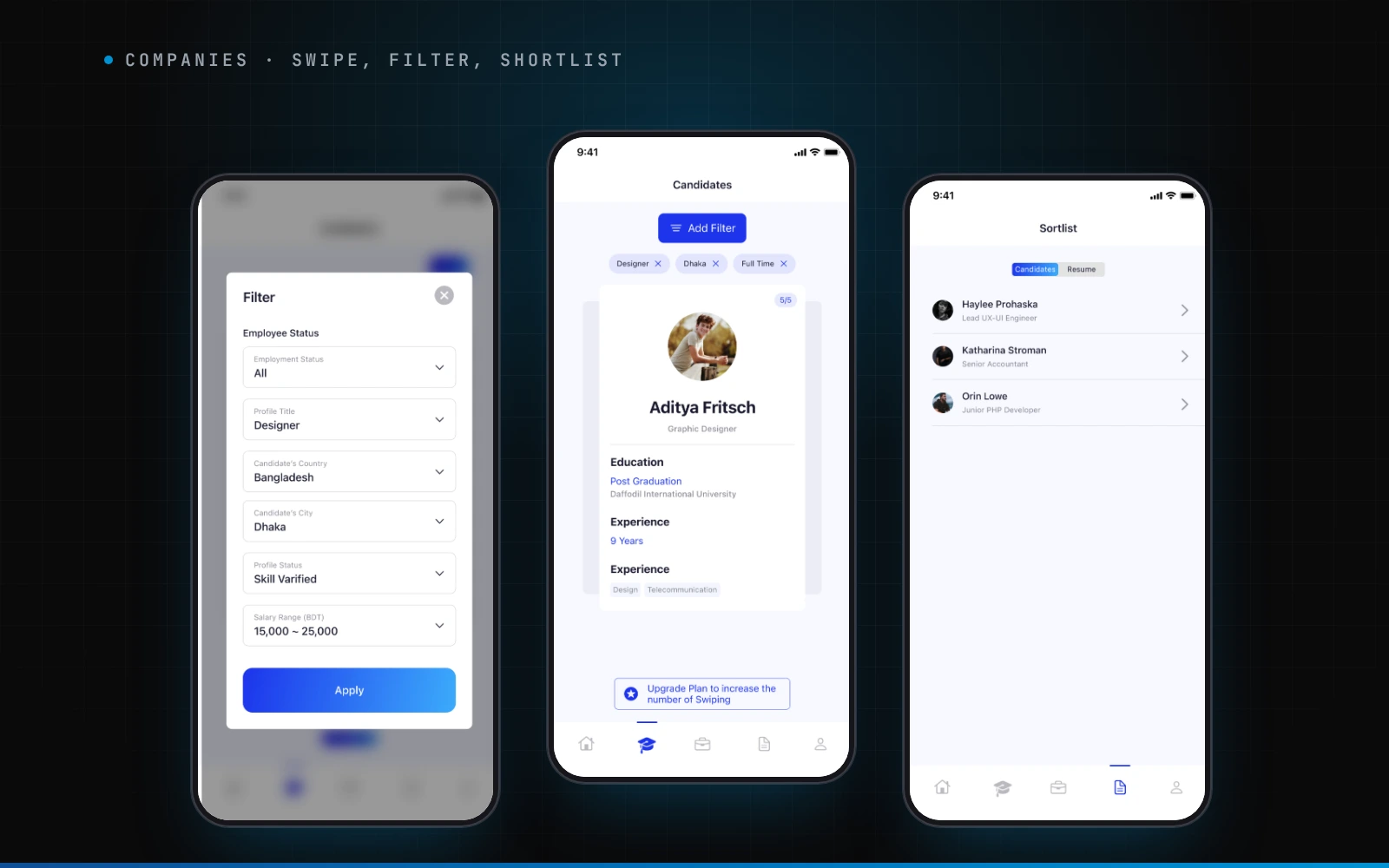
- Swipe through candidate cards instead of reading a pile of emailed CVs, with filters for job title, location, salary range and verified skills.
- Mutual interest only. A connection opens when both sides say yes.
- Post jobs with requirements, job type and salary range, and keep a shortlist with CVs to download.
- Subscribe for more. Packages set how many candidates a company can swipe and unlock candidates' email and phone number.
For the Oggrow team: the whole marketplace on one screen
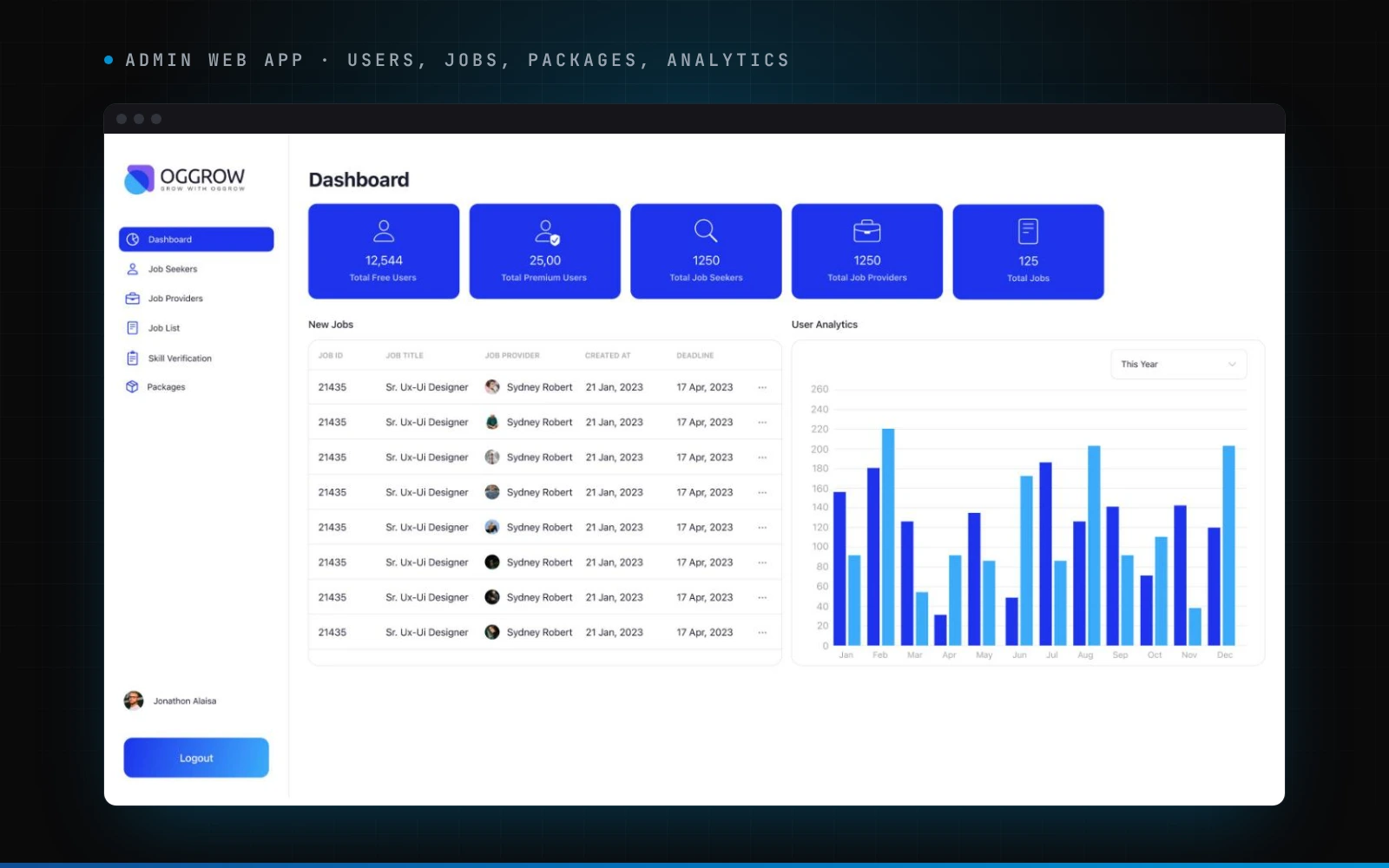
- A dashboard of free and premium users, candidates, companies and jobs, with user analytics by month.
- Manage users: view, edit, block or remove candidates and companies, and see which companies are connecting with which candidates.
- Verify skills that candidates submit.
- Create and edit subscription packages: the number of swipes, contact visibility and price, and see which companies bought each one.
How we built it
Mutual interest is the gate
The core rule was the order of events: a connection opens only when both sides are interested. That keeps candidates from being contacted by companies they never chose, and keeps companies' time on people who want the role. It's what let the app take over the first round of calls: "are you both interested?"
A business model built into the product
Oggrow earns from companies, so the app had to sell as well as match. Subscription packages control how many candidates a company can swipe and whether it sees contact details, and the Oggrow team can create and change packages from the admin app.
The hard part: getting through App Store review
Building the iOS app was the easy half. Getting it live on the App Store took far longer than expected: Apple asked for verification step after verification step before approving it. We worked through each one until the app was approved. Our lesson: plan App Store review as its own phase, with time and paperwork set aside, not as a last step on launch day.
The results
| Before | After |
|---|---|
| Matching by email and phone calls | Matching in an app, on iOS and Android |
| Companies reading CVs that arrive by email | Swipe, filter by verified skills, match |
| Introductions that needed the team each time | Connections that open on mutual interest |
| A manual process | The whole matching process automated |
What we'd do again
- Make mutual interest the gate. It keeps both sides' time for real conversations.
- Build the business model into the product. Packages the Oggrow team edits in its own admin app.
- One codebase for two stores. Flutter let a small team ship iOS and Android in two months.
- Budget for App Store review. Plan verification time before launch day.
Frequently asked questions
How does a mutual-match recruitment app work?
Companies swipe through candidate profiles and candidates show interest in jobs. When both sides are interested, a connection opens and they can take it forward. In Oggrow's app, filters for job title, location, salary and verified skills help companies swipe on the right people.
How do recruitment apps make money?
One common way is charging the hiring side. Oggrow's app sells subscription packages to companies: more candidate swipes, and access to candidates' email and phone numbers. The Oggrow team creates and prices the packages in its admin web app.
How long does it take to build a recruitment app?
Oggrow's platform took two months with a team of four: a UI designer, a Flutter developer, a React and Node.js developer and a project manager. That covered the iOS and Android app, the admin web app and the brand website.
Why can it be hard to get an app onto the App Store?
Apple reviews every app before it goes live, and Oggrow's iOS release needed many verification steps before it was approved. Plan review as its own phase, with time set aside, rather than expecting approval on launch day.
Still matching people by email and phone? Book a call, or see how we approach mobile app development.