
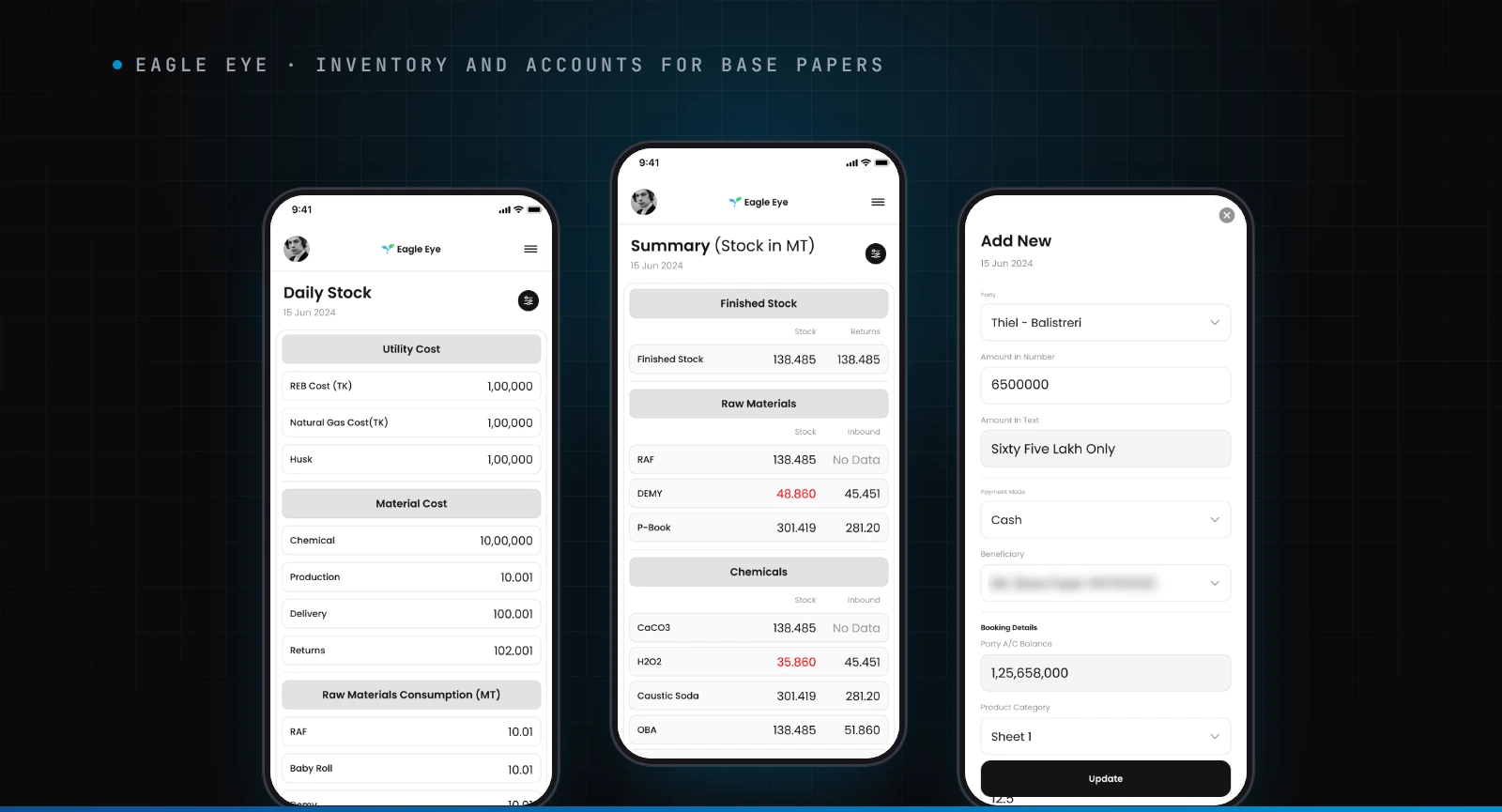
A paper mill runs on tonnes: waste paper and chemicals coming in, rolls and sheets going out. At Base Papers, a 100% recycled paper mill in Bangladesh, those numbers travelled through WhatsApp messages, and stock mismatches meant orders the mill couldn't deliver. We built Eagle Eye, one inventory and accounts app for Android and iOS, where the floor, marketing and accounts each record their part and management sees the whole mill in one place. Before that, we built the mill's website.
Base Papers Ltd has worked with Devs Core twice: the website in 2022, and the management app in 2024.
At a glance
- Client: Base Papers Ltd, a 100% recycled paper mill in Bangladesh (basepapers.co)
- What we built: Eagle Eye, an inventory and accounts management app with five roles (mobile app development), and the company website (web development)
- Replaced: stock and account updates sent over WhatsApp, and the MD's own Excel workbook
- Covers: finished stock, raw materials, chemicals, production, daily costs, sales bookings, dealer orders, purchases, bills, income and expenses, with notifications and approvals
- Timeline: the website in 2022; the app in 3 months in 2024
- Team: a UI designer, a Flutter developer, a Django backend developer and a project manager
- Stack: Flutter (Android and iOS), Django, WordPress for the website
- Use: an internal app for the mill's team, not on public sale
The challenge: a mill run on chat messages
Before Eagle Eye, the people who knew the numbers and the people who needed them were connected by WhatsApp.
- Stock lived in messages. Daily stock, raw material and chemical figures were posted in chats, so there was no single, current number anyone could trust.
- Mismatches cost real orders. When the recorded stock didn't match what was on the floor, the mill couldn't deliver what it had promised, and customers had a bad experience. The MD and GM put the cost of these mismatches in crores of taka.
- Decisions came too late. Without current stock, inventory decisions weren't made in time: what to buy, what to produce and what to hold.
- The MD kept his own Excel. The managing director ran a personal spreadsheet to keep track, and wanted the whole team working in one system so he could decide faster.
The numbers existed. They just lived in chats and a private spreadsheet, so they were never in one place when a decision had to be made.
What we built: one app, five roles
- Super admin, for management: sees all inventory and accounts, manages the lists behind them, and approves what marketing submits
- Supervisor, on the floor: records the daily stock: utility costs (electricity, gas, husk), material costs, production, deliveries and returns, and raw-material consumption in tonnes
- Staff: sees the stock summary: finished stock, raw materials and chemicals, with stock and inbound for each
- Marketing: records sales bookings and collections (party, amount, payment mode, product category and a photo of the document) for approval, and sees the accounts to plan sales
- Accounts: enters bills, income and expenses, and follows every booking and approval
It's one Flutter app on Android and iOS. Each person signs in and sees only the screens and actions their role allows, and every update reaches the summary management reads.
For management: the whole mill on one screen
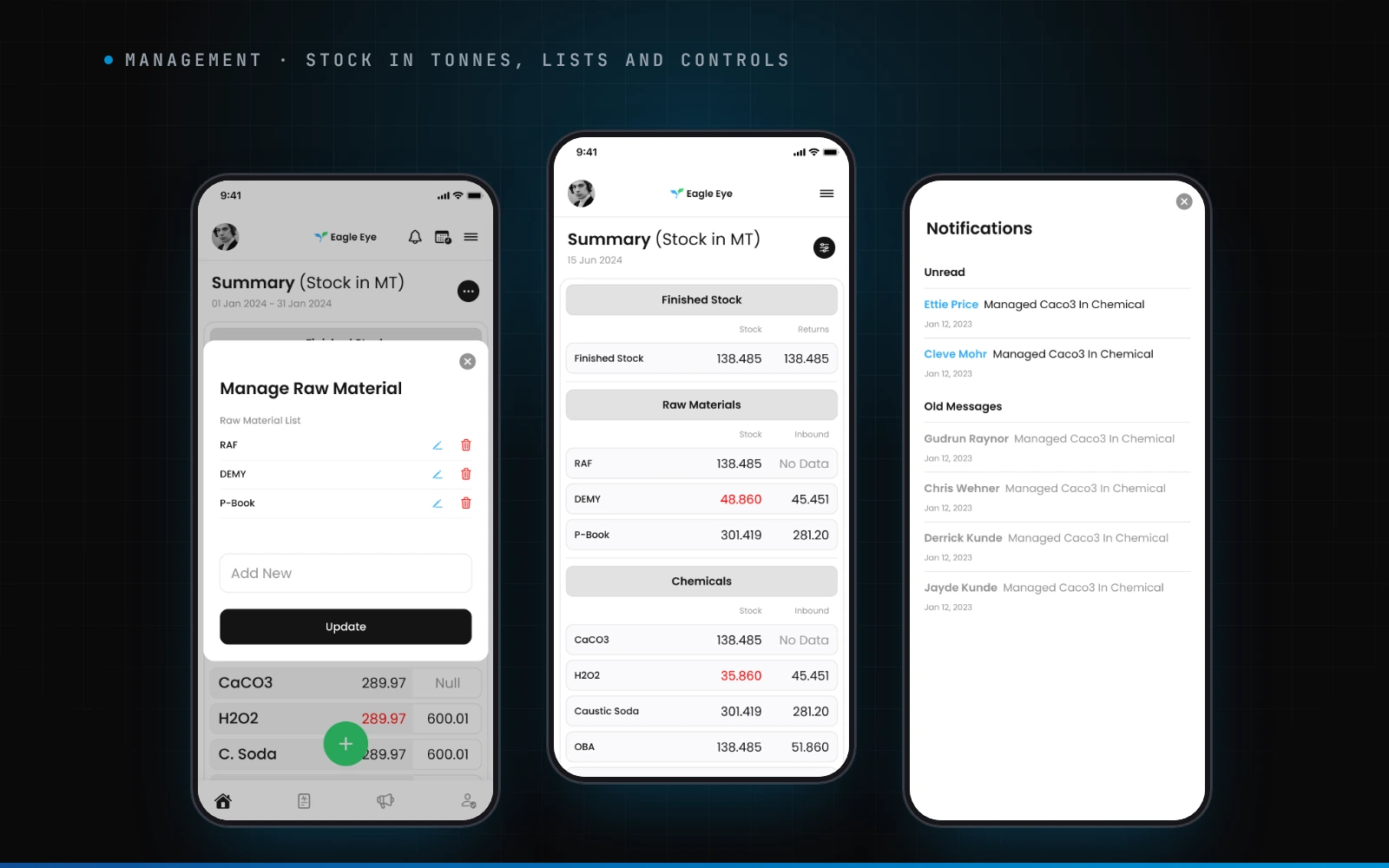
- One current number. The summary shows finished stock, raw materials (RAF, Demy, P-Book and more) and chemicals in metric tonnes, with stock and inbound side by side, for any date range.
- Control of the lists. The super admin adds or edits raw materials, chemicals, parties and beneficiaries, and every change shows up in the summary.
- Approvals, not chats. Marketing's bookings wait for the super admin's approval, and the team is notified when the status changes.
For the floor: the day's stock in one form
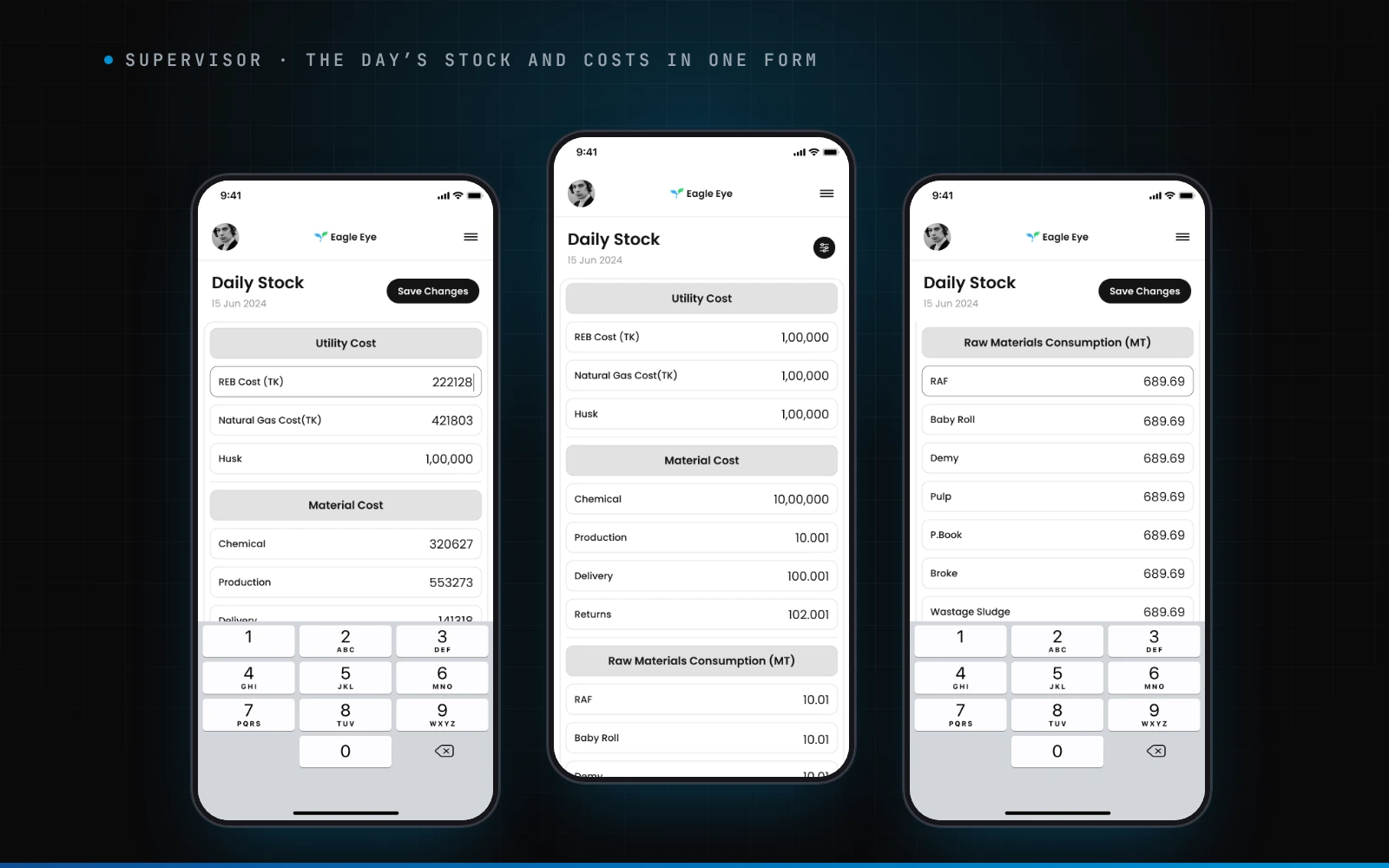
- One daily form instead of a chat. The supervisor enters utility costs, material costs, production, deliveries, returns and raw-material consumption on one screen, then saves.
- Built for a phone on the floor. Big number fields and a numeric keypad, so entering tonnes is quick.
- Any day, on demand. A date filter brings back any earlier day's figures.
For marketing and accounts: bookings with their paperwork
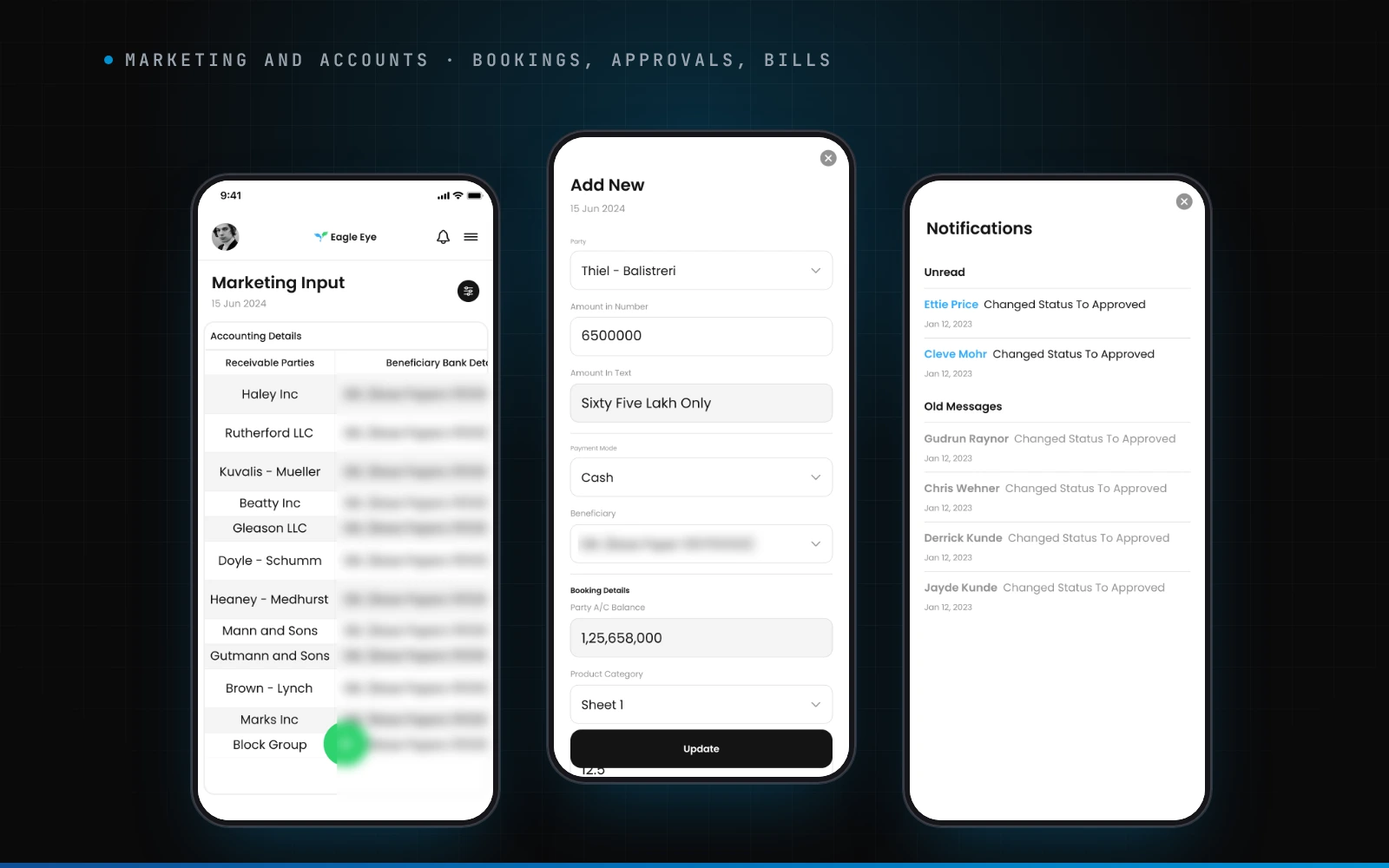
- A booking is a record, not a message. Marketing adds the party, the amount in figures and words, the payment mode, the product category (roll, sheet or A4) and a photo of the document.
- Approval before it counts. Each booking goes to the super admin, and accounts sees every update, so the books and the sales team are working from the same list.
- Accounts in the same app as stock. Accounts records bills, income and expenses alongside it, so the mill's money and its tonnes live in one system.
The website: a sustainable brand, shown in public
In 2022 we built basepapers.co on WordPress. The goal was to express the brand publicly, and for Base Papers the brand is sustainability:
- The story up front: all recycled paper, a zero-pollution process and a green workplace
- Its credentials in one place: licences and certifications, including ISO 9001, ISO 14001 and the Global Recycled Standard
- The pages a mill needs: products, process, partners, dealers, job openings and a blog
The team liked a theme, so we followed that design and built the site around their content.
How we built it
The hard part: two people, two ideas of the app
We started with the GM, who gave us the UX direction, and we built to it. When the MD saw it, it wasn't how he wanted to work, and he asked for a different UX. So we went back to the start with the MD as the decision-maker and rebuilt the experience around how he runs the mill. The lesson we took: in an owner-run business, the person who will make decisions from the app has to shape it from day one.
From one person's spreadsheet to a team's system
The MD's Excel system worked for him, but only he could keep it current. The goal was for his team to enter the numbers where they happen, on the floor, in marketing and in accounts, so the summary he reads is built by the people closest to the work, with approvals and history by date.
The results
| Before Eagle Eye | With Eagle Eye |
|---|---|
| Stock and accounts updates sent over WhatsApp | One app, five roles, one current number |
| Stock mismatches leading to orders not delivered | Mismatches that caused missed deliveries are solved |
| Inventory decisions made late | Management decides from current stock and costs |
| The MD's private Excel workbook | The whole team working in one system |
According to the mill's MD and GM, the stock mismatches had cost the business crores of taka in orders it couldn't deliver. With Eagle Eye in use, those problems are solved.
What we'd do again
- Find the real decision-maker first. Building to the GM's brief and then redoing it for the MD cost time. Now we ask on day one who will make decisions from the system.
- Replace the old tool completely. A new system that sits beside a trusted spreadsheet loses. It has to do everything the spreadsheet did.
- Design each role's job, not one app for everyone. The supervisor needs one form; the MD needs one summary.
- Keep paperwork with the record. A photo of the document on each booking keeps the evidence next to the number.
Frequently asked questions
What should an inventory management system for a paper mill track?
At a minimum: finished stock, raw materials and chemicals in tonnes, with what came in and what was used each day, plus production, deliveries and returns. Base Papers' app also tracks daily utility and material costs, sales bookings, purchases and the accounts, so stock and money are in one place.
Can a factory run inventory and accounts from a mobile app?
Yes, if each role gets only what it needs. At Base Papers, the supervisor enters the day's stock on a phone, marketing records bookings, accounts enters bills and expenses, and management sees and approves everything, all in one Flutter app on Android and iOS.
How long does it take to build a custom inventory and accounts app?
Base Papers' app took three months with a team of four: a UI designer, a Flutter developer, a Django backend developer and a project manager. That included rebuilding the UX when the MD's way of working differed from the first brief.
Why replace WhatsApp and Excel instead of using off-the-shelf software?
Because the mill's process didn't fit a generic product: tonnes of specific raw materials and chemicals, daily utility costs, marketing bookings that need approval, and five different roles. A custom app matched how the mill already worked, which is what got the team to stop using chats and the spreadsheet.
Running stock or accounts on chats and spreadsheets? Book a call, or see how we approach mobile app development.