
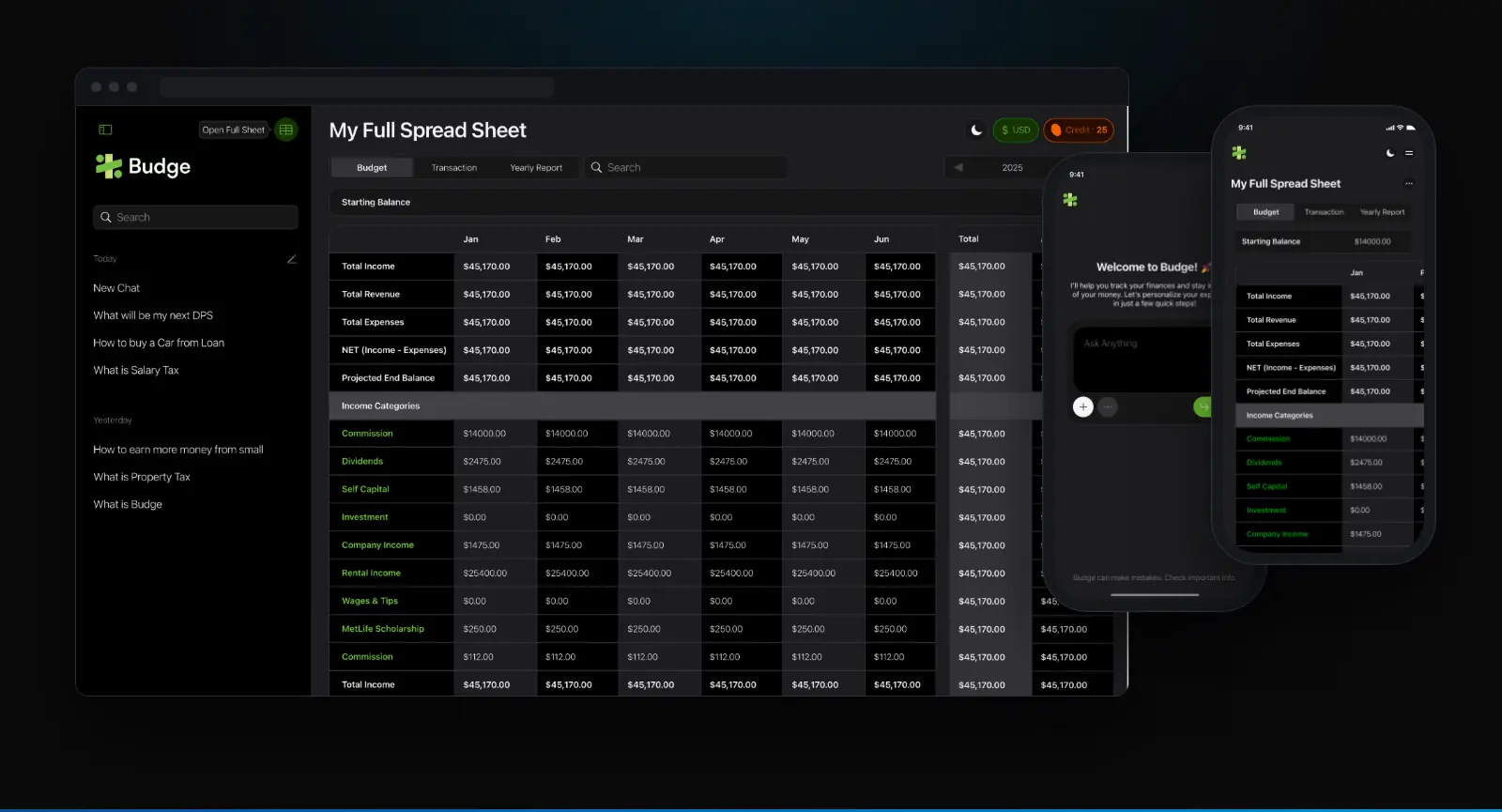
Most people want to manage their money, but budgeting apps bury them in dashboards and spreadsheets, and few can afford a financial adviser. Budge is our answer: an AI personal finance agent you simply talk to. Tell it what you earned or spent, by typing or by voice, and it records the entry, keeps your budgets and balance sheet up to date, and gives you plain guidance. It records 95% of entries correctly from ordinary chat, and every financial record is end-to-end encrypted, so even we can't read it.
Budge is our own product, not client work. We built it, we run it, and it's where we learn what an AI agent needs in production before we build one for a client.
At a glance
- What it is: an AI finance assistant for people who live on a budget: job holders, freelancers and solopreneurs
- Built by: Devs Core, as our own product (mybudge.ai)
- What we built: a chat-first web app, installable as a Progressive Web App on Android and iOS, with an AI agent that turns conversation into budgets, transactions and reports
- Replaces: budgeting spreadsheets, and apps full of charts people don't read
- First version: four weeks, from 10 February to 10 March 2025, with a team of four
- Launched: web and Android in October 2025; iOS followed
- Today: live, with a beta group of 100+ users in 7 countries
- Stack: Next.js, Firebase, a fine-tuned DeepSeek model, Mem0
The problem: managing money is stressful, and the tools don't help
Before we wrote any code, we did market research and talked to the people we wanted to help. They told us the same things:
- Budgeting apps are too complex. Dashboards, categories and charts overwhelm people who just want to know where their money went.
- Nobody explains anything. Apps track spending but don't tell you what it means or what to do next, and a personal finance adviser is out of reach for most people.
- Financial literacy is low. Many young earners, in the USA and in Bangladesh alike, never learned how to budget or grow savings.
People don't need another dashboard. They need someone to tell, in their own words, what happened to their money, and a straight answer back.
What we built: a finance buddy you talk to
- A chat interface, on the web and on phones, where people record income and spending in their own words, by text or voice
- An AI agent that understands the message, records it in the right account and category, and updates the budgets and balance sheet
- Automatic reports: a live balance sheet, category summaries and a yearly report, without building a spreadsheet
- Guidance: answers to money questions and gentle nudges when spending drifts from a goal
- 150+ currencies, for people who earn or spend in more than one
For users: say it once, and your books are done
Set up in a few taps
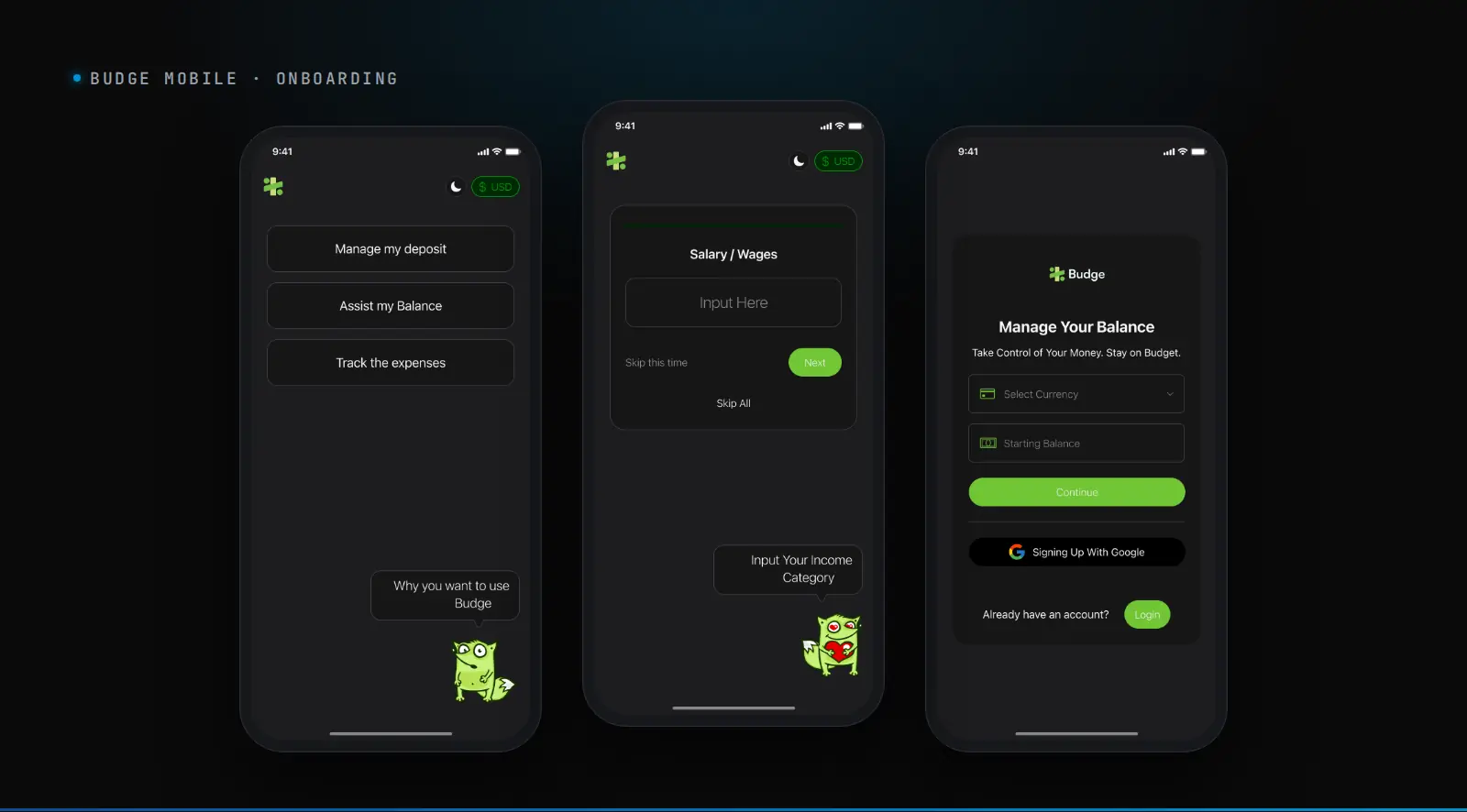
A short, friendly onboarding asks why the user wants Budge, their income sources (salary, freelance work, business, rent) and their main expenses (food, housing, transport, loans), then their currency and starting balance. Every question can be skipped. By the end, Budge knows enough to categorise their money without a settings page.
Record money by just talking
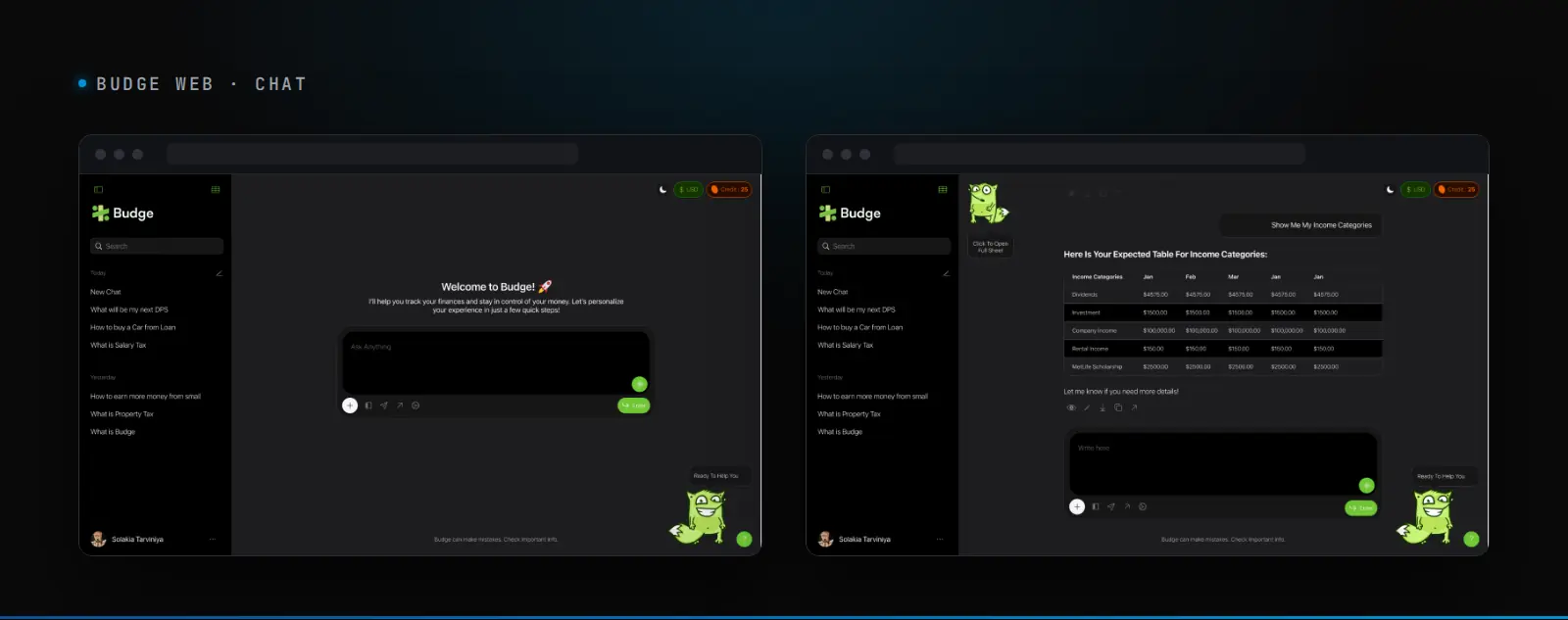
A user types "Got paid 1,200 from the client today" or "Spent 18 on lunch", or says it out loud. Budge records it in the right account and category, and the balance sheet updates. There's nothing to set up beyond a starting balance and the categories that matter to them.
See the whole picture without a spreadsheet
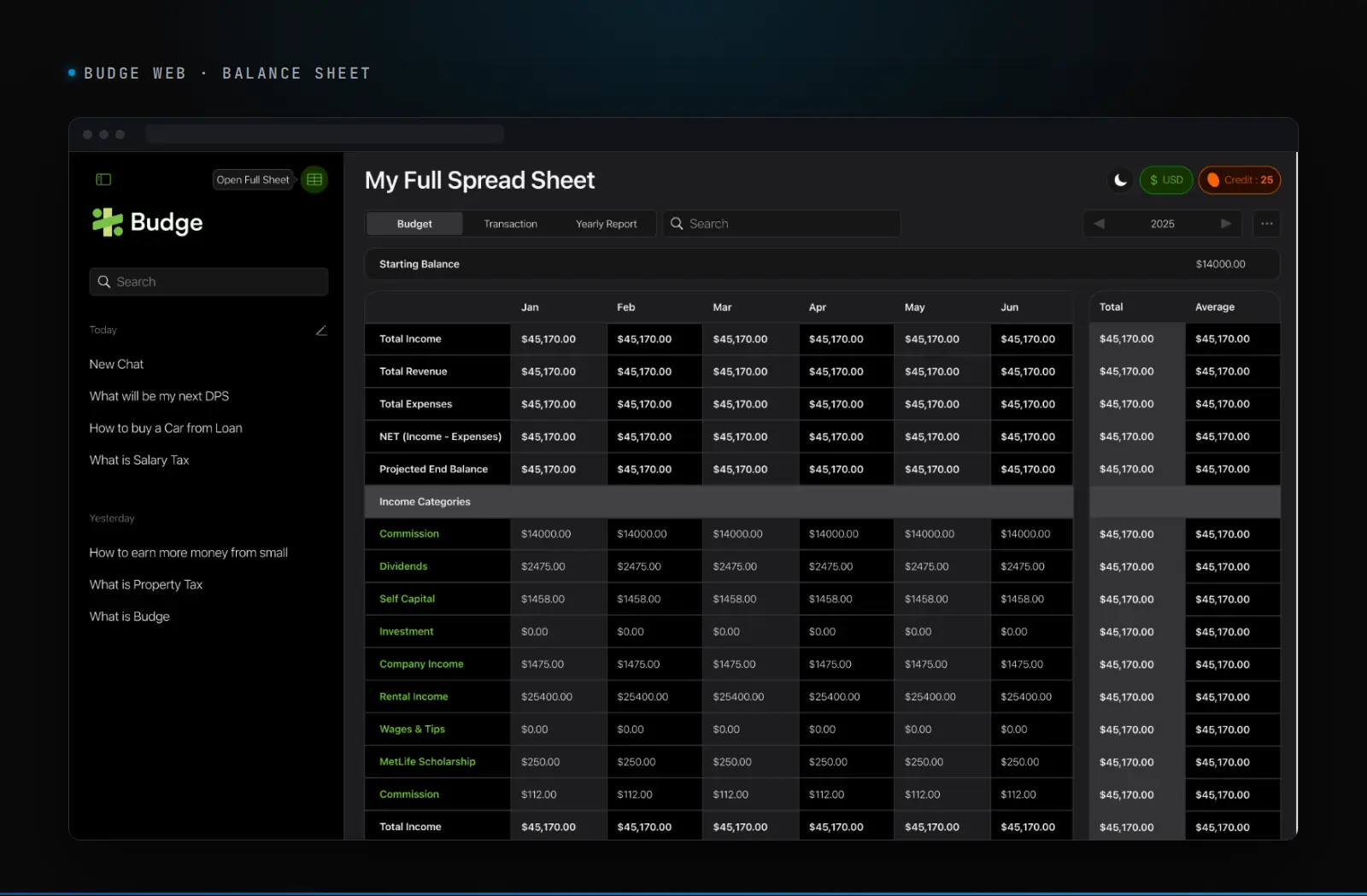
Every entry flows into a live balance sheet: income and expenses by category, month by month, with totals and a projected end balance. People who never kept a budget now have one, built from conversations they were having anyway.
Get guidance, not just charts
Because Budge knows the budget and the history, it can answer real questions: whether a purchase fits this month, where the money is going, how to save towards a goal. It remembers context between conversations, so users don't repeat themselves.
Keep their data private
Finance data is personal, so we designed Budge to be private from the start:
- End-to-end encrypted. Every financial record is encrypted and decrypted on the user's own device, protected by the phone's biometrics. Our team can't read anyone's finances.
- Never used for training. User data doesn't go into training AI models.
How we built it
A fine-tuned model for finance, not a general chatbot
A general-purpose chatbot can talk about money, but it can't be trusted to keep someone's books. We built Budge on DeepSeek, with three layers of work on top:
- Fine-tuning for finance-specific entries and questions
- Prompt engineering, so answers stay clear, safe and in plain language
- Tool handling, so the agent records transactions, updates budgets and reads reports through defined actions rather than free text
Mem0 gives the agent memory across conversations. We customised the model rather than calling a general one directly, for privacy and for finance-specific accuracy. Today, 95% of entries from chat and voice are recorded correctly, measured by our team.
One codebase for web, Android and iOS
We built Budge as a Next.js Progressive Web App on Firebase, so a single codebase serves the browser and installs as an app on Android and iOS. That let a team of four ship the first working version in four weeks.
Our users changed the roadmap twice
We planned bank integration; our users pushed back. Syncing bank accounts looked like the obvious next feature. When we asked, opinions were split, and many people were uneasy about an AI having access to their bank. So chat and voice stayed the core of Budge, and bank sync became an optional feature for later, not a requirement.
We launched on the web; people wanted an app. We kept the first launch web-focused. Users asked for a phone app, so we released Android. Then iPhone users asked too, and we published on iOS. Because Budge was already a Progressive Web App, each step was a release, not a rebuild.
The results
| Before Budge | With Budge |
|---|---|
| Spreadsheets or apps full of charts | A conversation in text or voice |
| Budgets set up by hand, then abandoned | Books updated automatically from each message |
| Tracking with no explanation | Answers and nudges in plain language |
| Worry about who can see your finances | End-to-end encrypted, readable only on-device |
- 95% of chat and voice entries recorded correctly
- 100+ users in the beta, across 7 countries, led by the USA and Bangladesh
- Live on web, Android and iOS
What we'd do again
- Research the market and talk to users before building. It told us what to build, and it stopped us building bank sync that people didn't want.
- Ship on the platform people already use, then follow them. The web first, then Android, then iOS, each when users asked.
- Design for privacy from day one. End-to-end encryption is much harder to add later, and for money it's what earns trust.
- Give the agent tools, not just a prompt. Structured actions are what make a finance agent reliable enough to keep someone's books.
Frequently asked questions
How long does it take to build an AI personal finance app?
Our first working version of Budge took four weeks with a team of four: a UI designer, an AI engineer, a frontend engineer and a brand and content expert. We then refined it with real users for several months before the public launch.
Can an AI agent keep financial records accurately?
Yes, if it's built for the job. Budge records 95% of chat and voice entries correctly because the model is fine-tuned for finance and writes records through defined tools, not free text.
How do you keep financial data private in an AI app?
In Budge, finance records are end-to-end encrypted: they're encrypted and decrypted on the user's device and protected by biometrics, so our team can't read them, and user data is never used to train models.
Should a finance app connect to users' bank accounts?
Ask your users first. Ours were split, and many didn't want an AI connected to their bank, so we made chat and voice the core and kept bank sync optional.
Planning an AI agent that handles sensitive data for your customers? Book a 30-minute call, or read how we approach AI agent development.